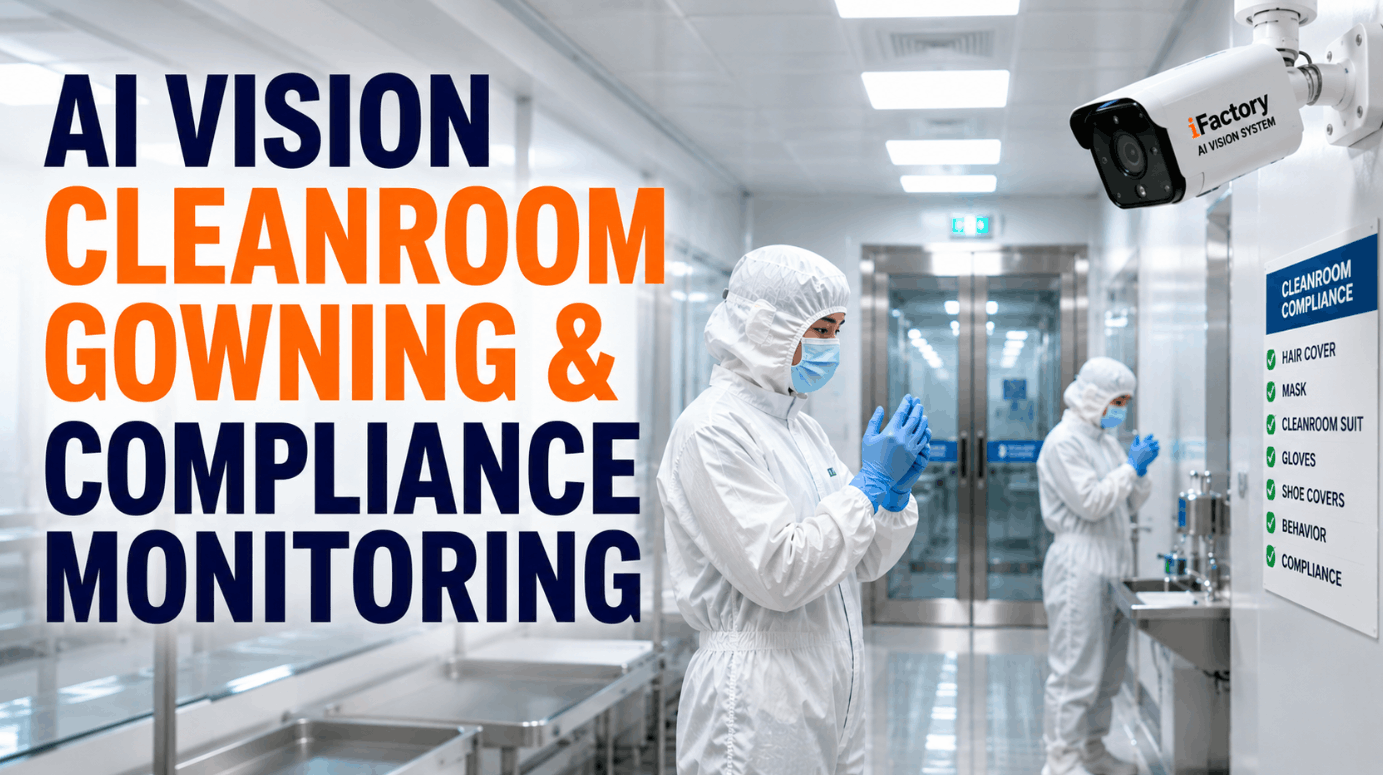
Most cleanroom AI vision projects fail during deployment, not the pilot. The demo works on a bench, then the camera goes up in a real airlock — and nobody planned the personnel ID handoff, the threshold was tuned for the wrong lighting, and validation is scrambled together the week before an audit. This checklist covers the five components that separate a system that survives a GMP inspection from one that becomes the finding. See how iFactory's AI Vision Camera platform is built for this path.
Cleanroom Safety · Pharma AI Vision · Deployment Checklist
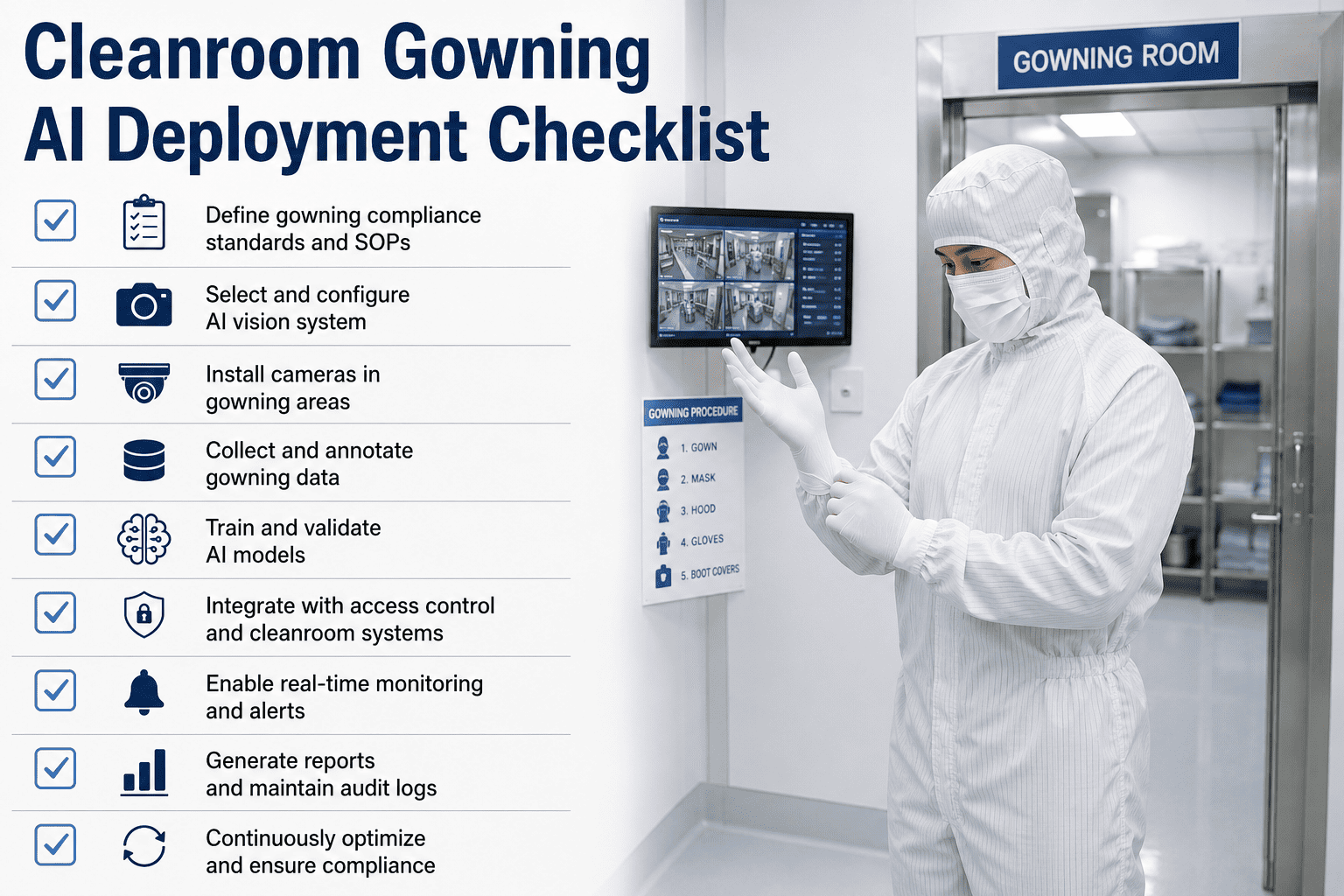
Cleanroom Gowning AI Deployment Checklist
Five components a validated gowning-monitoring deployment actually needs — camera placement, step sequencing, personnel ID, threshold calibration, and GMP validation — built for teams moving from pilot to production.
1Camera Placement
2Step Sequencing
3Personnel ID
4Thresholds
5GMP Validation
200-600
Hours typically spent validating a mid-size pharma CMMS or monitoring deployment
IQ · OQ · PQ
The three-stage validation sequence FDA-regulated facilities must document
21 CFR Part 11
Governs the audit trail and e-signature standard your gowning records must meet
Why This Matters
The Gap Between a Working Camera and a Validated System
A camera that correctly flags an exposed hairline during a demo is a proof of concept. A camera that holds up during an FDA inspection is a validated system with a documented installation record, a tested operational specification, evidence it performs correctly in your actual gowning room, and an audit trail nobody can quietly edit. Facilities that skip straight from pilot to production without walking through all five components below tend to discover the gap during their next regulatory visit rather than before it — which is precisely the wrong time to find out a threshold was never calibrated to their gowning room's lighting.
Section 01 — Camera Placement Across the Gowning Sequence
A camera covers the pre-gowning zone where personal items, jewelry, and outer clothing are removed, since contamination risk starts before the first garment goes on
Placement: Entry vestibule · Verifies: Personal-item removal, hand hygiene step
A dedicated camera angle covers the gowning bench area where coveralls, boots, and lower-body garments are donned, positioned to confirm the garment never touches the floor
Placement: Gowning bench, side angle · Verifies: Coverall/boot donning without floor contact
An upper-body camera angle is positioned to confirm hood, mask, and eye protection placement, with resolution sufficient to detect exposed skin at the hairline or around the mask edge
Placement: Head-height, front-facing · Verifies: Hood seal, mask position, no exposed skin
A final-check camera at the airlock inner door confirms the complete gowned state before the interlock releases, functioning as the last verification point before cleanroom entry
Placement: Airlock inner door · Verifies: Full-gown completion, interlock release trigger
Lighting at each camera position is confirmed to be even and shadow-free, since uneven lighting is a common cause of false negatives on glove-seal and mask-edge detection
Placement: All stations · Verifies: Consistent illumination for model accuracy
Camera fields of view are checked against gowning-room traffic patterns to confirm no blind zone exists between stations where a step could be skipped unobserved
Placement: Cross-station overlap check · Verifies: No blind zone between stages
Design principle
Camera coverage should follow the physical path of the gowning sequence, not just the doorway. A single camera at the airlock catches a badly gowned person on their way out of the process — coverage at each donning stage catches the specific step where the deviation happened, which is what a corrective action actually needs.
Section 02 — Gowning Step Sequence Programming
Programming the Model Around the Actual Donning Order
Gowning sequence is not a loose set of hygiene habits — in Grade A and B environments it is a validated, documented order where each garment is intended to contain the contamination risk introduced by the step before it. A model that only checks the end state (fully gowned or not) misses exactly the deviations that matter most: a glove donned before the sleeve seal was checked, or a hood put on after the mask instead of before it.
Hair cover / hood donned first, top-to-bottom order, before any other garment touches the head or face
Face mask and eye protection follow, checked for full nose-and-mouth coverage with no gap at the edges
Coverall donned next, verified not to contact the floor during the step, with suit legs tucked inside footwear
Boots or shoe covers follow, checked for a snug fit that fully encloses the suit leg opening
Gloves donned last, over the coverall sleeves to create a sealed cuff, with double-gloving verified in Grade A/B zones
Sequence-drift signal
Every facility's validated SOP varies slightly in exact wording, but the underlying logic is constant: each layer must close off the contamination pathway the previous layer created. The model should be programmed against your site-specific SOP sequence, not a generic gowning-order template, since a step logged as "out of order" against the wrong reference sequence generates false findings that erode confidence in the whole system.
Sequence Verification Checklist
The model's expected step order is configured directly from the site's validated gowning SOP, not a generic template pulled from a vendor's default library
Config source: Site-specific SOP document
Out-of-sequence donning is logged as a distinct finding category from incomplete donning, since the corrective action for each differs
Config source: Finding taxonomy
A revalidation trigger exists so that any SOP change to the gowning sequence automatically flags the model configuration for review before the next shift
Config source: Change control linkage
Section 03 — Personnel Identity Integration
Tying Every Gowning Event to a Named Individual
A gowning record with no operator identity attached is nearly worthless for GMP purposes — a finding needs a name for retraining, and an audit trail needs a name for 21 CFR Part 11 attribution. Personnel ID integration is the piece most deployments underplan, because it depends on systems outside the camera itself: badge readers, HR databases, and training-record systems that were never designed to talk to a vision platform.
| Integration Point |
What It Confirms |
Common Failure Mode |
Fix Before Go-Live |
| Badge reader at airlock |
Which individual entered at what timestamp |
Badge swipe not time-linked to camera event |
Sync clocks, test round-trip latency |
| Facial or badge-photo match |
The person gowning matches the badge holder |
No match step, so a shared badge goes undetected |
Add identity-confirmation step before interlock |
| Training record lookup |
The individual is current on gowning qualification |
Expired qualification not checked at entry |
Link training database to entry logic |
| Finding-to-operator record |
Which named individual triggered which deviation |
Findings logged as "Station 2" with no name |
Require named attribution on every finding |
Facilities running this without an integrated system typically fall back to manually cross-referencing camera timestamps against a paper sign-in sheet after the fact — which defeats the purpose of automated monitoring and reintroduces the same human-error risk the camera was meant to remove. iFactory's AI Vision Camera platform ties badge, training status, and gowning event into a single record at the point of entry, not after the fact.
Deploy a gowning-monitoring system built around your validated SOP, your personnel records, and your GMP documentation requirements from day one.
Section 04 — Compliance Threshold Calibration
Tuning Sensitivity Without Drowning the Team in False Alerts
A threshold set too loose misses real gowning deficiencies. A threshold set too tight buries the quality team in false alerts until nobody trusts the system enough to act on any of them — the same alert-fatigue pattern documented across AI-monitoring deployments generally. Calibration is not a one-time setting; it is a tuning process that runs through an initial baseline period before the system is trusted for autonomous interlock decisions.
Baseline Observation Window
Run the system in shadow mode — logging findings without gating the interlock — for an initial period long enough to capture normal gowning-room variation, including different operators, shifts, and lighting conditions across the day.
Confidence-Score Tiering
Configure at least two tiers: a high-confidence tier that gates the interlock automatically, and a lower-confidence tier that flags for human review rather than blocking entry outright, so borderline cases don't halt production unnecessarily.
Per-Zone Adjustment
Set thresholds independently per camera zone rather than one global setting, since lighting, angle, and garment type vary by station and a single global threshold will be miscalibrated for at least one of them.
Tuning discipline
Document every threshold change with a date, a reason, and who approved it. A threshold silently adjusted to reduce alert volume — without a documented rationale — is exactly the kind of undocumented change an inspector treats as a data-integrity concern, not a convenience.
Section 05 — GMP Validation Protocol
IQ, OQ, and PQ for a Vision Monitoring System
Any computerized system used to create or hold GMP records must be validated before it goes into production use — an AI vision system gating cleanroom entry and generating compliance records is squarely in that scope. The three-stage sequence below is the same validation logic applied to any regulated system, adapted to what a gowning-monitoring deployment specifically needs to prove at each stage.
IQ
Installation Qualification
Confirms cameras, network infrastructure, and software are installed exactly as specified — correct camera models at correct positions, network connectivity verified, software version documented and matched to the validated build.
OQ
Operational Qualification
Confirms the system performs according to its written specification under controlled test conditions — deliberately staged gowning errors are run through the system to confirm each one is correctly detected and logged, across every camera zone.
PQ
Performance Qualification
Confirms the system performs correctly under real operating conditions, with real personnel, across multiple shifts, over a defined observation period — proving the OQ result holds up outside a staged test environment.
Immutable
Audit trail requirement under §11.10(e) — records must be computer-generated, not user-editable
Unique
Every gowning event and finding must be attributable to a single named individual, never a shared login
Documented
Every threshold or model configuration change needs a recorded reason and approver, or it reads as an integrity gap
What Goes Wrong
Common Deployment Pitfalls
Vendor-default sequence template
The model ships configured against a generic donning order instead of the facility's own validated SOP, generating false sequence findings from day one.
No shadow-mode baseline
Interlock gating goes live before the system has observed enough normal variation, so the first weeks are dominated by false positives that erode operator trust.
Identity handled as an afterthought
Badge and training-record integration is left for "phase two," so early findings can't be attributed to a named individual and are unusable for retraining or audit purposes.
Undocumented threshold tuning
Alert thresholds get adjusted informally to cut down on noise, with no recorded rationale — a pattern that reads as a data-integrity concern during inspection.
Validation compressed into a sprint
IQ, OQ, and PQ get rushed into the week before go-live instead of run as a proper sequence, leaving gaps that surface later as unexplained deviations.
Camera coverage stops at the airlock
Only the final entry point is monitored, so a deviation at the gowning bench is invisible until the fully-gowned state is already checked at the door.
FAQs
Frequently Asked Questions
How long does a cleanroom gowning AI deployment actually take from installation to full validation?
Camera installation and basic configuration can be completed in a matter of weeks, but validation is the longer piece — a mid-size regulated deployment typically requires somewhere in the range of 200 to 600 hours of documented validation work across the IQ, OQ, and PQ stages, depending on the number of camera zones, the complexity of the gowning sequence being verified, and how mature the vendor's own validation documentation package is going in. Facilities that treat validation as a parallel workstream starting on day one of installation, rather than a final step squeezed in before go-live, consistently move through this faster.
Book a demo to walk through a realistic timeline for your specific gowning-room layout.
Does the AI system replace the human gowning qualification and observation program?
No — it strengthens the evidence behind it rather than replacing it. Personnel still complete formal gowning qualification, and a human quality function still reviews findings and owns corrective actions. What the camera changes is coverage and consistency: instead of periodic observed gowning checks that sample a fraction of entries, every entry at every shift is verified against the same objective standard, and the record of that verification is timestamped and attributable rather than dependent on someone remembering to document it.
What happens if the camera flags a false positive and blocks a qualified operator from entering?
This is exactly why the confidence-tiering approach in the threshold calibration section matters — a properly tuned system routes borderline or lower-confidence findings to a human reviewer for a quick override rather than hard-blocking the interlock on anything short of a high-confidence detection. During the initial shadow-mode baseline period, findings are logged without gating entry at all, which is specifically designed to surface and correct false-positive patterns before the system is trusted to make autonomous interlock decisions.
Can the same camera infrastructure support multiple cleanroom grades with different gowning requirements?
Yes, as long as the step-sequence configuration is set independently per zone rather than applied globally. An ISO 8 anteroom and a Grade A/B aseptic core have meaningfully different gowning requirements — the latter typically requires full-coverage suits, integrated hoods, and double gloving, where the former may only require a basic coverall and shoe covers. The camera hardware can be standardized across zones, but the expected sequence, the garment checklist, and the threshold settings need to be configured against each zone's own validated SOP.
Who is responsible for the validation documentation — the facility or the software vendor?
The regulated facility carries ultimate responsibility for validating any computerized system used to create GMP records, even when the vendor supplies supporting documentation. A vendor with pharma deployment experience typically provides installation qualification support materials and a vendor assessment package that meaningfully reduces the facility's own validation burden, but a vendor's marketing claim of being "compliant" is not a substitute for the facility's own documented IQ, OQ, and PQ evidence.
Contact solutions engineering to review what validation support comes bundled with deployment.
Move From Pilot to a Validated Production Deployment
iFactory's AI Vision Camera platform is built around the deployment path regulated facilities actually need — SOP-matched step sequencing, integrated personnel identity, tunable per-zone thresholds, and validation support across IQ, OQ, and PQ — so your gowning-monitoring system is ready for its next GMP inspection instead of scrambling to document it after the fact.