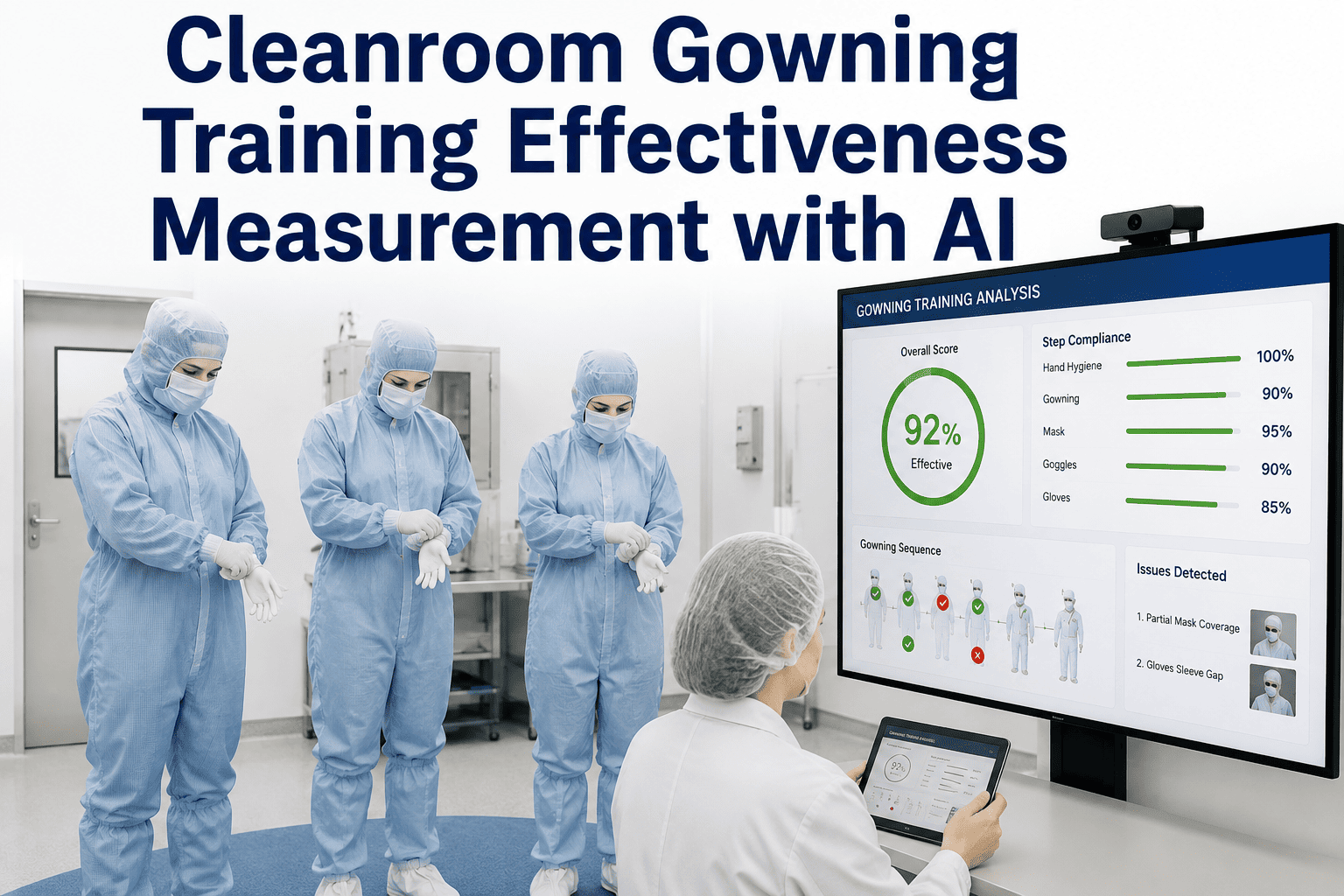
Most cleanroom training programs can prove that a class happened. They can rarely prove that it worked. An operator signs a training record after a gowning demonstration and passes a one-time observed check, and from that point forward the facility has no ongoing way to know whether that operator gowns correctly on a rushed Tuesday six months later. Training effectiveness gets measured by attendance, not outcome — and that gap is exactly where recurring gowning failures live. iFactory's AI vision platform tracks individual gowning compliance over time to close it.
You know who attended gowning training. Do you know who's still doing it right three months later?
AI vision tracks every operator's gowning compliance over time, surfacing exactly which steps get skipped, which operators need retraining, and whether your training program is actually closing the gap.
Training records prove attendance. They don't prove behavior.
A signed training record is a point-in-time snapshot: this person watched the demonstration, performed it once under observation, and was judged competent on that day. It says nothing about the next two hundred times that same operator gowns alone, under time pressure, on a shift where a supervisor isn't standing at the gowning bench watching every step. Competency on day one and consistency on day two hundred are two different things, and most training programs only ever measure the first.
The human body is a continuous particle source — a stationary person sheds roughly 100,000 particles of 0.3 micron or larger per minute, and an actively moving person sheds closer to five million. That is precisely why gowning technique matters as much after training as during it, and why a facility with a strong training program on paper can still see recurring contamination excursions traced back to gowning behavior. Regulatory citations bear this out directly: FDA warning letters have documented operators entering ISO 5 areas with exposed facial skin and hair, and sterile gowns touching the floor during donning — the kind of lapses that happen not because someone was never trained, but because nobody was measuring whether the training held.
This is also why experienced staff are not automatically the safest bet. Facilities repeatedly find that even long-tenured operators develop small habitual shortcuts over time — skipping a check step, rushing an overlap, treating a strict sequence as a familiar routine rather than a procedure that still deserves full attention. Without ongoing measurement, tenure gets mistaken for reliability, and the operators quietly drifting away from correct technique are the ones least likely to be flagged for a refresher, precisely because nobody is watching for the drift.
Gowning qualifications and behavioral audits exist precisely because facilities know initial training isn't enough on its own — but audits themselves are also a sample, not a census, typically covering a small fraction of gowning events across a small fraction of shifts. Book a 30-minute session and we'll show you what continuous gowning data looks like for a facility your size.
Every gowning event becomes a data point, not a pass/fail moment
Instead of a single observed check that generates one data point per operator per year, AI vision cameras at the gowning station and airlock capture every gowning event, every shift, for every operator — turning training effectiveness from an assumption into a trend line. The shift is a fundamental one: from sampling behavior once and extrapolating, to observing the full population of gowning events and letting the data show exactly where risk actually sits.
Individual compliance rate over time
Each operator's gowning accuracy is tracked event by event, so a slow decline in technique is visible weeks before it shows up as a contamination excursion, giving supervisors a chance to intervene while the fix is still cheap.
Step-level failure frequency
The system identifies which specific step in the gowning sequence — hood placement, glove overlap, mask seal — is failed most often, across the whole facility or by individual, so training time gets spent where it matters most.
Shift and time-of-day patterns
Compliance data segmented by shift often reveals that error rates climb during rushed periods — end of shift, high-throughput windows — pointing to process fixes beyond retraining alone.
Post-training trend verification
After an operator completes retraining, their compliance rate is tracked going forward to confirm the intervention actually worked, rather than assuming it did.
What individual tracking looks like in practice
Rather than treating every gowning failure as an isolated incident, the system builds a rolling compliance profile per operator — the same way a quality system tracks defect rates per line, applied to the person instead of the equipment.
A table like this replaces guesswork with a prioritized retraining list. Instead of retraining the entire floor on a fixed annual schedule regardless of who actually needs it, quality leads can target the operators and the specific failure modes the data actually points to — which is a more defensible approach in an audit and a more efficient use of training hours. It also reframes retraining as a routine, non-punitive management action rather than a rare escalation, since the data makes it clear that a dip in compliance is a normal, addressable event rather than a personal failing that has to be handled delicately.
The same scorecard structure is useful well beyond the retraining decision itself. During a contamination investigation, having each operator's gowning history already documented means the root-cause team isn't starting from scratch reconstructing who did what and when — the compliance record for the relevant shift and individual is already sitting in the system, timestamped and ready to review.
Not all gowning steps fail at the same rate — most facilities have never known which ones do
The gowning sequence follows a strict top-to-bottom order for a reason: each layer has to overlap the one before it to create a continuous barrier with no gaps. But not every step in that sequence is equally hard to execute consistently, and without data, every step gets the same amount of training attention regardless of where the real risk sits. A curriculum built on assumption spends equal time on the step operators get right nearly every time and the step they consistently struggle with, which is not an efficient use of a limited training window.
Illustrative failure-frequency pattern across a typical gowning sequence — your facility's actual distribution is established during the pilot period and is often the single most useful output of the entire measurement exercise.
Find out which gowning step your facility struggles with most
Every facility's failure pattern is different. See what a step-level breakdown of your own gowning data would reveal.
The excursion is expensive. The gowning failure that caused it was cheap to catch.
A contamination excursion traced back to gowning behavior triggers a cascade most quality teams know all too well: an investigation, a CAPA, potentially a batch disposition decision, and in serious cases a regulatory citation that puts the whole facility's inspection posture at risk. Every one of those consequences is expensive, slow, and reactive — they happen after the contamination has already occurred, when the only remaining question is how much damage was done.
Compare that to the cost of catching a declining compliance trend three weeks earlier, before it produces an excursion at all. A short, targeted retraining session for one operator on one specific step costs a fraction of a single investigation, and it happens proactively instead of in response to a failure that has already reached the product. The entire economic argument for continuous gowning measurement rests on this asymmetry: the intervention is cheap, and the event it prevents is not.
Proving the training budget is actually working
Quality and training leaders are regularly asked to justify the cost of gowning training programs, and until now most have had no better answer than attendance records and a hope that the numbers are lower than they'd otherwise be. Continuous compliance tracking gives a direct before-and-after comparison instead, replacing an assumption with a number that holds up in a budget review or an audit.
Baseline period
Compliance rate is measured across the operator population before any new training intervention, establishing the starting point.
Targeted retraining
Retraining is delivered specifically to the operators and failure modes the data identified, rather than a blanket refresher for everyone.
Post-training trend
Compliance is tracked for each retrained operator going forward, confirming whether the specific intervention actually changed behavior.
Documented ROI
The before-and-after compliance delta becomes a defensible, quantified answer to what the training budget delivered.
What facilities see after deploying gowning compliance tracking
How gowning compliance tracking rolls out
The measurement layer is designed to sit alongside your existing training program and gowning SOPs, not replace them. It adds the ongoing verification piece that most programs currently lack, without asking your quality or training teams to redesign a curriculum that already works for the parts it was built to cover.
Weeks 1-2: Gowning sequence mapping
Your facility's specific gowning SOP and step order are mapped to the camera's verification checklist, matched to each zone's classification requirements.
Weeks 3-5: Camera installation and calibration
Cameras are positioned at gowning stations and airlocks, and the model is trained against your actual garments, lighting, and gowning bench layout.
Weeks 6-8: Shadow-mode data collection
The system runs alongside existing observed checks to validate detection accuracy and establish the facility's baseline compliance rate before it starts driving decisions.
Week 9 onward: Live tracking and scorecards
Individual operator scorecards and step-level failure data go live, giving quality and training leads a continuous view instead of a once-a-year snapshot.
Gowning compliance measurement, explained plainly
Stop measuring training by attendance. Start measuring it by outcome.
See what continuous gowning compliance data would reveal about your own operators and training program.