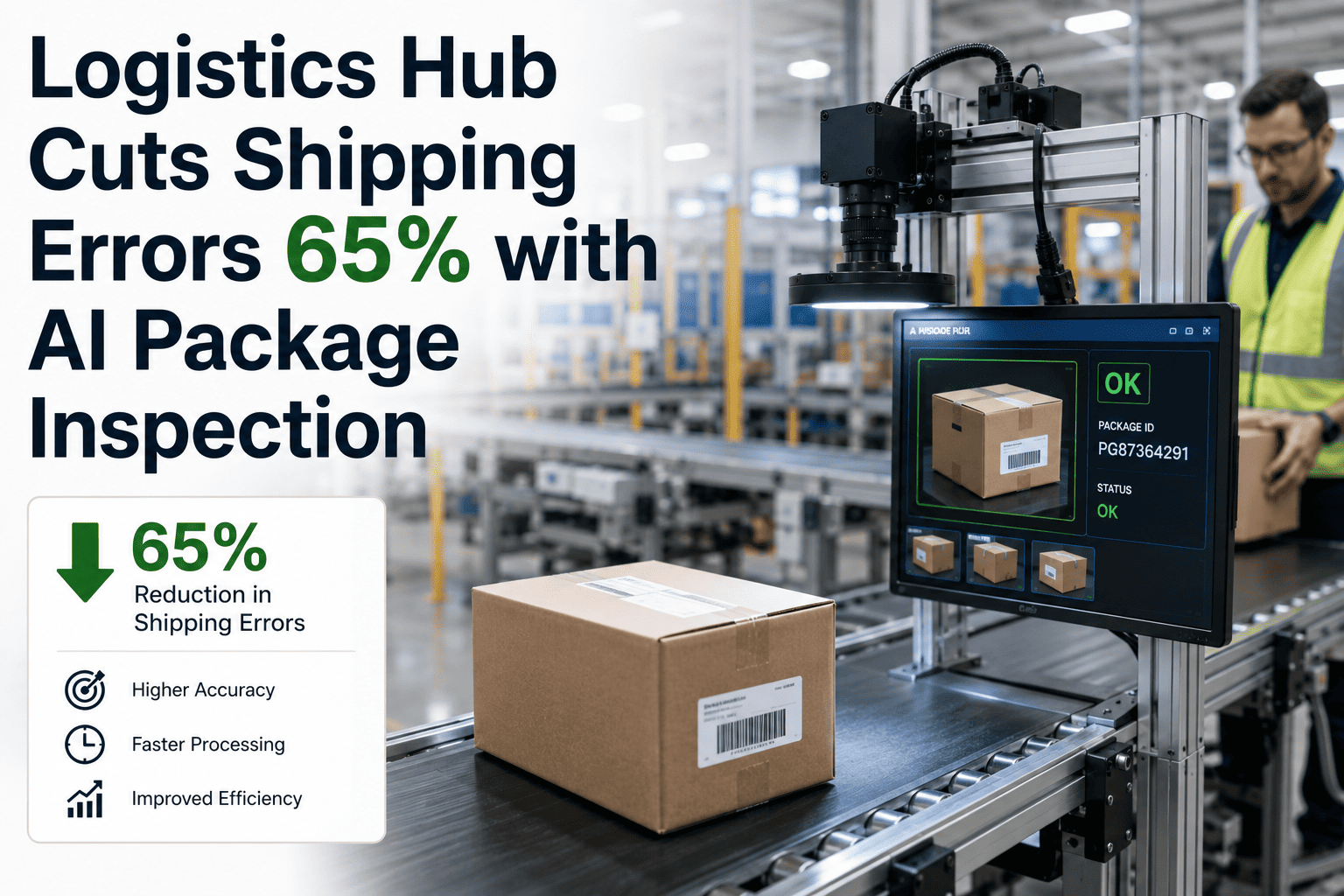
Twelve thousand parcels an hour. Three sortation cells. Seven dock doors. A single scanner error at the pack line multiplies across a shift into ninety-six wrong packages on ninety-six trucks — every one a refund and a phone call. This is the story of a midwestern distribution hub that stopped chasing errors and started catching them in-flight with AI vision at every conveyor and dock. Shipping errors fell 65 percent in a single quarter, damage claims dropped 40 percent, ROI landed in 90 days. To scope the same playbook, book a 30-minute logistics assessment.
How a 380,000 sq ft Distribution Hub Cut Shipping Errors 65% With AI Package Inspection
A high-volume midwestern fulfillment operation replaced trigger-based scanning with continuous AI vision across every dock, conveyor, and pack station — and rewrote its accuracy KPIs inside one quarter.
The Challenge — Four Silent Cost Centers Eating the P&L
Before the deployment, the hub ran on trigger-based handheld scanning, weight-check gates at the pack line, and a two-inspector team at the dock doors. It was the industry-standard setup — and it was quietly bleeding money at every step. The internal audit team mapped four failure modes that together were costing the operation over $3.4 million a year in direct and indirect losses.
Wrong SKUs Reaching the Truck
At 85 million parcels a year, a 1.2 percent mispick rate is over a million wrong packages leaving the building. At an industry-standard $75 fully loaded remediation cost per incident, that is roughly $76 million in cascading exposure before customer churn.
Boxes Crushed Before Dispatch
Damaged boxes were being handed to carriers because no station in the flow was systematically inspecting for compromised packaging. Claims came back weeks later — the DC absorbed the cost with no traceability to the offending conveyor or shift.
Manual Barcode Verification Bottleneck
Every parcel passed through a handheld scan-and-verify step at the pack line. When one operator fell behind, the whole conveyor upstream stalled. Peak-hour throughput was capped at 8,400 parcels an hour when the plan called for 12,000.
No Image-Linked Chain of Custody
When a carrier dispute or customer claim landed, the operations team had no image record of the parcel at any stage. Claims defaulted to write-offs because there was no visual proof of condition when the box left the dock.
The Turning Point — When the Math Stopped Working
Two things changed inside one board meeting. First, a large retail client threatened to reroute volume after a spike in Q2 mis-ships. Second, the operations VP ran a fully loaded cost-per-error calculation and discovered that a single percentage point of shipping accuracy was worth more than the entire annual capex request for the pack-line upgrade. The AI vision proposal moved from "innovation backlog" to "board-approved" in eleven days.
We had been chasing a 0.3 percentage-point accuracy improvement for two years with more handheld scanners, more training, and more auditors. The AI vision pilot was proposed to catch the same errors continuously and at line speed. When we stopped asking "how do we scan faster" and started asking "how do we not need to scan at all", the whole business case flipped.
— Operations Vice President, quoted in the internal deployment memo
Running a fully loaded cost-per-error number for your facility? Book a 30-minute ROI walkthrough and iFactory will build the calculation with your data.
Inside the Solution — AI Vision at Every Zone the Parcel Touches
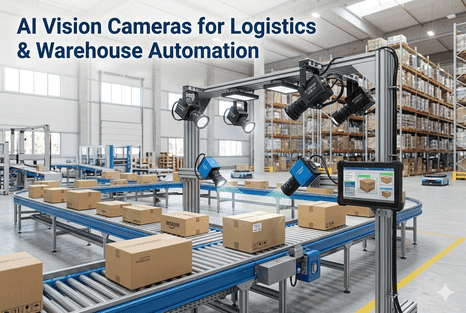
The deployment was not a single camera doing a single job. It was a layered inspection architecture with dedicated AI models at four distinct zones — dock receiving, conveyor sortation, pack verification, and dispatch loading. Every parcel gets four independent verdicts across its journey, each one written to the WMS with a timestamped image for downstream traceability.
Dock Receiving — Inbound Damage Capture
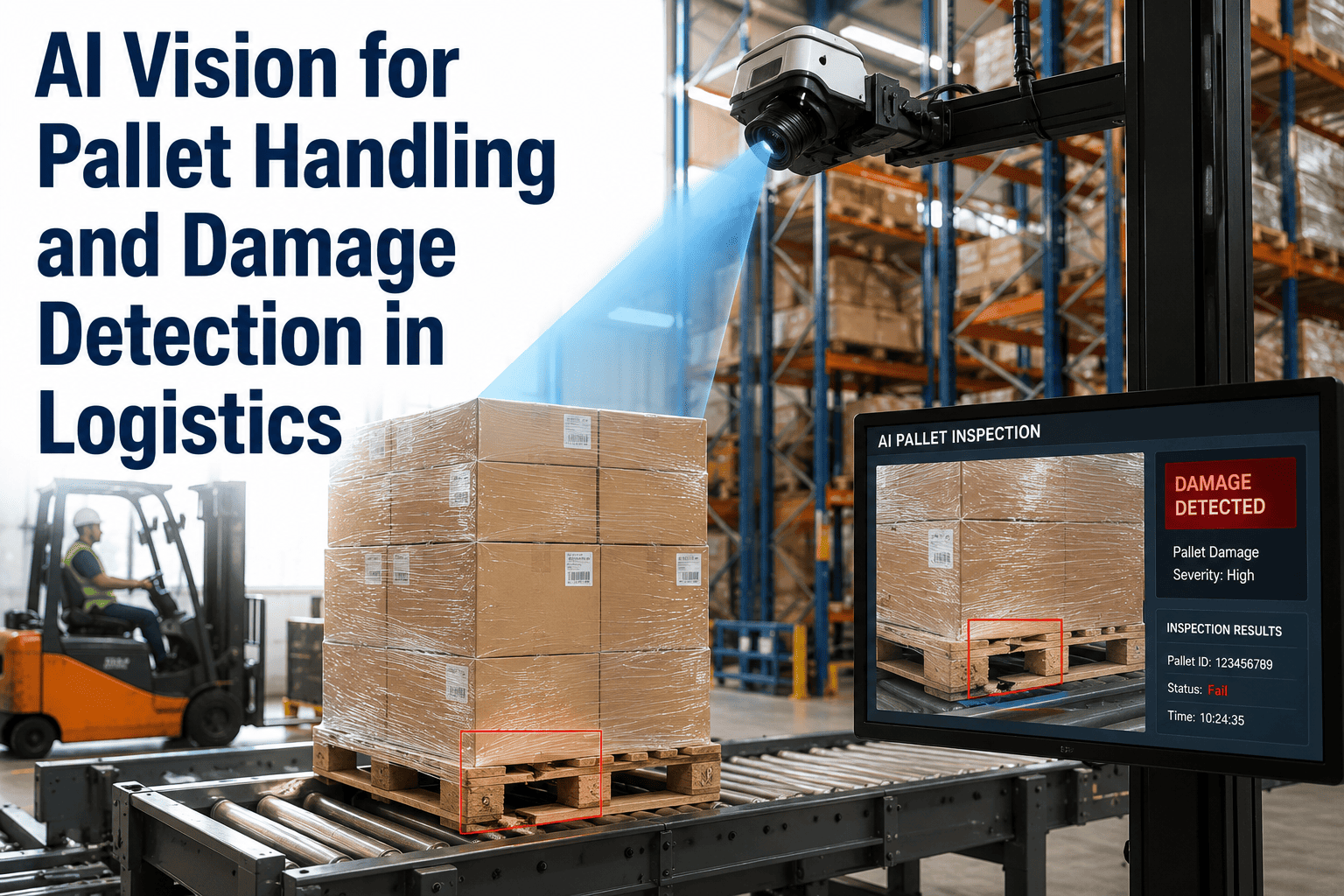
Ceiling-mounted cameras image every inbound pallet as it crosses the dock threshold. Compromised boxes are flagged before they enter the flow, with condition images written to the WMS receipt — giving the DC a clean handoff line with its inbound carriers.
Conveyor Sortation — Label & Barcode Verification
Line-scan cameras above the main sortation belt decode every barcode, cross-check the shipping label against the order manifest, and route mislabeled packages to a divert lane before they hit the sort cells — eliminating the handheld scan step entirely at cruise speed.
Pack Verification — Right Item, Right Box, Right Address
A vision station at every pack cell confirms the SKU against the pick list, verifies the label matches the order, and validates package integrity before the box is sealed. Operators get a green light or an audible flag — not a screen to squint at during peak.
Dispatch Loading — Trailer-Level Load Audit
Cameras at every dock door image every parcel as it crosses the trailer threshold and reconcile the load against the manifest in real time. Missing or misrouted parcels generate a supervisor alert before the trailer seals — turning the last-mile handoff into a documented event.
Want the same four-zone architecture mapped to your facility layout? Book a facility walk — iFactory will scope cameras, lighting, and WMS integration against your existing conveyor.
Every Uninspected Parcel Is a Damage Claim Waiting to Land
iFactory deploys AI package inspection across dock, conveyor, pack, and dispatch zones with WMS-native integration. Fixed price, 90-day timeline, image-linked traceability from receiving to trailer seal. Prove the accuracy delta on one line, then scale to the plant.
The Numbers That Moved — Quarter Before vs Quarter After
The deployment went live at the end of Q4. The comparison below is a straight quarter-over-quarter delta with identical volume and product mix, so the numbers isolate the AI vision effect. Every KPI moved — and three of them moved by more than a full standard deviation.
The 90-Day Build — How the Deployment Actually Happened
The hub committed to a fixed 90-day window from contract signature to live routing at all four zones. No production stoppage was allowed at any point. iFactory's field team worked around the peak-holiday sortation window, using overnight and weekend maintenance shifts for every physical install. Below is the timeline that landed the ROI inside the quarter.
Facility Walk & Baseline Metrics Capture
iFactory engineers walked all seven dock doors, three sortation cells, and twelve pack stations. Ninety days of scan-error, damage-claim, and audit data was pulled. Baseline established the $3.4M annual failure cost the pilot was scoped to move.
Camera & Lighting Engineering
Camera positions specified for every zone, line-scan versus area-scan decisions locked, LED lighting engineered for reflective label surfaces and mixed-height parcels. Optical validation completed against the smallest detectable defect before any hardware was ordered.
Hardware Install & WMS Integration
Cameras, GPU inference cabinets, and lighting installed during scheduled maintenance windows. Zero production stoppage. Real-time API integration built against the existing WMS for order-manifest cross-checks and defect-code write-back.
Shadow Mode & Model Tuning
All four zones ran in shadow — flagging errors and logging verdicts alongside manual QC without controlling flow. Daily accuracy reviews with the operations team tuned confidence thresholds against real production images.
Live Routing & KPI Handoff
Divert and alert logic went live at all four zones. Operations dashboard rolled to plant leadership. Impact report signed at day 90 — the 65 percent error reduction, 40 percent damage-claim drop, and full peak throughput were all measured within that window.
The Ripple Effects Nobody Predicted
The headline numbers were the ones the business case tracked. The downstream effects — the ones nobody wrote a KPI for — turned out to matter almost as much. Six months in, the operations team was reporting benefits that had never appeared on the original ROI worksheet.
Damage Claims Now Win 94% of the Time
With a timestamped image of every parcel at trailer load, the DC now defends carrier disputes with visual evidence. Recovered write-offs alone paid for the platform's second year.
Auditors Redeployed to Exception Handling
The two-inspector dock team was reassigned to inbound quality escalations and carrier relationship work — higher-value tasks the DC had never had capacity for.
The Retail Client That Almost Left, Stayed
The account that triggered the board escalation renewed for three years after seeing the accuracy delta in the Q1 scorecard — expanded volume in Q2 alone covered the platform investment.
Damage Patterns Now Traceable to Conveyors
Image-tagged damage data revealed one specific transfer point causing 38 percent of pre-dispatch damage. A $12K conveyor guard reduced damage claims by another 15 percent.
12,000 PPH Sustained Through Peak Season
Removing the handheld scan bottleneck freed the sortation line to run at rated throughput. Peak season was absorbed with no overtime and no temporary labor spike.
Cargo Insurance Premium Renegotiated
With documented parcel-condition traceability, the DC's cargo insurance underwriter reduced the premium at renewal — an outcome nobody had scoped in the original business case.
Curious which ripple effects your operation would see first? Book an outcome-mapping session — iFactory will project the specific downstream benefits for your workflow.
Frequently Asked Questions
Can AI package inspection really run at 12,000 parcels per hour without slowing the line?
Yes. The line-scan cameras and on-prem GPU inference cabinet decode every barcode and cross-check the label against the manifest in under 120 milliseconds. That is faster than any handheld scan, and it happens without an operator in the loop. The line runs at rated throughput and the verdicts flow directly to the divert logic. If you want throughput modeling for your specific conveyor speed, book a throughput assessment.
Does the system replace our WMS, or work with it?
It works with it. iFactory integrates to SAP EWM, Manhattan, Blue Yonder, Körber, HighJump, and custom WMS platforms via standard REST APIs. Every AI vision verdict is tagged to the shipment ID, order line, and dock door — all visible inside the existing WMS. Your team keeps their tools; the vision system feeds them cleaner data and closed-loop verdicts they can act on in real time.
How does image-linked traceability actually help with damage claims?
Every parcel gets a timestamped image at inbound receipt, at conveyor transit, at pack seal, and at trailer load. When a customer or carrier disputes package condition, the DC pulls the four images and settles the dispute with visual evidence. In this deployment, the claim-defense rate went from 6 percent to 94 percent in one quarter — recovering write-offs that paid for the platform outright.
Do we need to shut the line down for installation?
No. Every camera bracket, GPU cabinet, and lighting enclosure is engineered to install during scheduled maintenance windows — overnight and weekend shifts. This deployment installed across seven dock doors and twelve pack stations with zero production stoppage across the 90-day window. To review the maintenance-window sequencing for your facility, reach out to the iFactory field team.
What kind of ROI window is realistic for a facility our size?
Most logistics facilities with three or more active dock doors and a peak throughput above 5,000 parcels per hour hit full platform ROI in 60 to 120 days. The drivers are mispick reduction, damage-claim recovery, and freeing the audit team from manual scan work. This case-study hub crossed break-even at day 87. For a facility-specific projection, book a 30-minute ROI walkthrough.
Turn Every Parcel Into an Inspected, Traceable, Defensible Event
The playbook that cut this hub's shipping errors by 65 percent — dock through dispatch, four AI vision zones, WMS-native integration, 90 days from signature to live routing — is available to your facility on a fixed price. Start with one zone, prove the delta, then scale.