A pilot in one store can be run on enthusiasm. A rollout across fifty, five hundred, or five thousand stores cannot. The moment an AI vision program leaves its first location, everything that worked because someone was watching it starts to fail quietly at scale — camera coverage varies, planograms drift, network conditions differ store by store, and the compliance number that looked crisp in the pilot dashboard blurs into "roughly, on average" across the portfolio. Only about a quarter of retailers who launch AI programs manage to operationalize them across their full estate. iFactory is built for the other side of that gap — the multi-store deployment layer, portfolio dashboards, and standardized model operations that make chain-wide vision a working system rather than an ongoing pilot. Talk to our team about how the platform is architected for scale.
CHAIN-WIDE · ENTERPRISE-READY · PORTFOLIO VIEW
Multi-Store AI Vision Deployment for Retail Chain Operations
Standardize AI shelf monitoring across 50, 500, or 5,000 stores. Compare stockout, compliance, and loss metrics across every location from a single portfolio dashboard — with a rollout model built for real retail estates, not lab environments.
~25%
Share of retailers that have actually operationalized AI at chain scale — the rest are still stuck in pilot loops
$1.7T
Annual cost of global inventory distortion tied to poor shelf visibility across retail estates
Up to 65%
Reduction in stock-outs reported after edge AI vision goes live across store networks
70%
Inventory accuracy floor in a typical unautomated store — the gap AI vision is designed to close
Why Multi-Store Rollout Is a Completely Different Problem
Single-store deployments succeed because there is a single team, a single network, a single planogram, and a single manager who cares about the outcome. All of that disappears the moment the program crosses store number two. A rollout that treats every location as "just another instance of the pilot" invariably runs into the friction points below — the same friction points that separate the AI programs that scale from the ones that quietly die between the pilot report and the enterprise decision meeting.
01
Camera and network variance
No two stores in a real estate have identical camera coverage, resolution, or network conditions. A model tuned on the pilot store's cameras will produce inconsistent detection accuracy the moment it moves to a store with different fixtures, lighting, or bandwidth.
02
Planogram drift across locations
Corporate planograms rarely match store-level reality across an entire chain. Regional variations, seasonal resets, and local adjustments accumulate — and any compliance score is only meaningful if the system knows exactly what each store is supposed to look like today.
03
Product catalog fragmentation
SKU masters, pricing structures, and business rules often vary across regions and banners inside the same corporate group. Without a unified reference, the vision layer cannot generate directly comparable metrics across the portfolio.
04
Alert routing at scale
One store can absorb ad-hoc alert handling. A network of hundreds cannot. Without categorized routing, prioritization, and shift-aware assignment, alerts either overwhelm store teams or get ignored across the estate.
05
Model governance and updates
Retraining and updating detection models across a large estate cannot be a manual process. Without a centralized deployment pipeline, some stores run last month's model, some run last quarter's, and portfolio metrics stop being comparable.
06
Cross-store benchmarking
Regional managers need to know which stores are outperforming and which are dragging portfolio numbers down — but only if the underlying score is generated the same way in every location. Otherwise the leaderboard measures scoring bias, not performance.
The Hub-and-Spoke Architecture That Makes It Work
iFactory's multi-store platform runs a hub-and-spoke architecture designed specifically for the physics of retail estates. Each store is an intelligent spoke, running local edge detection to keep latency low and stay resilient through network interruptions. The central hub handles model management, portfolio dashboards, cross-store benchmarking, and integration with enterprise systems. Neither layer works well without the other — and the split is what allows the program to scale without collapsing under its own weight.
HUB
Central Vision Platform
Portfolio-wide dashboards and cross-store benchmarking
Central model registry, versioning, and staged rollout
Enterprise integrations — inventory, workforce, BI, planogram
Governance, audit trails, and role-based access control
Store A · Edge Node
Local detection, local buffering, syncs to hub on schedule
Store B · Edge Node
Runs same detection model with local calibration for its cameras
Store C · Edge Node
Continues detecting during WAN outages, syncs backlog on reconnect
Store D · Edge Node
New store onboards with a template, no per-site custom engineering
What the Portfolio Dashboard Actually Shows You
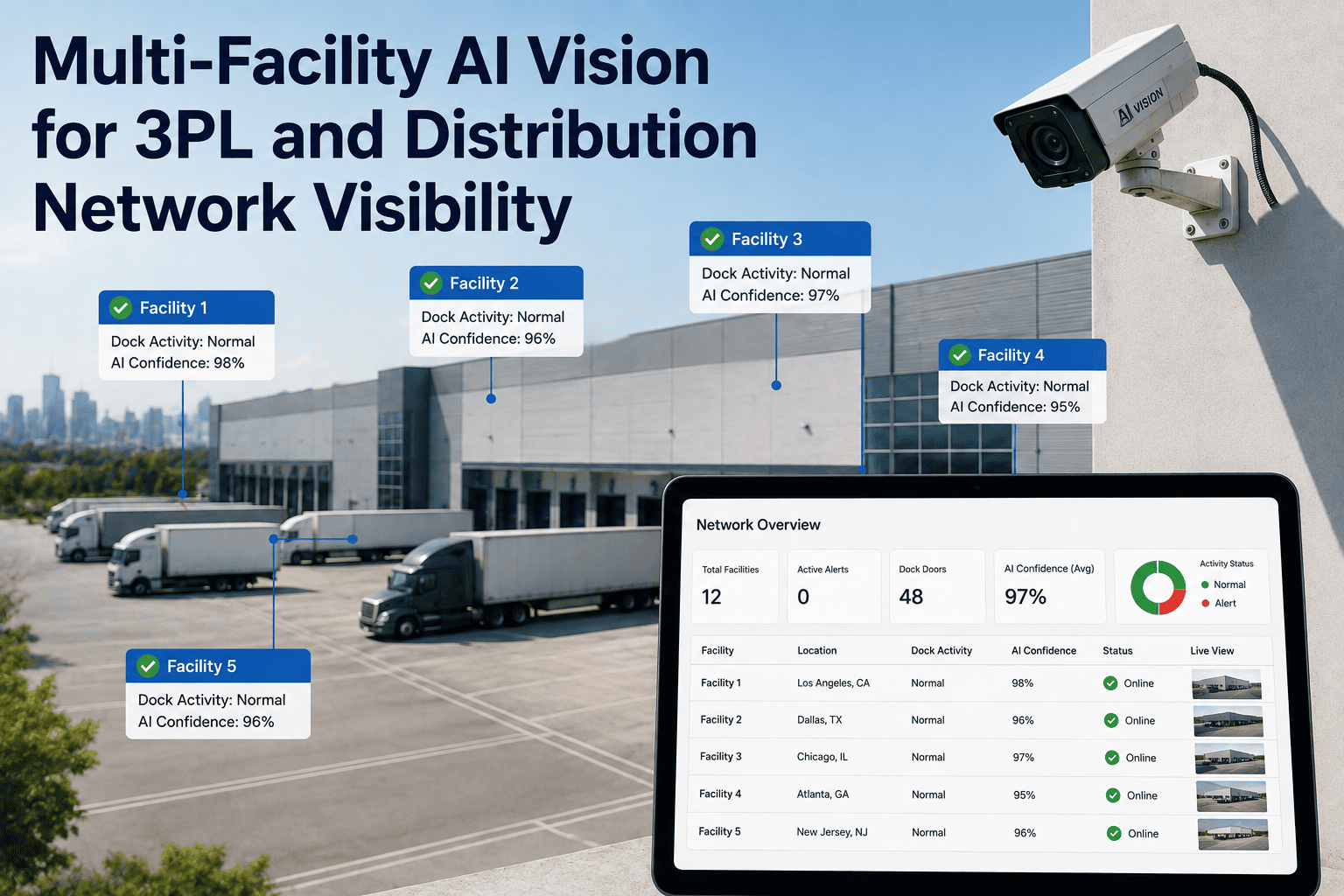
Corporate visibility is the reason a multi-store AI program exists at all. If a regional director cannot open one screen and immediately see which stores are outperforming the network on stockouts, which are dragging compliance down, and which have moved into or out of the top decile this week, the program is not delivering enterprise value — no matter how good the pilot store looks in isolation.
Stockout Rate Ranking
LIVE
Every store ranked by out-of-stock incidence on top-velocity SKUs, with the network median highlighted. Regional managers instantly see which stores need attention and which are setting the pace.
Planogram Compliance Score
LIVE
Same scoring model applied to every store, so a 92 in Chicago means the same thing as a 92 in Dallas. Trend lines show whether compliance is climbing, holding, or slipping across the estate.
Shrink & Loss Signals
LIVE
Per-store shrink indicators combined with vision-detected loss patterns, ranked from most improved to most concerning. Loss prevention teams work the list instead of guessing where to look.
Alert Response Times
LIVE
How long each store takes to close a restock, pull, or replace ticket after detection. The metric that separates stores that "have the system" from stores that "actually use the system."
Region, banner, and store-format views layered over the same underlying data — so the same platform serves store managers, district managers, and the corporate C-suite without three parallel toolsets.
Model Version Coverage
LIVE
Which stores are running which model version, when the last update landed, and whether any locations are drifting behind the current baseline. Governance is a first-class metric, not an afterthought.
See a Live Multi-Store Dashboard on Your Own Estate
iFactory can walk you through the portfolio dashboard using anonymized data from an existing multi-store deployment and then scope a pilot against your own store list, camera inventory, and regional structure — no rip-and-replace, no lock-in.
The Rollout Wave Model — 50 to 5,000 Stores Without Chaos
Rolling out AI vision across a large retail estate is not a project managed by pushing a "deploy all" button. It is a sequence of waves, each of which proves value on a bounded set of stores before the next wave commits. iFactory's rollout model is structured explicitly around this reality — small enough to move quickly, large enough to gather signal, disciplined enough to catch problems before they scale.
WAVE 1
2–5 stores
Beachhead pilot on representative store formats. Establish detection accuracy, alert routing, dashboards, and the baseline metrics the rest of the rollout will be measured against.
Weeks 1–8
WAVE 2
10–30 stores
Expand to one region or banner. Test the deployment template against real variance in camera coverage, network conditions, and store-level operational habits before wider commitment.
Weeks 9–20
WAVE 3
50–200 stores
Multi-region expansion with regional dashboards and district manager onboarding. Model governance, integration workloads, and support processes are hardened for enterprise scale here.
Months 6–10
WAVE 4
500 → 5,000 stores
Chain-wide activation, with new-store onboarding down to a documented template. Portfolio-level roll-ups, executive dashboards, and continuous model improvement operate as steady-state.
Month 10 onward
Pilot Store vs Chain-Wide Deployment — The Metrics That Change
The metrics that matter for a single pilot store are not the same metrics that matter for the estate. A pilot succeeds on detection accuracy and alert-to-action time. A chain-wide deployment succeeds on standardization, portfolio comparability, and operational governance. Scroll horizontally on mobile to see how the focus shifts as the deployment scales.
Scroll to compare deployment scales
Integrations That Make the Vision Layer Actually Useful
A vision platform that lives in its own silo is a very expensive dashboard. The value shows up when detection events flow into the systems your operations already run — task management, inventory, workforce, and business intelligence. iFactory is designed to integrate with the enterprise stack rather than replace it, so the AI layer amplifies your existing operating rhythm instead of creating a parallel one.
Inventory Management
Vision-detected stockouts and phantom OOS trigger inventory adjustments and replenishment tasks without a manual reconciliation cycle.
Workforce & Task Systems
Alerts route to the same handheld app your associates already use — no new device, no separate login, no extra learning curve.
Planogram Repository
Current planograms flow into the detection layer so compliance is scored against the actual current spec, not last quarter's version.
Business Intelligence
Compliance, shrink, and stockout metrics feed your existing BI stack for executive dashboards and cross-functional reporting.
Loss Prevention
Vision-detected loss patterns route to the loss prevention team's case-management system with photo and timestamp evidence attached.
Merchandising Systems
Category managers get facing-level performance data by SKU, store, and region — grounded in what the shelf actually looks like.
Frequently Asked Questions
How long does a full chain-wide rollout actually take from pilot to steady-state?
Realistic chain-wide rollouts run 12 to 24 months from the first pilot store to steady-state coverage across the estate, depending on chain size, store-format diversity, and how many enterprise integrations move in parallel. The pilot itself typically stabilizes inside the first quarter, the regional expansion wave runs through the following two quarters, and full estate rollout is timed to the retailer's own capital planning cycle. iFactory's rollout model is deliberately structured in waves so that each expansion decision is grounded in measurable performance from the previous wave, rather than assumed from the pilot alone. You can
contact our team to map a wave plan against your specific estate.
Do all our stores need identical camera hardware for the deployment to work?
No. iFactory's edge detection is designed to work across a range of camera types, resolutions, and mounting positions — provided the coverage on the fixtures you want to monitor is adequate. During the initial assessment we map your existing camera inventory across the estate, flag stores where supplemental cameras would materially improve accuracy, and quote only the hardware genuinely required for reliable detection. The goal is a consistent detection layer running on heterogeneous store hardware, not a uniform hardware refresh across a whole chain before the first alert can fire.
What happens to detection at a store when the connection to the central platform goes down?
Every store runs local edge detection that continues to operate independently of the central hub. If the WAN link to the central platform is interrupted — during weather events, ISP outages, or maintenance windows — the store's edge node keeps analyzing camera feeds, generating alerts, and buffering results locally. Once connectivity is restored, the buffered data syncs automatically to the central platform without operator intervention, so nothing is lost from the outage window. This resilience is one of the reasons the architecture is designed as edge-plus-hub rather than pure cloud, especially for retailers with locations in areas of variable connectivity.
How does iFactory handle stores that belong to different banners or operate under different planograms within the same corporate group?
Multi-banner and multi-format estates are a core design case for the platform. Each store or store cluster can be assigned its own planogram set, SKU master reference, and alert-routing configuration while still feeding into unified portfolio dashboards where corporate leadership needs consolidated visibility. Regional and banner-specific views layer over the same underlying detection data, so a banner president sees only their stores while a group CEO sees the whole estate — both looking at metrics generated the same way. This lets acquired chains, franchise networks, and multi-format retailers run one vision platform instead of several parallel ones.
Which enterprise systems does the platform integrate with, and how much custom work does that require?
iFactory provides documented API-based integrations for common retail systems — inventory management, workforce and task-routing apps, planogram management, business intelligence stacks, and loss prevention case management platforms. Standard integrations to major retail systems are configuration rather than custom development. Where a retailer runs less-common or homegrown platforms, the integration model uses documented event feeds and REST APIs to avoid brittle point-to-point custom code. Integration timelines and scope are estimated during the pilot design phase so that you have a defensible plan before committing to enterprise-scale rollout. To scope integrations against your specific stack,
book a demo and we will walk through the technical picture in detail.
Turn Chain-Wide Shelf Visibility From Ambition Into Operating Rhythm
Every retailer wants standardized shelf metrics across their estate. iFactory delivers them — with edge detection at every store, hub-level portfolio dashboards, wave-based rollout designed for real chains, and integrations that plug into the systems your operations already run. Fewer pilots that never scale. More AI that actually runs the estate.