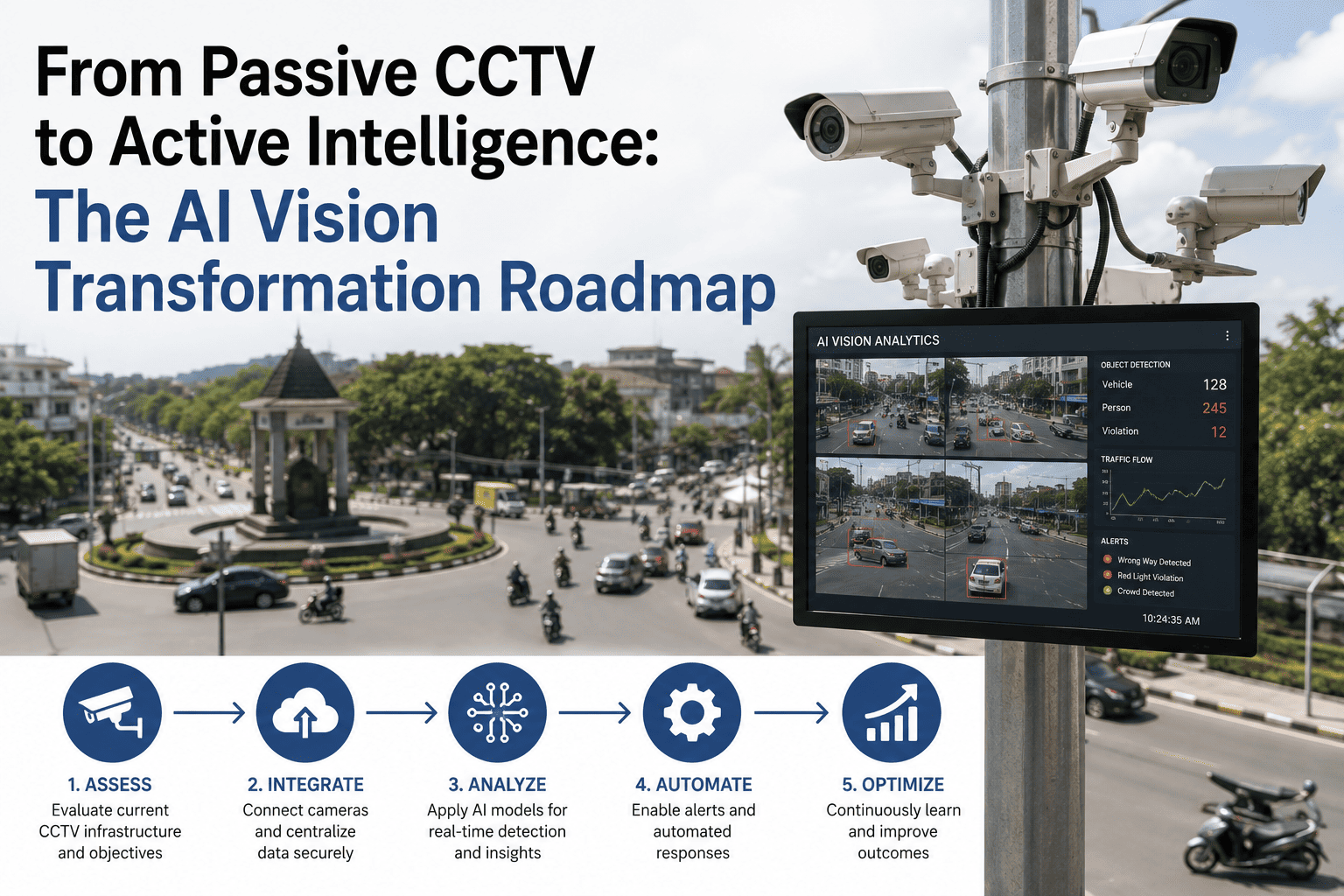
Most industrial sites already own the hardware this transformation runs on. Cameras are mounted above conveyor lines, dock doors, and production cells across nearly every facility built in the last decade, and almost all of that footage does the same job it did twenty years ago: it records, it sits on a server, and someone reviews it after something has already gone wrong. The global video analytics market is on track to reach roughly $15 billion this year alone, and the gap driving that growth is not a hardware gap, it is an intelligence gap. This roadmap walks through the four phases that move a site from passive recording to a fully closed-loop AI vision system, and what changes operationally at each stage.
From Passive CCTV to Active Intelligence
Four phases, existing camera infrastructure, and a defined path from footage nobody watches to a system that detects, decides, and dispatches on its own.
The Camera Was Never the Limitation
Watching multiple live feeds in a control room is a monotonous task, and after prolonged hours of screen monitoring, even trained staff experience reduced attention and visual fatigue. Expecting a person to catch every anomaly across dozens of camera feeds in real time is not a realistic operating model, it is a structural gap dressed up as a staffing problem. Most passive CCTV deployments fail for this reason rather than a hardware reason: the footage exists, but nobody, and nothing, is watching all of it, all the time.
The consequence compounds across every function that touches the video feed. False alerts from basic motion sensors waste attention and breed complacency. Recording-only systems allow problems to develop for hours before anyone notices. Manual safety and quality checks happen on a schedule, not continuously, which means the gaps between checks are exactly when things go wrong. AI vision does not replace the camera. It replaces the assumption that a human needs to be watching it every second for the footage to be useful.
The Four-Phase Maturity Ladder
Each phase below builds on the one before it, and each delivers a measurable operational change on its own, so the transformation produces results at every stage rather than only at the finish line.
Phase 1: Connect What You Already Have
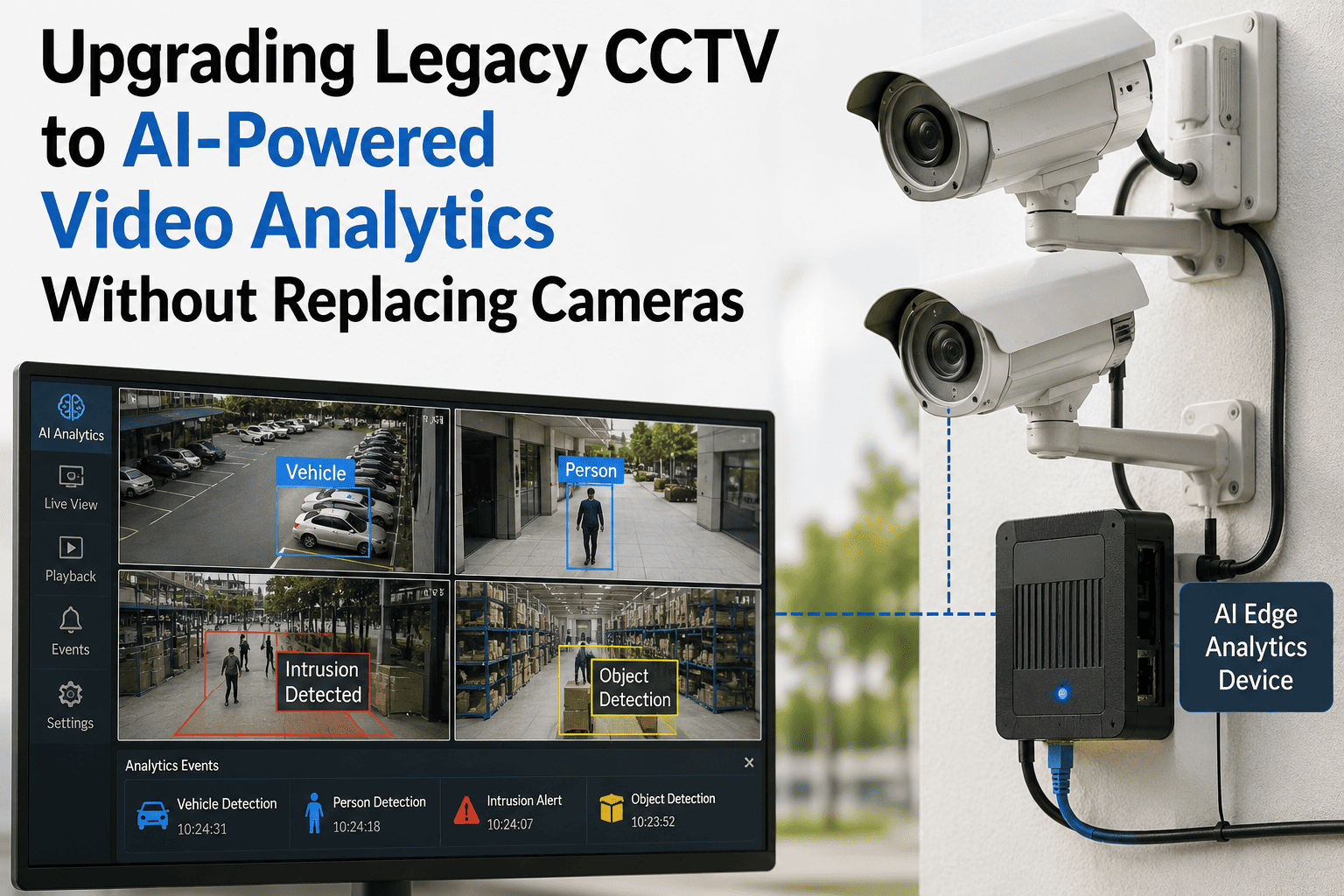
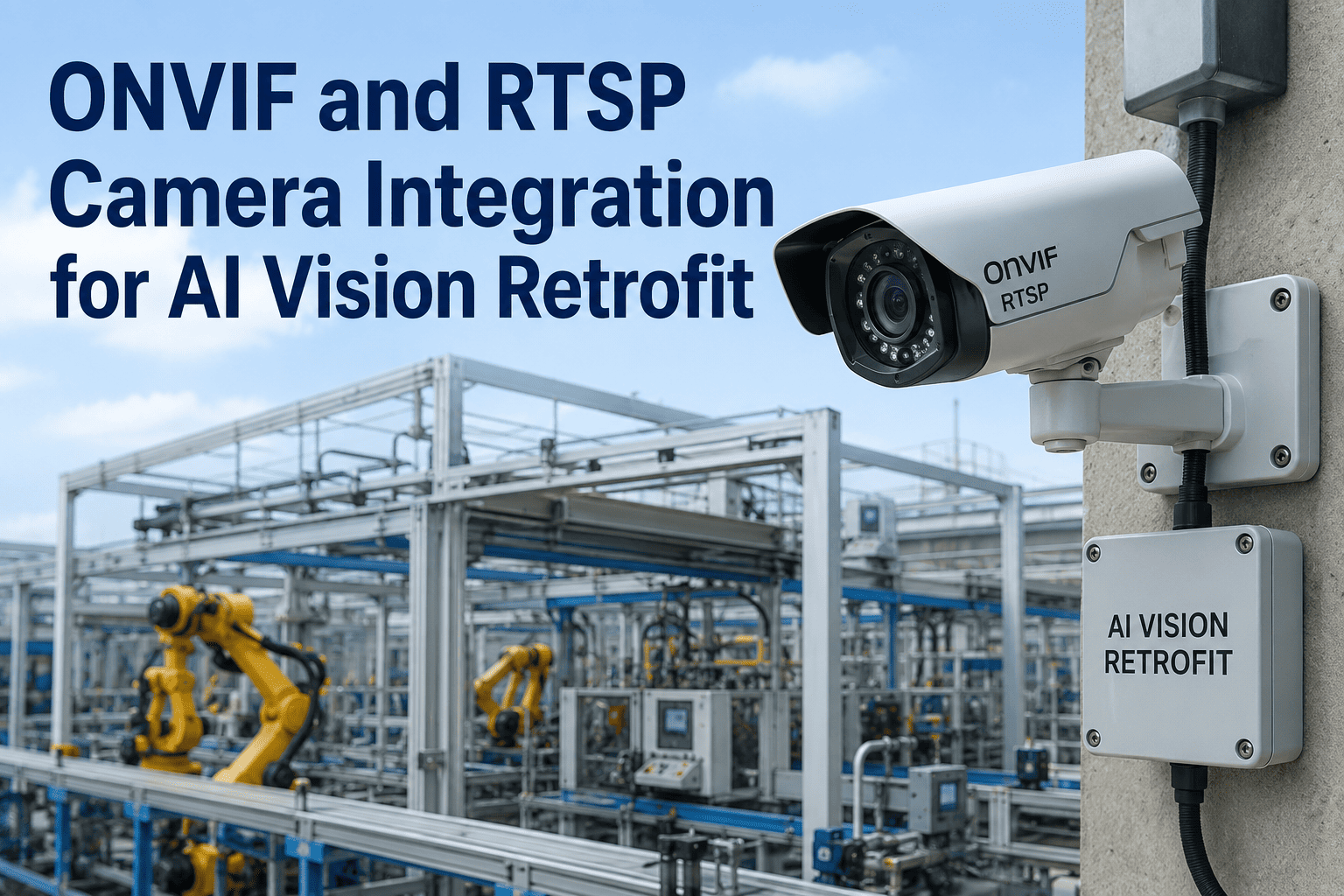
The single most common misconception about this transformation is that it requires ripping out an existing camera network and starting over. It does not. Most industrial sites already have adequate camera coverage over the areas that matter most, and the work in Phase 1 is almost entirely on the software side: routing existing RTSP or NVR feeds into an inference pipeline, verifying resolution and lighting are sufficient for the fault types being targeted, and running the AI model against live footage without yet acting on what it sees.
First real-time detections typically go live within days of connecting existing cameras, not months of new hardware procurement. See what your current camera footprint is already capable of.
Phase 2: Turn Footage Into Alerts
This is the phase where the system stops being a smarter recorder and starts being an active observer. Once the model is validated in shadow mode, alerting is switched on, and the system begins pushing real-time notifications the moment it recognizes a defined fault signature, safety violation, or process deviation, instead of waiting for a human to stumble across it during a review.
The shift here is as much organizational as it is technical. Alerts have to reach the right person, through the right channel, with enough context to act immediately, or the phase fails to deliver value even if the detection itself is accurate. A flagged anomaly that lands in an unmonitored inbox produces the exact same outcome as no detection at all.
Phase 3: Close the Loop With WMS and CMMS
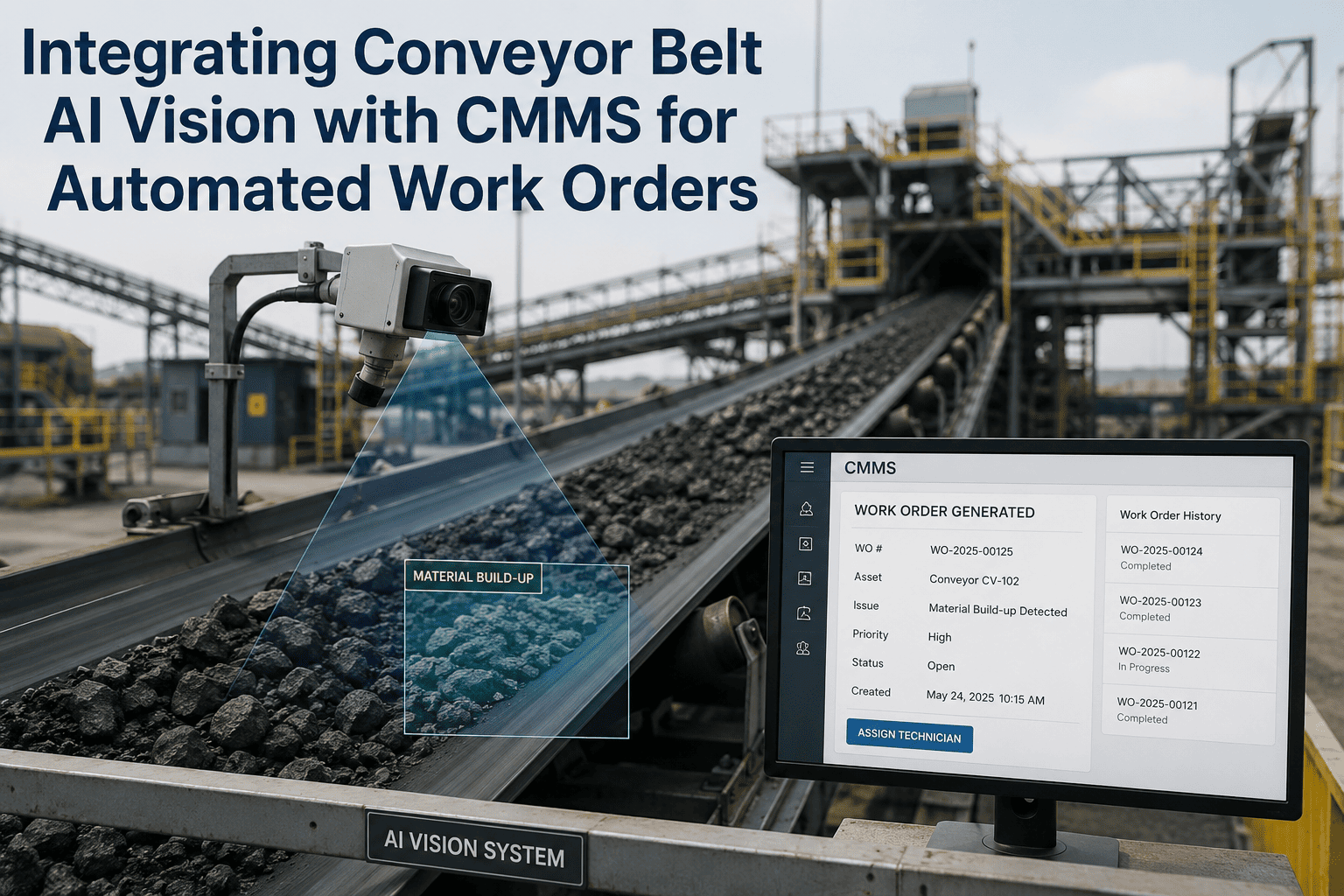
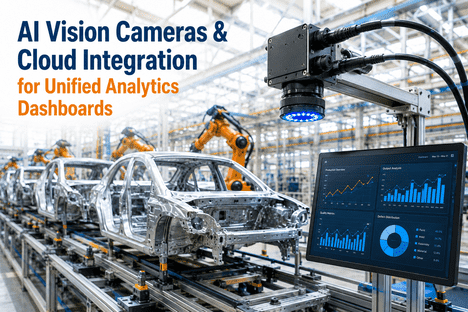
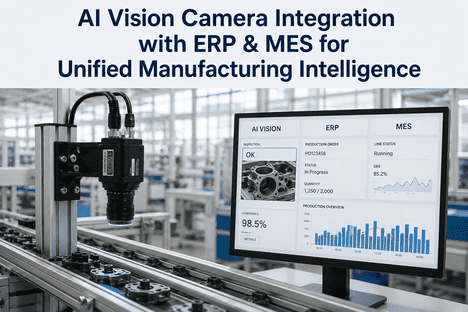
An alert that still requires someone to manually open a work order, look up the asset, and dispatch a technician has only solved half the problem. Phase 3 is where detection stops ending at a notification and starts triggering structured, automated action. A detected fault generates a work order directly in the existing CMMS, complete with asset ID, fault classification, severity, and a visual evidence frame attached, with no manual data entry step in between.
On the warehouse and logistics side, this same integration lets the WMS reroute fulfillment away from equipment showing early failure signals, keeping operations running while maintenance is dispatched before a full breakdown forces a stop. The two systems begin operating as a single feedback loop instead of two disconnected platforms that both happen to reference the same equipment.
| Integration Point | What Connects | Operational Result |
|---|---|---|
| Fault detection | AI vision to CMMS work order | Work order created automatically with full failure context |
| Fulfillment routing | Equipment health to WMS dispatch | Orders rerouted away from at-risk equipment automatically |
| Maintenance timing | WMS volume forecast to PM schedule | Preventive tasks shifted to low-volume windows automatically |
| Technician dispatch | Fault severity to skill-based routing | Right technician assigned without manual coordination |
Phase 4: From Reactive to Predictive
The first three phases are about closing the gap between an event happening and a person acting on it. Phase 4 removes the event from the front of that chain entirely. With enough closed-loop history built up through Phases 2 and 3, the system has a growing record of what fault signatures preceded past failures, what maintenance actions resolved them, and how long each piece of equipment ran before showing the same pattern again.
That history becomes the training data for failure probability scoring. Instead of waiting for a defect to cross a visible threshold, the system flags equipment trending toward failure while there is still time to schedule a fix during planned downtime rather than react to an unplanned one. Recurring defect pattern detection also starts surfacing site-wide, showing operations leaders which equipment class or which line configuration produces the same failure repeatedly, turning individual incident data into a plant-wide reliability program.
Why the Transformation Is Accelerating Now
Frequently Asked Questions
Your Cameras Are Already Doing Half the Work
See what your existing camera infrastructure looks like running through all four phases, and where your site would start on the roadmap.