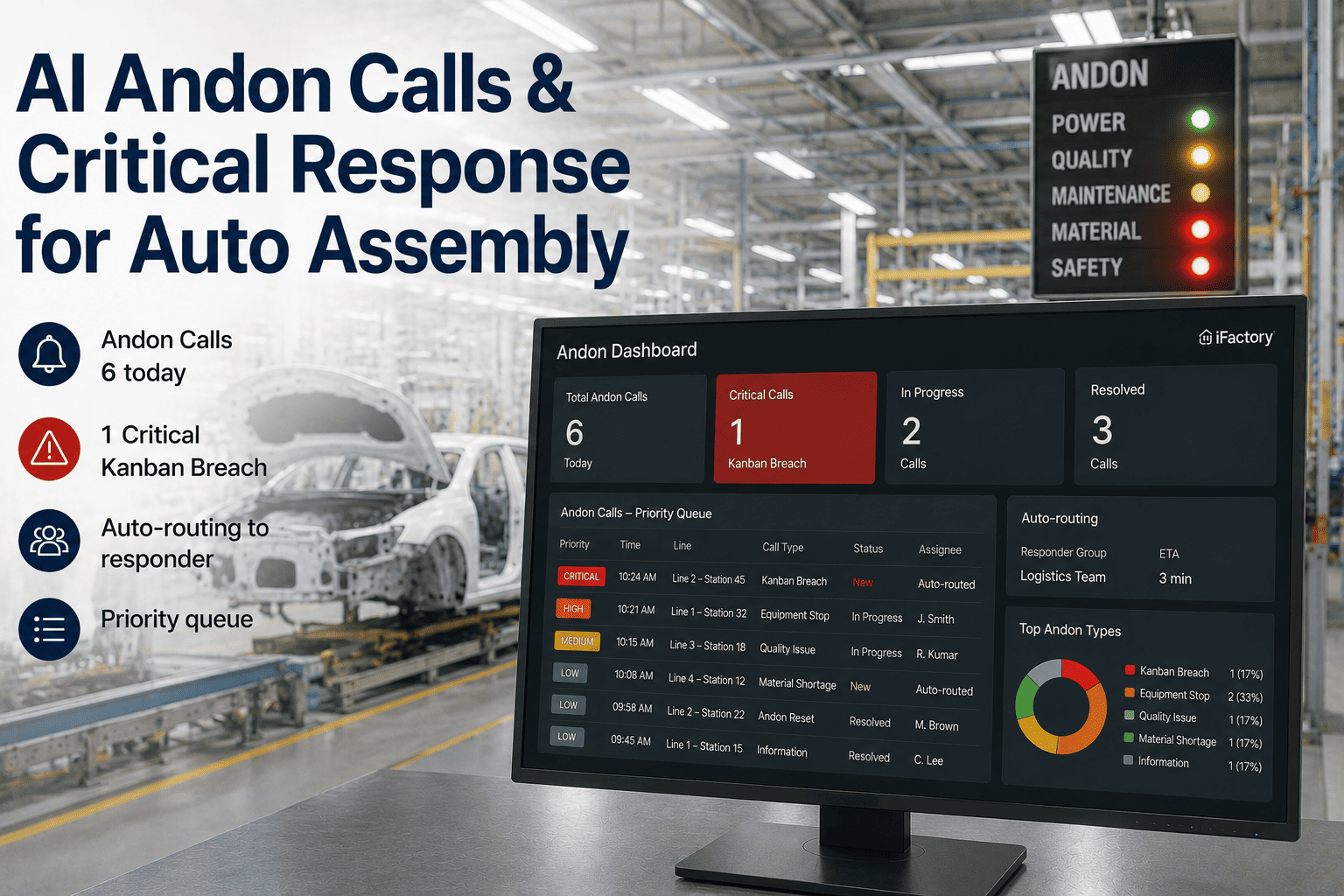
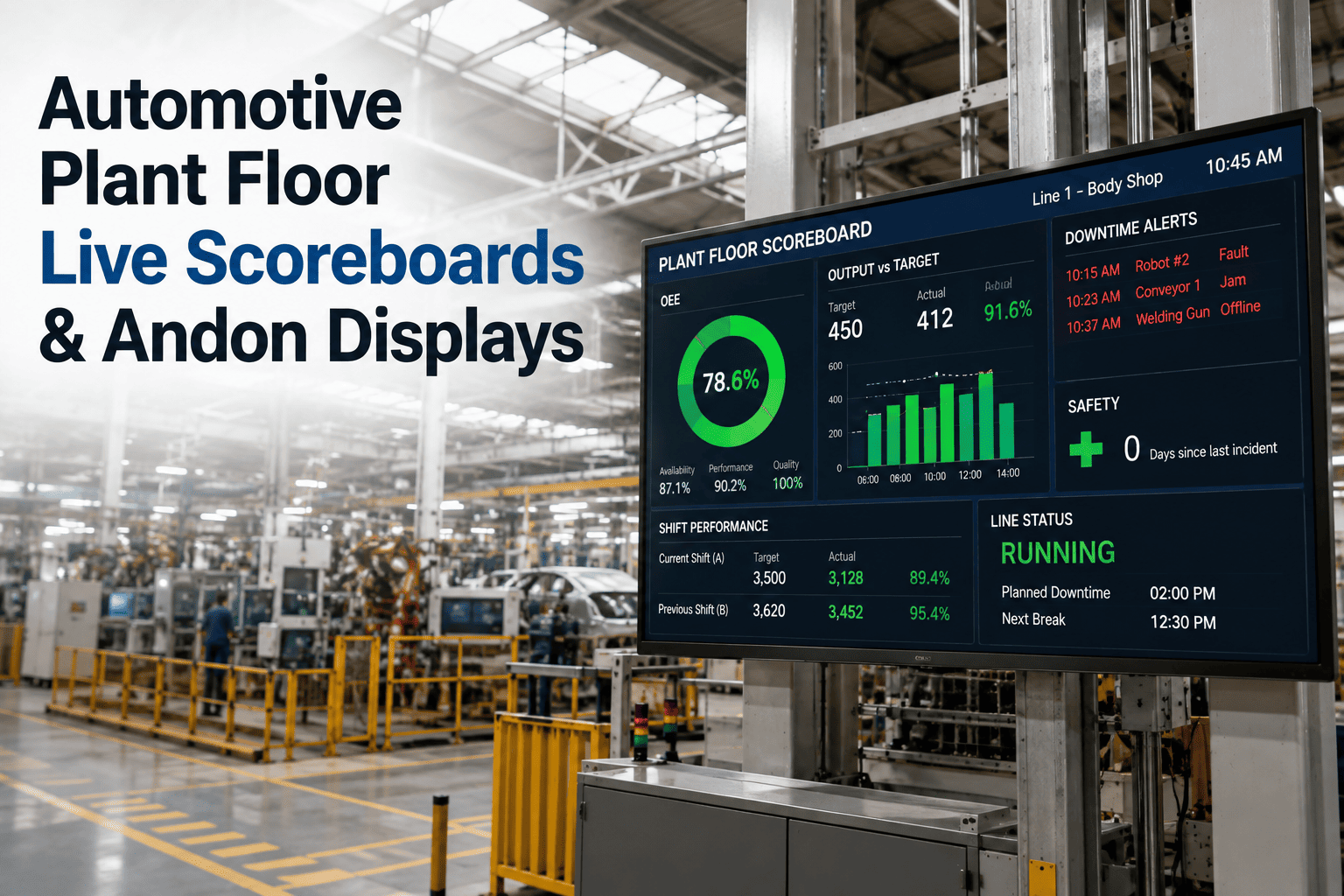
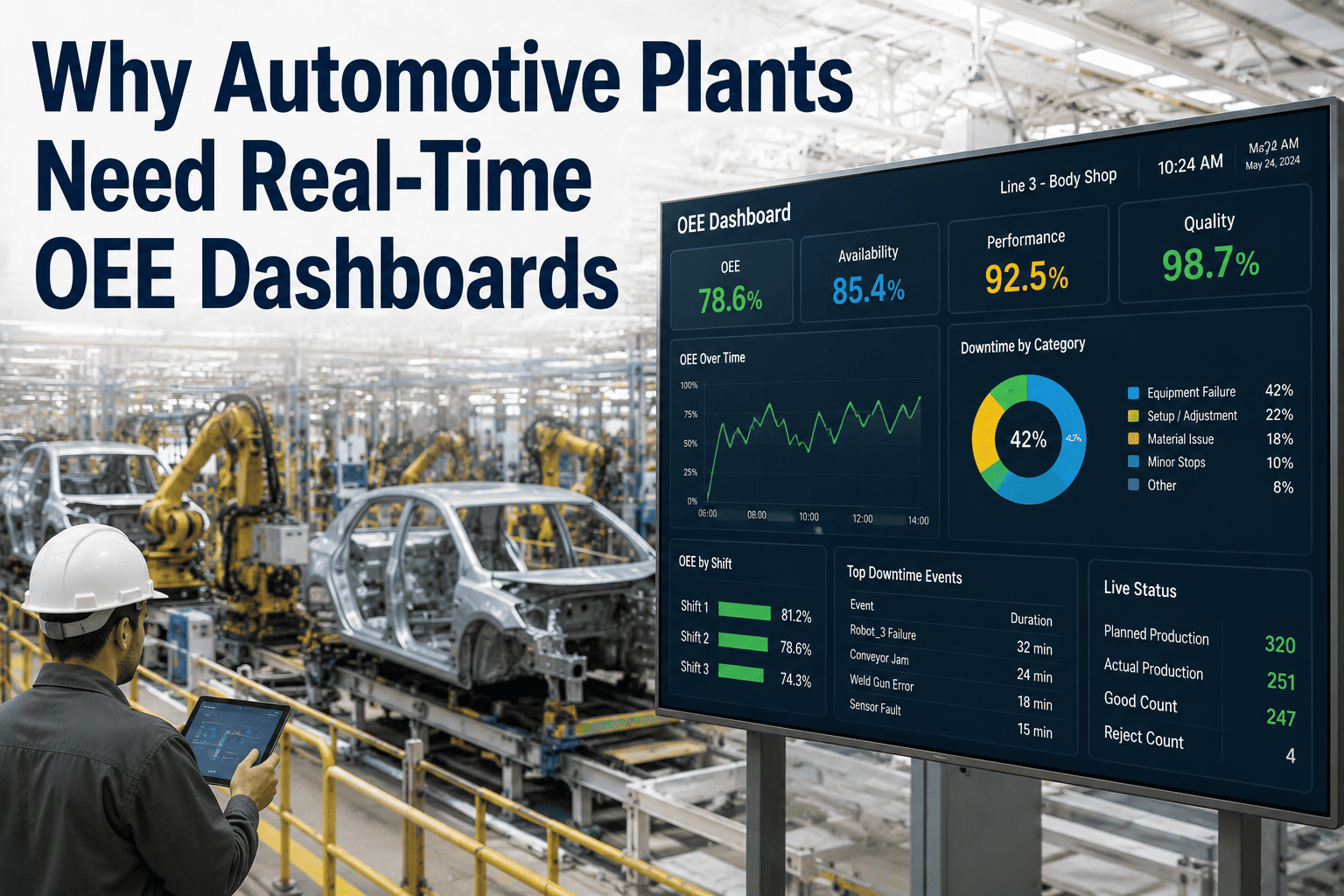
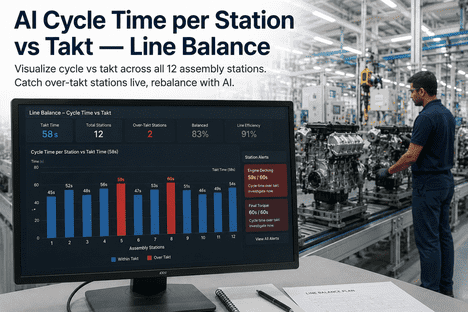
The andon cord is one of the great ideas in manufacturing: give every operator the authority to stop the line the moment something goes wrong, so a defect gets fixed at its source instead of traveling downstream. Fifty years on, the cord itself has barely changed — what matters now is everything that happens after it's pulled. A modern line generates a stream of andon calls across a shift: a quality issue at one station, a material shortage at another, an equipment fault, and every so often a critical one buried in the noise. Six calls today, and one of them is a critical kanban breach that will stop the line if it isn't handled first. The old model treats them as they arrive, first-come-first-served, and hopes the right person notices the important one. That's where response time leaks away — a critical call waiting behind two minor ones, or routed to a responder who isn't the fastest at that fault. AI andon changes what happens in the seconds after the pull: it scores every call by real urgency, orders them in a priority queue so the critical breach jumps the line, and auto-routes each to the responder best placed to resolve it — while safety calls always go straight to the top. Workers pull the same cord; the response behind it gets faster and better aimed. It runs on-premise, keeping your production and response data in-house. To see it on your line, book a demo.
AUTOMOTIVE ASSEMBLY · AI ANDON & CRITICAL RESPONSE
The Cord Is the Same. What Happens After the Pull Is Smarter.
A modern line raises many andon calls a shift, and the critical one can wait behind minor ones. iFactory scores every call by real urgency, orders them in a priority queue so a critical kanban breach jumps ahead, and auto-routes each to the responder best placed to fix it — safety always first. Signal-to-resolution time drops, on-premise, with workers pulling the same cord.
6 calls
Raised on the line today, across all call types
1 critical
Kanban breach that jumps to the front of the queue
auto-route
Each call sent to the best-placed responder
safety first
Safety calls always top priority, no matter the score
The Signal Is Solved. The Response Isn't.
Andon is the visible interface of Jidoka — the principle that work should stop the instant an abnormality appears, so the problem is countered at its source before it moves downstream. Pulling the cord communicates three things at once: where the problem is, what type it is, and how urgently it needs a response. That part has worked for half a century. What has changed, and where the value now lives, is everything after the signal: which call gets attention first, who responds, how fast they arrive, and whether the fix is captured so it doesn't recur. On a busy line raising many calls a shift, the signal is no longer the hard part — the orchestration of the response is.
First-Come Isn't First-Priority
Handled in the order they arrive, a critical call can sit behind two minor ones simply because it was pulled a moment later. Arrival order has nothing to do with urgency, so a material breach that threatens a line stop waits while a cosmetic quality query gets worked first — the single most common way response time is lost.
The Wrong Responder Is Slower
A call routed to whoever is nearest, rather than to whoever resolves that fault fastest, adds minutes to every event. Without matching the call type to the responder with the right skill and the best track record on it, the plant leaves resolution speed on the table on calls that are racing a takt-time clock.
The Stack Light Is Only 15%
The red-yellow-green tower is the visible symbol of andon, but in a modern deployment it represents a small fraction of the system's value. The real engine is the routing and escalation logic behind it — which alert maps to which condition, which person is notified through which channel, and how long before it escalates.
Signal Fatigue Kills the System
When nothing visibly changes after a pull — no fast response, no captured resolution — operators learn the cord doesn't help and stop pulling it. A missing resolution loop is one of the top causes of failed andon: the signal decays into noise, and the Jidoka discipline that depends on every operator raising alarms quietly erodes.
The operational KPI of a modern andon system is signal-to-resolution time, not signal frequency. The goal isn't to raise more alarms or fewer — it's to close each one faster and make sure it doesn't come back. That's a problem of prioritization, routing, and loop closure, which is exactly what a stack light and a first-come queue can't provide.
Every Call Type, Its Own Response
A complete andon system doesn't treat all calls alike — each production deviation has its own signal, its own routing, and its own escalation rule. Knowing the four families is what makes prioritization meaningful, because urgency and the right responder differ sharply across them.
SAFETY
Always top priority
A safety call is the highest-priority signal on the line, and it is routed with immediate priority regardless of any other factor — no scoring, no queue position, straight to the front. This is a firm rule consistent with andon philosophy: nothing outranks a threat to a person, so the AI always escalates safety instantly to the right responders while everything else waits behind it. Getting this rule absolutely right is a precondition for trusting any prioritization at all.
EQUIPMENT
Fast, line-stop risk
A machine or equipment fault carries a high line-stop risk — an unacknowledged automotive equipment call can halt the line within a couple of minutes — so it needs rapid routing to maintenance with the right skills. Because equipment faults vary enormously in severity and resolution difficulty, this is exactly the category where matching the call to the technician with the fastest documented history on that fault type pays off most.
MATERIAL
The critical kanban breach
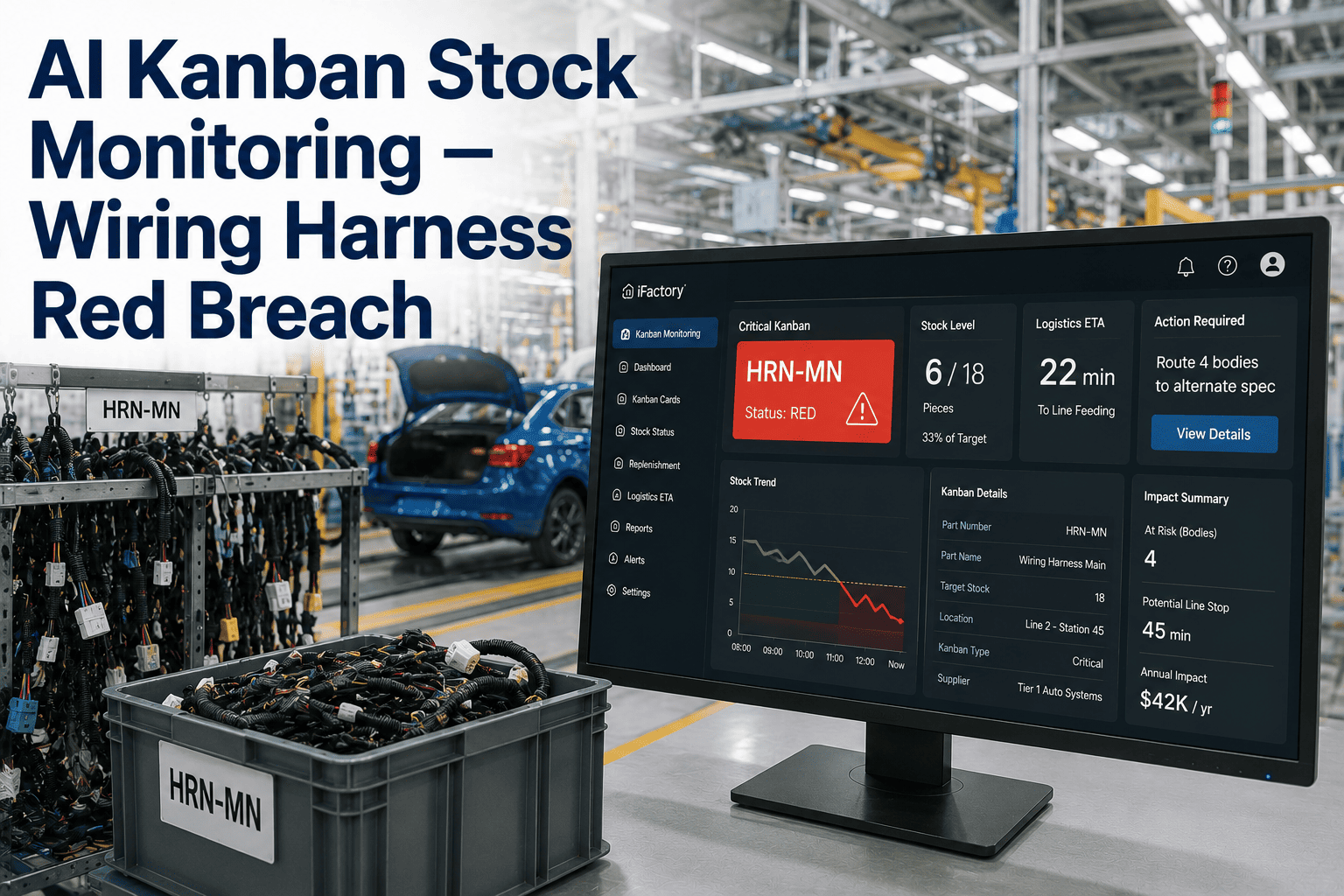
A material call flags a part shortage or line-side supply problem, and when it's a critical kanban breach — a part below safety stock with a stockout imminent — it can stop the line as surely as an equipment fault. These calls route to logistics and materials handling, and their urgency depends on how close the part is to running out, which is precisely the kind of context the AI weighs to decide whether this material call is routine or the one that must jump the queue.
A quality call is the original Jidoka case — an operator catching a defect and stopping work so it isn't passed downstream — routed to quality and the team leader. Severity ranges from a critical defect that must halt the line to a minor query resolvable within takt time, so quality calls span the priority range and depend heavily on the station's quality classification and the nature of the defect to place them correctly.
See Your Andon Calls Prioritized and Routed
Bring a shift's worth of andon calls and your response structure. iFactory engineers will show how AI scoring orders the queue so the critical call surfaces first, how auto-routing sends each to the best responder, and how signal-to-resolution time drops — with safety always first.
How the AI Scores Each Call
The prioritization isn't a guess — each call is scored on concrete factors that together estimate its true urgency and the fastest path to resolution. The scoring is a layer added on top of the existing andon, so line workers keep pulling the same cord while the response behind it gets sharper.
01
Station Safety and Quality Classification
Each call is weighted by the safety and quality classification of the station it came from, so an alert at a critical station is scored higher than the same alert at a low-risk one. This grounds priority in where the call originated, not just what type it is — the same signal can matter very differently depending on its station's role in safety and quality.
02
Historical Resolution Time
The AI factors in how long similar events have historically taken to resolve, so it can anticipate which calls will tie up a station longest and weigh them accordingly. Knowing a given fault type's real resolution history turns priority from a static rule into an informed estimate of impact on throughput.
Recurring Failure Signature
03
A call is scored higher when it matches a recurring failure signature — a pattern the line has seen before and that tends to escalate or repeat. Recognizing that this alert looks like a known bad actor lets the system flag it for faster, more decisive response rather than treating every occurrence as brand new.
Safety Overrides Everything
04
Whatever the other factors produce, a safety-critical alert is always routed with immediate priority regardless of any scoring — the one hard override in the system. Prioritization optimizes the response to everything else, but it never places any efficiency consideration ahead of a safety call, which jumps straight to the top by rule.
The scoring respects the plant's existing structure rather than replacing it. Technician assignment can be weighted by documented fastest-resolution history for a given failure type while still honoring the plant's shift assignments and escalation hierarchy — configured during onboarding with input from maintenance and quality leadership. The AI makes the response smarter within the rules the plant already runs, not around them.
Six Calls, One Critical: The Queue in Action
Here's what the system does across a real shift — six andon calls raised, one of them critical, all resolved in the right order by the right people. It's not a board showing six lights; it's an ordered response that puts the line-stopping call first.
1
Six Calls Land Across the Shift
Over the shift, six andon calls come in from different stations and types — quality queries, an equipment niggle, material requests. On a first-come board they'd be worked in arrival order; here they all enter a single scored priority queue the moment they're raised, ranked by real urgency rather than timestamp.
2
One Is a Critical Kanban Breach
Among the six is a material call that's a critical kanban breach — a part below safety stock, stockout imminent, a line stop coming if it isn't handled. The AI scores it far above the minor calls on station criticality and line-stop risk, and it jumps to the front of the queue ahead of calls raised before it.
3
Auto-Routed to the Right Responder
Each call is dispatched to the responder best placed to resolve it — the kanban breach to materials and logistics, an equipment call to the technician with the fastest history on that fault, a quality call to the team leader — through mobile push and the board, so the right person is moving in seconds, not after someone reads the board and decides.
4
Escalation Runs on a Timer
Every call carries a response window; if it isn't acknowledged in time the system escalates automatically to the next tier — backup, then supervisor, then manager. No critical call can sit unnoticed, because the timer, not a human remembering to check, drives escalation until someone owns it.
That's the shift handled: six calls into one scored queue, the critical kanban breach surfaced to the front and routed to materials while the minor calls are dispatched in parallel to their best responders, every call on an escalation timer. The line-stopping problem gets worked first by the right person — the outcome a first-come board and a stack light can't reliably produce.
Closing the Loop: From Signal to Improvement
Fast response is half the value; capturing what happened is the other half. Because every call and its resolution are logged, the andon stops being a momentary alarm and becomes a stream of operational data that both prevents signal fatigue and drives continuous improvement.
The Resolution Is Captured
When a call is resolved the andon resets and the resolution is logged, so something visible always changes after a pull. Closing the loop is what prevents signal fatigue — operators keep pulling the cord because it demonstrably works, preserving the Jidoka discipline that depends on every alarm being raised.
Response Time Becomes a Metric
Every call's signal-to-resolution time is tracked, turning the true andon KPI into a measured, trendable number rather than an impression. Teams can see whether response is improving, which shifts and stations lag, and where routing or staffing needs to change — managing the response by data.
Recurring Patterns Surface
Logged calls reveal which stations, machines, and failure types generate the most alarms and the longest resolutions, so chronic problems get identified and engineered out at the root. The andon data becomes the input to continuous improvement instead of evaporating the moment each light clears.
It Feeds OEE and Shift Reporting
Call and downtime data flow into the OEE and shift-reporting layer, tying andon activity to availability and throughput so its impact is visible in the numbers leadership already watches. The response system and the performance system become one view rather than two disconnected records.
On-Premise: Your Line Data Stays In-House
Andon orchestration runs on your live line status, call history, response structure, and staffing — operational data that reveals how the plant runs and performs — so the AI is built to run on-premise, inside your firewall, with the speed a live line demands.
Response and Line Data Stay Local
Prioritization and routing run on line status, call history, resolution times, and staff assignments — data that exposes how the plant operates and performs. On-premise processing keeps all of it inside your network and out of any external cloud, so sensitive operational data never leaves the plant.
Routing in Seconds, Not After a Round Trip
A call has to be scored and dispatched the instant it's raised, so the decision is computed against the live line locally — no round trip to a remote server. On-premise inference is what lets the right responder be moving within seconds of the pull, which is the entire point.
Runs Through Network Interruptions
Andon is safety-adjacent and can't depend on an internet link, so on-premise operation keeps prioritization, routing, and escalation running within the isolated operational-technology environment regardless of external connectivity — the resilience a response system must have.
Live in 6 to 12 Weeks
The turnkey model ships a pre-configured, racked-and-ready AI server with the software pre-loaded, so a focused andon-prioritization-and-routing scope goes live in 6 to 12 weeks — smarter response layered onto your existing cord and board without an open-ended build.
Layers Onto the Andon You Already Have
The intelligence is added on top of the existing system, not in place of it — line workers keep pulling the same cord, and the plant keeps its escalation hierarchy. The rollout is deliberately staged and low-disruption.
1
Connect the Existing Andon
The platform connects to your plant-floor andon — pull cords, buttons, or mobile triggers — and ingests every call in real time, so nothing about how operators raise alarms changes. The AI layer sits on top of the signals already being generated.
2
Configure Scoring and Routing
With maintenance and quality leadership, the scoring factors, the safety-always-first override, the responder-matching rules, and the escalation tiers are configured to the plant's real structure — weighting technicians by resolution history while respecting existing shift assignments and hierarchy.
3
Validate on Live Calls
The team confirms the queue orders calls sensibly, safety always routes first, and the responder matching holds up against real events — building trust that the prioritization reflects true urgency before it drives dispatch across every shift.
4
Scale and Close the Loop
Coverage extends across lines and areas, and the logged call and resolution data feed OEE, shift reporting, and root-cause analysis — so the andon both responds faster and drives the continuous improvement that engineers recurring problems out.
What Changes on the Line
AI andon turns a stream of undifferentiated alarms into an orchestrated response — the right call first, the right responder, the loop closed — so signal-to-resolution time drops and the Jidoka discipline stays strong.
01
The Critical Call Surfaces First
Scoring every call by real urgency puts a line-stopping breach at the front of the queue ahead of minor calls raised before it, so the problem that matters most is worked first instead of waiting its turn behind cosmetic ones — with safety always overriding to the very top.
02
The Right Responder Moves Faster
Auto-routing each call to the best-placed responder — the technician with the fastest history on that fault, the right team for that type — shaves minutes off every event compared with sending whoever's nearest, all within the plant's existing hierarchy.
03
No Call Falls Through
Timer-based escalation moves any unacknowledged call up the tiers automatically — backup, supervisor, manager — so nothing sits unnoticed, and the response no longer depends on someone happening to watch the board at the right moment.
04
Signals Become Improvement
Logging every call and resolution closes the loop that prevents signal fatigue, tracks response time as a managed KPI, and surfaces recurring patterns for root-cause fixes — turning the andon from a momentary light into a continuous-improvement engine feeding OEE.
Frequently Asked Questions
The questions assembly and continuous-improvement leaders ask most often about AI andon prioritization and response.
Does prioritizing calls ever put efficiency ahead of safety?
No — that's the one hard rule the system never bends. Safety-critical alerts are always routed with immediate priority regardless of any other scoring factor, consistent with standard andon philosophy that nothing outranks a threat to a person. The prioritization intelligence optimizes the response to everything else — equipment, material, and quality calls — deciding which of those should be worked first and by whom, but it never places any efficiency or throughput consideration ahead of a safety call. A safety pull jumps straight to the top of the queue and is escalated to the right responders immediately, no matter what else is happening on the line. This is deliberately configured as an override rather than a weighting, so it can't be outscored by a high-urgency equipment or material event. Getting this rule absolutely right is actually a precondition for the whole system: a plant can only trust AI to order its calls if it's certain that safety is carved out and always comes first. So prioritization makes the response to non-safety issues dramatically smarter while leaving the safety-first principle exactly where andon philosophy has always put it. To see how it's configured,
book a demo.
Do our operators have to change how they raise a call?
No — that's a core design principle. The prioritization and routing intelligence is added as a layer on top of your existing andon, so line workers continue pulling the same cord, pressing the same button, or using the same mobile trigger they always have. Nothing about raising an alarm changes for the operator. What changes is entirely behind the signal: instead of the call landing on a first-come board and waiting for someone to notice and decide, it's immediately scored for urgency, placed in a priority queue, and routed to the responder best placed to resolve it, with an escalation timer running. The platform connects to your plant-floor pull-cord, button, or mobile alert system and ingests every call in real time. This matters because andon's power comes from every operator being willing to raise alarms, and anything that made pulling the cord harder or more complicated would undermine that. By keeping the operator's action identical and improving only the response, the system makes the andon significantly faster and better targeted without asking the workforce to learn anything new or change a habit that's central to the line's quality culture.
How does it decide who the "right responder" is?
By matching the call to the responder most likely to resolve it fastest, within your existing structure. The routing engine can weight technician assignment based on documented fastest-resolution history for a given failure type — if a particular technician consistently resolves a certain equipment fault quickest, that fault type can be routed to them preferentially. It also factors the call type and the skills it requires: a material breach goes to logistics and materials handling, a quality defect to quality and the team leader, an equipment fault to maintenance. Crucially, all of this respects your plant's existing shift assignments and escalation hierarchy — the AI works within the structure you already run rather than overriding it, and the specific rules are configured during onboarding with input from your maintenance and quality leadership. So "right responder" isn't an abstract judgment; it's a configured combination of skill match, documented resolution history, and your own staffing and hierarchy rules. And if the assigned responder doesn't acknowledge within the response window, timer-based escalation automatically moves the call to the next tier — a backup, then a supervisor, then a manager — so a routing choice never leaves a call stranded.
We already have a digital andon board. Why add this?
Because a digital board and an AI response layer solve different halves of the problem. A digital board digitizes the signal — it shows call type, elapsed time, and escalation status, and logs events, which is a real step up from a stack light. But most digital boards still present calls in arrival order and leave the human to decide which matters most and who should go, and the stack light itself represents less than 15 percent of a modern andon's functional value. The value is in the routing and escalation engine: which alert maps to which condition, which person is notified through which channel, how long before escalation, and how it all feeds reporting. This AI layer adds exactly that — scoring each call by station criticality, historical resolution time, and recurring-failure signatures so the critical one surfaces first; auto-routing to the best responder rather than waiting for someone to read the board and assign; and driving timer-based escalation so nothing falls through. It also closes the resolution loop that prevents signal fatigue and tracks signal-to-resolution time, the true andon KPI. So if you have a digital board, you have good visibility; this turns that visibility into faster, better-targeted response and continuous-improvement data. Contact
iFactory support to see how it layers onto your board.
How fast does it deploy, and will our production data leave the plant?
Deployment runs in a defined 6-to-12-week window, because the turnkey model ships a pre-configured, racked-and-ready AI server with the software pre-loaded rather than requiring a ground-up build, and because it layers onto your existing andon hardware rather than replacing it — the platform connects to the pull-cords, buttons, or mobile triggers already on the line. On data, nothing leaves the plant: the system runs on-premise, inside your firewall, because it operates on your live line status, call and resolution history, response-time data, and staff assignments — operational information that reveals how your plant runs and performs, which is sensitive. Processing it locally keeps it out of any external cloud. On-premise operation also serves the real-time need: a call has to be scored and routed the instant it's raised, so the decision is computed locally without a round trip to a remote server, and the system keeps prioritization, routing, and escalation running within the isolated operational-technology environment even through a network interruption — essential for something safety-adjacent that can't depend on an internet link. So you get a fast, bounded, low-disruption deployment and full data control at once, with the smarter response layered onto the andon culture your line already has. Contact
iFactory support to scope a rollout.
SCORE THE CALL · ROUTE THE RESPONDER · CLOSE THE LOOP
Same Cord, Same Board — a Response That Puts the Critical Call First.
AI that scores every andon call by station criticality, resolution history, and failure signature, orders them in a priority queue so a critical kanban breach jumps ahead of minor calls, and auto-routes each to the best-placed responder — with safety always overriding to the top and timer-based escalation so nothing falls through. Signal-to-resolution time tracked and fed to OEE, on-premise, live in 6 to 12 weeks, on the andon you already have.