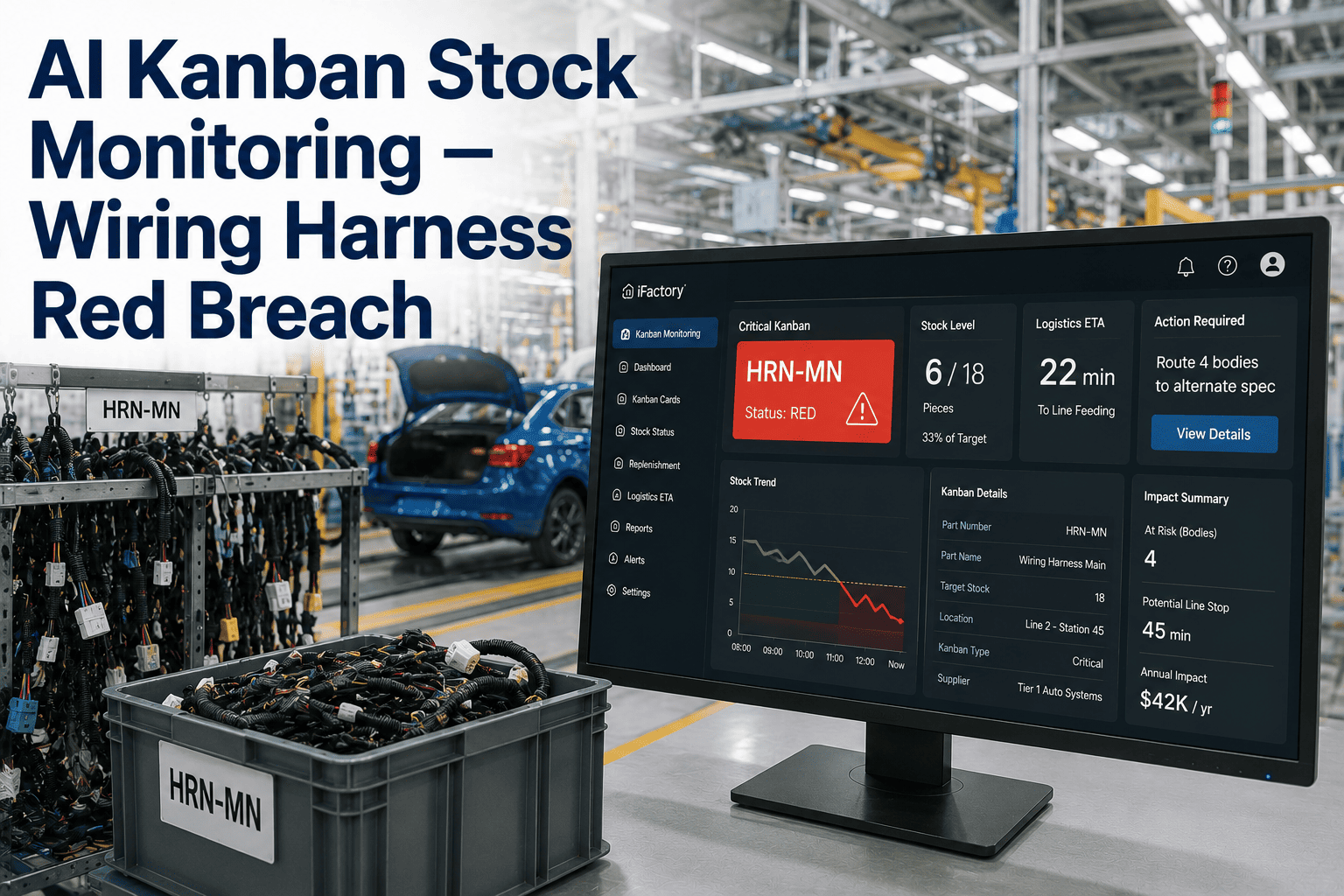
A wiring harness kanban has just gone red. Part HRN-MN, the harness for one build spec, is down to 6 units against an 18-unit target — below the reorder trigger and dropping with every body that consumes one. On a traditional kanban board that red light means one thing: someone scrambles. A logistics call goes out, a replenishment is requested, and everyone hopes the parts arrive before the last harness is fitted. If they don't, the line stops — and a stopped automotive line costs thousands of dollars a minute in idle labor, lost throughput, and downstream disruption. The problem is that a classic kanban signal is purely reactive: it tells you that you're low, but it doesn't know how fast you're consuming, when the replenishment will actually arrive, or what to do in the gap between now and then. AI kanban monitoring closes all three gaps. It tracks the consumption rate against stock and the live logistics ETA of the inbound parts — 22 minutes out — so it knows whether you'll run dry before they land. And when the math says you will, it does something a light on a board never could: it re-sequences the build, routing 4 bodies that need an alternate, in-stock spec through the station now and deferring the HRN-MN bodies until replenishment arrives — bridging the gap without stopping the line. It runs on-premise, because your build schedule and supplier data stay in-house. To see it on your line, book a demo.
AUTOMOTIVE ASSEMBLY · AI KANBAN STOCK MONITORING
When a Harness Kanban Goes Red, Route Around It — Don't Stop the Line.
A traditional kanban tells you stock is low; it can't tell you if replenishment beats the stockout, or what to do in between. iFactory tracks consumption against the live logistics ETA and, when HRN-MN hits red at 6 of 18, re-sequences the build — routing bodies needing an in-stock alternate spec through now and deferring the short ones until parts land. On-premise, keeping the line running through the breach.
6 / 18
Stock at the red breach, below reorder trigger
22 min
Live logistics ETA on the inbound replenishment
4 bodies
Routed to an alternate spec to bridge the gap
$42K/yr
Avoided line-stop and expedite cost on one line
Why a Red Kanban Is Already Too Late
Automotive assembly runs on just-in-time: production is pull-based, and a kanban signal authorizes replenishment of a specific part when its bin drops below a threshold. It's an elegant, self-regulating system — until the signal fires and the answer isn't fast enough. A plant may hold only around 40 minutes of parts line-side at any moment, so any supply failure has immediate consequences, and a missed delivery in a JIT system can stop the line within hours or less. The trouble with the classic kanban card is that it's a binary, reactive signal: it announces that stock is low, but it carries none of the information needed to know whether that's a manageable dip or an imminent stop, and it offers no action beyond "go get more."
The Signal Is Binary, Not Predictive
A kanban card flips from fine to reorder at a fixed threshold, with no sense of trajectory. It can't tell you the part is dropping unusually fast this shift because of the build mix, so a red that's normally routine can this time be racing toward zero — and the board looks identical either way.
It Doesn't Know the Replenishment ETA
The card signals a need but has no visibility into when the parts will actually arrive — whether the tugger, milk-run, or supplier truck is 5 minutes or 45 minutes out. Without the inbound ETA, no one can know whether replenishment will beat the stockout or lose to it until it's happening.
It Offers No Move But "Scramble"
When the light goes red the only built-in response is a manual escalation — call logistics, chase the part, hope. The kanban system has no mechanism to buy time, so the team is left reacting under pressure with the line's clock running, and a wrong guess about timing ends in a stop.
A Stop Is Enormously Expensive
An automotive line halt costs thousands of dollars a minute in idle labor, lost throughput, and downstream disruption, and it ripples through the whole plant's schedule. The asymmetry is brutal: the part shortage is small and temporary, but the stop it triggers is large and immediate — which is exactly the outcome worth engineering around.
Wiring harnesses make this especially sharp. They're variant-specific — a given body spec needs its particular harness — and fed just-in-time or just-in-sequence in a defined install order, so a shortage of one harness spec can idle the station even while harnesses for other specs sit in stock a few feet away. That variant structure is the problem the classic kanban can't exploit — and exactly the opening the AI does.
Two Moves a Light on a Board Can't Make
AI kanban monitoring adds the two things the classic signal lacks: the knowledge of whether you'll actually run out, and a way to act if you will. Together they turn a red breach from an emergency into a managed event.
MOVE 1
Predict the Stockout Against the Real ETA
The AI tracks the live consumption rate of HRN-MN against current stock to project exactly when it hits zero, and it pulls the real-time logistics ETA of the inbound replenishment — 22 minutes out. Now the question that a kanban light can't answer is answered precisely: will the parts arrive before the last one is fitted? If consumption will empty the bin in less time than the ETA, a stop is coming, and the system knows it minutes ahead instead of discovering it at the empty bin. That lead time is what makes the second move possible.
MOVE 2
Re-Sequence the Build to Bridge the Gap
Here's what no board can do: because bodies are built to variant spec and harnesses are spec-specific, the AI looks across the upcoming build sequence for bodies that need a different, in-stock harness spec — and routes those through the station now while deferring the HRN-MN bodies. Sending 4 alternate-spec bodies through first consumes stock the plant has and buys the ~22 minutes needed for HRN-MN replenishment to arrive, so the station keeps running and the short part is simply used later, once it's back in stock. The stockout is bridged, not suffered.
The combination is the whole point. Prediction alone would only tell you the stop is coming sooner; resequencing alone would be guesswork without knowing the ETA. Together they let the line absorb a red breach the way a driver eases around an obstacle instead of braking — the same throughput, routed around the gap.
See a Red Breach Routed Around, Live
Bring a critical line-side part that keeps threatening stops. iFactory engineers will show how consumption-versus-ETA prediction sees the stockout coming and how build resequencing routes around it — keeping the line running through a breach that today would mean a scramble or a stop.
The Breach: HRN-MN at 6 of 18
Here's the scenario the AI handles, step by step — a critical harness kanban going red and the line staying up. It's not a dashboard reporting a shortage after the fact; it's a sequence of decisions that prevents the stop the shortage would have caused.
1
Critical Kanban HRN-MN Goes Red
Stock on the HRN-MN wiring harness drops to 6 against an 18-unit target, crossing the reorder trigger into a red, critical state. On a normal board this is where the scramble starts; here it's where the AI starts calculating, because red is the beginning of the decision, not the end.
2
Consumption vs. 22-Minute ETA
The AI projects the burn-down of the remaining 6 units at the current consumption rate and pulls the inbound replenishment's live ETA of 22 minutes. The projection shows the bin emptying before the parts land — a stop is coming on the current sequence, and the system flags it with minutes of head start.
3
Find the Alternate-Spec Bodies
The AI scans the upcoming build queue for bodies whose spec uses a different harness that is currently in stock, and identifies 4 it can bring forward. These become the bridge: running them now keeps the station productive on parts the plant already has, instead of idling on the one it's short of.
4
Route 4 Bodies, Defer the Short Ones
It re-sequences the build — routing the 4 alternate-spec bodies through the station now and deferring the HRN-MN bodies by the ~22 minutes until replenishment arrives. The line never stops; the HRN-MN bodies are simply built once the harness is back in stock, and the red breach passes without a single idle minute.
That's the breach handled end to end: HRN-MN red at 6 of 18, consumption projected to beat a 22-minute ETA, 4 alternate-spec bodies routed forward to bridge the gap, the short bodies deferred and built on replenishment. Across a year of breaches like it on one line, avoiding the stops and expedites is worth roughly $42,000 — from resequencing decisions, not new inventory.
Routing Within Real Constraints
Re-sequencing a build to dodge a stockout only works if it respects everything else the sequence has to satisfy — you can't fix a harness shortage by creating three new problems downstream. The AI routes within the real constraints of the line, which is what makes the move safe to trust.
01
Every Routed Body Has Its Parts
The bodies brought forward are chosen precisely because their spec's harness — and their other line-side parts — are in stock, so routing them creates no new shortage. The move only pulls forward builds the station can actually complete now, trading a part it lacks for parts it has.
Deferrals Stay Inside Their Windows
02
The HRN-MN bodies are delayed only by the minutes needed for replenishment, kept within their build and due-date windows so downstream assembly and shipping schedules still hold. A short, bounded deferral bridges the gap without cascading into a late delivery.
Buffer and Sequence Limits Respected
03
Resequencing uses the buffers and reordering room the line actually has, and honors just-in-sequence constraints for components that must arrive in a fixed order. The AI plans the reshuffle within those physical and logical limits rather than assuming free rein to reorder the queue.
Replenishment Still Triggers Normally
04
Routing around the gap doesn't replace restocking — the replenishment for HRN-MN is still called and tracked, and the deferred bodies are built the moment it lands. The maneuver buys time for the normal pull system to catch up, it doesn't paper over a genuine supply problem.
This is why it's an optimization, not a trick: the AI is solving a constrained resequencing problem in real time — maximize the parts consumed from available stock, keep every build feasible, hold the deferred bodies inside their windows, and respect buffer and sequence rules — all in the minutes before a bin runs dry. That's a calculation for software, not a judgment call for a scrambling operator.
Beyond the Single Breach
Handling one red kanban is the vivid case, but the same monitoring changes how the whole line-side supply behaves — from reactive firefighting to predictive flow. The value compounds across every critical part on the line.
Earlier Warning, Fewer Reds
Because the AI tracks consumption trajectory rather than just a threshold, it flags a part trending toward a breach before it goes red — surfacing the risk while there's still time for a normal replenishment to prevent the red altogether. Many breaches are averted upstream rather than routed around at the last minute.
Consumption and ETA in One View
Line-side status, live consumption rates, and inbound logistics ETAs sit on one board, so a materials team sees not just which bins are low but which are actually at risk given how fast they're burning and when parts will arrive. The signal becomes informative rather than binary.
Right-Sized Line-Side Stock
With real consumption and lead-time data, kanban quantities and safety stock can be tuned to the demand each part actually sees, rather than padded against uncertainty. Better visibility lets the plant hold less line-side inventory without raising stockout risk — freeing space and working capital.
A Record of Every Near-Miss
Each breach and routed recovery is logged, building a history of which parts threaten stops, how often, and why — so chronic problem SKUs and weak supplier links get identified and fixed at the root. The firefighting data becomes a continuous-improvement input.
On-Premise: Your Build Schedule Stays In-House
Kanban monitoring runs on your build sequence, consumption data, and supplier logistics — operational information that reveals volumes, model mix, and supply relationships — so the AI is built to run on-premise, inside your firewall, with the speed a live line demands.
Schedule and Supplier Data Stay Local
Resequencing needs the build schedule, spec mix, and inbound logistics data, which expose production volumes and supplier relationships. On-premise processing keeps all of it inside your network and out of any external cloud, so competitively sensitive operational data never leaves the plant.
Decisions in the Minutes That Matter
A stockout is minutes away when it's detected, so the routing decision has to be computed against the live line immediately — which local, on-premise inference delivers without a round trip to a remote server. The recommendation lands while there's still time to act on it.
Runs Through Network Interruptions
Line-side supply can't depend on an internet link, so on-premise operation keeps the monitor and its routing logic running within the isolated operational-technology environment regardless of external connectivity — the resilience a continuous line requires.
Live in 6 to 12 Weeks
The turnkey model ships a pre-configured, racked-and-ready AI server with the software pre-loaded, so a focused kanban-monitoring-and-routing scope goes live in 6 to 12 weeks — predictive stock monitoring and resequencing without an open-ended platform build.
Start With the Parts That Stop You
Predictive kanban monitoring proves out fast on the handful of critical parts most likely to halt the line, then extends across the line-side. The rollout is deliberately focused.
1
Identify the Line-Stop Risks
Deployment starts with the critical, variant-specific parts most prone to threaten stops — wiring harnesses and similar just-in-sequence components — mapping their consumption patterns, kanban levels, and replenishment lead times to size where routing can help most.
2
Connect Stock, Build, and Logistics Feeds
The AI ingests line-side stock levels, the build sequence and spec mix, and inbound logistics ETAs, learning each part's real consumption behavior and which alternate specs can bridge which shortages — the data that makes prediction and routing possible.
3
Validate the Routing Recommendations
The team confirms that the resequencing suggestions keep every build feasible, hold deferrals within their windows, and respect buffer and just-in-sequence limits — building trust on a bounded scope before the AI drives routing decisions in live production.
4
Scale Across the Line-Side
With recoveries proven on the first critical parts, monitoring extends across the full line-side inventory, and the breach history feeds supplier and stock-level improvement so chronic risks are engineered out. Predictive kanban becomes standard across the line.
What Changes on the Line
AI kanban monitoring turns line-side supply from a reactive signal into a predictive, self-correcting flow — keeping the line running through breaches that today would mean a scramble or a stop.
01
Red Breaches Get Routed, Not Suffered
When a critical part goes red, the AI predicts whether replenishment beats the stockout and, if not, re-sequences the build to run alternate-spec bodies through — bridging the gap so the line keeps moving instead of halting on a part that's minutes away.
02
Stops and Expedites Avoided
Bridging a breach by resequencing turns a thousands-per-minute line stop into zero idle minutes and avoids the emergency-expedite costs of a frantic replenishment — worth roughly $42,000 a year on one line, entirely from smarter decisions rather than more inventory.
03
The Signal Becomes Predictive
Tracking consumption trajectory and live ETAs replaces a binary low-stock light with a real risk assessment, so the team acts on which parts will actually run out and when — catching many breaches early enough to prevent the red entirely.
04
Leaner Stock, Same Safety
Real consumption and lead-time data let kanban quantities and safety stock be right-sized to actual demand, so the line holds less inventory without raising stockout risk — freeing space and working capital while staying protected.
Frequently Asked Questions
The questions materials and assembly engineers ask most often about AI kanban stock monitoring.
How is this different from the electronic kanban board we already have?
An electronic kanban board digitizes the signal — it shows you which bins are low and can trigger a replenishment order — but it's still fundamentally a reactive threshold system. It tells you HRN-MN dropped to 6 of 18 and went red; it doesn't tell you how fast you're burning the remaining 6, when the inbound parts will actually arrive, or whether you'll run dry first. And critically, it has no action beyond signaling — when the light goes red, a human still has to scramble. This AI adds the three things the board lacks. It tracks the live consumption rate to project exactly when stock hits zero; it pulls the real logistics ETA of the replenishment, so it knows the parts are 22 minutes out; and when the projection shows a stockout coming before they land, it re-sequences the build to route alternate-spec bodies through and bridge the gap, keeping the line running. So the board tells you there's a problem; the AI tells you whether it's actually going to stop the line and then does something about it. It's the difference between a smarter alarm and an autonomous recovery. To see it against your board,
book a demo.
How can it keep the line running if a part has genuinely run out?
By using the fact that not every body needs the same part at the same station. Automotive bodies are built to variant spec, and a wiring harness is spec-specific — the HRN-MN body needs the HRN-MN harness, but the next body for a different spec needs a different harness that may well be in stock. Traditional kanban can't exploit that; it just sees one bin empty and the station idle. The AI looks across the upcoming build queue, finds bodies whose spec uses an in-stock harness, and routes those through the station now while deferring the HRN-MN bodies by the minutes until replenishment arrives. The station keeps working on parts the plant has, and the short bodies are simply built a little later once their harness is back — no stop, no idle. It's not creating parts from nothing; it's reordering the work so the plant consumes what it has while the missing part is en route. This only works within constraints — the routed bodies must have all their parts, the deferred ones must stay in their build windows — which the AI enforces, but when an alternate-spec body is available to bring forward, a shortage that would have stopped the line becomes a brief, invisible deferral.
Doesn't re-sequencing the build create problems downstream?
It would if done carelessly, which is why the routing is a constrained optimization rather than a simple swap. The AI enforces several limits at once. Every body it brings forward is chosen because its spec's harness and other line-side parts are actually in stock, so routing it creates no new shortage. The bodies it defers are delayed only by the minutes needed for replenishment and kept within their build and due-date windows, so downstream assembly and shipping schedules still hold. It respects the buffer and reordering capacity the line physically has, and honors just-in-sequence constraints for components that must arrive in a fixed order. And it doesn't replace normal replenishment — the HRN-MN restock is still called and tracked, and the deferred bodies are built the moment it lands. In other words, the maneuver is designed to buy time for the normal pull system to catch up without violating any of the constraints that keep the line valid. If no feasible resequencing exists — if there's no alternate-spec body to bring forward or a deferral would break a downstream commitment — the AI won't force one; it escalates instead, with more warning than a red light alone would give. The goal is to route around the gap only when it can be done cleanly.
Where does the $42,000 a year come from?
Primarily from avoided line stops and the emergency costs around them. An automotive line halt runs into thousands of dollars a minute in idle labor, lost throughput, and downstream disruption, so even preventing a modest number of stops a year is a large number. When a critical kanban like HRN-MN goes red and replenishment won't beat the stockout, the traditional outcomes are either a line stop or a frantic, expensive expedite — overtime, premium freight, a special run — to rush the part in. Routing around the breach by resequencing avoids both: the line keeps moving on parts already in stock, and the normal replenishment catches up without an expedite. Across a year of breaches on one line, avoiding those stops and expedites is worth roughly $42,000. And that figure is conservative in the sense that it counts the direct stop and expedite avoidance; it doesn't fully price the softer gains — the recovered throughput, the reduced schedule disruption downstream, and the working capital freed when better visibility lets you right-size safety stock. The projection is grounded in your line's actual stop cost, breach frequency, and part mix, measured during scoping, so the number reflects your operation rather than a generic benchmark.
How fast does it deploy, and will our production data leave the plant?
Deployment runs in a defined 6-to-12-week window, because the turnkey model ships a pre-configured, racked-and-ready AI server with the software pre-loaded rather than requiring a ground-up build, and the recommended scope is the handful of critical, stop-prone parts first so the value validates quickly before scaling across the line-side. On data, nothing leaves the plant: the system runs on-premise, inside your firewall, precisely because it operates on your build schedule, spec mix, consumption data, and inbound supplier logistics — information that reveals production volumes, model mix, and supply relationships, among the most competitively sensitive operational data you hold. Processing it locally keeps it out of any external cloud. On-premise operation also serves the line's real-time needs: a stockout is only minutes away when detected, so the routing decision has to be computed against the live line immediately, which local inference delivers without a remote round trip, and it keeps the monitor running within the isolated operational-technology environment even through a network interruption, so line-side supply never depends on an internet link. You get a fast, bounded deployment and full data control at once. Contact
iFactory support to scope the first critical parts.
PREDICT THE STOCKOUT · ROUTE AROUND IT · KEEP THE LINE RUNNING
A Red Kanban Shouldn't Stop the Line — It Should Trigger a Reroute.
AI that tracks consumption against the live replenishment ETA and, when HRN-MN hits red at 6 of 18 with parts 22 minutes out, re-sequences the build — routing 4 in-stock alternate-spec bodies through and deferring the short ones until stock lands. Every build kept feasible, every deferral inside its window, roughly $42K a year in avoided stops and expedites. On-premise, live in 6 to 12 weeks, no extra inventory.