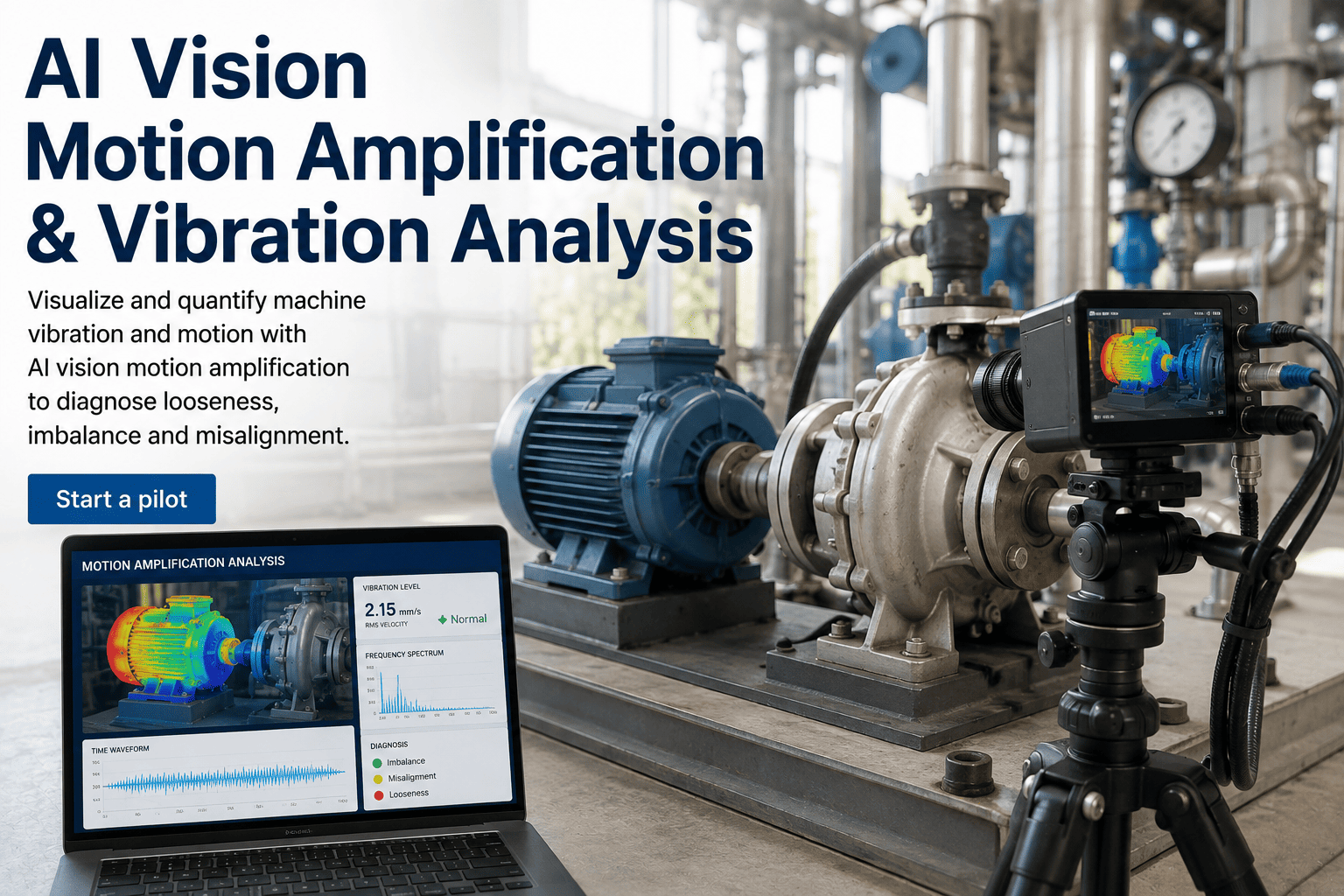
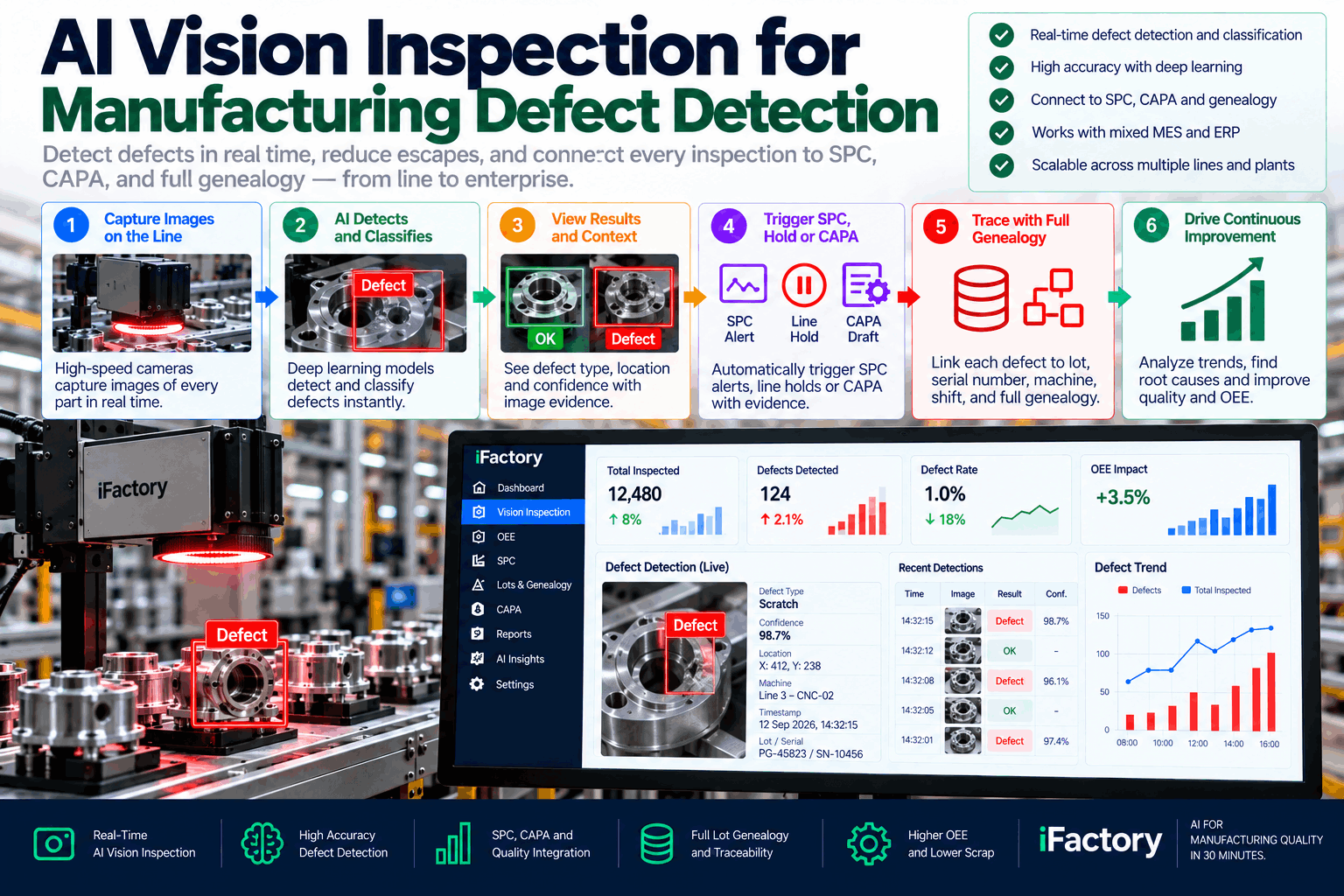
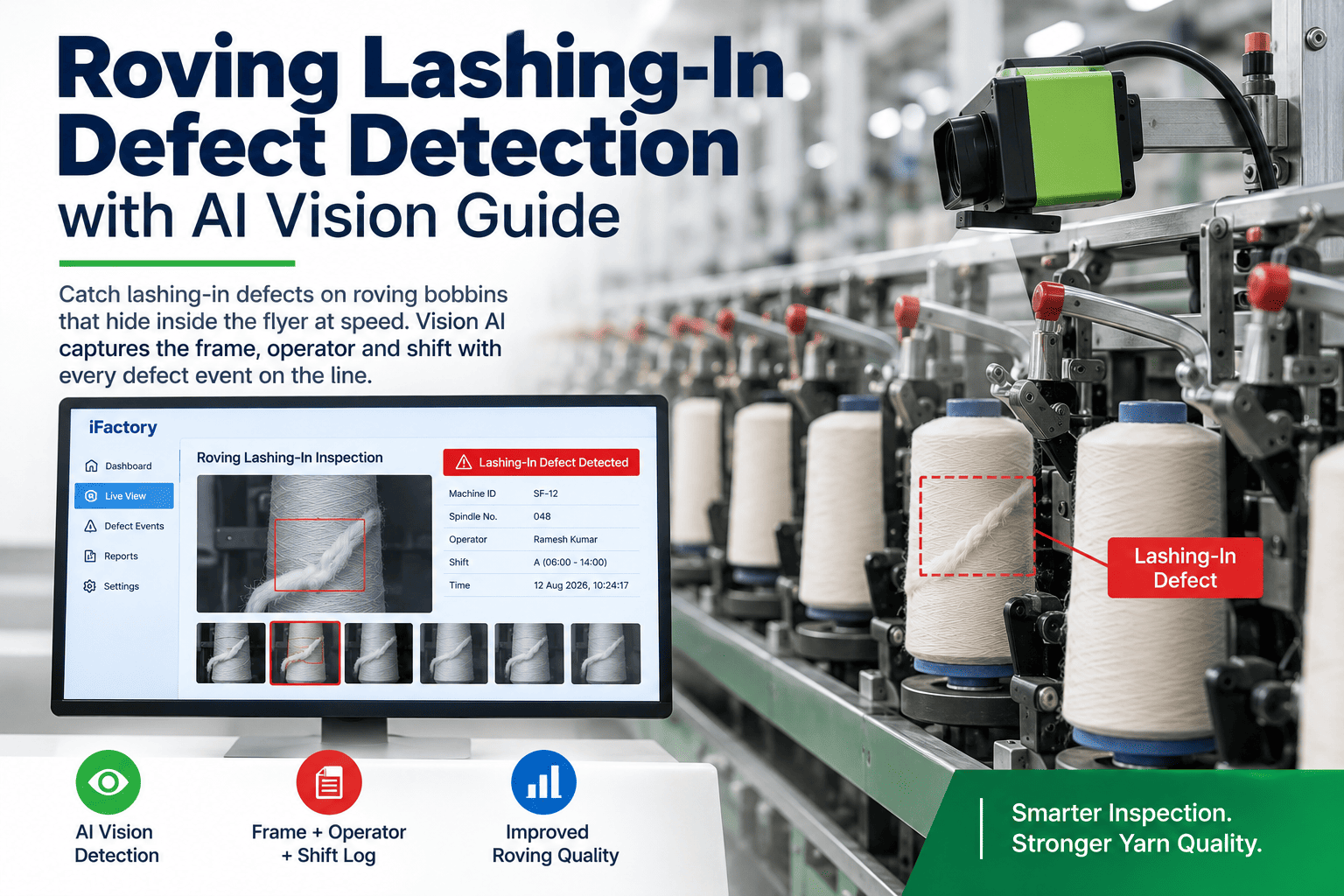
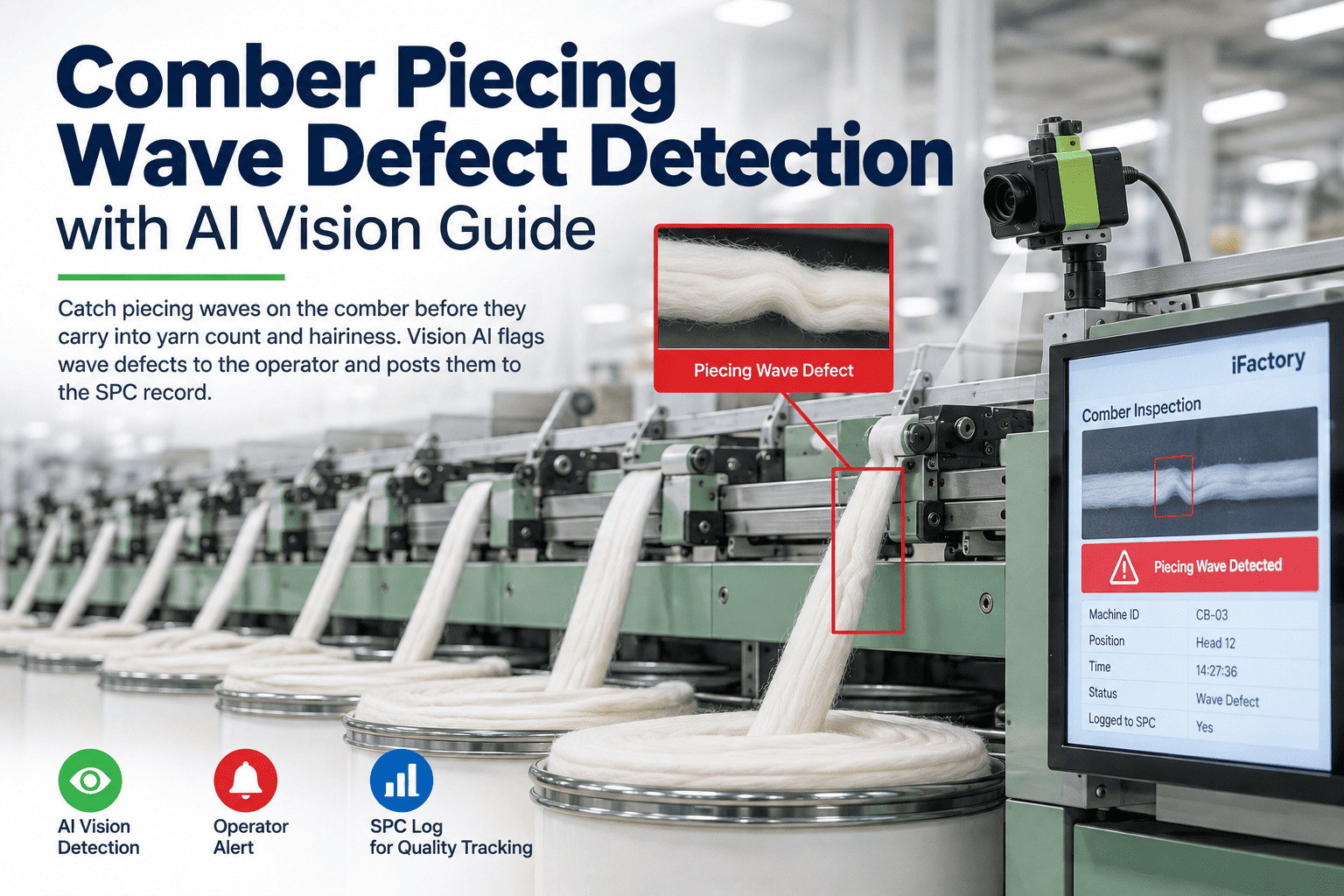
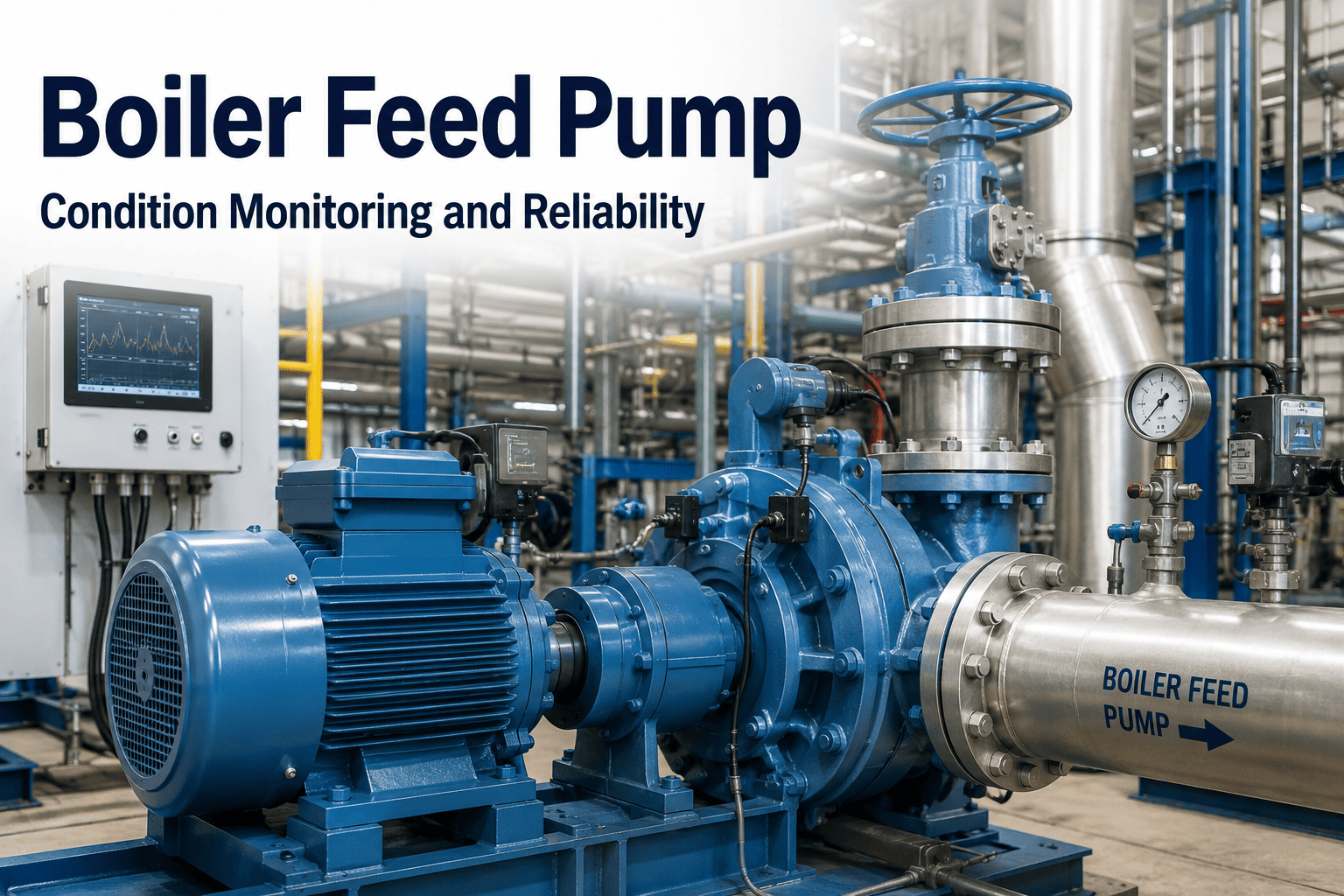
Every operating machine vibrates, and almost all of that motion is invisible. A pump wobbling a few microns from imbalance, a coupling twisting from misalignment, a baseplate rocking from soft foot, a bracket buzzing at resonance — these movements are far too small for the human eye, yet they are exactly the early signatures of the faults that eventually destroy rotating equipment. Traditional vibration analysis catches them through accelerometers bolted to bearing housings, one point at a time, producing spectra that take a trained specialist to read. AI vision motion amplification takes a different path: it films the machine running, turns every pixel in the frame into a motion sensor, and uses deep-learning optical-flow algorithms to magnify those sub-visible movements ten to a hundred times — so a whole machine's vibration becomes something you can watch, and quantify, in a single video. Looseness, imbalance, and misalignment each produce a distinct, visible motion signature, and you see where the movement originates instead of inferring it from a graph. It's non-contact, full-field, needs no shutdown, and makes the fault obvious even to a non-specialist. To run a pilot on your most troublesome asset, book a demo.
CROSS-INDUSTRY · AI VISION MOTION & VIBRATION ANALYSIS
See the Vibration That's Invisible to the Eye — and Diagnose It.
AI vision motion amplification turns every pixel of a video into a motion sensor and magnifies sub-visible movement 10–100×, making looseness, imbalance, and misalignment visible and measurable. Non-contact, full-field, no shutdown — you watch where the motion originates and quantify it at any frequency, instead of reading a spectrum one accelerometer point at a time.
10–100×
Magnification of sub-visible motion by AI optical flow
every pixel
Becomes a non-contact motion sensor in the frame
<0.1 µm
Sub-pixel displacement resolution achievable
no shutdown
Record while the machine runs — no sensors mounted
The Problem: The Motion That Matters Is Invisible
As industrial equipment operates, it produces vibrations and movements so small they can't be detected with the human eye — and yet these are the movements that matter. Over time, imperceptible motion causes components to misalign, loosen, and crack, reducing efficiency, damaging equipment, and building toward catastrophic failure if left unchecked. The reliability team's core challenge is that the earliest, most fixable signs of a developing fault are precisely the ones nobody can see, and the conventional tools for finding them are narrow, slow, or hard to deploy where the problem actually is.
The Eye Can't See the Warning
A machine drifting toward failure looks, to the naked eye, exactly like a healthy one. The micron-scale wobble of early imbalance or the faint rock of a soft foot is invisible in real time, so the developing fault gives no visual warning until the movement has grown large enough to be obvious — by which point the damage is well advanced.
Accelerometers See One Point at a Time
Contact vibration sensors measure a single location each, so building a picture of a whole machine means many mounted points and a lot of setup. On a large or complex asset, the sensor may simply not be where the problem is, and the limited number of measurement points can miss the true source of the motion entirely.
Some Places You Can't Mount a Sensor
Contact sensors are difficult or impossible to install in high-temperature, high-pressure, oil-and-gas, or corrosive environments, and on lightweight structures the mass of the sensor itself distorts the very vibration you're trying to measure. The places most in need of monitoring are often the hardest to instrument by contact.
Spectra Need a Specialist
Traditional analysis produces frequency spectra and waveforms that take a trained vibration analyst to interpret and, even then, communicate poorly to the people who authorize the repair. The diagnosis lives in a graph, not in something a maintenance planner or manager can look at and immediately understand.
The result is a gap between when a fault becomes detectable and when it becomes actionable. The motion is there weeks before failure, carrying the diagnosis in its pattern — but if it can't be seen, localized, and communicated, the plant reacts to the breakdown instead of the warning. Making that invisible motion visible is what closes the gap.
How AI Vision Motion Amplification Works
Motion amplification treats a video camera as a dense array of motion sensors and uses AI to pull the tiny, meaningful movements out of the footage and scale them up until they're plain to see. The pipeline is a handful of steps, each building on the last, and the same recording yields both a visual and a quantitative result.
STEP 1
Every Pixel Becomes a Sensor
The asset is filmed operating normally with a high-resolution, high-speed camera, and each pixel in the frame is treated as an independent motion sensor. Where a contact program has a handful of measurement points, a single video field of view has millions — a dense, full-field grid capturing how every visible part of the machine and its supporting structure moves together.
STEP 2
AI Optical Flow Extracts Displacement
Deep-learning optical-flow algorithms measure the sub-pixel displacement of every point frame to frame, achieving resolution down to a fraction of a micron. This is the AI core: learning-based motion magnification pulls a clean displacement signal out of the video, robust to noise and lighting, at rates fast enough to process the movement of the whole scene rather than a single tracked marker.
STEP 3
Filter by Frequency, Then Magnify
The motion is filtered by frequency — bandpass or notch filters isolating specific vibration modes, such as the 1X and 2X running-speed bands where the diagnostic content lives — and the isolated displacement is digitally scaled up ten to a hundred times. Amplifying only the frequency band of interest is what separates the fault's signature from the surrounding noise and makes it unmistakable.
STEP 4
Visualize and Quantify Together
The amplified motion is overlaid on the original video so the movement is visible in context, and a frequency spectrum and time waveform can be extracted for any pixel the analyst selects — plus an operational deflection shape showing the whole structure's vibration pattern at a chosen frequency. One recording delivers both the intuitive picture and the hard numbers, so the diagnosis is seen and measured at once.
Run a Motion-Amplification Pilot on Your Worst Actor
Pick the asset that keeps failing or vibrating and won't reveal why. iFactory engineers will record it running, amplify the motion, and show you the fault signature — looseness, imbalance, misalignment, or resonance — localized on video with the supporting spectra, no shutdown required.
The Fault Signatures It Makes Visible
The diagnostic power of motion amplification is that each common mechanical fault produces its own characteristic motion — and once magnified, the pattern points straight at the root cause. These are the signatures a reliability team reads directly off the amplified video, often confirmed against the running-speed frequency bands.
Imbalance
A slight mass imbalance in a rotor produces a characteristic wobble and overall shaking that becomes clearly visible when amplified, dominant at the 1X running frequency. Where a spectrum shows a 1X peak, the amplified video shows the rotor physically shaking — the same diagnosis, but obvious at a glance and localized to the offending component.
Misalignment
Even small misalignment in coupled shafts or gears manifests as complex bending and twisting motion, often with pronounced axial displacement at the free-end bearing and strong 2X content. The amplified view reveals the coupling working against itself in a way a single radial sensor reading would never make intuitive.
Looseness
Loose bolts, cracked frame welds, or a loosened bearing-seat anchor create small gaps, and the resulting extra movement — often a distinct vertical displacement right at the loose location — is highlighted on the amplified view. The video localizes looseness to the exact joint, turning a vague "something's loose" into a specific bolt to torque.
Soft Foot
An uneven machine mounting — one foot shorter or misaligned — causes a subtle rocking motion that the camera makes apparent, so the foundation can be leveled. It's one of the clearest wins for the technique, because soft foot is notoriously hard to confirm with point sensors but immediately visible as a rock once amplified.
Resonance & Structural Deflection
When a structure's natural frequency matches a forcing frequency, motion amplifies dramatically; the technique visualizes that resonance and the bending or flexing of frames, supports, and piping under load. Seeing the mode shape directly tells the team whether to stiffen, brace, or shift the operating speed away from the resonant band.
Piping & Flow-Induced Vibration
Excessive movement in pipework, including small-bore connections prone to fatigue failure, and flow-induced vibration are captured full-field across the run, not sampled at one clamp. The technique is well suited to catching the pipe motion that leads to fatigue cracking before a weld lets go.
Vision and Accelerometers: Complementary, Not Rival
Motion amplification doesn't replace contact vibration analysis — it fills the gaps contact sensors leave and makes their data easier to act on. The two work best together, and understanding where each excels is how a reliability program deploys vision to greatest effect.
WHERE VISION WINS
Full-Field, Non-Contact, Instant Insight
Vision captures the whole structure at once instead of one point, needs no sensor mounted or machine shutdown, reaches hot, pressurized, corrosive, or awkward locations through a zoom lens from a safe distance, and adds no mass to distort lightweight structures. Above all it's intuitive — the amplified video makes the fault obvious even to a non-specialist, so the diagnosis communicates instantly to whoever authorizes the fix.
WHERE CONTACT WINS
Precision and Continuous Trending
Contact accelerometers still offer higher raw precision than camera-based measurement and are well suited to fixed, continuous trending on critical bearings. The strongest programs pair them: permanently mounted sensors watch the critical points continuously, and vision is brought in to localize a source, diagnose a structural or resonance problem, capture a transient, or make a fault visible where a sensor can't go or can't explain.
The complementary play is the point. When a contact program flags rising vibration but can't pinpoint the source on a complex machine, motion amplification records the asset and shows exactly where the motion originates — turning an ambiguous spectral trend into a localized, visual root cause that closes the diagnosis.
Where It Delivers Across Industries
Because it works on anything that vibrates and needs only a line of sight, motion amplification applies across essentially every asset-intensive sector. The same technique that diagnoses a small pump scales to a wind-turbine blade or a plant structure, which is what makes it a genuinely cross-industry reliability tool.
01
Rotating Equipment
Motors, pumps, compressors, turbines, gearboxes, and fans — the core rotating fleet across every plant — are diagnosed for imbalance, misalignment, looseness, and bearing-related motion, with the source localized on video rather than inferred from a bearing-cap reading.
Piping & Structures
02
Pipework networks, vessels, supports, and structural foundations are assessed for excessive movement, resonance, and looseness across the whole run — catching flow-induced and small-bore vibration that leads to fatigue failure before a crack propagates.
03
Large & Remote Assets
Towers, cranes, and wind-turbine blades — large structures where mounting sensors is impractical — are visualized as readily as small machinery, provided there's a line of sight, with zoom lenses reaching movement that would otherwise be inaccessible.
04
Commissioning & Transients
New-machine commissioning and transient events like start-up and shut-down are captured with quick setup and no halt to operations, so the team can validate a fresh install or catch the brief resonance that only appears as a machine passes through a critical speed.
From One-Off Survey to Continuous Vision Monitoring
Motion amplification is powerful as an on-demand diagnostic, but its full value comes when it becomes a standing part of the predictive-maintenance program — baseline scans, continuous watch on critical assets, and integration into the maintenance workflow rather than an occasional specialist visit.
DIAGNOSTIC
Troubleshoot and Localize on Demand
Brought in when an asset is failing, vibrating, or newly commissioned, motion amplification records it running and localizes the fault fast — troubleshooting looseness, soft foot, or resonance, capturing a start-up transient, or validating a new machine, all without halting production or mounting hardware. This is the entry point most teams start from.
CONTINUOUS
Baseline, Watch, and Auto-Flag
Deployed as a program, vision monitoring baselines each asset's normal motion signature, watches critical equipment continuously, and flags deviation from the baseline automatically — feeding an anomaly straight into a maintenance work order with the amplified video and localized source attached, so the diagnosis and the corrective action live in one loop.
The amplified video does more than trigger the fix — it informs it. Results feed corrective-action planning and can inform engineering models of the structure, and because the fault is visible rather than buried in a spectrum, the case for the repair communicates instantly to planners and managers, compressing the time from detection to authorized action.
Turnkey, On-Premise Vision — Inside Your Network
iFactory delivers motion amplification as part of its predictive-maintenance vision capability, deployed turnkey and on-premise so the video and analytics stay inside your network and the tool layers onto the plant you already run.
1
Camera to Edge, No Mounting
High-speed cameras record the asset in operation and stream to an on-premise edge processor — no accelerometers to mount, no machine to shut down, and hard-to-reach or hazardous assets captured through a zoom lens from a safe line of sight.
2
AI Amplification Runs Locally
Deep-learning optical-flow magnification and frequency analysis run on the on-premise stack inside your firewall, so the video of your assets and the resulting diagnostics never leave your network — keeping operational data sovereign by design.
3
Baselines Your Assets' Normal Motion
In a short learning phase the system captures each asset's healthy motion signature, so continuous monitoring can flag deviation against that baseline rather than a generic threshold — tuned to how your specific machines actually move.
4
Flows Into the Maintenance Loop
A flagged anomaly generates a work order with the amplified video and localized fault source attached, so maintenance acts on a diagnosis they can see — and the vision layer works alongside contact sensors and existing condition-monitoring rather than replacing them.
What Changes for the Reliability Team
AI vision motion amplification changes how a reliability team finds, localizes, and communicates mechanical faults — turning invisible motion into a shared, visual diagnosis that speeds every step from detection to repair.
01
Faults Get Localized, Not Just Detected
Instead of a spectrum saying vibration is high somewhere, the amplified video shows exactly which component and joint is moving and how — turning detection into localization, so the team fixes the actual source rather than chasing it across a complex machine.
02
Diagnoses Anyone Can See
Because the fault is visible in the video, the case for a repair communicates instantly to planners and managers who don't read spectra, compressing the approval cycle. The diagnosis stops living only in the analyst's head and becomes something the whole team understands.
03
Reach the Assets Sensors Can't
Hot, pressurized, corrosive, lightweight, or hard-to-reach assets that resist contact sensors become monitorable through a lens from a safe distance, extending condition monitoring to equipment the program previously couldn't cover with accelerometers.
04
Faster, Safer Troubleshooting
Quick setup with no shutdown and no contact with moving parts means faster diagnosis and improved operator safety, and transient events like start-ups are captured without disrupting operations — so troubleshooting is both quicker and lower-risk.
Frequently Asked Questions
The questions reliability and maintenance teams ask most often when evaluating AI vision motion amplification.
Does this replace our accelerometer-based vibration program?
No — it complements it, and the strongest programs use both. Contact accelerometers still offer higher raw precision and are ideal for continuous trending on critical bearings, so they stay as the permanently mounted watch on your most critical points. Motion amplification fills the gaps they leave: it captures a whole machine or structure at once instead of one point, reaches assets where a sensor can't be mounted, and localizes a fault visually. The classic complementary play is when a contact program flags rising vibration but can't pinpoint the source on a complex asset — vision records it and shows exactly where the motion originates. You keep the precision and trending of contact sensors and add the full-field, intuitive, non-contact diagnosis of vision. To see how they'd work together on your assets,
book a demo.
How accurate is camera-based measurement compared to a real sensor?
AI optical-flow algorithms achieve sub-pixel precision down to a fraction of a micron, which is remarkable for a non-contact method and more than sufficient to detect and diagnose the imbalance, misalignment, looseness, and resonance faults that matter most. That said, contact accelerometers still provide higher raw precision, so vision isn't positioned as the highest-accuracy measurement in every case — it's positioned as full-field, non-contact, and intuitive. For diagnosis and localization, especially of structural and multi-component problems, the visual full-field picture is often more useful than a more precise single-point number. For the highest-precision continuous trending on a specific critical bearing, a mounted sensor remains the right tool, which is exactly why the two are deployed together.
What faults can it actually diagnose?
The common mechanical faults each produce a distinct, visible motion signature once amplified. Imbalance shows as a characteristic wobble and shaking at the 1X running frequency; misalignment as complex bending and twisting with axial movement at the free-end bearing and strong 2X content; looseness as extra movement and vertical displacement right at the loose joint, whether a bolt, weld, or bearing-seat anchor; soft foot as a subtle rocking of an unevenly mounted machine; and resonance as dramatically amplified motion when a natural frequency matches a forcing frequency, along with the bending and flexing of frames, supports, and piping. It also captures flow-induced and small-bore pipe vibration that leads to fatigue failure. Because you can extract a frequency spectrum for any pixel, these visual diagnoses are confirmed against the same running-speed frequency bands a traditional analyst would use.
Do we have to shut down the machine or mount anything?
No — that's one of the technique's biggest advantages. Motion amplification is entirely non-contact: you film the equipment while it runs normally, with no sensors to mount and no shutdown required. Setup is quick, and because nothing physically touches the moving parts, operator safety improves compared with mounting and wiring contact sensors on running equipment. It also reaches places contact methods can't — hot, pressurized, corrosive, or awkward locations captured through a zoom lens from a safe distance, and lightweight structures where a mounted sensor's own mass would distort the measurement. This non-invasive nature is what makes it practical for transient capture like start-ups and shutdowns, for new-machine commissioning, and for assets that simply can't be taken offline or instrumented by contact.
Can this run continuously, or is it only for one-off diagnostics?
Both. Many teams start with on-demand diagnostics — bringing motion amplification in to troubleshoot a failing or vibrating asset, capture a transient, or commission a new machine — because the fast, non-contact setup makes it ideal for targeted investigation. But it also runs as a continuous program: the system baselines each asset's normal motion signature, watches critical equipment continuously, and automatically flags deviation from that baseline. In continuous mode an anomaly feeds directly into a maintenance work order with the amplified video and localized source attached, so detection and corrective action live in one loop. iFactory delivers this as a turnkey, on-premise predictive-maintenance vision capability that works alongside your existing contact sensors and condition-monitoring, so you can begin with pilots and scale into standing monitoring on your most critical assets. Contact
iFactory support to plan a rollout.
SEE THE FAULT · LOCALIZE THE SOURCE · PROVE THE REPAIR
Make Invisible Vibration Visible — and Turn Motion Into Diagnosis.
AI vision motion amplification that magnifies sub-visible movement 10–100×, localizes looseness, imbalance, misalignment, and resonance on video, and confirms it against the frequency spectrum — non-contact, no shutdown, turnkey and on-premise, working alongside your contact sensors. Start with a pilot on your worst actor and see the diagnosis instead of reading it.