Stream Allen-Bradley ControlLogix Tags Into Live SPC Charts
By Henry Green on June 3, 2026
Real-time Statistical Process Control starts at the tag level — and for U.S. manufacturers running Allen-Bradley ControlLogix, CompactLogix, or GuardLogix controllers, that means getting clean, high-frequency data off the PLC and into an analytics layer before quality drift becomes a defect event. iFactory connects directly to your Allen-Bradley fleet over EtherNet/IP using native CIP messaging, reads up to 2,884 live tags at a 20 ms Requested Packet Interval, and streams every value into AI-powered SPC charts without an intermediary historian, a middleware server, or a manual export step. For a conversation about how iFactory connects to your specific Allen-Bradley configuration, Book a Demo with our PLC integration team.
Stream Allen-Bradley ControlLogix Tags Into Live SPC Charts
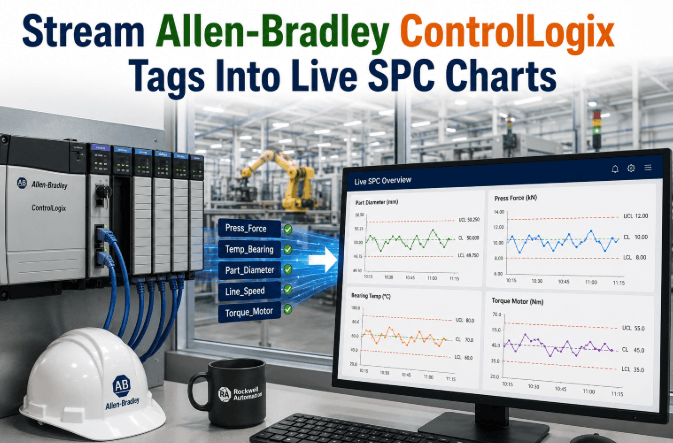
iFactory reads 2,884+ Allen-Bradley tags over EtherNet/IP at 20 ms RPI and streams them directly into AI-powered SPC — no middleware, no historian delay, no manual data export.
20 msRPI — Requested Packet Interval for live tag streaming over EtherNet/IP
2,884Live Allen-Bradley tags readable per deployment — ControlLogix, CompactLogix, GuardLogix
ZeroMiddleware servers required — native CIP messaging, direct EtherNet/IP connection
Studio 5000Logix Designer tag import — no manual tag configuration needed in iFactory
Why Allen-Bradley PLC Engineers Need Live SPC — Not Sampled Data
Most SPC deployments in Allen-Bradley environments suffer the same architectural problem: data moves from the PLC through a historian, gets batch-exported on a schedule, and arrives in the quality system minutes or hours after the process event that caused the variation. By the time the X-bar chart shows an out-of-control condition, the affected parts are already downstream — or already shipped. The value of SPC is in detecting variation before it produces defects, and that detection window only exists when SPC charts are fed by live PLC data at the scan rate the process actually demands.
iFactory eliminates historian latency entirely. The platform connects to your ControlLogix 5580 or 5570, CompactLogix 5380 or 5069, or GuardLogix safety controller over EtherNet/IP using Class 3 CIP messaging with a configurable RPI as low as 20 ms. Every tag value — DINT, REAL, BOOL, STRING — is timestamped at read time and written directly into the SPC engine. Control limits are calculated, violated limits are flagged, and alerts are generated within the same scan cycle the process engineer cares about.
Historian Latency Kills SPC Value
Batch exports from PI System or FactoryTalk Historian introduce minutes of delay between a process excursion and an SPC alert. iFactory's direct EtherNet/IP connection bypasses the historian layer entirely, streaming tag values at 20 ms RPI.
20 ms RPI vs. minutes of historian export lag
Manual Tag Configuration Overhead
Re-entering tag names and data types from Studio 5000 into a separate SPC system doubles configuration effort and introduces transcription errors. iFactory imports tag definitions directly from the Logix Designer project file.
Zero manual tag re-entry — imported from L5X project file
Fleet-Scale Tag Management
Managing SPC across a mixed fleet of 1756-L85E, 1756-L73, 1769-L36ERM, and CompactLogix controllers in the same plant requires a unified tag namespace. iFactory resolves controller-specific tag paths under a single asset hierarchy.
2,884 tags across ControlLogix + CompactLogix + GuardLogix
GuardLogix Safety Tag Visibility
Safety-rated process parameters on GuardLogix 5580S controllers are quality-critical but often excluded from SPC because standard historians cannot read GSV data. iFactory reads GuardLogix safety tags through dedicated CIP safety messaging paths.
Safety tags included — GuardLogix 5580S / 5570S supported
The Gap Between ControlLogix Scan Rate and Traditional SPC Update Frequency
A ControlLogix 5580 controller executes its scan task in 1–5 ms. A traditional SPC system fed by a historian samples the same process at 1–15 minute intervals. iFactory closes that gap: 20 ms RPI over EtherNet/IP means your SPC charts update at a rate that actually reflects what the process is doing — not what it was doing when the historian last polled.
How iFactory Connects to Your Allen-Bradley PLC Fleet
iFactory's Allen-Bradley integration is built on native EtherNet/IP and CIP — the same protocol layer Studio 5000 Logix Designer uses internally. There is no OPC server, no DCOM configuration, and no third-party middleware to license or maintain. The connection path is direct: iFactory → EtherNet/IP switch → 1756-EN2T / 1756-EN3TR / embedded Ethernet port → CIP Read/Write → tag value → SPC engine.
Step 1
L5X Project Import
Export your Studio 5000 Logix Designer project as an L5X file. iFactory parses the L5X tag database — controller-scoped and program-scoped tags, aliases, and UDT members — and populates the tag selection list automatically. No manual tag entry. Tag data types (DINT, REAL, BOOL, STRING, LINT, USINT) are preserved from the controller definition.
Step 2
EtherNet/IP Connection Configuration
Enter the controller IP address and slot number. iFactory initiates a CIP Forward Open to establish a Class 3 connection with the specified RPI — 20 ms default, configurable down to 10 ms for high-speed process loops. The 1756-EN2T supports up to 128 CIP connections; iFactory manages connection pooling automatically across multi-chassis ControlLogix systems.
Step 3
Tag Selection and SPC Mapping
Select the tags to monitor from the imported list. Map each tag to an SPC chart type — X-bar/R, I-MR, p-chart, c-chart, or Cpk trend — and assign engineering unit conversions where needed. iFactory supports array element addressing (e.g., Conveyor_Speed[3]) and UDT member access (e.g., Station04.TorqueActual) natively within the tag browser.
Step 4
Live SPC Chart Activation
Once tags are mapped, iFactory activates the CIP polling loop at the configured RPI. Tag values stream into the SPC engine, control limits are calculated from the first statistically significant sample set (typically 25–30 subgroups), and live charts become visible to operators on the plant floor dashboard within the same shift the connection is configured.
1756-L8SP / 1756-L7SPGuardLogix 5580S / 5570S — standard + safety tag access
Want to confirm iFactory's integration path for your specific Allen-Bradley controller model and firmware version? Book a Demo with our PLC integration engineers — we'll walk through your exact hardware configuration.
Allen-Bradley Tag Types and SPC Chart Mapping
Not every Allen-Bradley tag belongs on an X-bar chart. The data type, update frequency, and engineering meaning of each tag determine which SPC chart type delivers actionable information — and iFactory's tag-to-chart mapping is configured at the tag level, not the controller level. The table below shows how common Allen-Bradley tag patterns map to SPC chart types in iFactory deployments.
Scroll to compare
Tag Pattern
Logix Data Type
SPC Chart Type
Typical Use Case
Torque_Actual, Pressure_PV, Temp_Zone3
REAL
X-bar / R or I-MR
Continuous process variables — torque, pressure, temperature loops
Cycle_Count, Part_Count, Reject_Count
DINT
c-chart or u-chart
Defect count per production unit or time interval
Pass_Fail_Bit, Vision_OK, Leak_Test_Result
BOOL
p-chart or np-chart
Attribute data — pass/fail results from in-line inspection stations
Conveyor_Speed[0..7] (array elements)
REAL array
Multi-stream I-MR
Zone-by-zone speed monitoring across a multi-zone conveyor
Station04.TorqueActual (UDT member)
UDT.REAL
X-bar / R
Structured UDT access for assembly torque per station
Weld_Energy, Seal_Force (GuardLogix safety)
REAL (safety)
I-MR with Cpk trending
Safety-rated process parameters from GuardLogix 5580S controllers
iFactory SPC Capabilities Specific to Allen-Bradley Fleet Operations
Connecting to Allen-Bradley controllers is the integration layer. The SPC capabilities that deliver value to PLC engineers and quality teams operate on top of that tag stream — and iFactory's AI-powered analytics engine is built to handle the data characteristics that Allen-Bradley deployments produce at scale.
AI-Powered Control Limit Calculation
iFactory calculates control limits from live tag data without requiring a PLC engineer to manually enter UCL/LCL values. As the process stabilizes over the first 25–30 subgroups, limits are set automatically and recalculated on a rolling basis as the process evolves — flagging shifts before they produce defects.
AI-Native
Nelson Rule and Western Electric Violation Detection
All eight Nelson rules and the four Western Electric zone tests are applied in real time against the incoming tag stream. Any violation — a single point beyond 3σ, a run of 8 above the mean, a trend of 6 consecutively increasing — triggers an alert routed to the responsible operator or quality engineer within the same scan window.
Real-Time
Cross-Controller Process Correlation
A quality event at Station 4 (CompactLogix 5370) may be caused by a parameter drift at Station 1 (ControlLogix 5580). iFactory correlates tag streams across multiple controllers in the same asset hierarchy, surfacing upstream process causes of downstream defect patterns that single-controller SPC tools cannot detect.
Fleet-Scale
Process Capability Reporting (Cp, Cpk, Pp, Ppk)
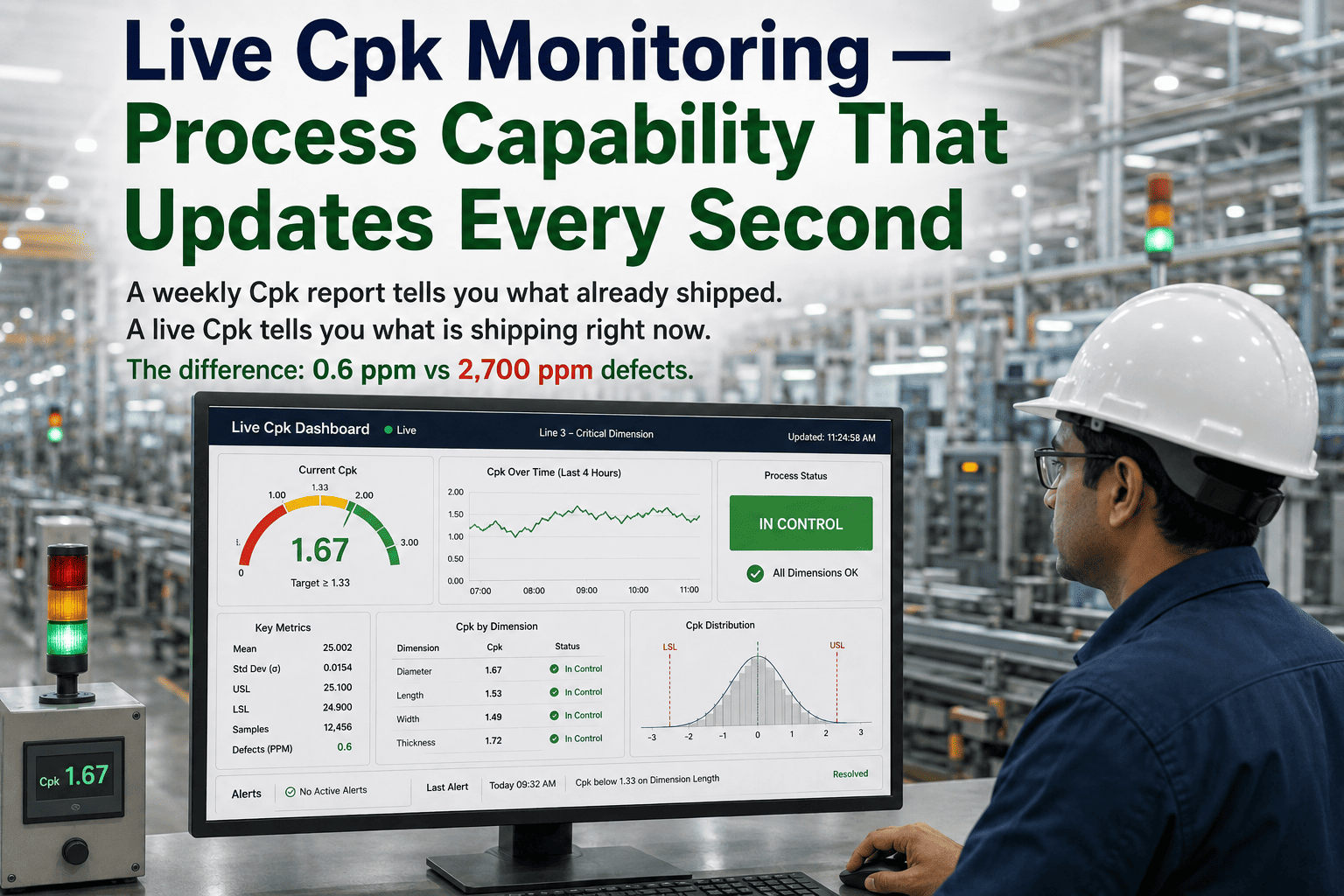
Cp, Cpk, Pp, and Ppk are calculated continuously from the live tag stream against user-defined specification limits. Capability indices are trended over time per tag, per production order, and per shift — giving quality teams the data they need for PPAP submissions, customer scorecards, and internal process improvement priorities.
Quality Reporting
Alarm Integration Without PLC Modification
SPC violation alerts are generated by iFactory's analytics engine — not by ladder logic changes in the PLC program. No Studio 5000 project modification, no I/O card additions, and no control system impact. Alerts route to operator HMI, email, SMS, or Slack depending on alert severity and team configuration.
Non-Invasive
OEE and SPC in a Single View
iFactory pulls production count, cycle time, and downtime tags from the same Allen-Bradley controllers feeding SPC — combining OEE calculation with quality monitoring in a unified plant floor dashboard. PLC engineers and production supervisors see process capability and availability in the same interface without switching between systems.
Unified Analytics
iFactory SPC Results Across Allen-Bradley Deployments
Manufacturing facilities that have connected iFactory to Allen-Bradley PLC fleets report measurable quality outcomes within the first production quarter: defect detection lead time reduced from shift-end reporting to within-cycle alerting; Cpk improvement of 0.15–0.40 index points on primary process parameters; and scrap rate reductions of 18–32% on processes where out-of-control conditions were previously caught only through end-of-line inspection.
Comparison: Traditional SPC Data Path vs. iFactory Direct Tag Streaming
Traditional SPC Architecture
PLC → OPC server → Historian → CSV export → SPC software
5–60 minute data latency between process event and SPC alert
Manual tag re-entry from Studio 5000 into SPC system
OPC-DA / DCOM configuration overhead; server licensing cost
GuardLogix safety tags excluded from SPC pipeline
Separate systems for OEE, maintenance, and quality — no correlation
iFactory Direct Tag Streaming
PLC → EtherNet/IP → iFactory SPC engine — three hops, no middleware
20 ms RPI — SPC alert within the same production cycle as the excursion
L5X project import — tag names, types, and aliases populated automatically
Native CIP — no OPC server, no DCOM, no middleware license required
GuardLogix safety tags included via CIP safety messaging path
OEE, predictive maintenance, and SPC in one platform — native correlation
Expert Perspective
The Allen-Bradley environment is one of the most tag-rich in U.S. manufacturing — a mid-size automotive assembly plant with a mixed ControlLogix and CompactLogix fleet can easily have 3,000 to 5,000 monitored tags across the production floor. The challenge has never been getting data out of the PLC; EtherNet/IP makes that straightforward at the protocol level. The challenge is what happens between the controller and the SPC chart — every historian, every OPC server, every middleware component in that path adds latency and complexity. When I advise manufacturers on SPC modernization, the first question I ask is: what is your actual data latency from process event to control chart point? For most facilities running traditional architectures, the honest answer is somewhere between five minutes and never. A direct CIP connection with a 20 ms RPI changes that equation entirely. You are not just getting faster data — you are getting data that is actually representative of what the process is doing at the moment of the quality event, not a reconstruction of it from a downsampled historian. That is a fundamentally different analytical capability, and the defect reduction results that follow reflect it.
— Senior Controls and Quality Systems Engineer, U.S. Automotive Manufacturing · 22 Years Allen-Bradley PLC Integration Experience · Former PLC Systems Lead, Tier 1 Automotive Supplier · ISA Member, SME Quality Division
What U.S. Manufacturers Achieve with iFactory Allen-Bradley SPC
18–32%
Scrap Rate Reduction
On processes where out-of-control conditions were previously caught only at end-of-line inspection — shifted to within-cycle SPC alerting
0.15–0.40
Cpk Index Improvement
On primary process parameters within the first production quarter after live SPC activation on Allen-Bradley tag streams
< 1 Shift
Time to Live SPC Charts
From L5X import to live SPC charts on plant floor dashboards — no multi-week integration project, no middleware deployment
Zero
PLC Program Changes
No Studio 5000 modifications, no ladder logic additions — iFactory reads tags without writing to the controller or modifying the control program
Connect Your Allen-Bradley PLC Fleet to Live SPC — Starting This Week
iFactory's EtherNet/IP integration reads ControlLogix, CompactLogix, and GuardLogix tags at 20 ms RPI and streams them into AI-powered SPC charts without middleware, without historian configuration, and without Studio 5000 program modifications. U.S. manufacturing teams are live with SPC in less than one shift from L5X import to first control chart.
Does iFactory require an OPC server to connect to Allen-Bradley ControlLogix controllers?
No — iFactory connects directly over EtherNet/IP using native CIP messaging. No OPC server, no OPC-UA gateway, and no DCOM configuration is required.
Will iFactory's EtherNet/IP connection interfere with my Allen-Bradley PLC's scan cycle or performance?
iFactory uses Class 3 CIP Read — a passive read operation that does not write to the controller or interact with the control program. CPU load impact is typically less than 1% on 1756-L7x and L8x processors.
Can iFactory read UDT (User-Defined Type) members and array elements, not just simple scalar tags?
Yes — iFactory supports full Logix tag path syntax including UDT member access (e.g., Station04.TorqueActual) and array element addressing (e.g., ZoneSpeed[3]) natively via the L5X import and CIP tag browser.
What Studio 5000 Logix Designer firmware versions does iFactory support?
iFactory supports Logix firmware versions 20 through 35 (current). Both Studio 5000 v21 through v36 project file formats are supported for L5X tag import. Book a Demo to confirm compatibility with your specific firmware revision.
Can iFactory connect to both ControlLogix and CompactLogix controllers in the same plant simultaneously?
Yes — iFactory manages simultaneous EtherNet/IP connections to multiple controllers across the facility, unifying ControlLogix 5580/5570, CompactLogix 5380/5370, and GuardLogix controllers under a single tag namespace and SPC dashboard.