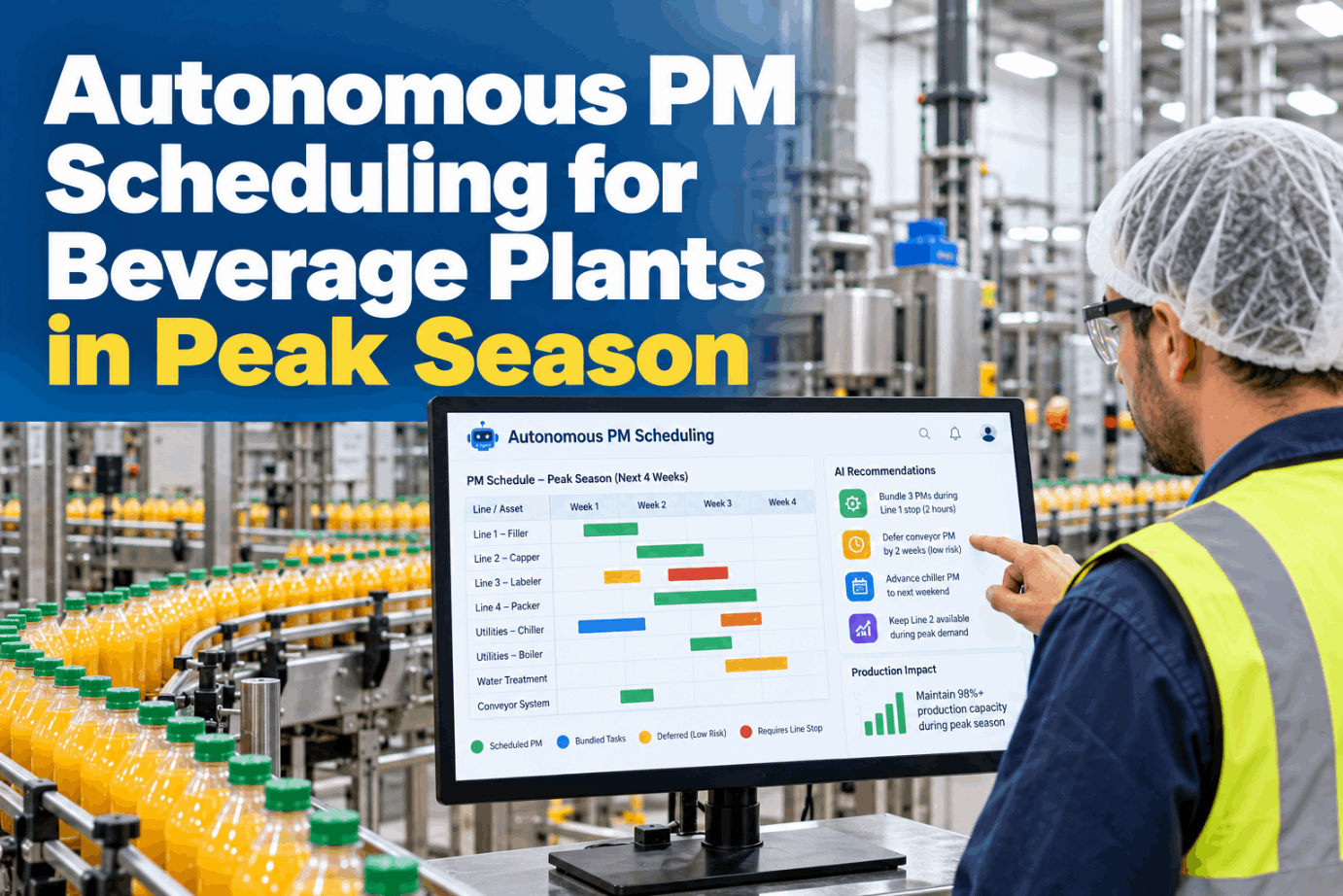
Summer is when a beverage plant earns its year, and it is also when maintenance has the least time. Lines run flat out, weekend shutdowns are sold to production, and the only stops left are changeovers and CIP cycles. PMs get pushed, and the ones that matter most can slip with the rest. Autonomous PM scheduling bundles PMs into the stops you already have, judges which ones can safely wait and keeps the ones that never wait on time. See a peak week planned in a short PM agent demo.
Fit Every PM Into Peak Season Without Taking a Line Hour
iFactory Autonomous PM Agent bundles PMs by line stop, predicts which can safely defer and books critical PMs into the shortest feasible windows during peak demand. Planners approve every deferral.
Summer Beverage Demand Squeezes the Maintenance Calendar
Peak beverage season runs from late spring through summer, and C.H. Robinson notes that demand rises with temperature and that weather and promotions can upset even a well-built forecast. Capacity planning for that peak shapes the whole maintenance year. The hours free for maintenance shrink exactly when a failure costs the most. Plan the year in four phases and let each one carry the work it suits. Map your own season with our planning team.
The Line Stops You Already Have in Peak Season
In peak season maintenance rarely gets a stop of its own. The windows are the stops already in the plan: changeovers, CIP, short weekend shutdowns and the occasional unplanned stop. The useful insight is what each stop leaves free. During a filler CIP the product path is busy with cleaning, but the labeler, packer, wrapper and conveyors downstream sit idle. Lengths below are illustrative. Your production plan and validated CIP recipes set the real ones. Find your hidden windows in a line stop review.
A Worked Bundle Inside One CIP Window
The example uses illustrative minutes. The filler CIP lasts 55 minutes. Each technician loses 10 minutes to lockout and handback, so each has 45 usable minutes, or 90 technician-minutes for two. The agent packs five downstream PMs into that time. A 25-minute palletiser gripper inspection won't fit the 18 minutes Tech B has left, so it moves to the weekend shutdown. Check your own bundles with our support team.
Which PMs Can Safely Wait, and Which Never Do
Food safety, regulatory and safety PMs are locked: they never defer, whatever the production plan says. For the rest the agent weighs criticality, condition data and the P-F interval, the time between a detectable warning and failure. Reliabilityweb notes that RCM practice often sets an inspection interval at about half the P-F interval. A deferral is allowed only if the stretched interval plus the time to plan the repair still fits inside it. See the rules applied in a deferral walkthrough.
Deferral Calls Worked Through for Six PMs
The rows show the rules at work. P-F intervals and repair lead times are assumed for illustration. Your history, condition data and OEM advice set the real values. Calibration stays on time for a reason: FSMA rule 21 CFR 117.165(a)(1) lists "calibration of process monitoring instruments and verification instruments" as a verification activity, with written procedures setting how often. Review your own PM list with our reliability team.
When Sales Takes the Weekend, the PMs Still Get Done
Ask the agent what a plan change does to your PMs. It answers with what it can bundle, what can safely wait and what needs your decision, with the reasons laid out.
Do the Big Work Before the Heat Arrives
The best peak-season PM plan starts in spring. Any job that needs a long window should be done in the pre-season overhaul, so summer windows only carry short tasks. The agent builds the overhaul list from three sources: long PMs that fall due during peak, PMs it expects to defer, and defects found on condition routes but not yet fixed. Build your overhaul list in a pre-season planning session.
Guardrails the Agent Never Crosses
Autonomous does not mean unsupervised. The agent books work only inside rules the planner sets. It never defers a locked PM, never shortens a validated CIP or sanitation step, never books lockout work without the permit and crew, and never lets a PM pass its due window without a person deciding. Every proposal shows its reasons. Set your own rules with our support team.
- Bundle PMs into planned stops inside their due windows
- Move a PM to an earlier window
- Book crews, parts and lockout points for a bundle
- Keep a ready list for unplanned stops
- Every deferral, with P-F headroom and risk shown
- Any PM that needs a new line stop
- Any change to a locked PM, which can only move earlier
- Anything that would pass its due window
Size the Capacity You Keep, With Your Own Numbers
The value of capacity protection is production hours kept in peak season, so measure it in hours and cases, not in invented savings. Every input below is assumed. The minutes avoided per bundle are set well below the 117 in the worked example to stay conservative. Replace them with your own figures in a value sizing call.
Put a money value on those cases only with a margin figure your finance team agrees. Fewer mid-peak failures from PMs done on time add value too, but leave them out unless your own history supports a number.
Five Steps to a Peak Season Plan That Holds
Start in winter, so the agent has run in shadow before the first hot week. The work is mostly data: tagging PMs, loading stops and agreeing deferral rules. Weekly, plant managers should watch four numbers: share of PMs bundled, deferrals open, locked PMs done on time, and the deferred backlog left at season end. Plan the rollout with our implementation team.
The Autonomous PM Agent, Delivered Ready to Plan
iFactory delivers the Autonomous PM Agent as a turnkey system. A pre-configured NVIDIA AI server ships racked and ready, with the scheduling agent and deferral models loaded, so plans are built on site. You rack it, plug in power and Ethernet, and the AI is live. To scope it for your lines, request a turnkey quote.
- Pre-configured NVIDIA AI server, racked and ready
- CMMS connector for PMs, history and backlog
- Link to the production plan and CIP schedule
- Condition data from routes, oil samples and sensors
- Locked rules for food safety and regulatory PMs
- Planner approval screen with reasons for every move
- Weekly peak-season report by line
PM library loaded and tagged, stops and CIP schedule linked, locked PMs agreed.
Agent proposes bundles and deferrals while planners compare with their own plan.
Approvals switched on, planners trained, weekly peak-season review started.
Peak Season PM Scheduling Built for Beverage Lines
iFactory plans around the stops your lines already have, so beverage line uptime and PM quality both hold through summer. Our support team can plan a pilot on one line.
What Plant Managers Ask About Peak Season PM Scheduling
Protect Summer Capacity Without Skipping the PMs That Matter
Bundle PMs into the stops you already have, defer only what can safely wait and keep locked PMs on time. The full system is delivered turnkey and goes live in 6 to 12 weeks.