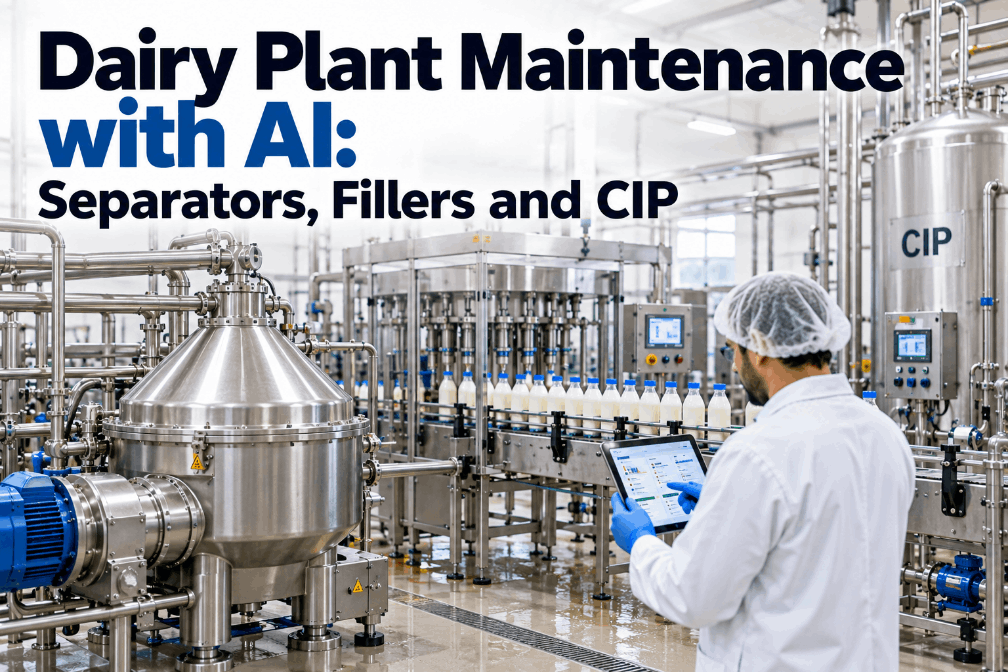
Dairy Plant Maintenance with AI: Separators, Fillers and CIP
By Jackson T on October 19, 2026
A dairy plant rarely fails in one big way. It fails in small ones: a separator bowl that vibrates a little more after each rebuild, a homogenizer that takes longer to reach pressure, a filler seal jaw running slightly cool, a CIP return temperature that dips for a minute nobody saw. Each one is a maintenance problem and a food safety problem at the same time. Dairy plant maintenance with AI connects the two, so every repair ends with a cleaned, verified and released machine. See it on a real line in a short dairy maintenance demo.
DAIRY ASSET MODELS · PREDICTIVE AI
Separators, Homogenizers, Fillers and CIP on One Maintenance Record
iFactory Dairy Asset Models track separator vibration and bowl run-down, plan filler PMs and build sanitary repair release into every work order. Technicians log checks by voice, even in wet, cold rooms with gloved hands.
Cream separator · brake applied · bowl at standstill
Baseline, last 20 stops3:40
This stop2:55
Technician · voice"S2 bowl at standstill, lock ring marks aligned."
iFactory · read backLogged to WO 4471. Run-down 2 min 55 s, 20% under baseline. Bearing check added.
Sanitary release pending · QA sign-off required
DAIRY PROCESSING RELIABILITY
Four Asset Families, One Hygiene Rule
Milk plant equipment shares one rule: any part that touches product must be cleanable, inspectable and put back exactly as designed. The Grade "A" Pasteurized Milk Ordinance (PMO) sets the sanitary rules for US Grade "A" plants, and the 3-A Sanitary Standards describe hygienic design for dairy equipment. Equipment built to a current 3-A standard is accepted as meeting the PMO's sanitary design and construction rules. So maintenance in a dairy is never only mechanical. Map your own line with our dairy support team.
Separator
Bowl balance, bearings, desludgeWatch vibration, run-down time and discharge timing
›
HTST pasteurizer
Plates, diversion valve, recorderCovered by PMO equipment tests and your sealed controls
›
Homogenizer
Valves, seats, plungers, sealsWatch pressure stability, seal flush and run hours
›
Filler
Nozzles, seal jaws, change partsWatch seal temperature, rejects and PM intervals
CIP loop under every circuitTime, temperature, concentration and flow recorded for each cycle, then linked to the asset it cleaned
CREAM SEPARATOR MAINTENANCE
Reading the Separator Bowl: Vibration and Run-Down
A separator bowl spins at several thousand rpm, so small changes in balance show up fast. One OEM instruction manual, for example, sets a vibration limit of 9 mm/s at full speed and names incorrect assembly or poor bowl cleaning as the usual causes of excess vibration. It also notes that bowl parts are balanced as a set and must never be mixed between machines, and that without a brake the run-down can exceed two hours. Run-down time adds a second view: compare each stop with the machine's own history. Review your separator data with our separator specialists.
After a bowl rebuildCompared with pre-rebuild level
Run-down shorter than baseline
More drag than usual. Check bearings, sediment build-up and any contact in the bowl.
Run-down longer than baseline
The brake is doing less work. Check brake linings and brake operation.
Vibration higher after rebuild
Check assembly marks, disc stack pressure and that every bowl part carries this machine's number.
Safety first
Never start dismantling until the bowl is at complete standstill and the power is isolated and locked. Use the revolution counter or motor fan to confirm it has stopped.
HOMOGENIZER WEAR
Valves, Seats and Plungers: What Wear Looks Like
A homogenizer is a high-pressure piston pump with a homogenizing valve on its outlet. Its wear parts give clear signals if someone collects them: product in the seal flush water, a pressure gauge that swings, a valve that can no longer hold set pressure. Trending these by run hours, not calendar dates, shows when a rebuild is due. Get a wear-part trend sheet from our support team.
Wear part
Typical sign
What to log
Usual response
Plunger seals
Product or cloudiness in the seal flush water
Flush condition per plunger, each shift
Replace seals, inspect plunger
Plungers
Scoring, lines or heat marks on the surface
Photo and note at each seal change
Polish or replace plunger
Pump valves and seats
Gauge needle swinging, knocking, set pressure hard to reach
Pressure stability and pulsation trend
Inspect valves, check inlet pressure
Homogenizing valve and seat
Valve cannot hold set pressure, product drifts out of spec
Run hours since rebuild, seat face condition
Turn or replace seat and forcer
Impact ring
Wear grooves at the valve gap
Condition at each valve rebuild
Replace with valve set
Crankcase and drive
Oil temperature rising, noise, belt wear
Oil temperature and oil change hours
Oil change, belt check
Ask the Asset Model, Not the Spreadsheet
Each Dairy Asset Model keeps the history of one machine: vibration, run-down, run hours, PMs, CIP cycles and releases. Ask it a question by voice or text and get the answer with the work order already drafted.
iFactoryVibration is steady and under your alert level. Run-down has been 18 to 20% short of baseline on the last three stops. I suggest a bearing check in Monday's CIP window.
Maintenance leadBook it. Move the H1 valve rebuild to Tuesday.
iFactoryWO 4480 raised for S2 with sanitary release attached. H1 rebuild moved to Tuesday.
DAIRY FILLER PM
A Filler PM Ladder for Cartons, Jugs and Cups
Fillers combine the hygiene risk of a product-contact machine with the wear of a packaging machine. Seal quality depends on temperature, pressure and dwell time staying in range, and nozzles that tail or splash into the seal area are a common cause of weak seals. Clean filling, regular wear checks and timely part replacement are the basics. Build your own filler ladder in a PM planning session.
Every shift
Nozzle drip check, seal jaw temperature reading, reject count, visible leaks and loose guards
Weekly
Seal jaw faces and coatings, cutter blades, conveyor guides, filler valve seals on a rotating sample
Monthly
Dosing pump wear, sensor and encoder checks, gearbox and chain lubrication with food-grade lubricant
Each format change
Change parts counted out and in, settings confirmed for the new pack, first-pack seal check
OEM hours or yearly
Major seal kits, bearings, heater cartridges and the full OEM service list
PMO DAIRY CIP SYSTEM RECORDS
CIP Circuit Verification: Time, Temperature, Concentration, Flow
A CIP circuit only cleans when every condition is right at the same time. Under PMO Item 12p, pipelines and equipment cleaned in place need a recording device in the cleaning solution return line that records time and temperature, and the records must be kept for at least three months. Flow matters too: about 5 ft/s (1.5 m/s) in pipelines keeps flow turbulent enough to scrub the walls. iFactory checks every cycle against its recipe and links any miss to a likely equipment cause. Ask our CIP support team for a verification sheet.
Circuit C3 · Filler 2 · Caustic stepHeld for review
Time10 min 20 sRecipe 10 min · met
Return temperatureAbove recipe minimumWhole step · met
ConcentrationIn conductivity bandWhole step · met
Flow4.4 ft/s for 40 sRecipe 5.0 ft/s · missed
Low flowSupply pump impeller or seal, blocked spray device, valve not fully open
Low concentrationDosing pump, chemical supply, conductivity probe drift
Short timeSequence timing, valve feedback, an early step change
DAIRY PLANT MAINTENANCE AI TEMPLATE
Sanitary Repair Release: The Checklist Every WO Closes With
A repair is not finished when the machine runs again. GFSI schemes say the same thing in their own words. BRCGS clause 4.7.4, for example, requires maintenance work to be followed by a documented hygiene clearance procedure. In a dairy that usually means parts accounted for, product-contact surfaces checked, the circuit cleaned and sanitized, and QA sign-off before product runs. Use this as a starting point and see how it closes a work order in a release workflow demo.
1Before the machine leaves maintenance
2Clean and verify
3Release
VOICE LOGGING
Hands-Free Logging for Wet, Cold Processing Rooms
Dairy processing rooms are cold, wet and washed down every day. Technicians wear gloves, and phones and paper do not last long near a hose. Voice logging lets them speak readings and checks while they work, and iFactory reads each value back before it saves it to the work order. Set up voice commands for your rooms with our support team.
"H1 seal flush clear, pressure steady at one-eighty bar."
Homogenizer H1Seal flush: clear · Pressure: 180 bar · Saved to PM 2210
"Filler two, jaw three running cool, changing the heater cartridge."
Filler F2Jaw 3 low temperature · Part used: heater cartridge · Release check added
These show how the asset models usually respond. They are illustrations, not case studies or customer results. Walk through your own week in a scenario review.
Monday
Separator run-down short three stops in a rowBearing check booked in the CIP window. WO closes only after the release checklist and QA sign-off.
Wednesday
CIP flow miss on a filler circuitCycle held, rerun approved by QA, supply pump seal found leaking and replaced the same shift.
Friday
Homogenizer pressure starts to swingPulsation trend flagged. Pump valves inspected at the next planned stop, one worn seat replaced.
DAIRY PLANT MAINTENANCE AI BEST PRACTICES
Six Habits for Plant Managers That Make the Models Useful
AI is only as good as the history behind it. These habits keep that history clean and keep maintenance, sanitation and QA working from the same record. Ask our dairy team how other plants set them up.
01Baseline every machineRecord vibration and run-down after a known good rebuild
02Count run hoursPlan wear parts on hours, not dates
03Link CIP to assetsA missed cycle points to a pump, valve or probe
04Release every repairNo WO closes without hygiene clearance
05Log at the machineSpeak readings in the room, not at the end of shift
06Review weeklyMaintenance, sanitation and QA look at one trend
TURNKEY AI DEPLOYMENT
Dairy Asset Models on a Server That Arrives Ready
iFactory delivers Dairy Asset Models as a turnkey package. A pre-configured NVIDIA AI server ships racked and ready with the separator, homogenizer, filler and CIP models pre-loaded, so data from your machines is processed on site. You rack it, plug in power and Ethernet, and the AI is live. To scope it for your plant, request a turnkey quote.
What's Included
Pre-configured NVIDIA AI edge server, racked and ready
Asset models for separators, homogenizers, fillers and CIP
Vibration and run-down capture for each separator
CIP cycle checks against your own recipes
Filler and homogenizer PM plans on run hours
Voice logging for wet, cold rooms with read-back
Sanitary repair release built into every work order
Live in 6–12 weeks
Wk 1–4
Connect and Baseline
Server installed, sensors and CIP data linked, baselines taken after known good rebuilds.
Wk 5–8
Tune and Shadow
Models run alongside current PMs, release checklists agreed with QA and sanitation.
Wk 9–12
Go-Live and Training
Alerts, voice logging and release steps switched on, crews and QA trained.
HOW iFACTORY FITS
Dairy Plant Maintenance AI Software Built Around Hygiene
iFactory treats every dairy repair as both a reliability task and a food safety task. Our support team can walk you through a pilot plan.
1
Reads the separator. Vibration and bowl run-down are compared with each machine's own baseline.
2
Plans filler PMs. Ladders by shift, week, month and format change, with wear parts on run hours.
3
Logs checks by voice. Readings spoken in the room are read back and saved to the work order.
4
Releases every repair. Sanitary release and QA sign-off are built into each WO.
1000+
Industrial clients running iFactory
99.9%
Platform uptime for round-the-clock dairies
6-12 wks
From racked server to live asset models
FREQUENTLY ASKED QUESTIONS
What Plant Managers Ask About Dairy Plant Maintenance AI
What is bowl run-down analysis on a cream separator?
It is the time the bowl takes to come to a full stop after the motor is switched off, compared with the same machine's history under the same conditions. A stop that is shorter than usual suggests more drag, such as bearing wear or sediment. A longer stop suggests the brake is doing less. It works best alongside vibration data.
Does the AI replace PMO equipment tests?
No. PMO tests on pasteurizer controls, recorders and diversion valves are done by the regulatory agency or as the PMO requires, and sealed controls stay sealed. iFactory keeps the maintenance history around those tests and makes sure repairs are released correctly.
How does it check a CIP cycle?
It compares time, return temperature, concentration and flow for each step with the recipe for that circuit. When a step misses, the cycle is flagged for QA review and the likely equipment cause, such as a pump, valve, steam supply or probe, is raised as a work order.
Does voice logging work in cold, wet rooms?
Yes. Technicians use a rugged headset or handheld and speak readings while wearing gloves. iFactory reads each value back before saving it, so a misheard number can be corrected on the spot.
What is a sanitary repair release?
It is the hygiene clearance step after maintenance: parts and tools accounted for, contact surfaces checked, the equipment cleaned and sanitized, and QA sign-off before product runs again. BRCGS clause 4.7.4 calls it a documented hygiene clearance procedure.
How do we start?
Start with one line, usually the separator, homogenizer and filler that cause the most unplanned stops. Take baselines after known good rebuilds, agree the release checklist with QA and switch on voice logging for that room. Our support team can plan that pilot with you.
Every Dairy Repair Ends Clean, Checked and Released
Track separator vibration and run-down, plan filler and homogenizer PMs on run hours, verify CIP cycles and release every repair through QA. The full system is delivered turnkey and goes live in 6 to 12 weeks.