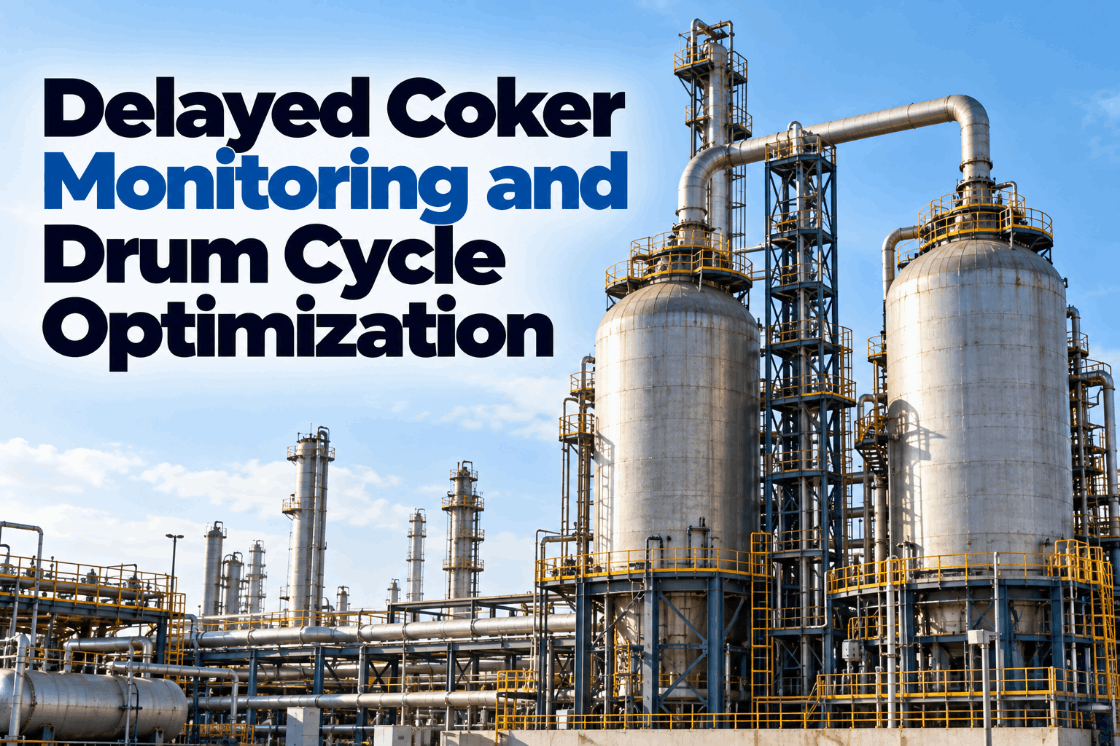
A delayed coker turns the heaviest residue in the refinery into lighter liquids and solid petroleum coke, and it does so in a cycle that never stops. One drum fills with hot residue while the other is steamed, quenched, unheaded and cut out with high-pressure water. Then the drums switch. Every cycle heats and cools the drums, every switch carries risk, and every choice about cycle time, heater outlet temperature and drum pressure moves liquid yield, coke quality and drum life. Most cokers run these cycles on fixed timings and operator judgment. This guide explains the drum cycle, coke types and shot coke hazards, heater fouling and run length, foaming, drum fatigue and how continuous monitoring helps coker teams run shorter, safer and more profitable cycles. To see your coker cycle data analyzed, book a short walkthrough.
Delayed Coker Monitoring and Drum Cycle Optimization: Safer Switches, Better Yields, Longer Drum Life
Drum cycles, heater run length, foaming and shot coke risk watched cycle by cycle, so coker teams can shorten cycles where it pays and protect drums and crews where it does not.
Why Coker Cycles Are Hard to Optimize
Delayed cokers sit at the bottom of the refinery barrel, upgrading residue that would otherwise be sold as low-value fuel oil. Industry sources describe drum fill cycles of 12 to 24 hours. A widely cited tutorial by Ellis and Paul notes that most typical cokers run about 16-hour cycles, that one refinery ran 12-hour cycles, and that 10–11 hours proved extremely difficult.
Shorter cycles add capacity, but each cycle is a thermal shock to the drums. Digital Refining’s review of coke drum design states that low-cycle thermal fatigue is the most common failure mechanism of coke drums, with bulging and cracking concentrated in particular zones of the shell. A refinery that pushes cycle time without watching drum condition may gain throughput and lose drums.
Yield and safety pull in different directions too. Higher drum temperature can raise liquid yield, but higher temperature with heavy, asphaltenic feed increases the chance of shot coke, which brings its own hazards when the drum is cut. Every decision is a trade-off, and the information needed to make it is spread across heater, drum, fractionator and lab data.
Bringing that information together is what continuous monitoring does. We can review your coker data on a call.
The Delayed Coker Drum Cycle
A two-drum coker repeats the same sequence on each drum.
Hot residue from the heater flows into the drum, where it cracks and forms coke over many hours.
Feed moves to the other drum. Steam must flow before and immediately after the switch so unconverted feed does not coke and plug lines.
The full drum is steamed to strip hydrocarbons, then filled with water to cool the coke.
Water is drained and the top and bottom heads are opened.
High-pressure water jets drill a pilot hole and cut the coke out of the drum.
The empty drum is closed, tested and heated with vapors from the other drum before the next fill.
Each step has a time and a risk. Shortening the total cycle means shortening one or more steps, which is why cycle optimization needs data from every step, not just fill time.
Drum switch timing deserves special attention. The Ellis and Paul tutorial warns that steam must flow before and immediately after the switch; without it, unconverted feed cokes and plugs channels. Tracking switch sequences shows whether they are being done consistently across crews.
Step-by-step timing across cycles shows where time is lost. See it in a demo.
Coke Types and Shot Coke Hazards
The type of coke produced depends on feed and conditions, and it matters for both value and safety.
| Coke type | How it forms | Uses | Operating notes |
|---|---|---|---|
| Sponge coke | Typical structure from many residues | Anode grade if specifications are met, otherwise fuel | Most common in many refineries |
| Shot coke | High-asphaltene feed and high drum temperatures form spheres about 2–5 mm across | Fuel grade, unsuitable for anodes | Loose and free-flowing, raising cutting hazards |
| Needle coke | Asphaltene-free feeds under controlled conditions | Graphite electrodes | Tight specifications on expansion and sulfur |
Shot coke is the main safety concern. Because it does not form a solid mass, it can flow uncontrollably when a drum is unheaded, and hot spots inside the coke bed can remain after quench. The Ellis and Paul tutorial describes steam eruptions during pilot-hole cutting, when cold cutting water hits exposed hot coke, and notes that such eruptions have caused fatalities in the past.
Predicting shot coke risk before unheading gives crews time to prepare: longer quench, slower draining and procedures for loose coke. The predictors are known from operating experience: feed asphaltene content, heater outlet temperature, drum pressure and recycle ratio.
Shot coke risk ratings are often the first feature coker crews ask for. Our engineers set them up with your operating history.
Heater Fouling and Run Length
The coker heater raises residue to cracking temperature. Industry sources give heater outlet temperatures of roughly 460–505 °C, with Ellis and Paul citing about 500 °C as typical.
Some cracking starts in the heater, leaving coke on tube walls.
Coke insulates the tubes, so firing increases and tube metal temperature climbs.
Digital Refining notes peak heat flux can be about 2.3 times the average, so hot spots set the limit.
Steam injected into the coils, around 1 wt% of feed in the Ellis and Paul tutorial, keeps velocity up and slows coking.
With good practice, coker heater runs of 18 months are possible, according to the same tutorial.
Heaters are decoked by pigging, spalling or steam-air methods, each with its own downtime.
Digital Refining’s work on coker heaters states that peak tube metal temperature limits run length. Monitoring tube temperatures by pass, together with firing, outlet temperature and velocity steam, shows how fast each pass is fouling and when it will reach its limit.
Fine coke carried back from foam-over events accelerates heater fouling, so heater and drum data belong in the same picture. A sudden change in fouling rate after a foaming event is a common pattern.
Heater run-length projection is part of every coker rollout.
Foam-Over and Antifoam Use
As the drum fills, a foam layer forms on top of the coke bed. If it rises too high, foam carries over into the overhead vapor line.
Ecolab notes foam-over fouls the transfer line and fractionator suction screens.
Fine coke carried back fouls heater tubes.
Nuclear or radar level devices show foam height approaching the top.
Temperature and pressure changes in the overhead line.
Silicone antifoam is injected near the end of fill; Ellis and Paul suggest a cost around $0.10 per ton of coke.
Leaving enough free space at the top of the drum.
Antifoam is effective but has side effects. Silicone can carry into downstream units and affect catalysts, so plants try to use the minimum needed. Monitoring foam height against antifoam dosing shows whether dosing is matched to actual foaming.
Drum outage, the free space left at the top, trades capacity against foam-over risk. A model of foam behavior by feed and conditions lets the plant fill drums higher when risk is low and leave more space when it is high.
Foam-over history often explains unexplained fouling downstream. Ask our team to review yours.
Drum Fatigue, Bulging and Cracking
Coke drums heat to process temperature and cool with water every cycle. Over thousands of cycles, that thermal cycling damages the shell.
Illustrative. Each drum alternates, so one full drum cycle spans two fill periods. Strain gauge and temperature data show whether the extra cycles are harmful.
Digital Refining’s review of coke drum design reports cycle times ranging from as little as 14 hours to more than 24 hours across units, with bulging concentrated in particular zones of the shell. Aspen Aerogels notes drums can grow by more than 20 cm in length and circumference as they heat.
How the drum is quenched and heated matters as much as how often. Fast, uneven quenching causes steep temperature gradients and higher stress. Skin thermocouples and strain gauges show which cycles are harsh, and those cycles can be linked to specific procedures or crews.
Linking cycle time decisions to drum strain data protects the most expensive equipment in the unit. Discuss it with our specialists.
Fixed Cycle Timings Versus Data-Driven Cycles
The difference between fixed timings and data-driven operation shows in capacity, safety and drum life.
- Same cycle time regardless of feed
- Shot coke found during cutting
- Antifoam dosed by habit
- Heater decoke found at the limit
- Drum stress unknown per cycle
- Switch steps vary by crew
- Cycle time set by feed, throughput and drum condition
- Shot coke risk rated before unheading
- Antifoam matched to measured foam
- Heater run length projected
- Harsh cycles identified from strain data
- Switch sequences checked for consistency
Data-driven operation supports the crews and engineers who run the coker; it does not replace their procedures. All safety-critical steps remain under the plant’s procedures and interlocks, and recommendations start in advisory mode.
See how cycle insights are presented to coker crews in a session.
Delayed Coker Monitoring Checklist
Use this checklist to prepare a coker for cycle monitoring.
Most cokers have the data spread across systems. Combining it is the first step of a coker review.
What Coker Cycle Optimization Is Worth
Value comes from capacity, yield, safety and drum life.
Yield effects can be significant: Aspen Aerogels reports that a 5 °C rise in drum temperature can add 0.5–1% liquid yield, though it must be weighed against shot coke risk and heater fouling. Capacity gains from shorter cycles must be weighed against drum fatigue.
A review of a few months of cycle data usually shows where time and yield are lost. Book one with our advisors.
How iFactory Delivers Coker Cycle Monitoring
Step times and variation across cycles and crews.
Rating from feed, temperature and pressure history.
Days to tube temperature limit by pass.
Foam height against antifoam dosing.
Strain and temperature gradients per cycle.
Liquid yield and coke make by cycle.
It runs on premises beside your DCS and historian. Share a few months of coker data and we will show your cycle step analysis in a working session.
See Where Your Drum Cycles Lose Time and Yield
Share heater, drum and fractionator data for a few months. We analyze every cycle step, rate shot coke risk and show how cycle time affects yield and drum stress.
Feed asphaltene content and heater outlet temperature both rose overnight. The model rates the risk of shot coke in this drum as elevated, so cutting crews should treat it as shot coke.
Shot Coke Risk Flagged Before Unheading
This exchange shows how a refinery engineer might use iFactory.
iFactory ships as a pre-configured NVIDIA AI server, racked and ready with the delayed coker cycle monitoring models loaded. Rack it, plug in power and Ethernet, and the AI is live on your network. Our scope covers data connections across coker heaters, drums, fractionator and utilities, DCS, PLC/SCADA, historian, LIMS and CMMS integration, cabling and network setup, operator and engineer training, and 24×7 remote monitoring. Recommendations run in advisory mode first, and nothing writes to your control system without your management of change approval.
Server installed, DCS and historian links live, historical process, lab and maintenance data loaded.
Models calibrated on your own unit data, then run in advisory mode on one unit with your process engineers reviewing every recommendation.
Rollout to the agreed units under your management of change, operator and engineer training, and 24×7 remote monitoring in place.
Software, server and integration come as one package. For pricing on your site, contact our sales team.
Frequently Asked Questions
Industry sources give fill cycles of 12 to 24 hours. Ellis and Paul note most typical cokers run about 16 hours, with shorter cycles possible but increasingly difficult.
Shot coke forms as loose spheres about 2–5 mm across when feeds are high in asphaltenes and drum temperatures are high. It can flow uncontrollably at unheading, and hot spots can cause steam eruptions during cutting.
Peak tube metal temperature, which rises as coke builds in the tubes. With good practice, including velocity steam, runs of about 18 months are possible.
Repeated heating and quenching cause low-cycle thermal fatigue, which Digital Refining identifies as the most common failure mechanism of coke drums.
A long-used rule of thumb puts coke yield at about 1.6 times the feed’s Conradson or Ramsbottom carbon residue.
A coker can typically be monitored within a 6–12 week rollout, using existing signals. Plan it with our engineers.
Run Safer, Shorter, More Profitable Coker Cycles
iFactory tracks every drum cycle, rates shot coke risk before unheading, projects heater run length and links cycle choices to drum strain, so capacity gains do not cost drums or safety.
Illustrative. Shorter cycles add capacity but raise thermal cycling on drums, so each step is checked against drum strain data.