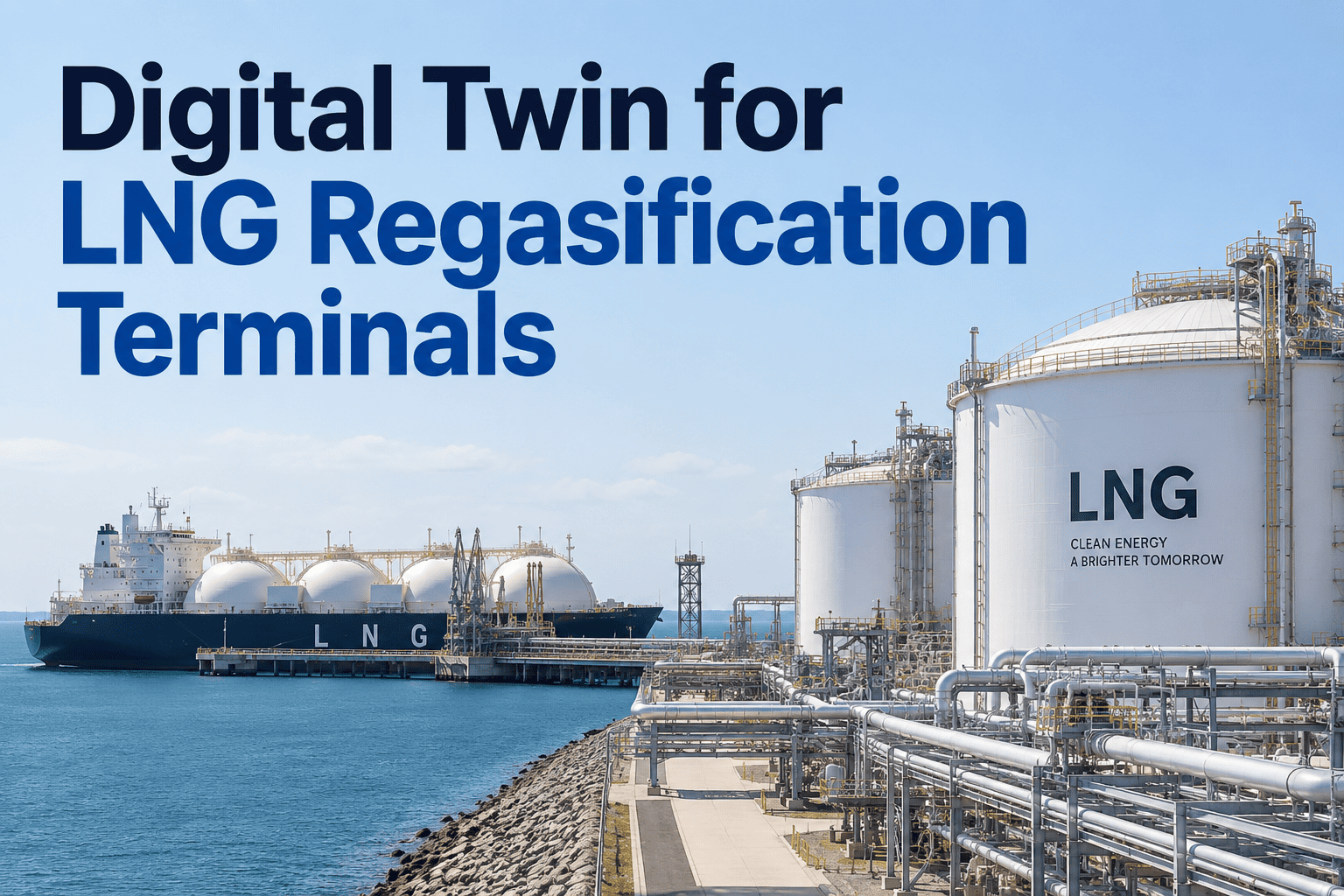
An LNG regasification terminal looks simple on a flow diagram — take cryogenic liquid from the tanks, pump it up, warm it back to gas, send it to the grid — but every step is a coupled trade-off. Which vaporizers do you run when the seawater is cold? How do you schedule the boil-off gas compressors as demand swings? How do you meet a variable send-out at the right Wobbe Index without burning more fuel than you must? These decisions interact, so optimizing them one at a time leaves value on the table. A digital twin simulates the whole terminal at once — ORV, STV, and SCV vaporization, boil-off gas, and send-out together — so the fuel-minimizing schedule is found before the shift runs it. You can book a demo to see it on your terminal's data.
Simulate the Whole Regas Terminal, Then Send Out at the Lowest Fuel-Gas Cost
A digital twin of ORV, STV, and SCV vaporization, boil-off gas, and send-out — running the coupled trade-offs together so you optimize send-out schedules, cut fuel gas consumption, and minimize flared BOG on one model.
The Decisions Are Coupled, So Optimizing Them Separately Leaves Money on the Table
A regas terminal isn't a line of independent units — it's a set of interlocked choices where the best answer to one depends on all the others. Run more submerged combustion vaporizers and you burn more fuel gas; lean on open rack vaporizers and you're at the mercy of seawater temperature; push send-out up and boil-off dynamics shift. Each lever moves the others, which is exactly why a spreadsheet or a single-variable rule of thumb can't find the real optimum — and why the value hides in the interactions.
Every vaporizer type has a different cost to run. Submerged combustion vaporizers consume roughly 1.5 percent of the LNG they process as fuel, while open rack vaporizers run on seawater heat. The right mix at any hour is a fuel-cost decision that shifts with conditions.
ORV performance depends directly on seawater temperature, which changes by season and by day. A vaporizer plan that's optimal in summer can be infeasible in a cold snap, forcing more fuel-burning SCV capacity online.
Heat ingress into cryogenic storage at around minus 160 degrees generates boil-off gas continuously and unavoidably. Managing it — recondensing, compressing, or flaring — is a running cost and emissions burden that couples tightly to send-out rate.
Grid demand and the required gas quality — calorific value, Wobbe Index — change through the day, so a static operating plan is either over-provisioned and wasteful or short and scrambling to catch up.
ORV, STV, and SCV — Each With a Different Cost to Turn Liquid Into Gas
The heart of regas optimization is choosing which vaporizers to run, because that choice largely sets your fuel-gas bill. The three types trade capital, footprint, and — most importantly for operations — running cost, and the twin models each one's real performance so the dispatch reflects true cost, not a nameplate assumption.
The most common type, around 70 percent of installations, using seawater as the heat source so it burns no fuel to vaporize. The catch is dependence on seawater temperature — its capability rises and falls with the sea, so the twin has to model that relationship to know how much ORV duty is actually available at any hour.
A shell-and-tube exchanger design, often run with an intermediate fluid, giving stable performance that's less exposed to ambient swings than ORV. It sits between the seawater-dependent ORV and the fuel-burning SCV, and the twin places it in the dispatch where its stability is worth more than ORV's free heat.
Burns gas to heat a water bath, consuming roughly 1.5 percent of the vaporized LNG as fuel — the highest running cost, which is why SCVs are typically reserved for peaking, startup, or when no free heat source is available. Every hour of avoidable SCV duty the twin can shift to ORV or STV is direct fuel-gas savings.
Because seawater temperature, send-out demand, and BOG load all move, the fuel-minimizing vaporizer mix is different from hour to hour — there's no single correct dispatch. A plan set at the start of a season and left alone drifts steadily away from optimal as conditions change, quietly burning more SCV fuel than necessary. The twin re-solves the mix against current conditions, so the terminal is always running the cheapest feasible combination that still meets send-out and spec.
Find the Cheapest Vaporizer Mix for Every Hour
iFactory models ORV, STV, and SCV performance against live seawater temperature, demand, and BOG load — so the twin dispatches the lowest-fuel combination that still meets send-out, and re-solves as conditions move.
The Gas That Boils Off Whether You Want It or Not
LNG sits in the tanks at around minus 160 degrees, and no amount of insulation fully stops heat from leaking in — so a fraction of the liquid is always boiling back to gas. That boil-off gas has to go somewhere, and where it goes is a cost, an emissions, and a pressure-control decision all at once. A twin that models BOG generation and its handling routes it the cheapest safe way rather than defaulting to the flare.
The best outcome: BOG is recondensed against the cold LNG stream and sent out as product rather than lost. The twin sizes recondenser duty against send-out rate so as much BOG as possible becomes revenue.
BOG compressors are a major energy load, and running them well is a scheduling problem across unloading, holding, and send-out modes. Smart compressor scheduling is where studies have cut BOG-related waste substantially.
Ship unloading drives a large, transient spike in BOG that a steady-state plan handles badly. The twin simulates the unloading transient so the terminal is ready for the surge instead of flaring through it.
Every unit of BOG flared is product burned and emissions released. Modeling the full BOG path lets the terminal push flaring to the genuine last resort rather than a routine pressure-relief habit.
Meet a Moving Demand at Spec, at the Lowest Cost to Do So
Everything upstream exists to deliver send-out: the right volume of gas, at the right pressure, at the contracted quality, when the grid needs it. Because demand varies and quality has to stay within the calorific and Wobbe Index window, the send-out schedule is a genuine optimization — and it's the one the twin exists to solve, with fuel gas and BOG as the costs it minimizes along the way.
The twin takes the expected send-out profile across the horizon — hourly and daily demand, nominations, contractual minimums — as the target the whole terminal plan has to hit, rather than reacting to demand as it arrives.
Against that profile it solves which LP and HP pumps and which vaporizers to run each period — the combination that meets volume and pressure at the lowest fuel-gas and energy cost, respecting equipment limits and avoiding hard cycling that shortens asset life.
Send-out has to stay within the calorific value and Wobbe Index the grid contract specifies. The twin accounts for LNG feed composition so the dispatch delivers on-spec gas, flagging when blending or adjustment is needed before it becomes an off-spec event.
When demand shifts, seawater temperature changes, or a ship arrives, the twin recomputes the optimal plan rather than leaving the terminal on a stale schedule — the difference between chasing conditions and staying ahead of them.
The Same Terminal, Run on a Fixed Plan vs. a Living Model
The gap between a terminal run on operator experience and static plans versus one run on a live twin shows up on exactly the numbers that matter — fuel gas, flared BOG, and how often send-out is met without a scramble.
| Decision | Static Plan / Experience | Live Digital Twin |
|---|---|---|
| Vaporizer mix | Set by habit, over-uses fuel-burning SCV | Cheapest feasible mix re-solved hourly |
| Seawater temperature | Reacted to after ORV capacity drops | Modeled ahead, dispatch adjusted early |
| Boil-off gas | Flared on pressure as a routine | Recondensed and compressed first, flare last |
| Ship unloading surge | Handled reactively, often with flaring | Transient simulated, terminal prepared |
| Send-out schedule | Conservative, over-provisioned to be safe | Optimized to demand at lowest cost |
| Gas quality | Checked after the fact | Held in the Wobbe window by design |
A Twin Is Only as Good as the Physics and Data Behind It
A regas digital twin earns trust the same way the validated dynamic models in the literature do — by being grounded in real equipment physics and checked against the terminal's own operating data. These are the foundations that make the twin's recommendations something an operator will actually run.
Pumps and vaporizers are modeled from their real performance curves — mass flow, head rise, seawater temperature, fuel-gas consumption — so the twin converts measurable process variables into true cost and duty, not idealized assumptions.
The model is checked against the terminal's actual data, the way rigorous dynamic simulations are validated against real operations, so its predictions match how the plant genuinely behaves before anyone acts on them.
Because unloading, holding, and send-out are transient by nature, the twin models the dynamics rather than a single operating point, so it handles the surges and swings where static models fail.
The optimization penalizes hard cycling and maintenance overlap alongside fuel cost, so the plan it recommends protects equipment reliability rather than trading it away for a marginal efficiency gain.
One Model From Tank to Send-Out, Optimized Continuously
iFactory builds the terminal twin on your real equipment and data, runs the coupled optimization across vaporization, BOG, and send-out, and keeps re-solving as conditions move — turning the terminal's biggest operating trade-offs into a continuously optimized plan instead of a set of separate judgment calls.
What LNG Terminal Teams Ask About the Digital Twin
Run Your Terminal on a Model, Not a Fixed Plan
iFactory's digital twin simulates ORV, STV, and SCV vaporization, boil-off gas, and send-out as one model — so you optimize send-out schedules, cut fuel gas, and minimize flaring on decisions solved together instead of one at a time.