Food Manufacturing Autonomous Quality Agent: How It Works

By Jackson T on October 24, 2026

food-manufacturing-autonomous-quality-agent-works

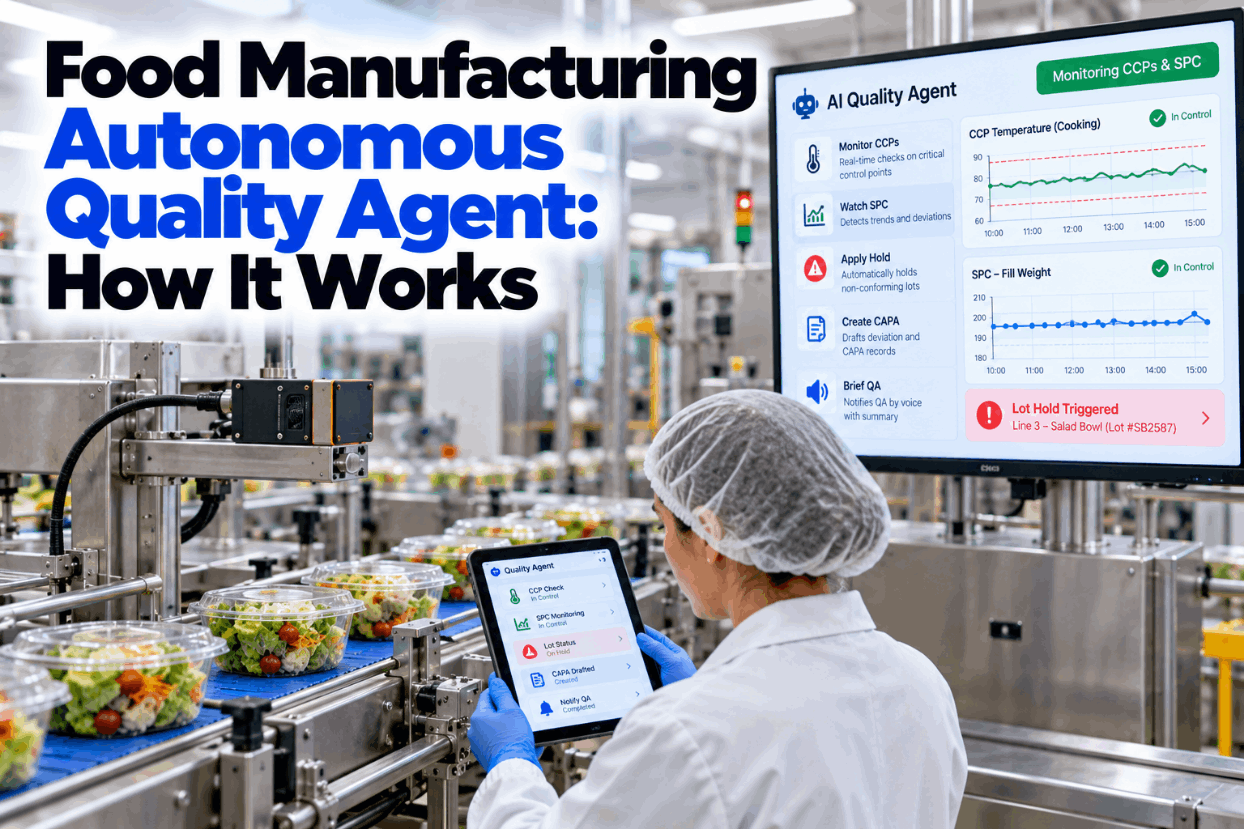
A cook step reads two degrees low at 2 a.m. A metal detector check fails on the last pack line. A fill weight drifts for an hour. In each case someone has to spot it, hold the right cases, write the deviation and wake the right person. An autonomous quality agent does that groundwork against your food safety plan, inside limits you set, and never signs the release. See it handle a CCP deviation in a short food quality agent demo.

AUTONOMOUS AGENT · FOOD QUALITY

An Agent That Holds the Lot and Leaves the Release to QA

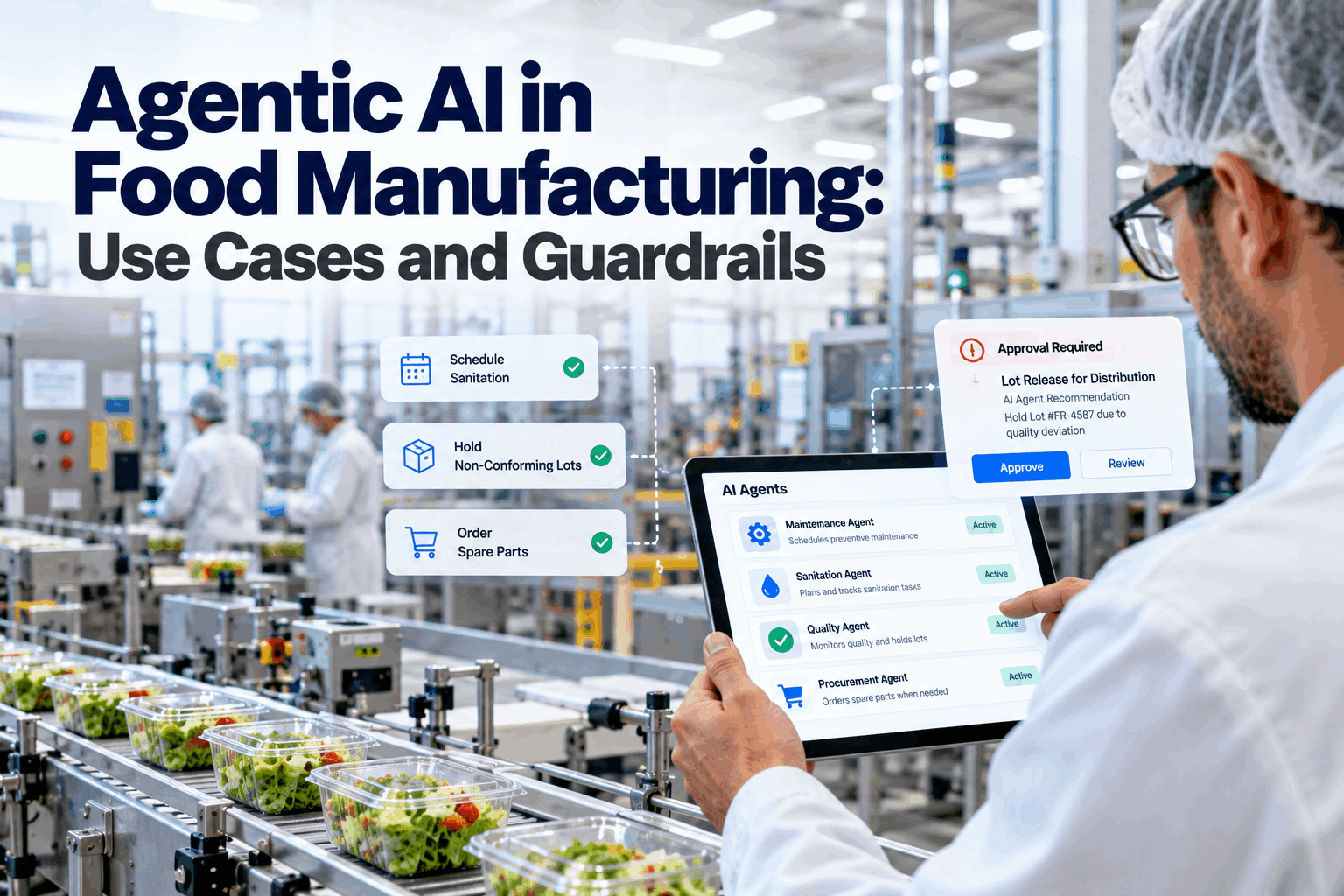
The iFactory Quality Agent watches CCP and SPC data, places holds, drafts deviations and CAPAs and briefs QA by voice. Lot release always remains a human decision, signed by the people your food safety plan names.

CCP 2 · Cook step · Line 4Hold placed
Validated limit: core 74°C minimum
Lowest reading71.2°C for 6 min
Lot on holdL-0412 · 38 cases
DeviationDV-117 drafted for QA
Voice brief to QA on call · 02:17"Line 4 cook step under limit. Lot L-0412 held. Deviation ready for review."
Release: QA signature required
CCP AUTOMATION AND SPC MONITORING

Critical Limits and Control Limits Are Not the Same Signal

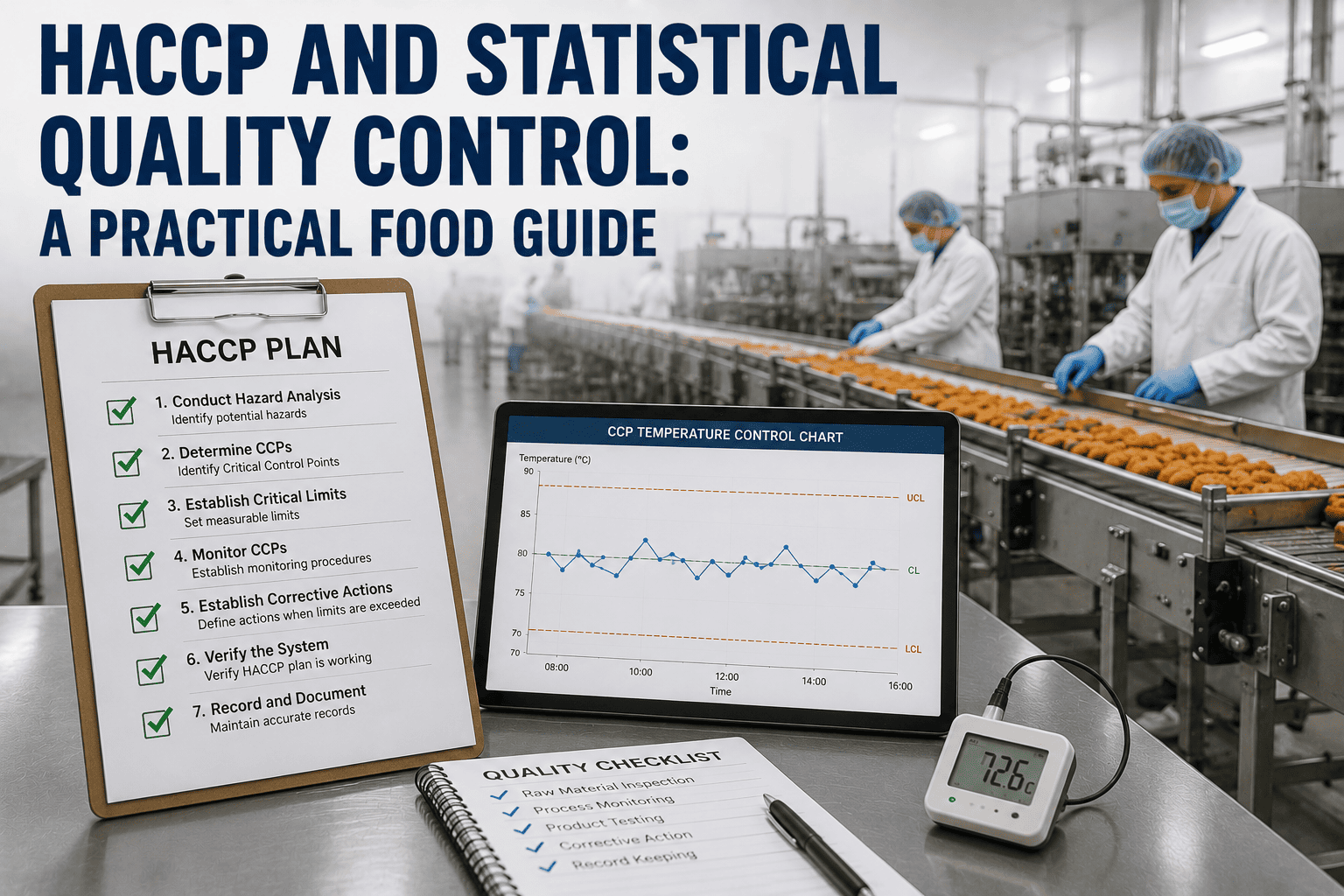
A food line produces two kinds of limit, and the agent treats them very differently. A critical limit on a CCP or preventive control is a food safety boundary set in your HACCP or food safety plan. Crossing it means a required corrective action. An SPC control limit is a statistical boundary based on how the process normally behaves. Crossing it is an early warning, often well before any food safety limit is at risk. Review your own limits with our food quality team.

CCP OR PREVENTIVE CONTROL LIMIT
  • Set by the food safety plan and validated
  • Examples: cook core temperature, metal detection, pH, allergen label check
  • A breach is a deviation and needs corrective action
  • Agent holds affected product at once
SPC CONTROL LIMIT
  • Calculated from process data, usually ±3 sigma
  • Examples: fill weight, oven zone temperature, seal pressure
  • A rule break signals a process change, not a failed product
  • Agent notifies and asks for checks, no hold by default
Why the agent reads both

A cook temperature trending down under SPC rules is a warning that a CCP deviation may be coming. The agent links the two, so QA hears about the trend first.

AUTONOMOUS QUALITY AGENT FOOD SOFTWARE

Which SPC Rules the Agent Applies, and What Each Triggers

The agent uses the Western Electric and Nelson rules, which test a control chart for patterns as well as single points. Zone A lies between 2 and 3 sigma from the centre line, zone B between 1 and 2, and zone C within 1. You choose which rules run on which chart, because more rules catch more changes but also raise more false alarms. Set rules per chart in a chart setup session.

Rule
Pattern
What it often means on a food line
Default agent response
WE 1 · Nelson 1
1 point beyond 3 sigma
A sudden event: probe fault, a bad batch, a missed step
Notify line lead and QA
WE 2 · Nelson 5
2 of 3 points in zone A or beyond, same side
A shift starting, such as a new ingredient lot
Notify, request extra checks
WE 3 · Nelson 6
4 of 5 points in zone B or beyond, same side
A smaller, steady shift in the process mean
Notify line lead
WE 4 · Nelson 2
8 (WE) or 9 (Nelson) points on one side of centre
A sustained offset, such as a filler set point moved
Notify line lead
Nelson 3
6 points in a row rising or falling
Wear or drift: heating element, scale, blade
Notify, link to any CCP nearby
Nelson 4
14 points in a row zig-zagging up and down
Over-adjustment, or two heads or lanes mixed on one chart
Log for review
Nelson 7 and 8
15 points in zone C, or 8 points with none in zone C
Limits no longer match the process, or mixed data streams
Log, suggest limit review
DEVIATION AUTOMATION

Mapping 21 CFR 117.150 to What the Agent Does

Under 21 CFR 117.150, corrective action procedures must make sure four things happen when a preventive control is not properly carried out, and every action must be documented. HACCP plans carry the same idea in Principle 5. The cards below show how the work splits. The agent gathers evidence and contains the product. People correct the cause and judge the food. Map this split to your own plan with our support team.

(i)
Identify and correct the problemAgentDrafts the deviation with readings, times and likely causePeopleFix the cause and confirm the control is back in limit
(ii)
Reduce the chance it happens againAgentDrafts a CAPA and finds earlier similar deviationsPeopleApprove, assign and verify the CAPA
(iii)
Evaluate all affected food for safetyAgentWorks out the lot window and attaches all data for itPeopleQA or PCQI judge the food, with testing if needed
(iv)
Keep affected food out of commerceAgentPlaces the hold in ERP and WMS so it can't shipPeopleDecide release, rework, diversion or disposal
QUALITY DECISION SUPPORT

Five Autonomy Levels, Set Action by Action

Autonomy is not one switch. Each action the agent can take gets its own level, written into your procedures and approved by QA. A plant might allow automatic holds on CCP deviations from day one, keep CAPAs at draft only and never let the agent touch release. Levels can be raised or lowered at any time, with the change logged. Choose levels for each action in a guardrail workshop.

L0
ObserveLogs the signal onlyNelson 4 pattern on a filler chart
L1
NotifyBriefs people by voice or messageFill weight trending down
L2
ContainPlaces reversible holds, asks for checksCook CCP below its limit
L3
DraftPrepares records for human reviewDeviation, CAPA, release packet
L4
Human onlyThe agent may not act at allRelease, disposition, recall decision

A Night-Shift Briefing QA Can Act On

The agent doesn't leave QA a pile of alarms. It speaks a short brief, answers follow-up questions and confirms back each instruction before it acts. Holds and drafts are ready before anyone opens a laptop.

QA on call and iFactory · voice
QA leadWhat's on hold tonight?
iFactoryOne lot. L-0412 on Line 4, cook step at 71.2°C for six minutes against a 74°C limit. 38 cases held. Earlier and later lots read in limit.
QA leadKeep the hold, add it to the morning review.
iFactoryConfirmed: hold stays on L-0412, deviation DV-117 added to the 07:00 QA review.
ALLERGEN GUARDRAILS

Allergen Controls Get Tighter Rules, Not Looser Ones

FDA has said undeclared allergens are a leading cause of food recalls, so allergen signals get the strictest settings. Under 117.150(c), some allergen and sanitation problems can be handled as prompt corrections rather than full corrective actions, but they still need a record. The agent treats every allergen mismatch as a hold first and leaves the call on correction or corrective action to QA. Set allergen rules with our allergen specialists.

Changeover
No sign-off, no releaseOutput made after an allergen changeover is held until the clean and inspection are signed off.
Label and pack
Label must match the orderA label, film or ink-jet code that doesn't match the work order puts that pack run on hold.
Receiving
Status before useAn ingredient lot with a missing or changed allergen statement stays in quarantine status.
QA ASSISTANT ESCALATION

Who Hears About It, and How Fast

Escalation follows time and severity, not volume. If nobody acknowledges a brief, the agent moves one step up the list. It never makes up for silence by doing more on its own, so a missed call leads to a louder alert, not a bigger action. The timings below are example settings for a CCP deviation, and you set your own. Agree your ladder in a QA workflow session.

0 min
Line leadVoice alert at the line, hold confirmed
5 min
QA technicianBrief and lot window sent
15 min
QA on callPhone call if not acknowledged
30 min
QA manager or PCQIJoins if the cause is not found
If shipped
Plant managerRecall team alerted, people decide
AUTONOMOUS QUALITY AGENT FOOD TEMPLATE

The Release Packet the Agent Prepares, and the Signature It Can't Give

Whether a plant uses positive release with test-and-hold or releases on records, someone named in the food safety plan signs. The PCQI must review, or oversee review of, monitoring and corrective action records within 7 working days under 117.165. The agent's job is to put every record for a lot in one packet so that review is quick and complete. Ask our support team for a sample packet.

Lot and productLot, line, date, SKU, allergen profile
CCP recordsEvery reading for the lot window
DeviationsOpen and closed, with actions taken
Hold historyWho placed, changed or lifted each hold
Test resultsMicro, allergen and lab checks if required
Label checkLabel, code and order match
Agent summaryWhat it saw, did and could not judge
Release decisionQA name, signature, time, reason
AUTONOMOUS QUALITY AGENT FOOD EXAMPLES

Three Overnight Events, Illustrated

These are illustrations of how the agent typically responds, not case studies. Each one shows a different level at work, from a hold that runs on its own to a trend that only earns a message. Your own plan and procedures decide the real response. Walk through your own recent deviations in a scenario review.

Metal detector check fails
Hold back to the last good checkThe test piece is not rejected at 03:10. Output since the 01:10 pass goes on hold. QA has it re-screened after repair and releases the cases that pass.
Allergen changeover not signed
First output held at onceLine 2 restarts after a milk product before sign-off. The agent holds the output and alerts QA, who checks the clean and decides how to record it.
Fill weight trend
Message only, no holdNelson rule 3 fires on one filler head. No CCP is involved, so the agent notifies the line lead, who finds a worn valve.
AUTONOMOUS QUALITY AGENT FOOD BEST PRACTICES

A Guardrail Checklist to Finish Before Go-Live

Most problems with quality agents come from settings nobody wrote down. Work through this list with QA, production and the PCQI before any hold is switched on. Tick items here as you go, and keep the signed list with your food safety plan. For a version with your own CCPs filled in, contact our support team.

Before holds go liveQA and PCQI
Before drafts go liveQA and production
TURNKEY AI DEPLOYMENT

Quality Agent, Plant Connectors and AI Server in One Package

iFactory delivers the Quality Agent as a turnkey bundle. A pre-configured NVIDIA AI server ships racked and ready with the agent, the SPC rules engine, voice briefing and your autonomy levels pre-loaded, so CCP data stays on site. You rack it, plug in power and Ethernet, and the AI is live. To scope it for your plant, request a turnkey quote.

What's Included
  • Pre-configured NVIDIA AI edge server, racked and ready
  • Connectors for CCP loggers, SPC, metal detectors and checkweighers
  • Hold links to your ERP and WMS
  • Deviation, CAPA and release packet drafts in your QMS
  • Voice briefings with confirm-back for QA and line leads
  • Autonomy levels and escalation ladder set to your plan
  • 24×7 remote monitoring of the agent and hardware
Live in 6–12 weeks
Wk 1–4
Connect and Configure

Server installed, CCP and SPC data linked, autonomy levels agreed with QA and the PCQI.

Wk 5–8
Shadow Mode

The agent proposes holds and drafts on one line while QA compares its calls with their own.

Wk 9–12
Go-Live and Training

Approved levels switched on, QA and line leads trained, escalation tested on every shift.

HOW iFACTORY FITS

A Food Quality Agent That Works Inside Your Plan

The iFactory Quality Agent follows your HACCP or food safety plan rather than writing its own. It does the watching and the paperwork, so QA spends its time on decisions. Our support team can walk you through a pilot plan.

1
Monitors CCP and SPC data. Critical limits and control chart rules are checked continuously, and linked.
2
Applies holds. Affected lots are blocked in ERP and WMS within the levels you approve.
3
Drafts deviations and CAPAs. Records arrive with readings, lot windows and evidence attached.
4
Briefs QA by voice. Short spoken briefs with confirm-back, while lot release always remains a human decision.
1000+
Industrial clients running iFactory
99.9%
Platform uptime for round-the-clock food plants
6-12 wks
From racked server to a live quality agent
FREQUENTLY ASKED QUESTIONS

What Food QA Leaders Ask About Autonomous Quality Agents

What is an autonomous quality agent in food manufacturing?
It is AI software that watches CCP, preventive control and SPC data, and carries the response forward. It can hold affected lots, draft deviations and CAPAs, gather the records for a lot and brief QA by voice. Each action has an autonomy level you set, and every step is logged.
Can the agent release a lot?
No. Release, rework, diversion and disposal are always human decisions, made by the people your food safety plan names, usually QA with PCQI oversight. The agent prepares the release packet so that review is faster and complete, but it cannot sign it.
How does it treat a CCP deviation differently from an SPC alarm?
A CCP or preventive control breach is a food safety deviation, so the agent holds affected product and drafts the deviation at once. An SPC rule break, such as six points trending down, is a process warning. By default the agent notifies people and asks for checks, without placing a hold.
Does it meet the corrective action rules in 21 CFR 117.150?
It supports them. The rule requires that problems are corrected, recurrence is reduced, affected food is evaluated and kept out of commerce, and actions are recorded. The agent handles containment and records. The facility, and its PCQI, remain responsible for the decisions and the review.
How are allergens handled?
With the strictest settings. Output after an allergen changeover is held until sign-off, label and code mismatches hold the pack run, and ingredient lots with a changed allergen statement stay in quarantine status. QA decides whether each event is a correction or a corrective action.
What does an implementation guide for a food quality agent look like?
Connect CCP and SPC data on one line, agree autonomy levels and the escalation ladder, then run in shadow mode while QA compares the agent's calls with their own. Switch on holds first and drafts next. Our support team can plan that pilot with you.

Faster Holds, Complete Records, Same People Signing

Connect your CCP and SPC data, write down the agent's limits and let it watch every shift while QA keeps the release. The full system is delivered turnkey and goes live in 6 to 12 weeks.
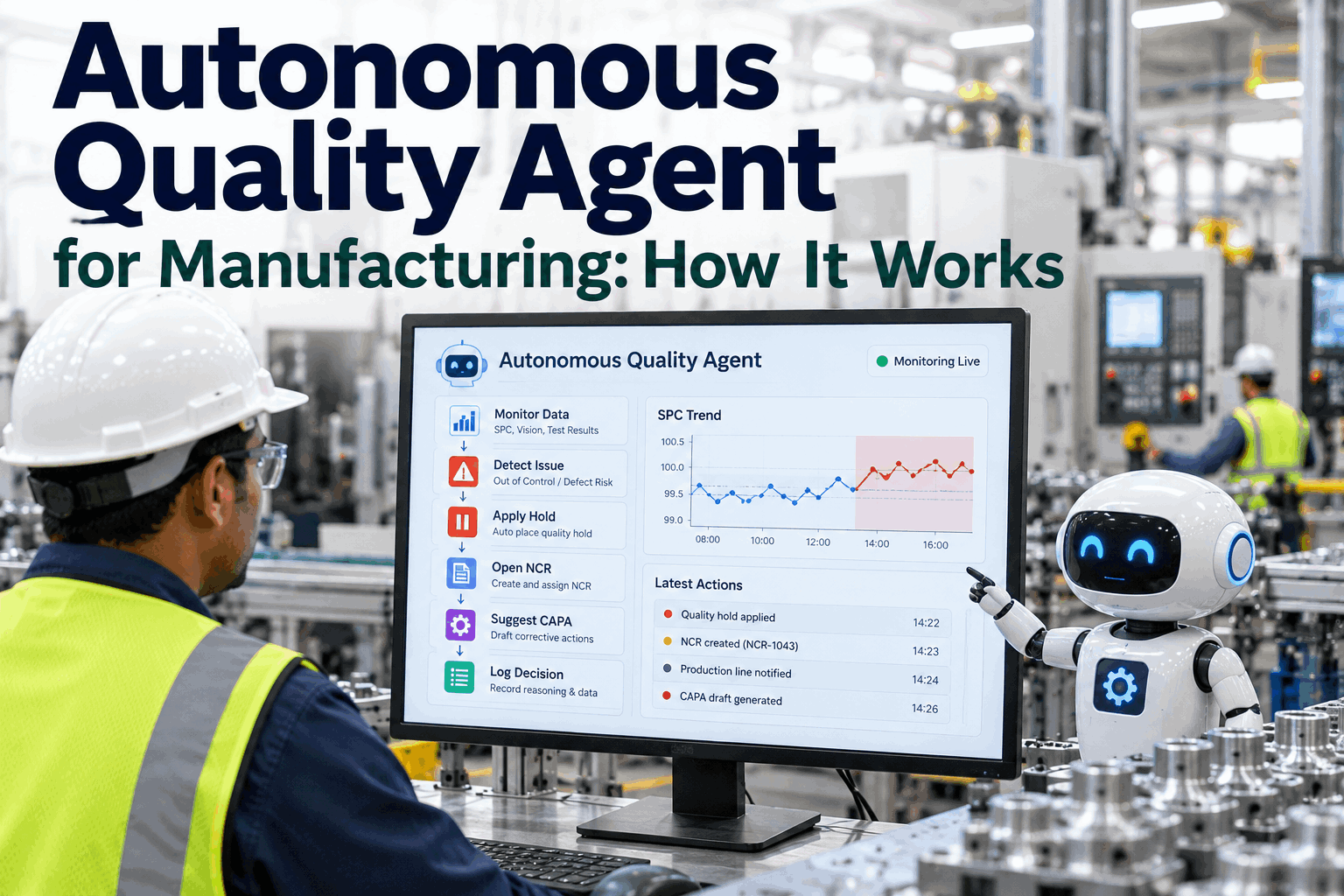
Example agent week · Food plant
CCP deviationsHeld at once, drafted for QA
SPC rule breaksBriefed to line leads
Allergen checksMismatches held until sign-off
Lot releaseSigned by QA only
Every action logged against the lot

Share This Story, Choose Your Platform!