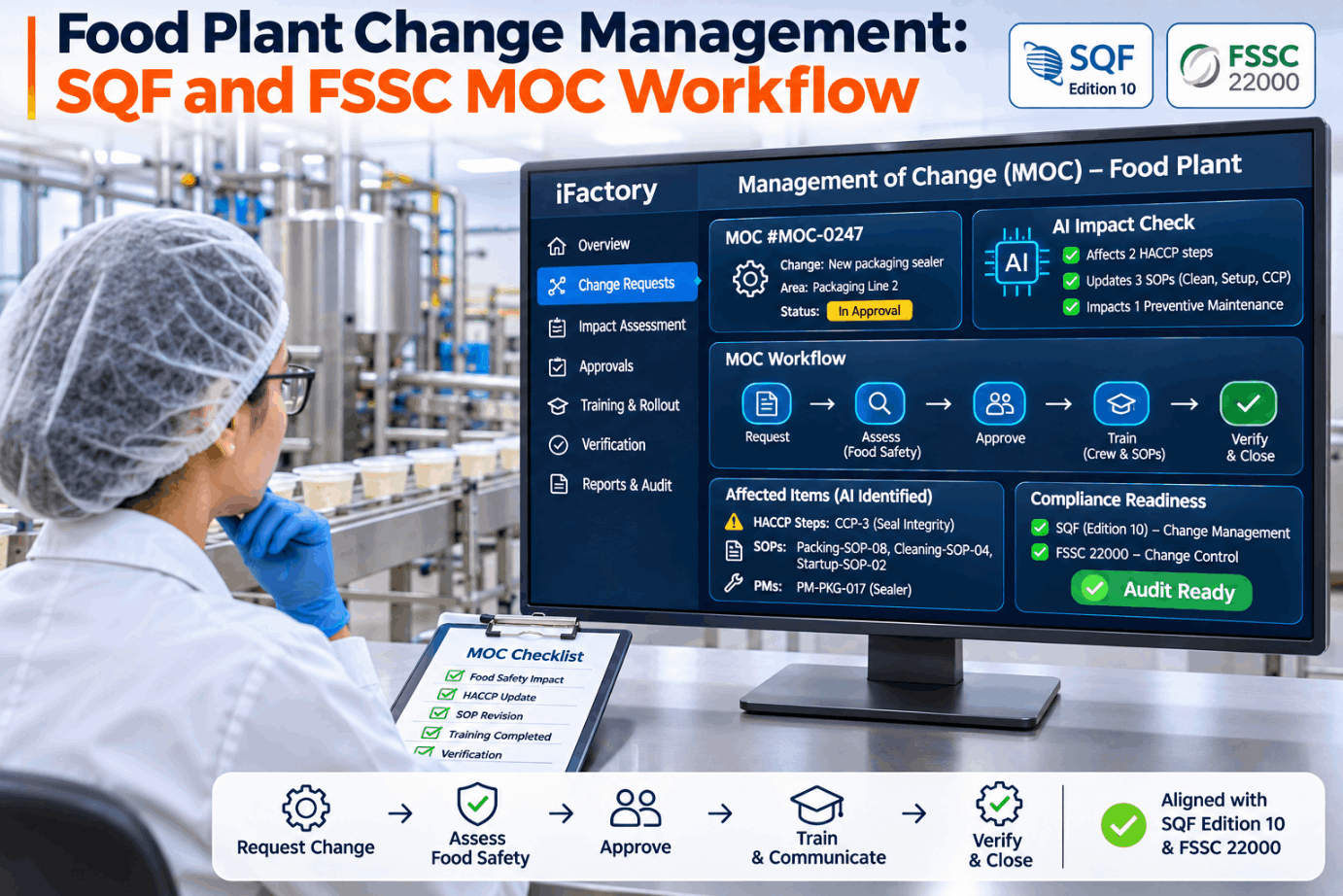
In a food plant, the change that causes trouble is rarely the big capital project. It is the new supplier's starch, the faster belt setting or the cleaning chemical swapped during a shortage, made by someone who didn't know it touched a CCP or an allergen control. Management of change (MOC) gives every one of those changes the same short route: assess the food safety impact, approve, train, verify and keep the record. Walk through a live MOC record in a change workflow demo.
MOC MODULE · AI IMPACT CHECK
Every Plant Change Assessed, Approved and Trained Before It Goes Live
iFactory's MOC Module lists the HACCP steps, SOPs and PMs a change touches, routes it to the right approvers and holds go-live until training is done. Every step is kept as a record ready for SQF, FSSC 22000 and BRCGS audits.
MOC-118 · New metal detector aperture · Line 4
Permanent change · significant · raised by maintenance
CCP 3
SOP-22
PM-0412
Label: none
Food safetyApproved
MaintenanceApproved
ProductionApproved
QATraining 9 of 14
WHAT COUNTS AS A CHANGE
Seven Kinds of Change That Need an MOC
Most missed changes aren't hidden; they just never reach the food safety team. A short list of change types, posted where people raise work orders and purchase requests, catches most of them. The examples below show what each type can touch. Ask our support team how change types are set up as MOC forms.
Equipment
New detector aperture, second-hand fillerHygienic design, CCPs, PMs, cleaning stepsIngredient or supplier
New starch supplier, changed specAllergen status, specs, label, supplier approvalProcess parameter
Oven belt speed raised by 10%Kill step, critical limits, validationLayout
Line moved, new wall openingHygiene zoning, people flow, pest accessCleaning chemical
New sanitizer or detergentContact time, residue, rinse checks, SSOPsPackaging
Thinner film, new label stockSeal strength, claims, food contact statusSoftware
Checkweigher recipe, PLC logicReject function, records, CCP monitoringUsually not an MOC
Like-for-like parts and routine PMHandled by the work order, unless the part or method differs
WHAT THE STANDARDS ASK
Change Clauses in SQF, FSSC 22000, ISO 22000 and BRCGS
Every GFSI-benchmarked scheme now expects a planned, recorded way to handle change, and SQF Edition 10 makes it a named element. The wording below is a short paraphrase with status as of November 2026, so read the standard itself and confirm dates with your certification body. See how one MOC record maps to each scheme in a compliance walkthrough.
TEMPORARY VS PERMANENT CHANGES
A Temporary Change Still Needs an End Date and a Way Back
Temporary changes are where control slips most often. A borrowed pump, a stand-in ingredient or a bypassed sensor "just for this week" can quietly become how the line runs. Treat them with the same impact check, plus an end date and a reversal check. Talk through your temporary change rules with our support team.
Temporary change
- Same impact check, scaled to the risk
- End date set at approval, with an owner
- Reversal checked and signed when it ends
- Past its end date, it becomes a permanent MOC
Permanent change
- Full impact assessment by the HACCP team
- HACCP plan revision, SOPs, PMs and specs revised
- Training finished before go-live
- Verification after start-up, then formal close-out
FOOD PLANT CHANGE MANAGEMENT TEMPLATE
A Change Impact Assessment in Six Questions
A change impact assessment asks the same questions every time, whoever raises the change. Tick each item once the HACCP team has answered it, and record why when the answer is "no impact". Get a copy of the full form from our food safety team.
The AI Lists What a Change Touches. Your Team Decides.
When an MOC is raised, iFactory reads the asset, line and ingredient links and lists the HACCP steps, SOPs and PMs likely to be affected. The HACCP team confirms, adds or removes items and validates the result.
MOC-118 · QA manager and iFactory
QA managerWhat does MOC-118 touch?
iFactoryThe Line 4 metal detector is CCP 3. I found SOP-22 for the start-up test, PM-0412 for calibration and the test-piece entry in the HACCP plan. No label impact.
QA managerAdd the reject bin check, SOP-31.
iFactoryAdded. Approvals sent to food safety, maintenance, production and QA. Go-live waits for training.
MOC APPROVAL
Who Signs Depends on the Risk Class
One approval route for every change either slows small changes down or waves big ones through. Most plants use a few risk classes, each with its own approvers. The classes below are examples; your procedure sets the real ones. Set up approval routes with our support team.
Like-for-like
Work order onlySame part, same spec, same method. No MOC.Minor
Supervisor and QANew label stock to the same spec, a moved hand-wash sink.Significant
Food safety, maintenance, production, QAAnything touching a CCP, allergen control or process limit.Emergency
On-call QA, then the full teamAct now to stay safe, record fast, review in full after.
TRAINING BEFORE GO-LIVE
No Go-Live Until the Right People Are Trained
A change is only as safe as the people running it on the first shift. The MOC lists who needs training by role, and go-live stays held until every name is signed off. For MOC-118, that means operators, technicians, QA and shift leads all know the new start-up test. See the training gate in a live MOC demo.
MOC-118 · training by role9 of 14 signed off
Line 4 operators5 / 8
Maintenance techs2 / 3
QA technicians2 / 2
Shift leads0 / 1
VERIFICATION AFTER THE CHANGE
Prove the Change Works Once the Line Runs
Approval says the plan is sound; verification shows the change works in production. Set the checks when the MOC is approved, so nobody has to invent them later. Plan verification steps with our support team.
First run
Start-up test passedDetector test with each test piece, reject confirmed into the locked bin.First week
CCP records reviewed dailyTest results, rejects and any false rejects checked by QA.First month
PM and sanitation checkedPM-0412 done on its new interval, new fittings cleaned and inspected.Close-out
HACCP team signsVerification evidence attached, MOC closed with a date.
EMERGENCY CHANGES
When the Change Can't Wait for a Meeting
Breakdowns and supply gaps don't wait for approvals. SQF Edition 10 names emergency and unplanned changes in its change element, which means the shortcut has to be a planned one. Picture a sanitizer that can't be delivered, and an approved substitute used for three nights. Rehearse your emergency route in a scenario session.
1Make safeHold product if there's any doubt.
2Call on-call QASpoken approval, logged with time.
3Record fastEmergency MOC opened within one working day, as an example rule.
4Review in fullHACCP team runs the impact check after the fact.
5DecideReverse it, or make it permanent through a standard MOC.
PROCESS CHANGE RECORDS
What an Auditor Expects in One MOC Record
An auditor checking SQF, FSSC 22000 or BRCGS change control will usually pick a few recent changes and trace them end to end. Each record should answer that trace without a hunt through email. Request a sample record layout from our support team.
MOC number and titleMOC-118, detector aperture, Line 4
Type and classEquipment, permanent, significant
Reason and requesterLarger pack size, maintenance lead
Impact assessmentSix questions answered, HACCP team signed
Documents revisedHACCP plan, SOP-22, SOP-31, PM-0412
ApprovalsFour names, dates and roles
Training14 of 14 signed before go-live
Verification and close-outEvidence attached, closed with a date
FOOD PLANT CHANGE MANAGEMENT FOR PLANT MANAGERS
Four Numbers That Show Whether MOC Is Working
A monthly look at a few numbers shows whether changes are being closed or just opened. The figures below are an assumed example to show the arithmetic. See these numbers on a live board in a plant manager demo.
Open MOCs past target date18.2%4 of 22 open
Temporary changes past end date16.7%1 of 6 live
Emergency MOCs reviewed on time3 of 3Full review within the set window
Average days, raise to close19.0285 days across 15 closed MOCs
FOOD PLANT CHANGE MANAGEMENT BEST PRACTICES
Three Changes Handled Well
These are illustrations of good practice, not case studies. Your own procedure and HACCP team decide the real answer each time. Talk through a change you have coming up with our support team.
New flour supplier
Allergen check before the first deliveryThe new mill also handles soy. The spec, supplier approval and allergen matrix are revised, and the label is checked for a precautionary statement.Checkweigher software
Treated as a CCP-adjacent changeThe vendor's new version changes reject timing. A reject test runs at start-up and records are checked for a week before close-out.Cleaning chemical shortage
Temporary, with a fixed endAn approved substitute is used for two weeks with a rinse check added. The MOC closes when the usual product returns.
FOOD PLANT CHANGE MANAGEMENT COST AND ROI
Count the Hours a Paper MOC Costs Today
The main value of MOC is the incident that never happens, which shouldn't be priced. The time spent chasing signatures and assembling records can be. Every input below is assumed; swap in your own. Run your own numbers through it in a 30-minute session.
MOCs a year, assumed60
Hours per MOC chasing approvals and records on paper, assumed3.0
Hours per MOC with a routed workflow, assumed1.0
Hours to pull MOC evidence for each audit, paper vs workflow, assumed16 vs 4
Hours a year, one audit60 × 2 = 120, plus 12 = 132 hours
TURNKEY AI DEPLOYMENT
Change Workflow and AI Impact Check on Your Own Server
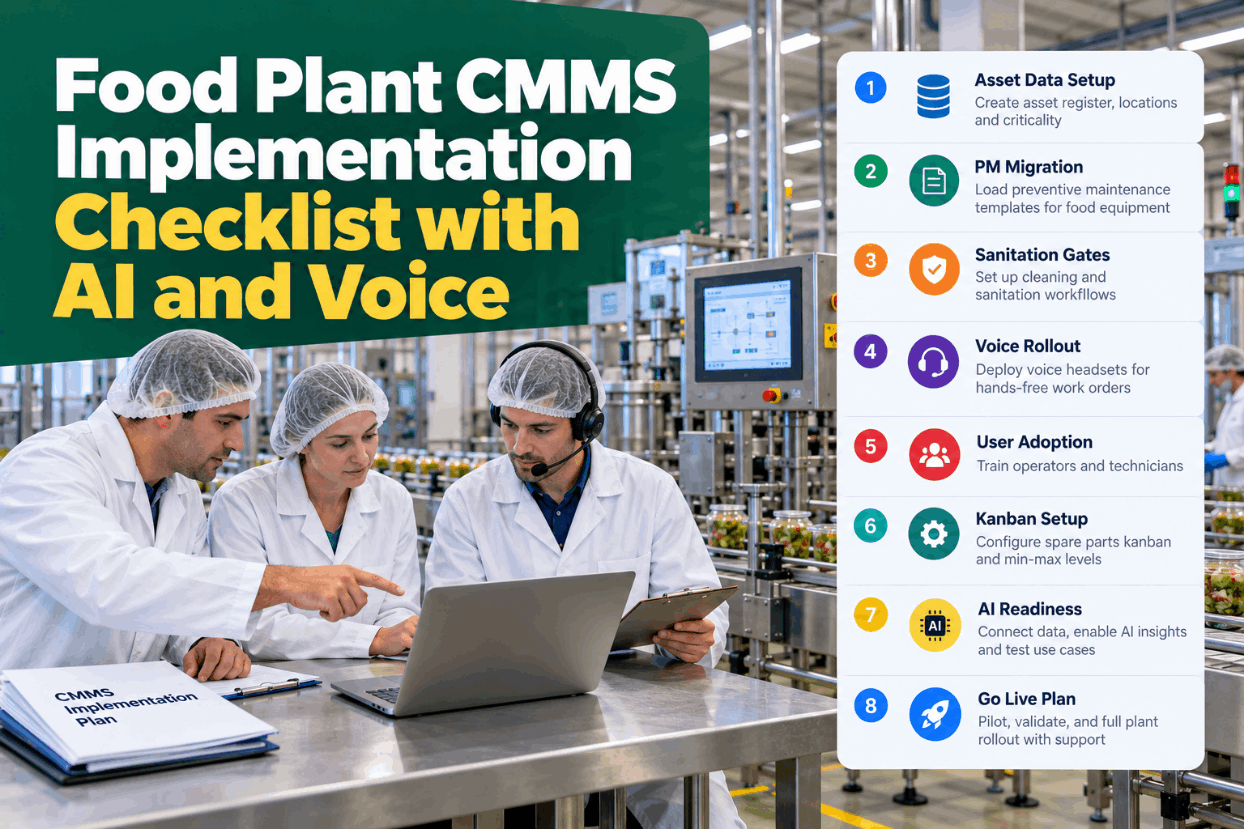
iFactory delivers the MOC Module and AI Impact Check as a turnkey package. A pre-configured NVIDIA AI server ships racked and ready, so your HACCP plan, SOPs and asset data stay on site. You rack it, plug in power and Ethernet, and the AI is live. Scope it with our support team.
What's Included
- Pre-configured NVIDIA AI server, racked and ready
- MOC forms by change type and risk class
- AI impact check linked to HACCP steps, SOPs and PMs
- Approval routing with electronic sign-off
- Training gate tied to go-live
- Verification and close-out tasks
- Audit-ready record export for SQF, FSSC 22000 and BRCGS
Live in 6–12 weeks
Wk 1–4
Load and Link
HACCP plan, SOP list, PM plan and assets linked; risk classes and approvers agreed.
Wk 5–8
Pilot on One Line
Live MOCs on one line, with every AI suggestion checked by the HACCP team.
Wk 9–12
Plant-Wide Go-Live
All departments raising MOCs, with the training gate and audit export switched on.
HOW iFACTORY FITS
Food Plant Change Management Software That Keeps the Record
iFactory joins the change request, the HACCP plan and the maintenance plan in one record, so nothing a change touches is missed. See the fit for your plant in a short demo.
1
Lists what a change touches. The AI suggests affected HACCP steps, SOPs and PMs for the team to confirm.
2
Routes approvals by risk. Each class goes to the right approvers, with names and dates kept.
3
Holds go-live for training. The change can't start until every listed person is signed off.
4
Keeps audit-ready records. Each MOC traces end to end for SQF Edition 10 change management audits.
1000+
Industrial clients running iFactory
99.9%
Platform uptime for food and process plants
6-12 wks
From racked server to live MOC workflow
FREQUENTLY ASKED QUESTIONS
Change Management Questions From QA and Operations Leaders
What is management of change in a food plant?
It is a set route for any change that could affect food safety: equipment, ingredients or suppliers, process settings, layout, cleaning chemicals, packaging and software. Each change is assessed for food safety impact, approved, supported by training, verified once running and kept as a record.
What does SQF Edition 10 ask for on change management?
Element 2.3.5 asks for a documented procedure to evaluate changes that could affect food safety, including temporary, emergency, unplanned and corrective-action changes, with changes confirmed or validated, documented and communicated. SQFI released Edition 10 in March 2026 and expects audits to start in early January 2027. You can
see a record mapped to 2.3.5 before your audit.
Does the AI decide which HACCP steps are affected?
No. It suggests the HACCP steps, SOPs and PMs linked to the asset, line or ingredient being changed. The HACCP team confirms, adds or removes items, decides on any HACCP plan revision and validates the result. To see how suggestions are reviewed,
walk through it with our team.
How should temporary changes be handled?
With the same impact check as a permanent change, scaled to the risk, plus an end date, an owner and a signed reversal check. A temporary change that runs past its end date should become a permanent MOC. Our
support team can help set those rules.
Is replacing a part like-for-like a change?
Usually not. A part of the same spec fitted by the same method is handled by the work order. If the part, material, supplier or method differs, or the work touches a CCP or allergen control, raise an MOC.
How do we start an MOC workflow in our plant?
Agree your change types and risk classes, link the HACCP plan, SOPs and PM plan, then pilot on one line before going plant-wide. Most sites keep paper and digital side by side for the pilot. To plan your first weeks,
book a 30-minute demo.
Make Every Change One You Can Defend at Audit
AI-listed impacts, approvals routed by risk, training before go-live and a full record for SQF, FSSC 22000 and BRCGS. The MOC Module arrives turnkey and goes live in 6 to 12 weeks.
Example MOC log · this quarter
Open MOCs22
Closed this quarter15
Temporary changes live6
Emergency MOCs3
Every change linked to its HACCP steps, SOPs and PMs