Food Plant Daily Startup Routine with an AI Checklist Agent

By James C on November 3, 2026

food-plant-daily-startup-routine-ai-checklist-agent

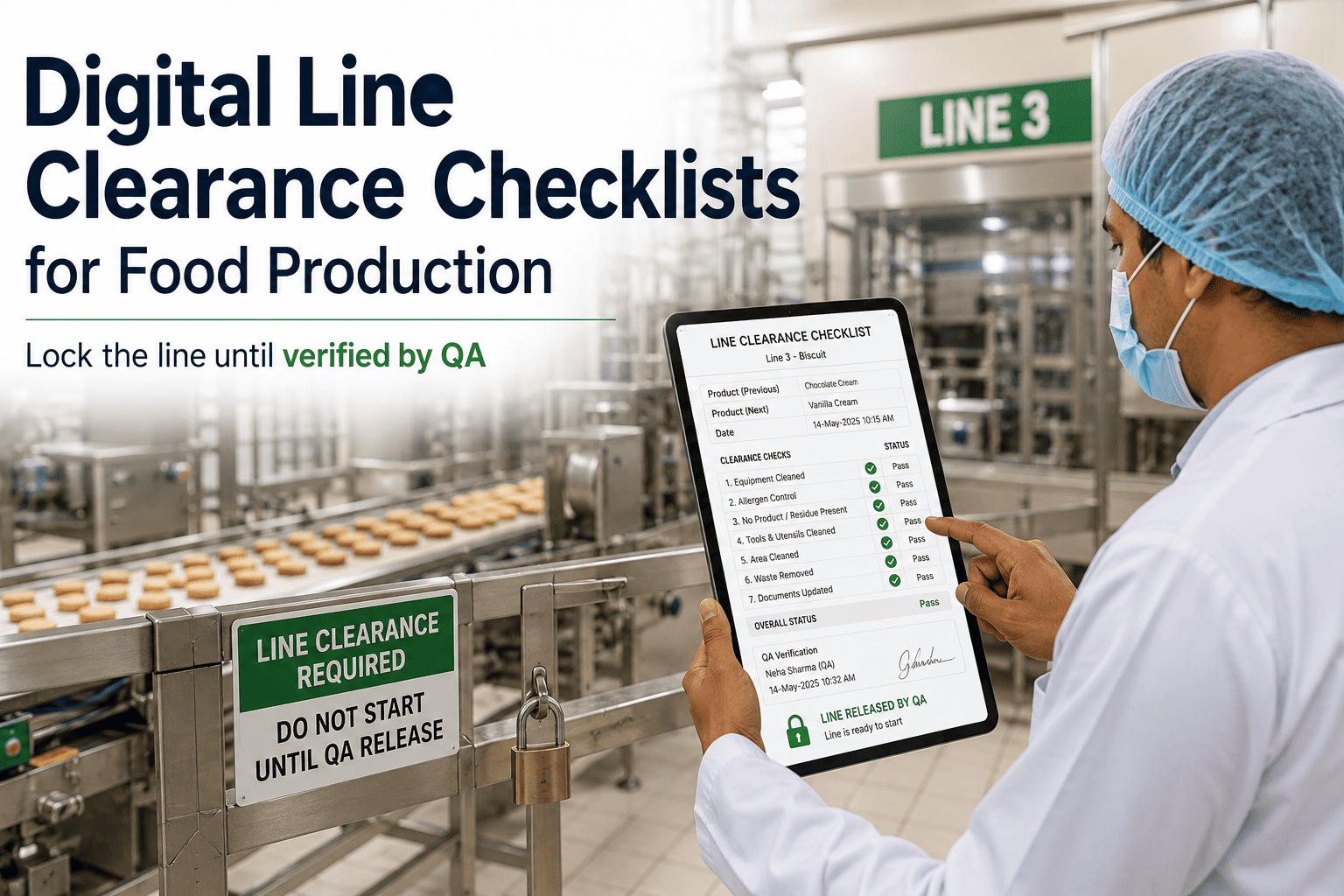
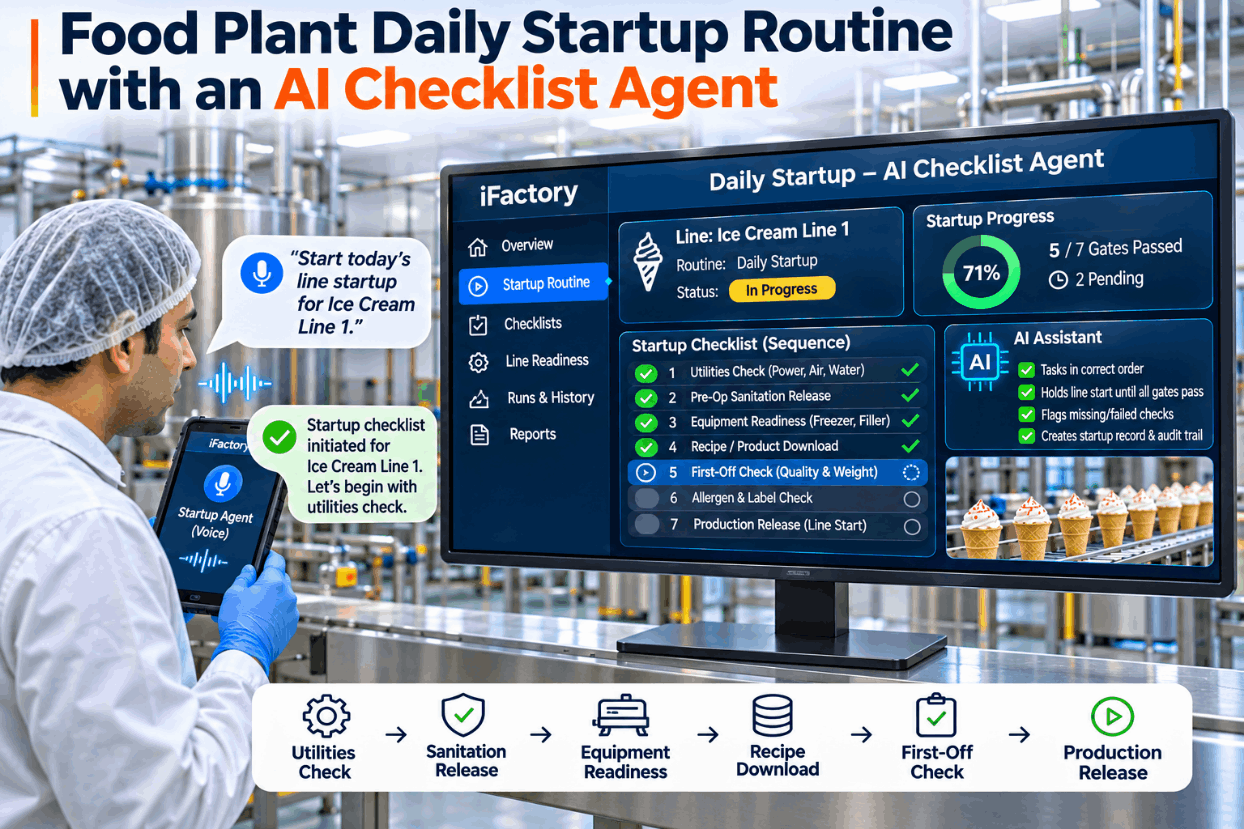
Most food plant mornings start the same way: someone walks the line with a clipboard, someone else calls maintenance about the air pressure, and production wants to run at 06:00 whether QA has signed off or not. The steps are known. What goes wrong is the order, the handoffs and the one check that gets done after the line is already running. An AI checklist agent keeps each gate in sequence, confirms it by voice and holds the start in software until every gate has passed. See a full startup run in a short startup agent demo.

STARTUP ORCHESTRATION AGENT

Every Startup Gate in Order Before Line 3 Runs

iFactory sequences startup tasks across sanitation, maintenance, QA and production. Each owner confirms their gate by voice, the agent reads it back, and the line start stays on hold in software until every gate passes.

Line 3 · Tuesday startupPlanned start 06:00
Utilities04:30 ✓
Sanitation release05:10 ✓
Pre-op QA05:25 ✓
Recipe load05:35 ✓
Allergen checkopen
First-offlocked
Line 3 start held · 1 gate open
STARTUP SEQUENCE

Eight Gates Between an Empty Line and the First Good Pack

Order matters because each gate depends on the one before it. A pre-op inspection on a line that sanitation has not released is wasted effort. A metal detector test before the right recipe is loaded checks the wrong product settings. A first-off check before the allergen gate passes may approve product that has to be held. The sequence below is a common one. Your HACCP or food safety plan sets your own. Ask our support team to map your plant's order.

1UtilitiesAir, steam, refrigeration and water at setpoint
2Sanitation releaseSanitation lead signs the line over as clean
3Pre-op inspectionQA checks surfaces, guards and the area
4Allergen verificationChangeover checked against the next product
5Recipe loadOrder and recipe version released to the line
6Equipment checksMetal detector or X-ray test, scales, coders
7First-off checksWeight, seal, code date and label on first packs
8ReleaseProduction runs at rate
Gates 4 and 5 can overlap

The agent can stage the recipe early so it knows the next product's allergen profile, as on the Line 3 board above. The recipe is not released to run until the allergen check passes.

WHO OWNS EACH GATE

One Owner and One Piece of Evidence per Gate

A gate with two owners is a gate nobody owns. Each step gets one named role, one piece of evidence and one short spoken phrase the agent listens for. The agent reads every confirmation back before it closes the gate, so a misheard word never opens the line. Set up owners and phrases in a gate setup session.

Gate
Owner
Evidence recorded
Spoken confirmation
Utilities
Maintenance or utilities tech
Air, steam, refrigeration and water readings in range
"Utilities Line 3 ready"
Sanitation release
Sanitation lead
Clean complete, tools and chemicals removed, sign-off name
"Line 3 released from sanitation"
Pre-op inspection
QA technician
Inspection result, any re-clean called and photo of findings
"Pre-op Line 3 pass"
Allergen verification
QA technician
Allergen of last and next run, test type and result
"Allergen check Line 3 negative"
Recipe load
Line lead
Order, recipe version and label artwork match the schedule
"Recipe loaded, order 4418"
Equipment checks
Line operator
Metal detector test pieces passed, scale check, coder test print
"Detector test pass, all three"
First-off checks
QA technician
Weight, seal, code date and label on first packs
"First-off Line 3 approved"
WHAT A HOLD MEANS

A Software Hold, Never a Safety Interlock

When a gate is open, the agent holds the line start in software. In practice it keeps the order or recipe from being released in the MES or line control and shows the line as not ready. That is a production control, not a machine safety device. Guards, interlocks and lockout/tagout under OSHA 29 CFR 1910.147 stay exactly as they are, and sanitation release is still signed by a person. Review where the hold sits in your systems with our support team.

What the hold does
  • Keeps the order or recipe from release until every gate passes
  • Shows the line as held, with the open gate and its owner
  • Calls the owner of the open gate by voice
  • Logs who confirmed each gate and when
What the hold never does
  • Replace machine guards or safety interlocks
  • Replace lockout/tagout before people work on equipment
  • Sign a sanitation release or QA approval for a person
  • Stop a running machine in an emergency
UTILITIES STARTUP

Air, Steam, Refrigeration and Water Come First

A line that starts on low air pressure or warm cold rooms will stop again within the hour. Utilities are the first gate because every later check assumes they are steady. The agent reads the values your systems already measure and asks the utilities tech to confirm anything it cannot see. Your setpoints and limits come from your own engineering and food safety plan. See the utilities gate in a live walkthrough.

Compressed air
Header pressure at setpointDryer running with no dew point alarm. Filters for product-contact air in date.
Refrigeration
Rooms and chillers in rangeCold rooms at temperature, no ammonia detector alarms, compressors loaded normally.
Steam and hot water
Pressure and temperature upBoiler on line, CIP and wash water at temperature for the first clean-in-place cycle.
Potable water
Supply checkedPressure normal and any residual or treatment check your water plan requires is done.

Say It Once, Hear It Back, Close the Gate

Owners confirm gates with a short spoken phrase while their hands stay busy. The agent reads the key details back, waits for a yes and then opens the next gate in the sequence.

Line 3 · QA technician and iFactory · 05:52
QA technicianAllergen check Line 3 negative. Sesame, lateral flow.
iFactoryLine 3 allergen check, sesame, lateral flow, negative, 05:52. Correct?
QA technicianYes.
iFactoryAllergen gate closed. Recipe released. Line operator, metal detector test is next.
FIRST OFF INSPECTION AND RECIPE DOWNLOAD

The Last Checks Before the Line Runs at Rate

The recipe download sets the line for the right product. The detector test proves the detector rejects test pieces on that setting. First-off checks prove the first packs are right. BRCGS Food Safety Issue 9 expects documented procedures for testing metal detectors and X-ray units, including methods and frequency. Ask our QA support team how your current records map across.

Recipe downloadGate 5
Order4418 · Sesame bagel 6-pack
Recipe versionRev 7, matches schedule
Allergen profileWheat, sesame
Label artworkMatches order
Detector testGate 6
FerrousRejected
Non-ferrousRejected
StainlessRejected
Reject binLocked, alarm tested
First-off checkGate 7
"First-off Line 3, weight good, seal good, code date good."
Read back: Line 3 first-off, weight, seal and code date good. Correct?
ResultApproved by QA, line released
MISSED-STEP PATTERNS

The Steps That Slip When Mornings Run Late

Missed steps are rarely random. They cluster on late mornings, short-staffed shifts and product runs that look the same as yesterday's. Because every gate is time-stamped, the agent can show which steps are done out of order and when. The counts below are an illustration of four weeks on one line, not plant data. See pattern reports on sample data in a readiness demo.

6
Detector test logged after releaseThe test was done, but recorded after packs were already running.
4
First-off taken before rate speedPacks checked at slow speed, before seals had settled.
3
Pre-op started before sanitation releaseQA began inspecting while sanitation was still finishing.
2
Allergen check skipped on a same-allergen runAssumed unneeded. Your plan decides when it truly is.
FOOD PLANT DAILY STARTUP ROUTINE TEMPLATE

A Line Startup Checklist You Can Use Tomorrow

Use this as a starting point and change it to match your HACCP plan, SSOPs and equipment. It works on paper, and the same items become the agent's gates once loaded. For USDA-inspected meat and poultry plants, 9 CFR 416.13(a) requires the pre-operational procedures in the Sanitation SOPs to be done before operations start. Our support team can send you an editable version.

AUtilities and sanitation
BPre-op and allergen
CRecipe and equipment
DFirst-off and release
FOOD PLANT DAILY STARTUP ROUTINE EXAMPLES

Three Mornings and the Gate That Held Each One

Each morning below is an illustration of a typical hold, not a case study. Your own procedures set the right response. Walk through your own mornings in a startup scenario review.

05:05 · Line 1
Air pressure low at the utilities gateThe agent holds Line 1 and calls the utilities tech. A dryer fault is cleared, and sanitation release follows on time.
05:48 · Line 3
Allergen check still open near start timeRecipe is staged but not released. QA confirms a negative test at 05:52, and the detector test is called next.
06:10 · Line 2
Detector test fails on stainlessThe line stays held. Maintenance checks the detector set-up, the test is repeated and passed, and first-off follows.
FOOD PLANT DAILY STARTUP ROUTINE FOR PLANT MANAGERS

Production Readiness Numbers Worth a Weekly Look

A plant manager does not need to watch every gate. A weekly view of a few readiness measures shows whether mornings are getting smoother or slipping. Each one comes straight from the gate time stamps. Ask our support team which measures suit your lines.

Time to first good packMinutes from planned start to the first approved pack
On-time gatesShare of gates closed by their target time
Holds per weekHow often a gate held the line, and which one
Longest-waiting gateThe step that most often leaves the line waiting
Out-of-order stepsChecks recorded after a later gate had closed
Re-done checksGates that had to be repeated after a fail
FOOD PLANT DAILY STARTUP ROUTINE COST AND ROI

Time to First Good Pack, Counted in Line Minutes

The simplest way to size the value is to count minutes between planned start and the first approved pack. Every input below is assumed and is there only to show the sums. Swap in your own times and rates, and keep quality savings out unless your records support them. Build your own version in a readiness planning call.

Average start to first good pack48 min, assumed
Target start to first good pack30 min, assumed
Minutes recovered per line per day48 − 30 = 18 min
Lines and production days3 lines, 250 days, assumed
Line minutes per year18 × 3 × 250 = 13,500 min, or 225 h
Packs per line minute40, assumed
Extra capacity at that rate13,500 × 40 = 540,000 packs a year
TURNKEY AI DEPLOYMENT

Startup Agent, Voice Headsets and Edge Server in One Package

The Startup Orchestration Agent comes as one turnkey package. Its pre-configured NVIDIA AI server ships racked and ready, with voice and sequencing models already loaded, so confirmations are handled on site. You rack it, plug in power and Ethernet, and the AI is live. For a package scoped line by line, contact our support team.

What's Included
  • Pre-configured NVIDIA AI edge server, racked and ready
  • Startup gates built from your HACCP plan and SSOPs
  • Voice confirmation with read-back for every gate
  • Recipe and order release hold through your MES or line control
  • Gate owner roster by line and shift
  • Readiness reports and missed-step patterns
  • Remote monitoring of models and hardware
Live in 6–12 weeks
Wk 1–4
Map Gates and Owners

Sequence, evidence and phrases agreed per line. Server installed and MES link planned.

Wk 5–8
Run Alongside Paper

Agent tracks gates without holding, while crews keep their paper checklist.

Wk 9–12
Switch On the Hold

Software hold turned on, owners trained, weekly readiness review started.

HOW iFACTORY FITS

Daily Routine Automation That Leaves People in Charge

iFactory runs the sequence and the paperwork, while the people who own each gate make every call. See how it fits your mornings in a 30-minute demo.

1
Sequences startup across teams. Sanitation, maintenance, QA and production see one ordered list.
2
Confirms each gate by voice. Short phrases, read back before the gate closes.
3
Holds line start in software. Order or recipe release waits until every gate passes.
4
Shows where mornings slip. Time-stamped gates reveal late and out-of-order steps.
1000+
Industrial clients on the iFactory platform
99.9%
Platform uptime for early-morning starts
6-12 wks
From racked server to held line starts
FREQUENTLY ASKED QUESTIONS

What Plant and QA Managers Ask About Startup Agents

Does the agent replace lockout/tagout or safety interlocks?
No. The agent only holds the order or recipe release in software. Machine guards, safety interlocks and lockout/tagout procedures stay in place and work exactly as before. Sanitation release and QA approvals are still signed by people.
What happens when a gate fails?
The line stays held, the gate owner is called by voice and the failure is logged with the time and reason. Once the issue is fixed and the check is repeated and passed, the next gate opens. You can watch a failed gate recover in a short demo.
Can a supervisor override a hold?
Only roles your plant names can release a hold early, and each override is logged with the person, the time and the reason. Some gates, such as allergen verification, can be set so they cannot be overridden at all. Our support team can help you set those rules.
Is a pre-op inspection required by law?
For USDA-inspected meat and poultry plants, 9 CFR 416.13(a) requires the pre-operational procedures in the Sanitation SOPs to be done before operations start. FDA-regulated plants follow the sanitation and preventive controls rules in 21 CFR 117, and certification schemes such as SQF expect pre-operational inspections after cleaning.
Does voice confirmation work with gloves and line noise?
That is why every confirmation is short and read back. The agent repeats the key details, such as line, allergen or result, and closes the gate only after a clear yes. If it is unsure, it asks again. Hear it on a loud line in a live session.
How do we start?
Choose a single line and list its current startup steps, owners and evidence. Let the agent shadow your paper checklist for several weeks before the hold goes live. To plan the first line, book time with our team.

Start Every Line in the Right Order

Sequence every startup gate, confirm each one by voice and hold the line in software until all pass. Delivered turnkey and live in 6 to 12 weeks.


Line 3 readiness · Tuesday · illustrative
Planned start06:00
Gates closed7 of 7
Holds this morning1, allergen check
First good pack06:24
Every gate confirmed, read back and logged

Share This Story, Choose Your Platform!