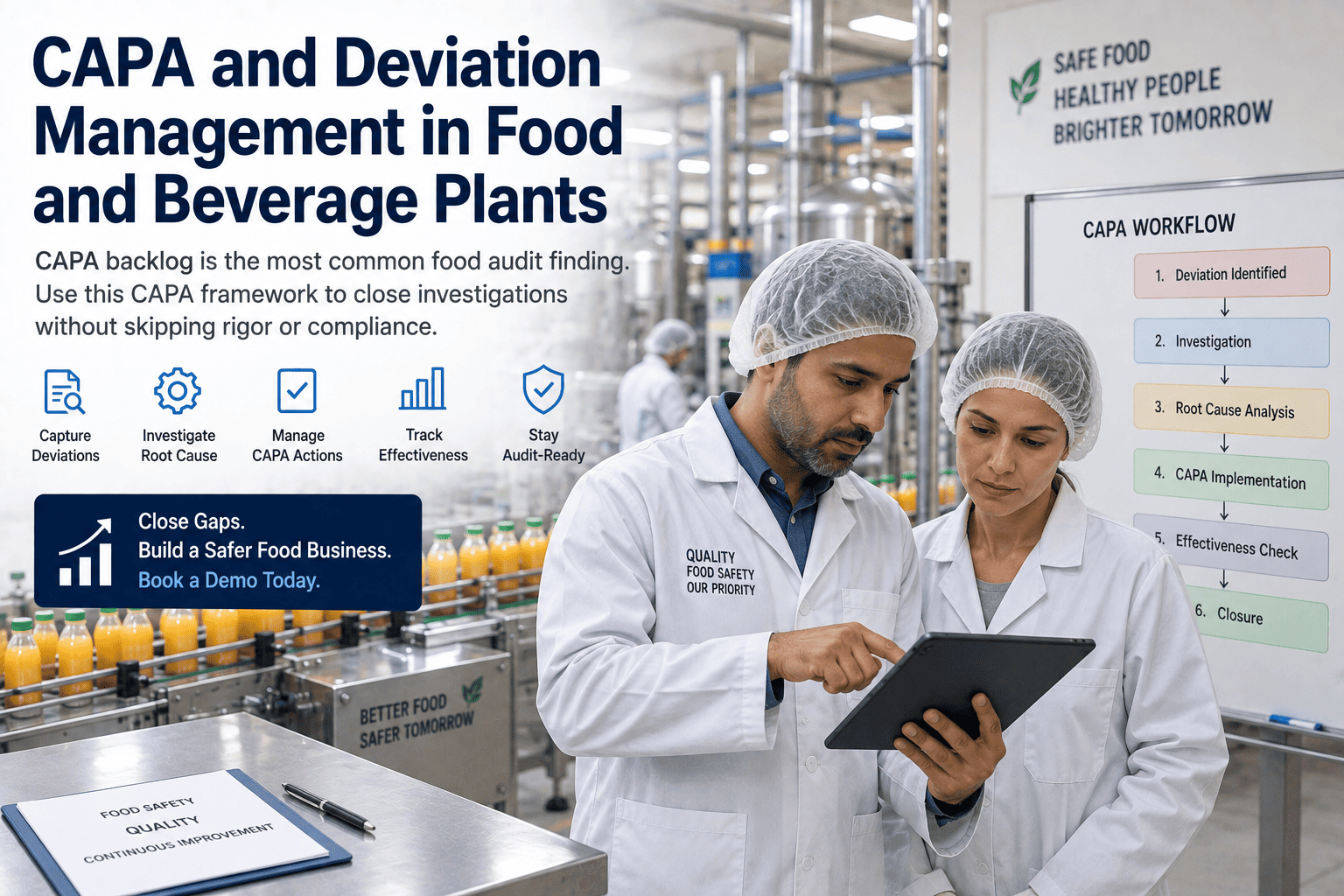
Food Safety Deviation Logging by Voice: Faster CAPA Starts
By James C on October 19, 2026
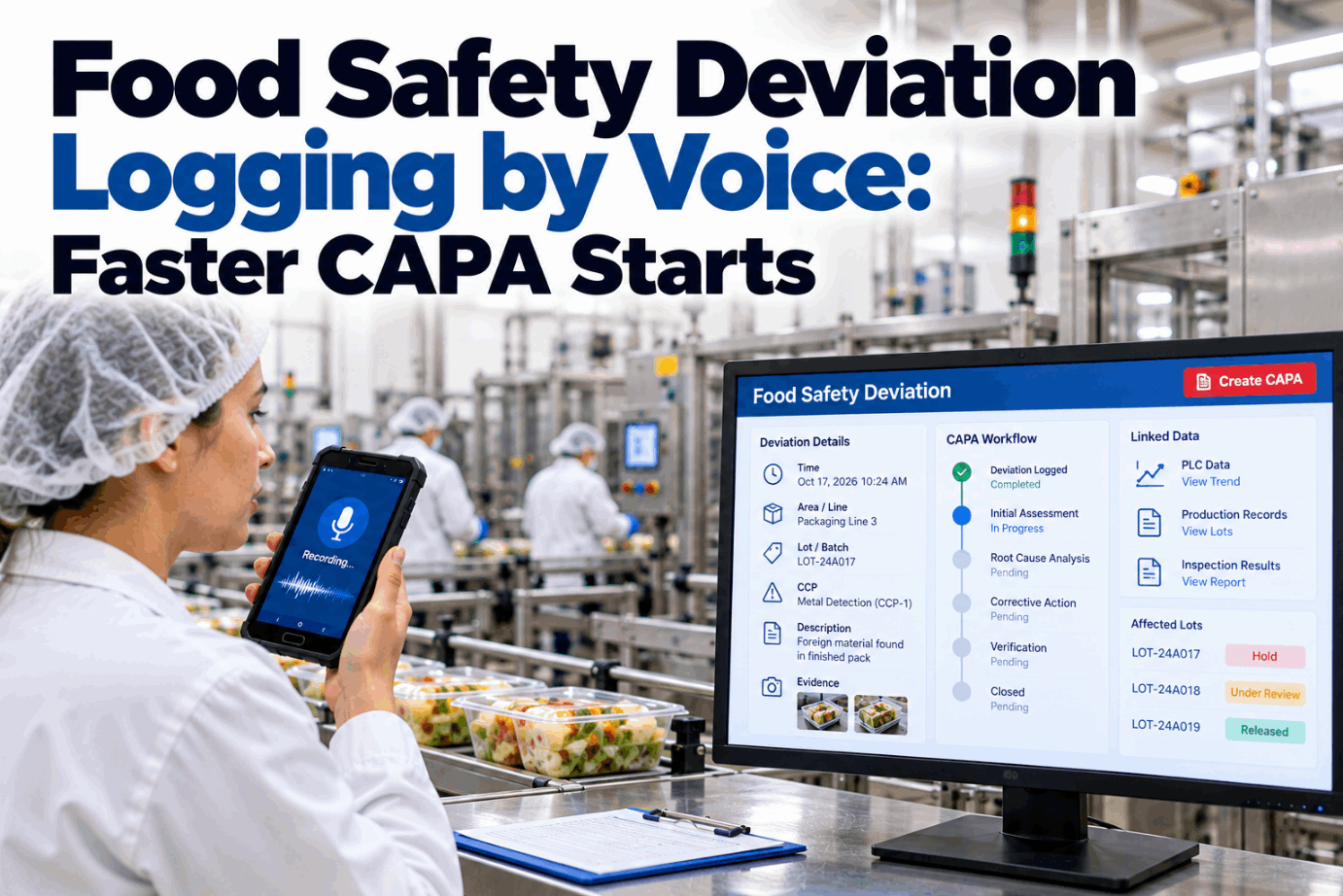
When a cook temperature falls below its critical limit, the first record of what happened is usually written last. Operators fix the problem first, which is right, and fill in the deviation form later from memory. By the time QA reviews it, the exact time, the lots affected and the actions taken are often vague. Food safety deviation logging by voice captures those facts at the line while they are still fresh, so every CAPA starts complete. Hear a deviation logged in a short voice demo.
VOICE DEVIATION AGENT · FOOD SAFETY
Log the Deviation at the Line, Start the CAPA With Every Fact in Place
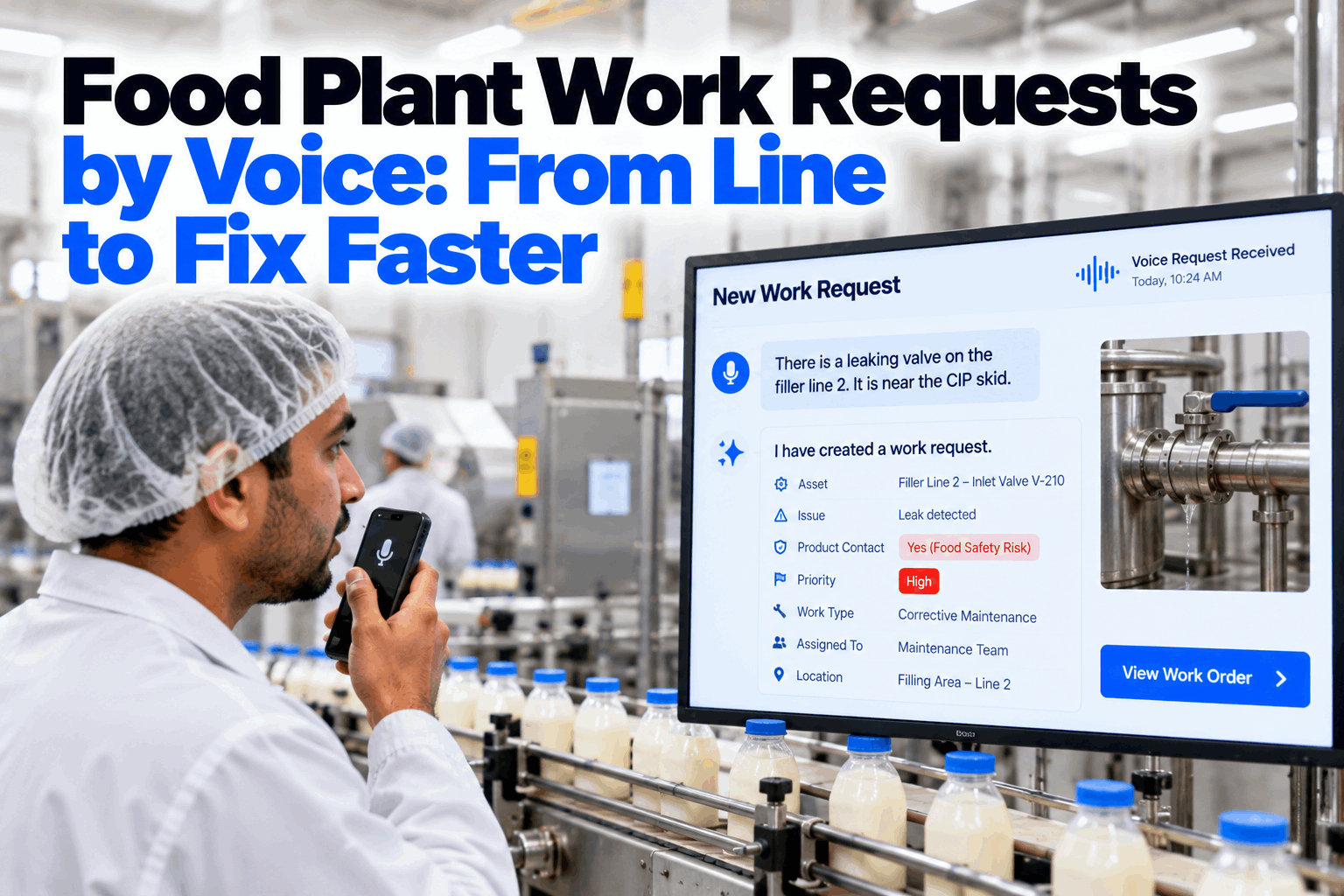
iFactory asks the operator short, guided questions by voice: time, lot, CCP and actions taken. It links the PLC data from the same window and opens a CAPA card with the evidence already attached.
Operator · 11:06"Cooker two, core temp low, sixty-nine point eight. Line held."
Time11:04, from PLC
Limit72.0°C · read 69.8°C
Lots2410-A, 2410-B
ActionLine held, product diverted
CAPA-0318 openedQA lead assigned
PLC trend 10:58–11:19Voice noteHold H-552
Confirmed back to operator: "Logged. Two lots on hold."
QA DEVIATION BASICS
Correction, Corrective Action or Something Unforeseen?
Under 21 CFR 117.150, the first question is what kind of problem you have. A deviation from a critical limit that your plan foresaw follows your written corrective action procedure. A problem with no written procedure, or a control that turns out not to work, needs the same steps plus a decision on reanalysing the plan. A minor, isolated sanitation or allergen slip fixed on the spot can be a correction. All of them must be recorded. Check how your plan sorts them with our support team.
117.150(c)
CorrectionA prompt fix to a minor, isolated sanitation or allergen control problem that does not directly affect product safety.Record it when appropriate
117.150(a)
Corrective actionA preventive control such as a CCP was not properly implemented, and your written procedure says what to do.Follow procedure, record every step
117.150(b)
Unanticipated problemNo written procedure exists, or a control or the plan is found to be ineffective.Same steps, plus reanalyse the plan if needed
FOOD SAFETY DEVIATION LOGGING TEMPLATE
What a Deviation Record Must Contain
FDA's record rules in 21 CFR 117.305 ask for the plant name and location, the date and time, the signature or initials of the person, the product and lot code where appropriate, and the actual values observed. Records must be made at the time of the activity. Add the four outcomes a corrective action must show, and you have a template that holds up at audit. Get a copy of this layout from our QA team.
Deviation DV-2214Plant 1, Leeds Road · Line 4
1Date and time14 Oct, 11:04 to 11:19
2CCP and limitCCP-2 core temp, 72.0°C minimum
3Actual value69.8°C lowest reading
4Product and lotsChicken strips, 2410-A and 2410-B
5Action takenLine held, 2 lots on hold H-552
6Recorded byJ. Patel, operator
Fields 1, 4 and 6Required on every record under 117.305(f)
Fields 2 and 3Actual values, not "low" or "out of spec"
Field 5 leads to four outcomesProblem fixed, recurrence reduced, food evaluated, unsafe food kept out of commerce
ReviewMonitoring and corrective action records reviewed within 7 working days
INCIDENT DOCUMENTATION
How Deviation Details Fade After the Event
Most incomplete deviation records are not careless. They are written late. Memory of the exact time, the reading and the lot on the line fades quickly once the shift moves on. The grid below is an illustration of the typical pattern, not measured data, but most QA leads will recognise it. Compare it with your own records in a record review.
Detail
At the line, minute 0
End of shift
Next morning
Weekly review
Exact start time
Exact
Rounded
"Late morning"
Missing
Lowest reading
Exact
Approximate
"Below limit"
"Below limit"
Lots on the line
Both lots
One lot
Guessed
Missing
Actions and order
Step by step
Main steps
Main steps
"Fixed"
Who did what
Names
Crew
Shift only
Shift only
CompletePartialVagueLost
VOICE INCIDENT CAPTURE
Guided Questions, Spoken in Under Two Minutes
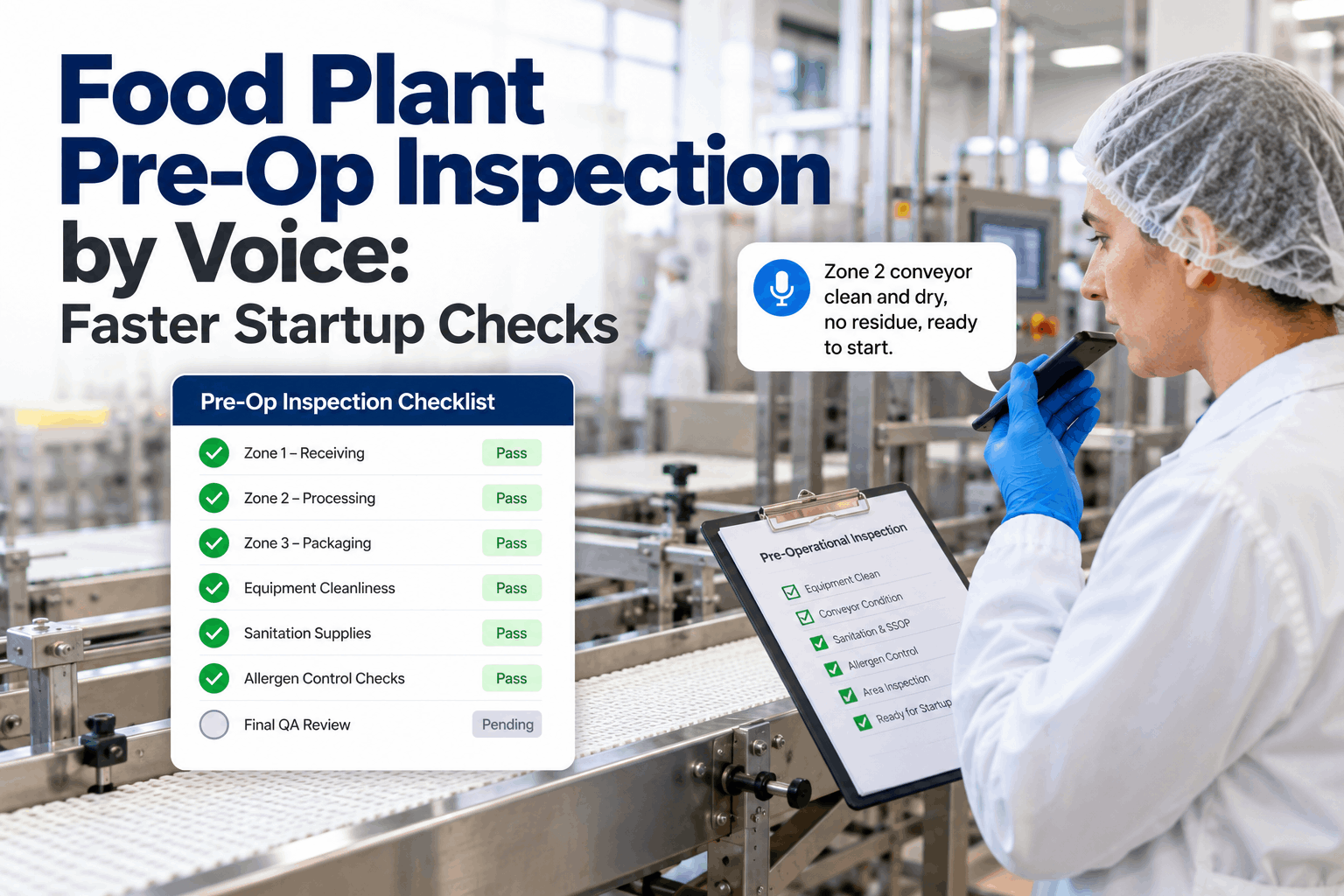
A blank text box invites "temp low, fixed". Guided questions ask for each fact in turn, in the operator's own words, and confirm each answer back. Where the PLC already knows the answer, iFactory fills it in and asks only for confirmation. Hear the full question set in a live session.
Q1
"Which line and which control point?"
"Cooker two, core temp."
CCP-2
Q2
"PLC shows 69.8 at 11:04. Is that right?"
"Yes, that's it."
Time, value
Q3
"Lots 2410-A and B were running. Any others?"
"No, just those two."
Lots
Q4
"What did you do first?"
"Held the line, diverted product to the hold cage."
Actions
Q5
"Do you know the cause yet?"
"Steam pressure fell, I think."
Suspected cause
Q6
"Is the CCP back within limit?"
"Yes, 74 since 11:19."
Control restored
From First Words to a Complete CAPA Card
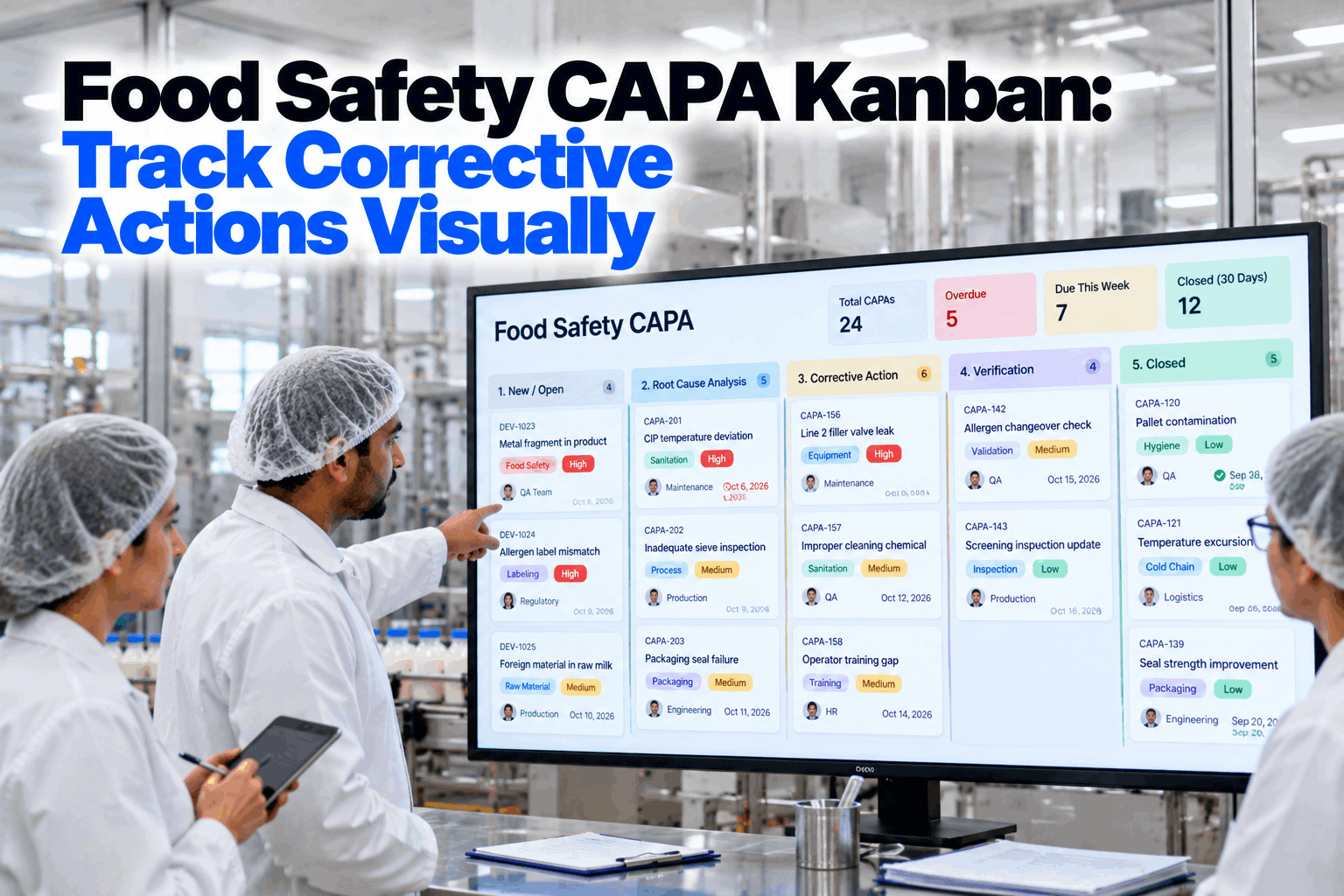
The iFactory Voice Deviation Agent asks the right questions, pulls the PLC trend for the same minutes and opens a CAPA card with evidence attached. QA starts the investigation with facts, not a chase.
QA leadWhat do we know about the cooker 2 deviation?
iFactoryCore temp under 72°C from 11:04 to 11:19, lowest 69.8°C. Lots 2410-A and B are on hold H-552.
QA leadAnything in the PLC data?
iFactorySteam header pressure fell at 11:01, three minutes before the temperature. The trend is attached to the CAPA.
LOT IMPACT ASSESSMENT
Drawing the Lot Window Correctly
The lot impact assessment answers one question: which product could have been affected? The window starts at the last reading known to be within limit, not when someone noticed, and ends when the CCP is confirmed back in control. Every lot that passed the CCP inside that window is evaluated. Set window rules for each CCP with our food safety team.
10:3010:4511:0011:1511:30
2409-F
2410-A
2410-B
2410-C
Deviation window
Window start10:58, last reading in limit
Window end11:19, back in control
Lots to evaluate2410-A and 2410-B
Why the start time matters
If the window starts at 11:06, when the operator spoke, product cooked between 10:58 and 11:06 is missed. Using the last good PLC reading closes that gap.
CAPA INITIATION
Four Things Every Corrective Action Must Show
21 CFR 117.150(a)(2) sets out what corrective action procedures must achieve, and USDA's 9 CFR 417.3 for meat and poultry sets a very similar list. A CAPA that opens with the deviation facts already recorded can focus on these four outcomes from day one. See the CAPA card layout in a short demo.
Find and fix the problemIdentify the cause and correct it, so the CCP is back in control.
Reduce the chance of recurrenceChange the process, equipment or training behind the cause.
Evaluate affected foodEvery lot in the window is assessed for safety.
Keep unsafe food out of commerceHeld product stays held until safety and labelling are assured.
FOOD SAFETY DEVIATION LOGGING EXAMPLES
Three Deviations, Logged by Voice
These are illustrations of how the agent handles common deviations. They are not case studies, and your HACCP plan decides the actual response. Notice that the window rule changes with the control: a detector failure reaches back to the last passed test, while a chiller failure covers one load. Bring your own CCPs to a walk-through call.
Metal detector
Said"Line six detector failed the ferrous test piece."
WindowSince last passed check, 09:00
ResultProduct since 09:00 held for re-screening
Chiller temperature
Said"Blast chiller three, core still 9 degrees at four hours."
WindowOne chiller load, three lots
ResultCAPA opened with chiller door and fan data attached
Allergen changeover
Said"Swab after the nut run failed, re-cleaning now."
WindowNo product run yet
ResultLogged as a correction, re-swab recorded
FOOD SAFETY DEVIATION LOGGING COST AND ROI
A Simple Worksheet for QA Time
The clearest saving is QA time spent chasing missing details before a CAPA can start. Size it with your own numbers. The inputs below are assumed, to show the arithmetic only, and the result is time, not a promised saving. Our team can build the case with your records.
Deviations logged per month20assumed
Records needing follow-up12assumed
QA minutes chasing each one30assumed
QA time per month on follow-up12 × 30 = 360 min = 6 hoursCompare with your own figure after a pilot
Add harder-to-price value: lot windows drawn from data rather than memory, fewer lots held "just in case", and records that are ready for the 7-working-day review. Leave recall cost estimates out unless your own data supports them.
FOOD SAFETY DEVIATION LOGGING FOR PLANT MANAGERS
Four Measures Worth Watching Each Month
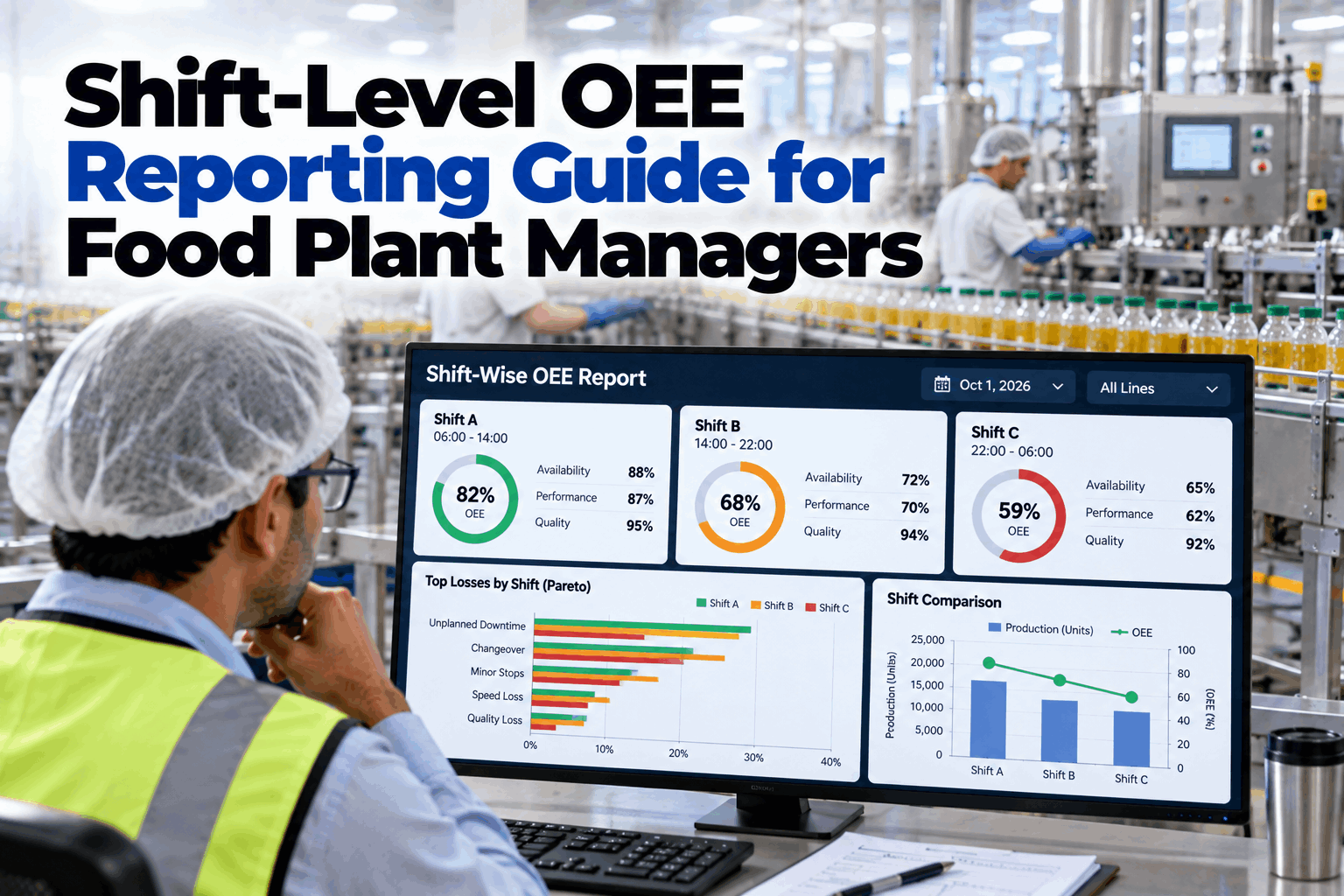
Plant managers don't need every record. They need to know whether deviations are captured quickly, completely and acted on. These four measures show it, and each one comes straight from the deviation records without extra data entry. Review them monthly with QA and production together, so trends lead to action rather than blame. Set them up on your own dashboard with our support team.
Speed
Minutes from event to recordFrom the PLC event time to the first logged entry
Completeness
Records complete at first reviewShare needing no follow-up from QA
Action
Days from deviation to CAPA closedWith effectiveness checked, not just signed
Recurrence
Repeat deviations by CCPThe same CCP failing again within 90 days
NONCONFORMANCE LOGGING
One Voice Entry, Routed to the Right Log
Operators should not have to decide which form a problem belongs on. They describe what happened, and the agent sorts it by type. A CCP deviation goes to the corrective action record, a quick sanitation fix becomes a correction, and a supplier or packaging problem goes to the nonconformance log. QA can re-route any entry, and every route is set by your own quality system. Map your routing rules in a setup call.
Operator speaks"Seal on pouch line two failing, film from the new reel."
CCP limit missedCorrective action record
Minor sanitation or allergen slipCorrection, recorded
Material or supplier problemNonconformance log, supplier notified
Quality only, no safety impactQuality deviation log
TURNKEY AI DEPLOYMENT
Voice Agent, PLC Links and AI Server, Delivered Ready
iFactory delivers the Voice Deviation Agent as a turnkey bundle. A pre-configured NVIDIA AI server ships racked and ready with speech and CAPA models pre-loaded, so voice is processed on site and works over line noise. You rack it, plug in power and Ethernet, and the AI is live. Scope it for your plant with a turnkey quote.
What's Included
Pre-configured NVIDIA AI server, racked and ready
Voice Deviation Agent with your CCP question sets
PLC and SCADA links for CCP readings and events
Automatic lot window from production data
CAPA cards with evidence attached
Headsets and handheld setup for line crews
24×7 remote monitoring and operator training
Live in 6–12 weeks
Wk 1–4
Ship and Connect
Server installed, CCPs and PLC tags mapped, lot data linked.
Wk 5–8
Tune and Pilot
Question sets tuned with QA, pilot on two lines with real deviations.
Wk 9–12
Go-Live and Training
All CCPs live, operators and QA trained, monthly measures started.
HOW iFACTORY FITS
Food Safety Deviation Logging Software That Starts the CAPA
iFactory connects the operator's words, the PLC record and the CAPA in one flow, so nothing is copied twice. See it on one of your CCPs in a live demo.
1
Guided voice questions. Time, lot, CCP and actions captured at the line and confirmed back.
2
PLC data linked. Readings and events from the same minutes are pulled in automatically.
3
Lot window from data. Affected lots are found from the last good reading, not from memory.
4
CAPA opened with evidence. QA gets a card with the record, trend and hold attached.
1000+
Industrial clients running iFactory
99.9%
Platform uptime for round-the-clock food lines
6-12 wks
From racked server to live voice deviation logging
FREQUENTLY ASKED QUESTIONS
What QA and Plant Leaders Ask About Voice Deviation Logging
What is food safety deviation logging?
It is the record made when a food safety control, such as a CCP, a sanitation control or an allergen control, is not met. It captures what happened, when, which product and lots were involved and what was done, and it is the starting point for corrective action and any CAPA.
Is a voice record acceptable as a deviation record?
The record that matters is the structured entry the voice capture produces, with actual values, date and time, product and lot, and the person's identity, as 21 CFR 117.305 requires. The spoken note can be kept alongside as supporting evidence. Electronic records should follow your site's controls for electronic recordkeeping.
What is the difference between a correction and a corrective action?
Under 21 CFR 117.150(c), a correction is a prompt fix to a minor, isolated sanitation or allergen control problem that does not directly affect product safety. A corrective action follows a CCP or other control failure and must fix the problem, reduce recurrence, evaluate affected food and keep unsafe food out of commerce.
Does every deviation need a CAPA?
Not always. Every corrective action must be recorded, but many sites open a formal CAPA only for CCP deviations, repeats or problems with no written procedure. Your quality system sets the rule. iFactory can open a CAPA card automatically for the cases you choose.
How does the agent know which lots are affected?
It reads production data for the line and finds the last reading within the critical limit. Every lot that passed the control point between that time and the point the CCP was back in control is listed. The operator confirms or corrects the list by voice, and QA can widen the window if the evidence calls for it.
How do we start?
Choose two lines with frequent or high-risk CCPs, load their question sets and link the PLC tags. Run for a month and compare record completeness and time to first entry with your paper records. Our support team can plan that pilot with you.
Every CAPA Starts With the Facts Already Recorded
Capture deviations by voice at the line, link the PLC data automatically and open CAPA cards with evidence attached. The full system is delivered turnkey and goes live in 6 to 12 weeks.