Handwritten Cone Ticket vs SAP Batch Reconciliation AI
By David Cook on September 19, 2026
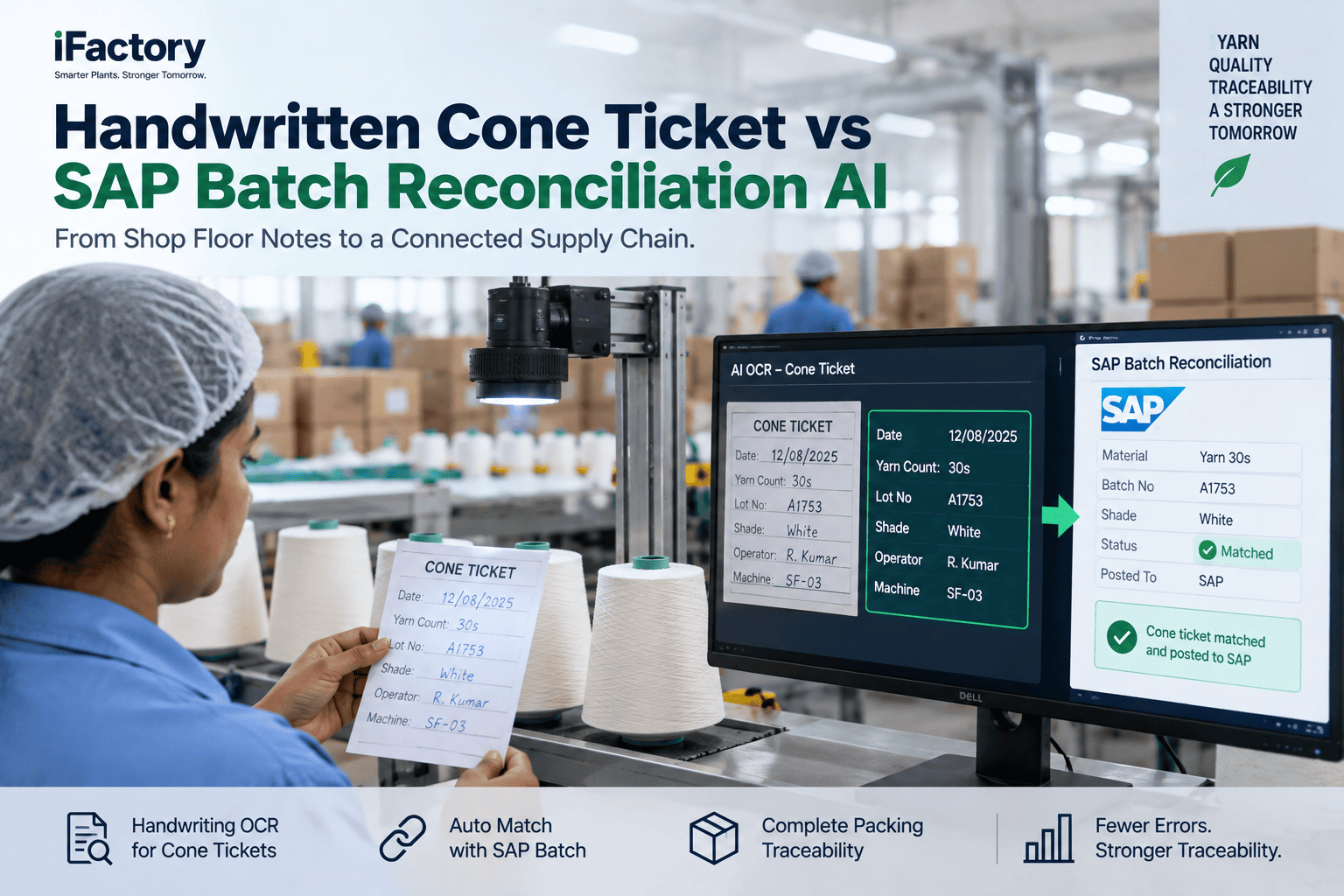
The traceability of a yarn shipment usually comes down to a slip of paper filled in with a ballpoint pen at the packing table. Lot, count, shade, machine, shift, operator. That ticket travels with the carton, and somewhere downstream a person is expected to read it and type it into SAP so the carton is linked to the batch it came from. When the handwriting is rushed, when a digit is transposed, when a ticket from the previous lot is reused because the pad ran out, the link is quietly wrong — and nobody finds out until a customer complains about a shipment and the traceback begins. iFactory's handwriting OCR vision reads the ticket at the packing station and posts a verified batch link into SAP before the carton moves.
AI Vision Traceability for Yarn Packing
Handwritten Cone Ticket vs SAP Batch Reconciliation AI
Vision OCR reads pen-written cone tickets at the packing table, validates every field against SAP, and posts the carton-to-batch link as the carton is closed. Mismatches are held, not shipped.
A customer claim, a contamination scare or a certification audit all ask the same question: which cartons came from which production lot. Answering it should take a query. In most yarn plants it takes two people, a week, a stack of ticket books and a set of assumptions, because the paper record and the system record were never properly joined. The cost is not only the search. It is the scope of what you have to recall or concede when you cannot prove the boundary of a suspect lot, and the audit findings that follow when the traceability chain has a handwritten gap in the middle of it. The ticket is not the problem — it is a fast, robust habit that works at the packing table. The problem is that nothing reads it.
From Pen to Batch Record, at the Packing Table
A camera over the packing station captures the ticket as it is placed on the carton. The model reads each field as handwriting rather than as print, returns a confidence per field, and matches the result to the open batch in SAP before the carton is sealed.
Ticket to batch link, at the point of packing
Nothing changes at the packing table. The operator writes the ticket as they always have, and the reconciliation happens around them. What changes is that a carton cannot leave with a link that does not hold together.
Every Field Checked, Not Just Read
Reading the handwriting is the easy half. The value is in cross-checking what was read against what SAP already knows should be true for that machine, that shift and that open batch, because that is what catches the transposed digit and the ticket carried over from the previous lot.
Carton reconciliation — packing line 2
Ticket readLot 24/8871 · Ne 30/1 · shade D-412
SAP batch418872, open
Lot numbermatches, high confidenceOK
Count and blendmatches material masterOK
Shade lotD-412 or D-4l2, unclearwatch
Frame and shiftconsistent with the batchOK
Cone count on ticket24, carton holds 24OK
One ambiguous character on the shade lot goes to the operator as a two-button confirmation. Everything else posts automatically, and the confirmed value is written back with the ticket image attached.
What a Shift Actually Looks Like
In practice most cartons reconcile with no human involvement at all, a minority need a one-second confirmation, and a small number are genuinely wrong and worth stopping. The point is that the third group is now found at the packing table rather than in a claim six weeks later.
One shift of cartons, and the traceback it enables
The held cartons are the ones that matter. Four percent of a shift is a small number until one of them reaches a customer as the wrong shade lot and the claim covers the whole shipment.
What the System Checks
Four checks run on every carton, and a carton has to pass all of them before the link is posted.
Handwriting OCR
Trained on real shop-floor tickets, pen and pencil, smudges and corrections, with a confidence score per field rather than one for the ticket.
Validation against SAP
Read values are tested against the open batch, the material master and the machine and shift that should be producing it.
Hold on mismatch
A carton that fails a check is stopped at the table with the reason shown, instead of being corrected from memory later.
Evidence trail
The ticket image, what was read, what was confirmed and by whom are stored against the batch for audits and claims.
What Ticket Reconciliation Delivers
The gain shows up twice: in the errors that never reach a shipment, and in the speed of answering the question an auditor or customer asks.
Seconds
To trace a carton
query, not a paper search
Fewer
Wrong batch links
caught at packing, not in a claim
Zero
Retyping
no second entry of the same data
Audit
Ready
ticket image held with the batch
Frequently Asked Questions
Can it really read our operators' handwriting?
Handwriting on a structured ticket is a much easier problem than free text, because the layout is fixed and the possible values are constrained. The model knows that a field holds a lot number in a known format, a count from your material master, or a shade lot from an open list, so it is choosing between plausible candidates rather than reading blind. Where a character is genuinely ambiguous, it says so and asks rather than guessing, and it is tuned on samples of your own tickets during setup.
Do we have to change how the packing team works?
No. The ticket stays, the pen stays and the sequence at the table stays. A camera and a small screen are added at the station, and the only new action is an occasional confirmation tap when a field is unclear. That is deliberate: systems that ask packing operators to type into a terminal under production pressure tend to be worked around, and a workaround is how you end up with untraceable cartons in the first place.
How does it post into SAP?
Through your standard integration layer, writing the carton-to-batch link and the associated characteristics against the batch record, with the ticket image attached as evidence. The exact posting depends on how your batch management and QM are configured, so the integration is scoped with your SAP team. Nothing is posted unless every validation has passed or an operator has explicitly confirmed the field in question.
What happens when a carton is held?
It stops at the table with the failing field and the reason shown on screen, so the operator can check the physical ticket immediately, while the lot is still in front of them. Most holds resolve in seconds because they are simple transcription problems. The ones that do not are the valuable ones: a ticket from the previous lot, a carton made against a batch that was already closed, or a shade lot that does not belong to this order.
Does this help with customer and certification audits?
That is usually the first thing auditors notice. Instead of demonstrating a procedure and producing sample tickets, you can show the complete chain for any carton: what was written, what was read, what was confirmed, by whom, and the batch it was bound to. For buyer audits and certification schemes that test traceability by picking a shipment and asking you to walk it backwards, having the evidence attached to the batch turns a stressful exercise into a query.
Link the Carton at the Table, Not in a Claim.
See Your Own Cone Tickets Read and Reconciled
Send us a sample of real packing tickets, smudges included. We'll show what the model reads, where it asks for confirmation, and how the validated link would post against your SAP batch.