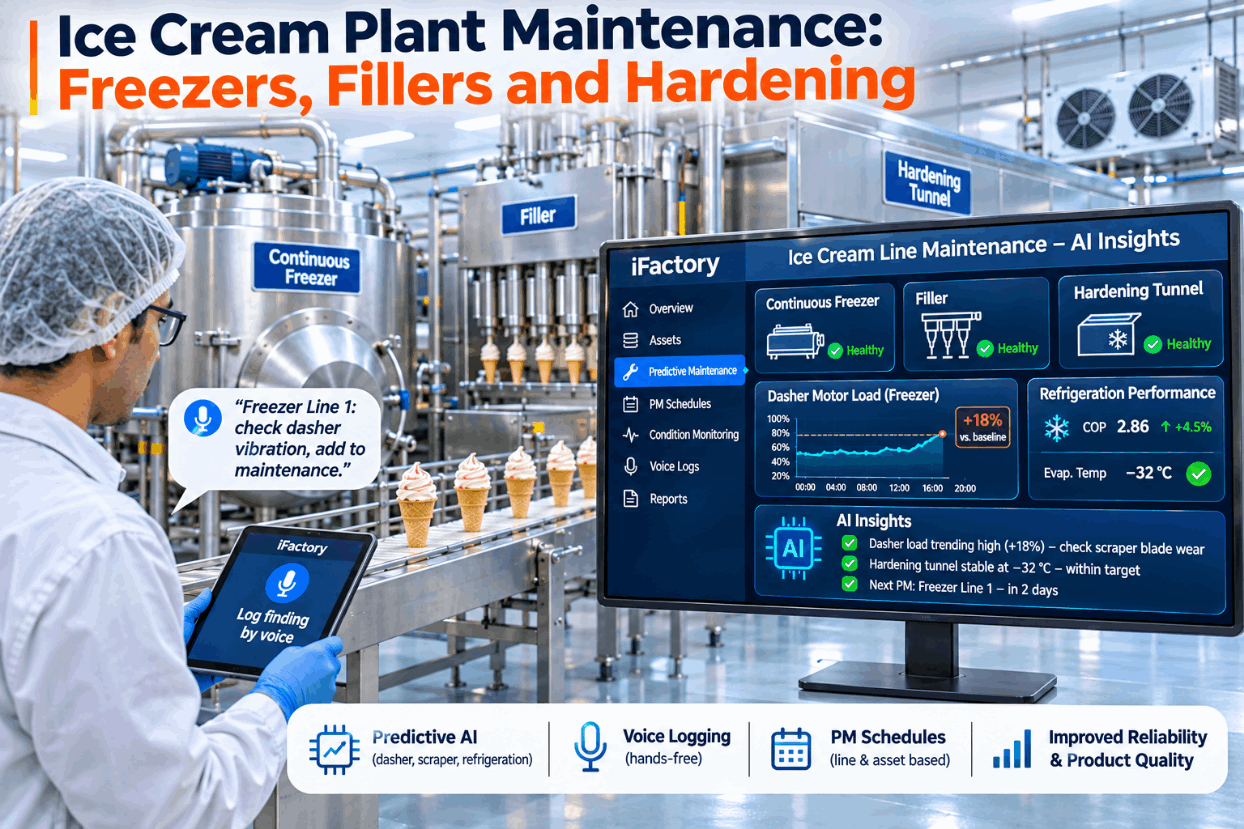
An ice cream line depends on its coldest, hardest-working parts: the dasher inside a frozen barrel, the scraper blades, the filler nozzles, the hardening tunnel fans and the ammonia plant behind them. Most failures give warning, but the warning is easy to misread when every recipe changes how hard the freezer works. This page sets out a PM plan by asset and shows how AI reads dasher motor load without mistaking a stiffer mix for worn blades. See it on your own freezer data in a 30-minute freezer walkthrough.
PREDICTIVE AI + VOICE · FROZEN DESSERTS
Ice Cream Plant Maintenance That Knows Blade Wear From a Stiff Mix
iFactory models dasher and scraper blade wear from motor load, after correcting for draw temperature, overrun and recipe. It trends hardening tunnel performance and lets crews log cold-room findings by voice, gloves on.
Freezer F2 · Vanilla, 5 L tubsIllustrative values
Dasher with scraper blades · ammonia-cooled jacket
Dasher motor38.2 A+9% vs baseline at same draw temp
Draw temp−5.6 °CInside this recipe's normal band
Overrun98%On target for this product
CONTINUOUS FREEZER DASHER
Inside the Barrel: What Each Part Does and How It Wears
In a continuous dairy freezer, mix and air are pumped into a jacketed barrel cooled by evaporating refrigerant. A dasher carries scraper blades that clear ice from the wall, roughly every 0.1 seconds according to Richard Hartel's 2019 review. Gear pumps meter mix in and ice cream out, and an air flow controller holds overrun. Review your own freezer models in a live session with our team.
SCRAPER BLADES
When Blades Go Dull, They Skate on the Ice
A sharp blade lifts the thin ice layer off the barrel wall so fresh mix meets the cold surface. A dull blade rides over it. A 2024 University of Wisconsin–Madison dissertation on dasher design calls this "skating" and links it to poorer freezer performance and product quality. Ask our support team how blade sets are tracked by hours.
SHARP BLADE SET
- Ice cleared every pass, wall stays cold
- Smaller ice crystals, smoother texture
- Steady load for a given recipe and draw temperature
DULL OR CHIPPED SET
- Ice builds on the wall and acts as insulation
- Coarser texture, more batch variation
- Load creeps up at the same product settings
- Chips are a foreign material risk and need a full check
Resharpen or replace?
Follow the freezer maker's limits for edge and blade width. Many plants keep numbered sets per freezer, log hours on each and swap at a CIP window. A chipped blade is replaced and the missing piece found before product is released.
DASHER MOTOR LOAD MODEL
Why Motor Load Alone Can't Call Blade Wear
Dasher motor load measures how stiff the product is as much as blade wear. Research freezers even use dasher torque as a viscosity reading. A colder draw, lower overrun, a richer mix or inclusions all push load up with perfectly good blades, so a model must normalise for draw temperature, overrun and recipe before it calls wear. Watch a normalised wear call in a short demo.
1Tag the recipeEach run carries its product code and blade set number
2Band the settingsGroup readings by draw temperature and overrun
3Compare like with likeLoad against the baseline for that recipe and band
4Watch the residualOnly the unexplained part of the load is trended
5Call it with careA steady rise over weeks raises an inspection, not a verdict
Baseline, vanilla at −5.6 °C and 98% overrun35.0 A
Reading today, same recipe and band38.2 A
Unexplained rise(38.2 − 35.0) ÷ 35.0 = 9.1%
Ask Why the Load Rose Before You Pull the Blades
iFactory splits a load change into what the product settings explain and what is left over, so the blade swap is planned for CIP, not guessed mid-run.
Freezer F2 · Maintenance lead and iFactory
Maintenance leadF2 dasher amps are up. Is that the new chocolate recipe?
iFactoryNo. The reading is vanilla at −5.6 °C and 98% overrun. Against that baseline the load is 9% higher, and it has risen slowly since blade set B went in 430 run hours ago.
Maintenance leadPut a blade inspection on Thursday's CIP window.
iFactoryDone. Work order raised for Thursday 06:00, set A reserved from the crib.
OVERRUN CONTROL
The Numbers Maintenance Should Know by Heart
A pump, seal or air fault often shows up first as a product number out of band, so maintenance needs to know what normal looks like. These are typical values from university and supplier sources; your own come from your recipes and freezer maker. In the US, the ice cream standard of identity (21 CFR 135.110) sets a minimum of 4.5 lb per gallon, which in practice caps overrun near 100%. Check your own bands with our support team.
4 °C
Mix into the freezerAbout 4 °C, after ageing (Hartel, CEP 2019)
−5 to −6
Draw temperature, °CTypical for ice cream; colder draw means stiffer product
~50%
Water frozen at drawThe rest freezes in hardening, reaching roughly 75–80%
25–150%
Overrun across frozen dessertsPremium products sit low; US ice cream near 100%
−30 to −40
Hardening air, °CTypical blast and tunnel air temperatures (University of Guelph)
−25 °C
Stable storageIce crystals stay stable below about −25 °C (Guelph)
FROZEN DESSERT FILLER
Cup, Cone, Stick and Extrusion Fillers: Where Wear Shows First
Fillers turn a stream of soft ice cream into exact portions, so wear shows up as weight drift, messy edges and stoppages. Nozzles wear on every type, faster with nuts, cookie pieces or fruit. Map your filler wear points in a filler review call.
Cup and tub
Dosing valves and nozzle tipsWeight drift, tails after cut-off, product on rims.Cone
Cone and sleeve feed, spray nozzlesOff-centre fills, misfed sleeves, blocked sprays.Stick novelty
Moulds, stick feed, releaseMisplaced sticks, product held in moulds.Extrusion
Dies and cutting wire or knifeRagged cuts and uneven piece weights.
Hygiene after every filler repair
Freezing does not kill Listeria monocytogenes, and frozen desserts have been linked to outbreaks, including one FDA investigated in 2023. Fillers, freezer outlets, drains and condensation are typical places to look. Every product-zone repair ends with cleaning, sanitising and QA release.
HARDENING TUNNEL
Spiral and Straight Tunnels: Fans, Coils and Ice Build-Up
Hardening tunnels blow very cold, fast air over product to freeze most of the remaining water. Moist air from doors and warm product turns to frost on the coils, choking airflow. iFactory trends tunnel air temperature, fan current and time since defrost, so a coil icing faster than usual stands out. The bars are illustrative. Get a sample trend from our support team.
Spiral HT-1 · setpoint −38 °CAir temperature rise above setpoint, by hours since defrost
0–4 h1 K
4–8 h2 K
8–12 h4 K
12–16 h6 K
Cold-store doors are part of the system
Fast doors, air curtains, gaskets and frame heaters keep moist air out. A torn gasket or failed heater lets ice form on the frame and floor: a frost load on coils and a slip hazard.
AMMONIA REFRIGERATION
The Ammonia Plant Has Its Own Rulebook
Many large ice cream plants run ammonia refrigeration. In the US, a process holding at least 10,000 lb of anhydrous ammonia falls under OSHA Process Safety Management, and IIAR standards set out inspection and minimum safety. iFactory keeps ammonia work orders and findings together for mechanical integrity records. It doesn't replace your PSM program or refrigeration contractor. Discuss your records in a call with our team.
OSHA 29 CFR 1910.119Process Safety Management. Appendix A lists anhydrous ammonia with a threshold quantity of 10,000 lb.
1910.119(j) mechanical integrityWritten procedures, inspections and tests to recognised practice; deficiencies corrected.
ANSI/IIAR 6-2019ITM tasks and frequencies for closed-circuit ammonia plant. A revised draft went to public review in 2024.
ANSI/IIAR 9-2020Minimum safety requirements for existing systems, with Addendum A (2024) clarifying scope and the compliance date.
ICE CREAM PLANT MAINTENANCE TEMPLATE
A PM Schedule by Asset, Ready to Adapt
A starting point: set final intervals from the OEM manuals, your run hours and, for ammonia, IIAR 6. Ask our support team for a blank copy you can load into iFactory.
VOICE FINDINGS IN COLD ROOMS
Log a Finding at −25 °C Without Taking Gloves Off
Nobody wants to type on a handheld in a hardening room. The technician speaks the finding, iFactory reads it back for confirmation, and the record lands on the right asset. Read-back matters where heavy clothing and fan noise make mishearing likely. Hear a cold-room round in a voice demo.
Technician · Hardening room 2"Tunnel two, coil four, heavy frost on the inlet face. Infeed door heater is cold."
iFactory read-back"HT-2, coil 4, heavy frost inlet face. Infeed door heater not warm. Raise a defrost check and an electrical job?"
Technician"Yes, both."
AssetHT-2 coil 4 · HT-2 infeed door
FindingHeavy frost, inlet face · heater cold
Jobs raisedDefrost check · electrical fault
LoggedTime, location and technician, confirmed by voice
ICE CREAM PLANT MAINTENANCE IMPLEMENTATION GUIDE
Start With One Freezer and One Tunnel
Start where stops cost the most, prove the model against what technicians find, then add assets. Plan the first steps with our support engineers.
Choose the pilotThe freezer with most blade or seal stops, plus its tunnel
Number the blade setsRecord hours and condition at each swap
Build baselinesWeeks of load by recipe, draw and overrun
Check against findingsCompare each wear call with what the blades look like
Add voice roundsCold rooms, doors and the ammonia plant
ICE CREAM PLANT MAINTENANCE EXAMPLES
Three Weeks on an Ice Cream Line, Illustrated
Each story is an illustration built from common freezer and tunnel patterns, not a customer result. Walk through your own in a working session.
High load, healthy blades
A new low-overrun recipeLoad jumps 12% on a premium run. Lower overrun and a colder draw explain it, so nothing is raised.Slow creep
Residual rising over five weeksSame recipe and band, load edging up. CIP inspection finds two rounded blades; the set is swapped.Late-shift warming
Tunnel air climbing fasterA voice round finds a cold door heater and a frosted coil. After repair the rise returns to normal.
ICE CREAM PLANT MAINTENANCE COST AND ROI
Litres at Stake Each Time a Freezer Stops
We don't quote savings. Every input here is an assumption that only demonstrates the sum, so replace it with your own stop logs and line rate. Our support team can help you gather those figures.
Freezer stops per month from blades, seals or pumps3, assumed
Minutes lost per stop, including restart40, assumed
Line output1,200 L per hour, assumed
Lost output per month3 × 40 = 120 min = 2 h × 1,200 = 2,400 L
Restart waste per stop60 L, assumed · 3 × 60 = 180 L
Litres at stake per month2,400 + 180 = 2,580 L × your margin per litre
TURNKEY AI DEPLOYMENT
Freezer Wear Models and Cold-Room Voice, Delivered Racked
A pre-configured NVIDIA AI server ships racked and ready, with load models, tunnel trends and voice set up, so data stays on site. You rack it, plug in power and Ethernet, and the AI is live. Scope your plant in a turnkey planning call.
What's Included
- Pre-configured NVIDIA AI server, racked and ready
- Connectors for freezer, filler and tunnel controllers
- Dasher load model with recipe, draw and overrun normalisation
- Blade set tracking by hours and condition
- Hardening tunnel and cold-store trends
- Voice logging with read-back for cold rooms
- PM schedule by asset, loaded and owned
Live in 6–12 weeks
Wk 1–4
Link Signals and Baseline
Server racked, freezer and tunnel signals linked, blade sets numbered and baselines started.
Wk 5–8
Shadow and Confirm
Wear calls run silently and are checked against blade inspections at CIP.
Wk 9–12
Go Live and Extend
Alerts and voice rounds switched on, then fillers, doors and more freezers added.
HOW iFACTORY FITS
Ice Cream Plant Maintenance Software Built for the Cold
iFactory works alongside your freezer controls and CMMS, adding the wear model and voice capture they lack. Talk it through with our support team.
1
Models dasher and blade wear. Motor load is compared with the baseline for the same recipe, draw temperature and overrun.
2
Tracks blade sets. Hours, condition and swaps are kept for every numbered set.
3
Trends hardening. Tunnel air, fan current and defrost are watched for faster icing.
4
Logs cold-room findings by voice. Spoken, read back, confirmed and placed on the right asset.
1000+
Industrial clients running iFactory
99.9%
Platform uptime for round-the-clock lines
6-12 wks
From racked server to live wear calls
FREQUENTLY ASKED QUESTIONS
Ice Cream Plant Maintenance for Plant Managers: Common Questions
How can AI tell worn scraper blades from a stiffer mix?
By not judging load alone. A colder draw, lower overrun or richer recipe all raise dasher load, so iFactory compares each reading with the baseline for the same recipe and band and trends only the unexplained rise. You can
see a normalised wear call on sample data.
How often should scraper blades be resharpened or replaced?
There's no single interval. It depends on OEM limits, run hours, recipes and inclusions. Tracking hours per numbered set against the load residual helps you find your own.
Does iFactory control the freezer or change overrun?
No. Draw temperature and overrun stay with the freezer controls and operators; iFactory reads data and raises work. To check which signals your freezers expose, our
support team can review them with you.
Is our ammonia system covered by OSHA PSM?
In the US, OSHA PSM applies to a process with 10,000 lb or more of anhydrous ammonia. IIAR 6 covers inspection, testing and maintenance; IIAR 9 covers existing-system safety. Your PSM coordinator decides coverage.
Does voice logging work in freezers and hardening rooms?
Yes, with read-back. Cold, fan noise and gloves make mistakes likelier, so every entry is read back for a spoken yes before saving.
Hear a cold-room round to judge it yourself.
Where should we start?
Start with the freezer that has the most blade or seal stops and the tunnel it feeds, then compare each wear call with what technicians find at CIP. To plan that pilot,
book a 30-minute call with our team.
Swap Blades When They Need It, Not When You Guess
Model dasher wear from motor load with the product effect taken out, trend hardening tunnels and log cold-room findings by voice. Delivered turnkey and live in 6 to 12 weeks.
Example weekly view · Line 1
Freezer F2 load residual+9%, inspection at CIP
Blade set B430 run hours
Spiral HT-1Icing faster after 8 h
Voice findings2 logged, both read back
Every finding tied to an asset and a work order