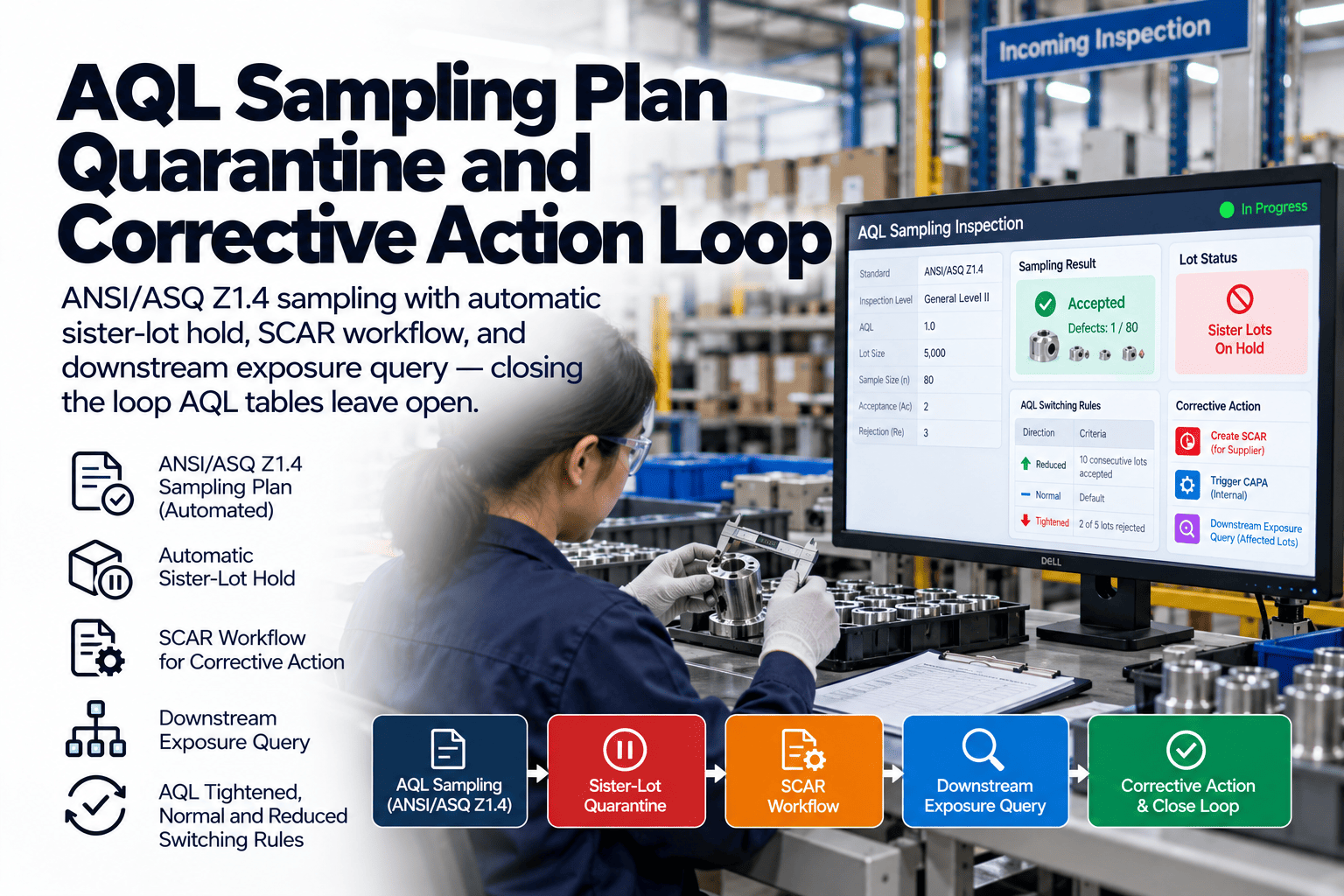
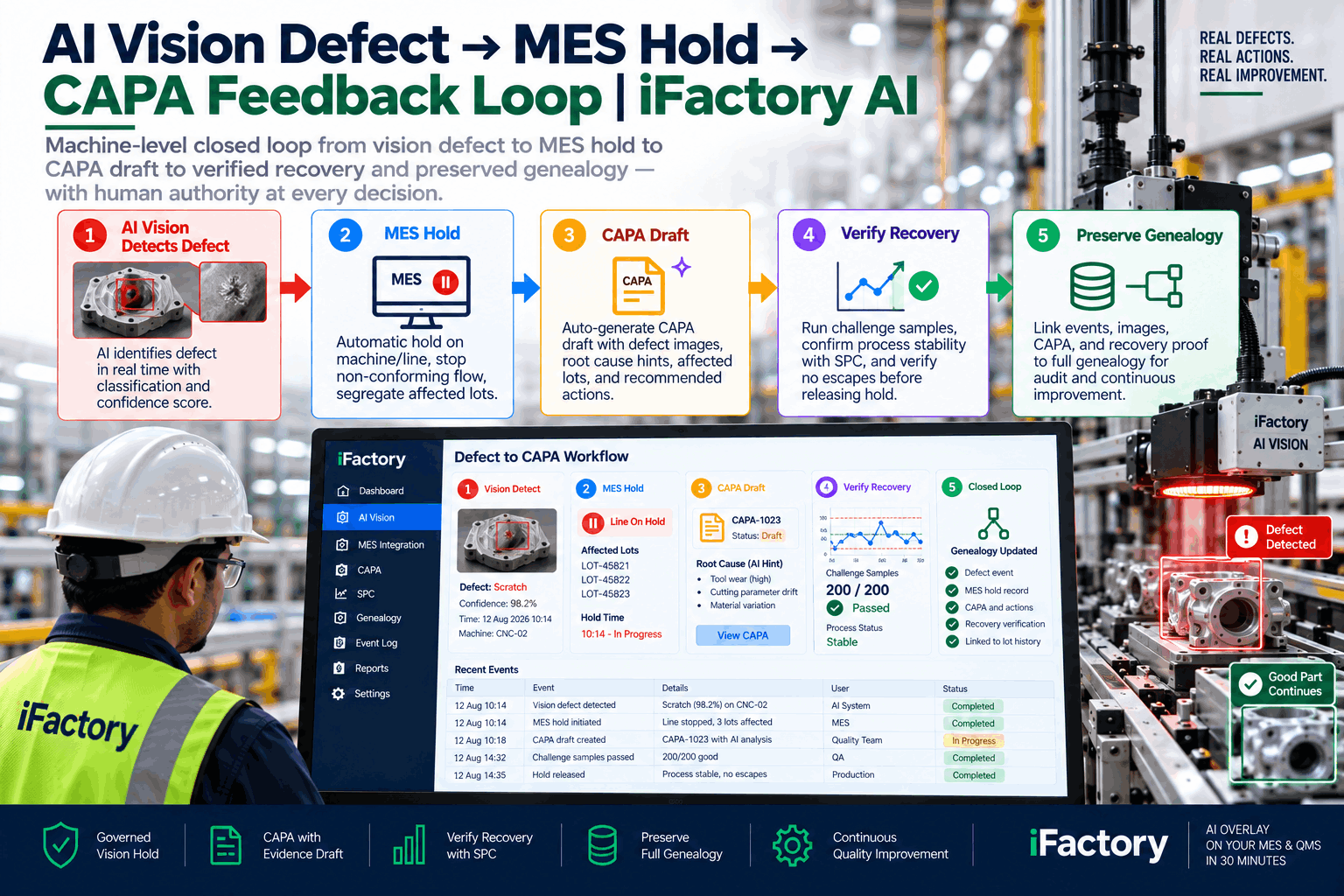
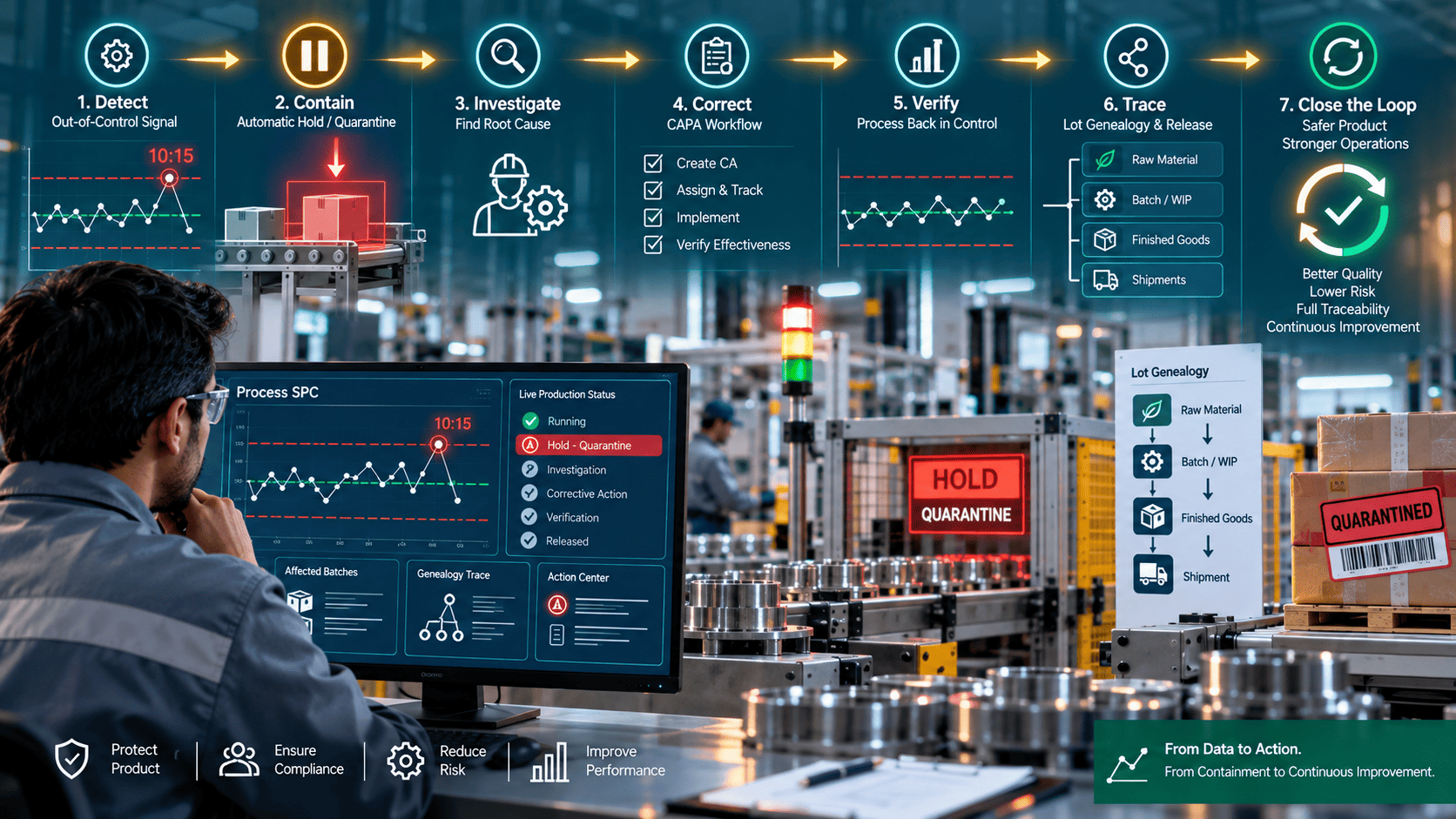
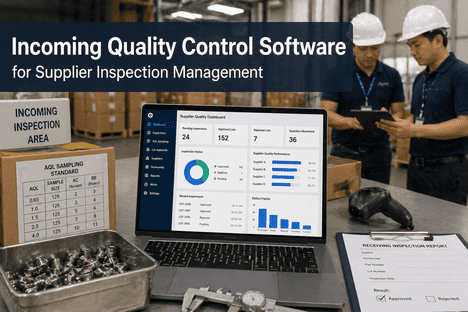
An ANSI/ASQ Z1.4 sampling plan (successor to MIL-STD-105E) tells incoming inspection which lots to accept and which to reject against the acceptance number Ac. What it doesn't do is drive what happens next. A rejected lot goes back to the supplier with a return-to-vendor slip; sister lots from the same supplier keep flowing through incoming; the downstream production line consuming the part family runs on until the specific reject is investigated. Closed-loop overlay reads the AQL disposition, applies automatic containment across the supplier's other lots on hand, drives supplier CAPA workflow, and connects the reject to downstream lot genealogy.
iFactory / AQL closed-loop overlay
Turn Every AQL Reject into Automatic Supplier Containment and CAPA
Overlay on incoming inspection reading ANSI/ASQ Z1.4 sampling dispositions and driving automatic hold on sister lots from the same supplier, supplier corrective action request (SCAR), and downstream genealogy exposure assessment — before the pattern repeats on the next receipt.
Result
3 defects · Ac=2 · REJECT
Traditional
Reject slip · lot returns
Closed loop
Auto-hold · CAPA · supplier SCAR · sister lots quarantined
ANSI/ASQ Z1.4
sampling honored
The Problem in AQL Disposition Follow-Through
A typical incoming inspection operation applies ANSI/ASQ Z1.4 sampling — general inspection level II by default, normal-tightened-reduced switching per performance history, acceptance numbers Ac and rejection numbers Re per lot size and AQL. When a lot fails against Ac, the disposition is standard: reject the lot, notify the buyer, return to supplier or send for 100% sort at supplier cost. What doesn't happen automatically is much of what should — sister lots from the same supplier still on the receiving dock aren't held, the downstream line consuming the same part isn't notified of exposure, SCAR isn't opened until someone remembers. AQL by design accepts risk; overlay limits the damage when the risk materialises.
Where AQL Disposition Actually Falls Short
AQL follow-through failure modes are consistent across incoming inspection operations. Each is a specific gap between disposition and action that overlay closes.
Sister lots keep flowing
Same supplier's other lots on receiving dock or in staging keep moving forward while the specific reject is investigated. Same defect pattern likely present; not held.
SCAR delay
Supplier corrective action request opened days after the reject. Supplier's next shipment already in transit under the same conditions. Pattern repeats.
Downstream exposure blind
Production line consuming the same part family from previous receipts of this supplier isn't notified. Exposure assessment happens after downstream defects surface.
Tightened-inspection misses
Switching to tightened inspection per Z1.4 rules requires manual attention; often missed for the next supplier receipt. Same AQL applied to a supplier now known to be underperforming.
What Good Looks Like in AQL Closed Loop
A working AQL closed-loop holds four disciplines together — disposition capture, sister-lot automatic hold, SCAR trigger, and downstream exposure assessment.
Disposition Capture
AQL disposition (accept, reject, tightened, reduced) captured at the moment of usage decision. Z1.4 switching rules applied automatically to the next receipt from the supplier.
Rules automated
Sister-Lot Hold
Reject on one lot triggers automatic hold on all other lots from the same supplier and same production window on receiving dock, staging, or in staged production. Same defect pattern likely; hold pending investigation.
Sister lots held
SCAR Trigger
Supplier corrective action request opened in QMS with reject context, defect codes, sampling record, and root-cause request. Supplier receives notification via portal or EDI; response tracked.
Supplier response tracked
Downstream Exposure
Production consumption records for the affected part family across previous receipts of this supplier surfaced. Exposure assessment complete before downstream defects appear.
Exposure pre-emptive
How iFactory AI Fits
iFactory AI overlays your incoming inspection system, warehouse management (WMS), MES, and QMS — capturing AQL dispositions, driving sister-lot holds in WMS, opening SCAR workflows in QMS, and querying downstream exposure via MES production records.
AQL Disposition
Overlay Layer
Overlay reads AQL sampling records from incoming inspection system. Z1.4 acceptance/rejection numbers, sampling level (I/II/III), and normal/tightened/reduced state per supplier per part.
Sister-Lot Hold
Overlay + WMS
Reject triggers hold on all other lots from same supplier and production window on receiving dock, staging, or WIP. WMS hold tags applied automatically; release requires investigation completion.
SCAR Workflow
Overlay + QMS
Supplier corrective action request opened in QMS with reject context and defect codes. Supplier notification via portal or EDI. 8D or equivalent structured response tracked to closure.
Exposure Query
Overlay + MES
Downstream consumption records for the affected part family across previous supplier receipts. Exposure assessment shows which assemblies, orders, and shipments carry material from the pattern.
Ask your incoming inspection lead what happens between an AQL reject and the supplier's next scheduled receipt. If the answer is "same sampling plan, no held sister lots, SCAR when we get around to it," the closed-loop overlay is the specific closure. Because AQL by design accepts risk; the loop limits the damage. Book an AQL closed-loop review.
8-Week AQL Closed-Loop Pilot on One Commodity Group
One commodity group with 5-15 suppliers, eight weeks. The pilot connects the overlay to incoming inspection, activates sister-lot holds, opens SCAR workflows for rejects, and closes the first month of downstream exposure assessment.
Weeks 1–2
Overlay Connect
Overlay connected to incoming inspection system, WMS, and QMS. Commodity group and supplier list configured. Baseline current-state AQL disposition-to-action cycle time.
Weeks 3–4
Sister Hold + SCAR
Sister-lot hold rules configured per supplier. SCAR workflow templates in QMS. First rejects trigger holds and SCAR. Supplier response cycle measured.
Weeks 5–6
Exposure Query
Downstream exposure queries active on triggered rejects. Production lines receive exposure notifications. Assessment cycle measured against baseline.
Weeks 7–8
Z1.4 Switching
Normal-tightened-reduced switching automated per Z1.4 rules. Supplier performance history feeds tightened inspection triggers. Rollout to remaining commodity groups scoped.
Who Owns the KPI
AQL closed loop crosses incoming inspection, supplier quality, warehouse, and downstream production. Each function owns a specific KPI or the loop stays open at the disposition step.
Incoming Inspection Lead
Reject-to-sister-hold cycle
Owns the loop outcome — time from AQL reject to sister-lot hold posting. Automated hold cuts cycle from hours to seconds.
Supplier Quality Manager
SCAR closure rate + supplier response time
Owns the supplier outcome — SCAR closure rate and median supplier response time. Automated workflow drives faster response and full closure.
Warehouse Lead
Held-lot accuracy + release cycle
Owns the WMS discipline — held lots accurately tagged and released promptly on investigation completion. Prevents both escape and unnecessary hold.
Production Manager
Downstream escape from supplier defects
Owns the propagation outcome — parts consumed downstream from held-then-cleared supplier lots. Pre-emptive exposure assessment prevents late-stage escape.
FAQ
Does this replace our existing incoming inspection system or work alongside it?
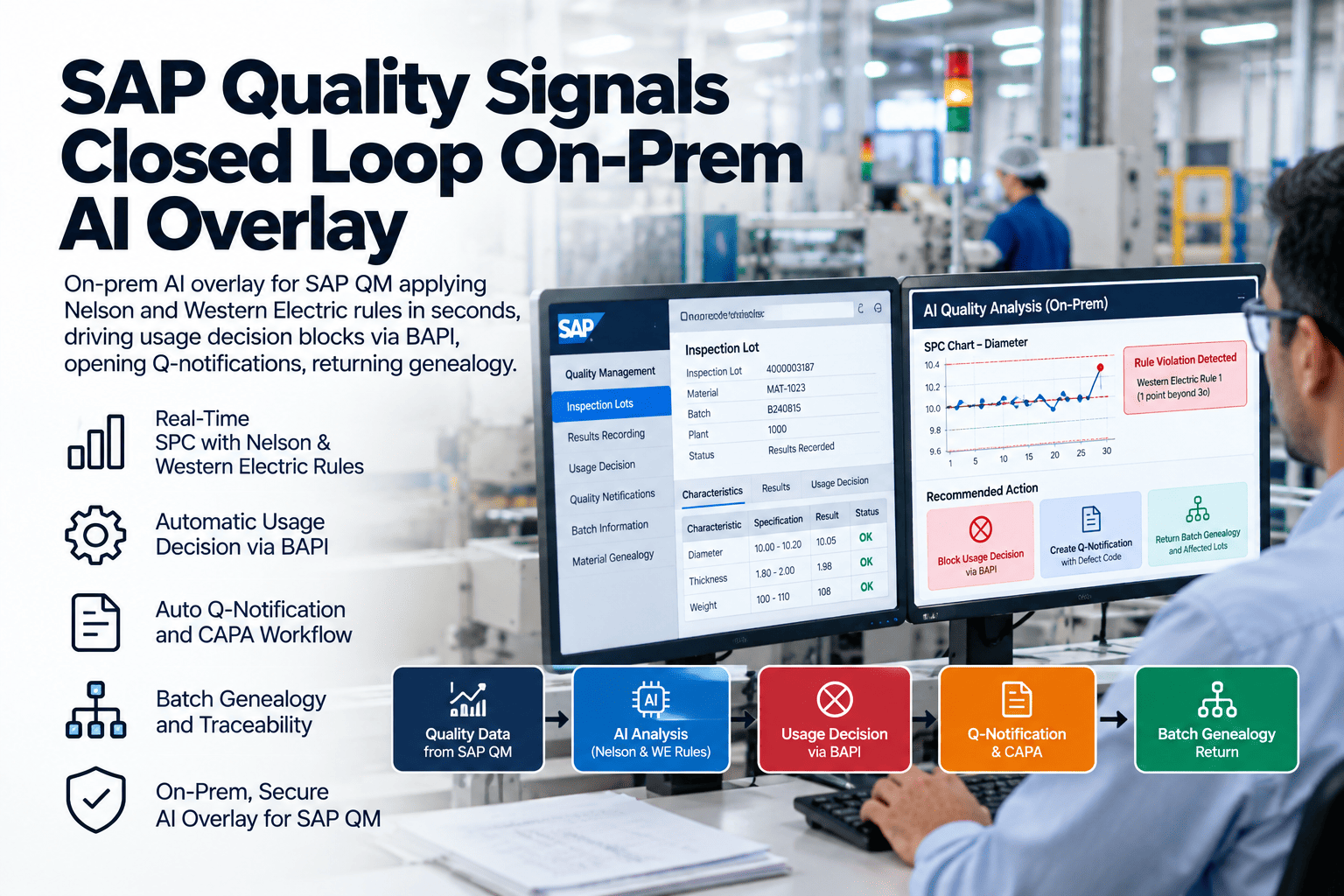
Overlay, not replacement. The existing incoming inspection system continues to apply ANSI/ASQ Z1.4 sampling, record measurements, and issue accept/reject dispositions the same way it always has. The overlay reads dispositions from the system and drives the downstream containment and CAPA workflow. Where the incoming inspection system is part of a larger QMS (Sparta TrackWise, MasterControl, ETQ Reliance, iBase-t Solumina, or SAP QM), integration reads through the QMS integration point; where inspection runs standalone (spreadsheet or dedicated tool), integration reads through the source system's export or API. What the overlay adds is the automated sister-lot hold, SCAR trigger, and downstream exposure query; what it doesn't change is how AQL sampling itself works.
How does automatic Z1.4 tightened/reduced switching actually get configured?
ANSI/ASQ Z1.4 defines specific switching rules — normal to tightened after 2 rejects in 5 consecutive lots, tightened back to normal after 5 consecutive accepts, normal to reduced after 10 consecutive accepts under certain conditions, reduced back to normal on any reject. The overlay tracks supplier receipt history per part and applies the switching rules automatically to the next receipt — inspection instructions carry the updated sampling level, sample size, and acceptance/rejection numbers. Where a site's practice deviates from strict Z1.4 (some sites apply tightened switching more aggressively for critical parts, or use custom switching rules for specific suppliers), configuration supports the local variant. What the overlay ensures is that the switching happens; what it doesn't do is impose a switching rule the site's quality policy hasn't agreed to.
Book an AQL closed-loop review to see the switching automation.
How does downstream exposure query work when we don't have full traceability from receipt to final assembly?
Downstream exposure query walks whatever traceability chain the MES actually captures — receipt lot to work order consumption at minimum, better if the chain extends through subassembly, final assembly, and shipment. Where the traceability is complete, the query returns the specific customer shipments carrying material from the supplier receipt window. Where the traceability is partial (receipt captured, consumption captured, but subassembly relationships not systematically recorded), the query returns the work orders that consumed the material and flags the subsequent traceability gap for manual assessment. The workflow is honest about what the data supports — it doesn't fabricate downstream links where none exist. Where the downstream escape risk justifies it, closing the traceability gap is a separate initiative the exposure query builds the business case for.
Stop letting AQL rejects close on paper alone.
Close the AQL Loop on One Commodity Group — Live
Bring one commodity group's supplier list, last quarter of AQL reject history, and current SCAR workflow cycle time. We'll walk what automated sister-lot hold and downstream exposure assessment would have caught, and demonstrate the SCAR workflow live.