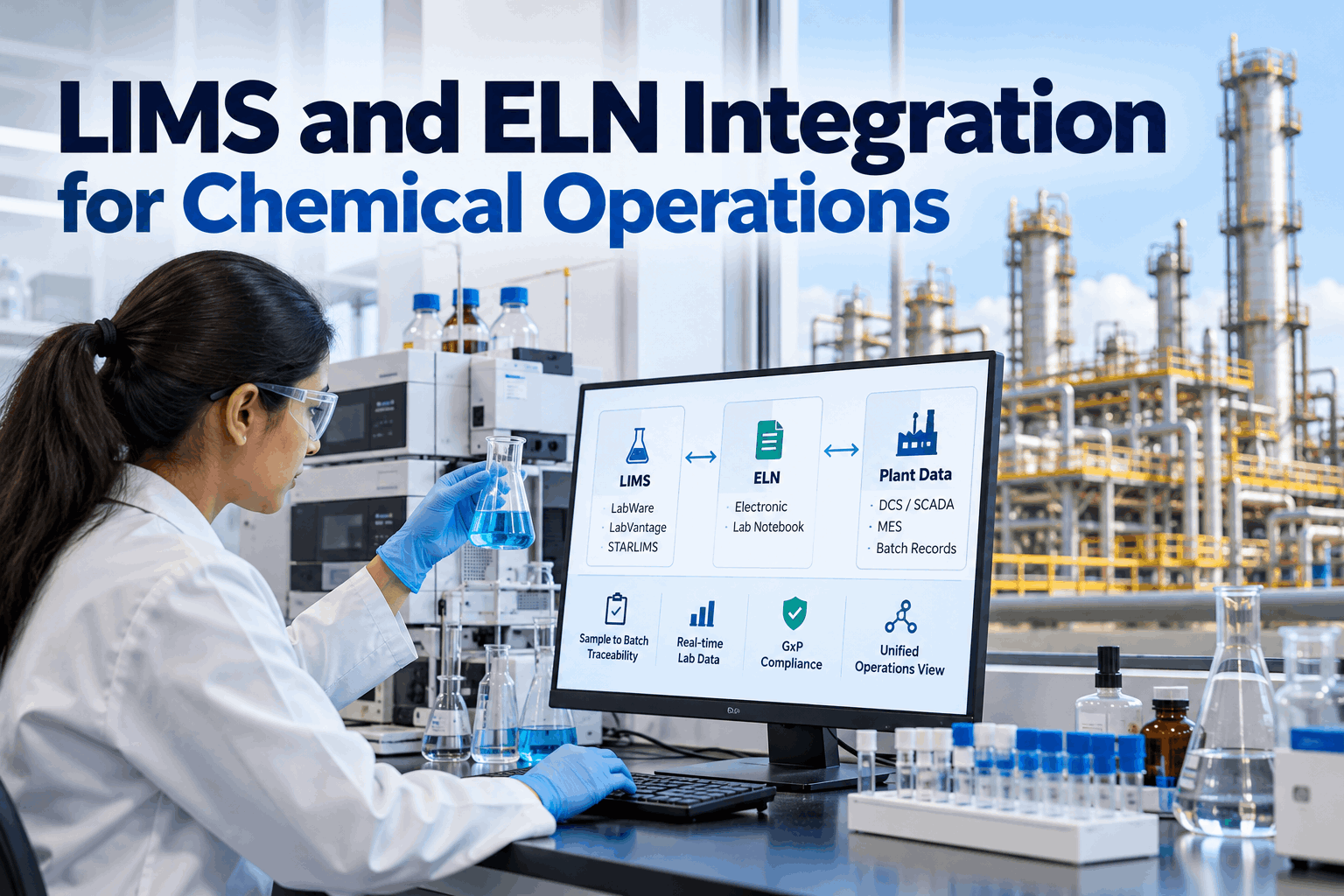
In most chemical companies, the lab and the plant run on separate systems. Recipes live in the ELN, sample results in the LIMS, batch execution in the MES and process conditions in the historian. When a batch fails a specification, someone pieces the story together by hand. Integrating LabWare, LabVantage, STARLIMS and your ELN with plant data gives true sample-to-batch traceability, which you can see in a short live demo.
Connect the Lab to the Plant for Real Sample-to-Batch Traceability
iFactory's LIMS / ELN Connector links lab systems with batch records, historian data and ERP lots. Every result can be traced to the batch, process conditions, raw materials and recipe version behind it, on-premise and within GxP controls.
Five Systems, Five Versions of the Same Batch
Each system was bought to do its own job well, and it usually does. The ELN was chosen by R&D, the LIMS by QC, the MES by operations and the ERP by finance, often years apart and without a shared plan for how they would talk to each other. The problem is that each one holds only part of the batch's story, and the IDs that should connect them, such as sample, batch, lot and recipe version, are entered by hand at the boundaries. When a result goes out of specification, the investigation starts with gathering data instead of analyzing it. Days can pass collecting exports from five systems before anyone can test a hypothesis, while the batch sits on hold and the next batches run under the same conditions. Our integration team can map your current systems.
Experiments, recipes, methods and tech transfer documents from R&D and process development.
Samples, test methods, specifications, results, approvals and certificates of analysis.
Batch execution, material charges, phase timings, operator entries and deviations.
Time-series process data such as temperatures, pressures, flows and dosing.
Raw material and finished lots, supplier certificates, orders and shipments.
Point-to-Point Links or a Central Connector
There are two broad ways to connect lab and plant systems. Point-to-point interfaces link each pair of systems directly. That works for one or two connections but grows into a web that is hard to validate and maintain. A central connector maps each system once and lets data flow through a shared model. For most chemical sites with four or more lab and plant systems, the connector approach is easier to validate and much easier to change later. You can compare the two on your own landscape in a working session.
- Fast for a single link, such as LIMS to ERP
- The number of interfaces grows quickly as systems are added
- Each interface is validated separately
- IDs mapped differently in each link
- Hard to trace a batch across more than two systems
- Each system is connected once
- One shared model for batch, sample, lot and recipe IDs
- A single validated integration layer
- Traceability across every connected system
- Swap or add systems without rewiring the rest
How LabWare, LabVantage and STARLIMS Typically Connect
All three major LIMS platforms support integration with enterprise and plant systems, though the methods differ. The summary below reflects publicly available vendor and industry information, and it is meant to show the range of options rather than rank the products. Your version, configuration and licensing decide what is actually available, so always confirm details with your vendor during scoping. Older on-premise versions in particular may support only file-based or database-level exchange, which still works but needs more careful validation. Our support team can review your LIMS version.
Ask Why a Batch Failed and Get the Whole Story
With lab, batch, process and lot data linked, quality and process teams can ask why a result went out of specification and get an answer that draws on every system at once.
The Six Links That Make Traceability Real
Traceability isn't one connection. It is a chain of IDs and time windows that let you move from any result to everything that influenced it, and back again. If any link in the chain is typed by hand or left out, the chain breaks at that point. Most plants already have five of the six links in some form. Usually it is the time window or the raw material lot that is missing. We can test your chain end to end in a data readiness call.
Five Uses That Pay for the Integration
Integration earns its cost through specific workflows that become faster, more reliable or possible for the first time. Picking one or two to start with gives the project a clear target and a result that people outside IT can see. These are the five that chemical operations most often start with. Our support team can help prioritize them for your site.
Certificates of analysis are assembled from approved LIMS results and ERP lot data without retyping.
Out-of-specification results open with process data, batch events and raw lots already attached.
Lab results are correlated with process profiles to find the conditions behind the best batches.
ELN recipes and methods move to MES and LIMS as structured data, not re-entered documents.
Batches with every result in specification and no open deviations are flagged for quick release.
Why Lab-to-Plant Integrations Disappoint
Most failed lab integrations don't fail on technology. The APIs usually work, and modern LIMS and ELN platforms all offer some way in. They fail on IDs, ownership and scope. These four pitfalls come up repeatedly, and each is much cheaper to address in design than after go-live. Our integration team can review your plans against them.
Integrations Are Part of the Validated System
In regulated chemical and pharmaceutical operations, an interface that moves results between systems is itself part of the computerized system and must be validated. Even in non-GxP specialty chemicals, customers increasingly audit how CoA data is produced, so the same discipline pays off. FDA's 21 CFR Part 11 and the EU's GMP Annex 11 both expect controlled, auditable data flows, and data integrity guidance builds on ALCOA+ principles. Integration features alone don't make a system compliant. Validation and governance of your configuration do. You can review a validation approach in a short session.
A Three-Step Path From First Link to Full Traceability
The fastest route to value is to start narrow, prove the chain on one product line, then widen. Choose a line with frequent investigations or customer CoA requests, so the benefit is visible to quality and commercial teams from the first weeks. Each step delivers something useful on its own, so the project pays back before it is finished. We can plan the steps for your site in a planning session.
- Connect LIMS, MES and historian read-only
- Align batch, sample and lot IDs
- Trace one product line end to end
- Use it for OOS investigations right away
- Add ERP lots, supplier certificates and the ELN
- Automate CoA generation
- Add sample login and lot status write-back
- Extend to the remaining product lines
- Correlate lab results with process profiles
- Find golden batch conditions per product
- Introduce release by exception
- Feed findings back into ELN recipes
Connector, Data Model and AI Server on Your Own Site
Lab and batch data are among a chemical company's most sensitive assets, because they encode recipes, process windows and the know-how behind product performance. iFactory delivers the LIMS / ELN Connector on-premise as a turnkey bundle. A pre-configured NVIDIA AI server ships racked and ready with the connector and analytics pre-loaded. You rack it, plug in power and Ethernet, and the AI is live. To scope it for your systems, request a turnkey quote.
- Pre-configured NVIDIA AI edge server, racked and ready
- Connectors for LabWare, LabVantage, STARLIMS and your ELN
- MES, historian and ERP integration
- Shared data model for sample, batch, lot and recipe IDs
- Cabling and plant network setup
- Validation documentation support and team training
- 24×7 remote monitoring
Server installed, systems connected read-only, ID mapping agreed.
Traceability tested on one product line, with CoA and OOS workflows piloted.
Validated go-live, write-back added where approved, teams trained.
A LIMS / ELN Connector Built for Chemical Operations
iFactory connects lab and plant systems through one validated layer, so every result carries its full batch context. The connector works alongside your existing systems rather than replacing them, so labs keep the LIMS and ELN they know. Our support team can review your system landscape before a pilot.
What Quality and IT Teams Ask About LIMS and ELN Integration
Give Every Lab Result Its Full Batch Story
Connect LabWare, LabVantage, STARLIMS and your ELN with MES, historian and ERP through one validated, on-premise layer, and trace any result to everything behind it. The full system is delivered turnkey and goes live in 6 to 12 weeks.