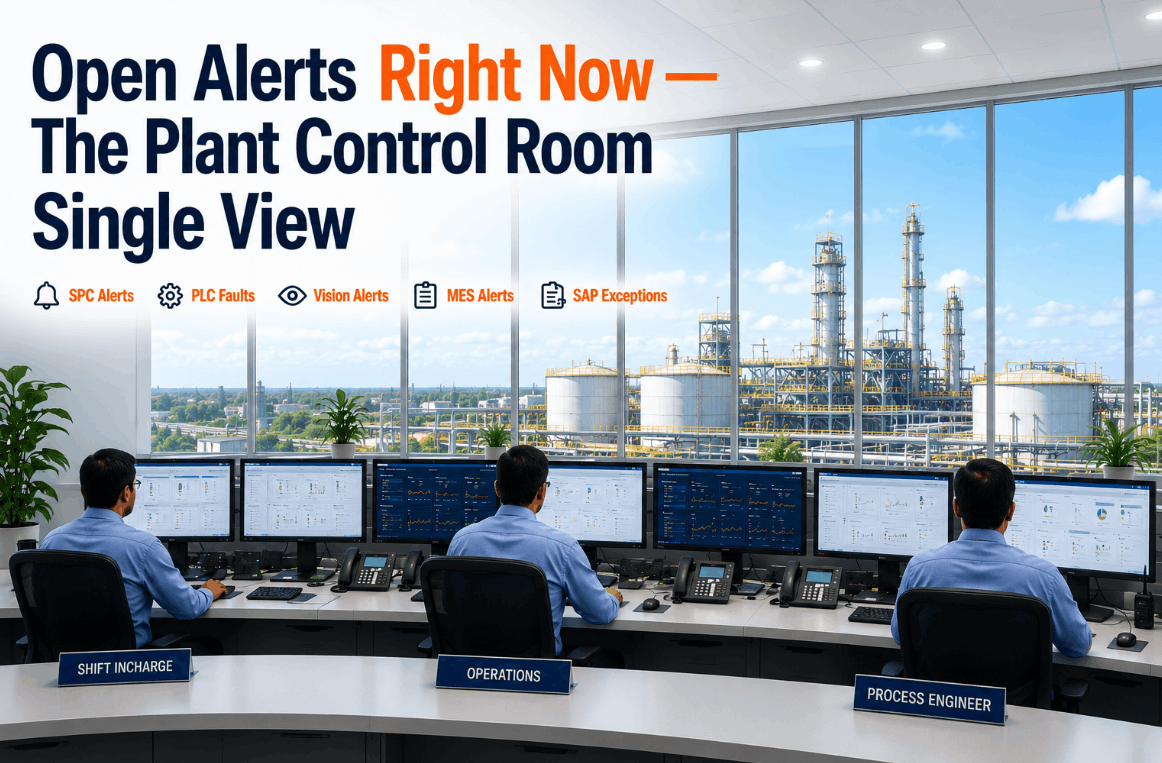
In today's integrated manufacturing facility, the operations control room is simultaneously the most critical and the most information-overloaded position on the plant floor. Shift supervisors and control room operators routinely manage twelve or more dashboards—SPC monitoring tools, PLC fault consoles, MES exception queues, vision system alerts, and SAP notifications—each running in a separate window, each using a different severity taxonomy, and none of them talking to each other. The result is a fragmented picture where nobody can answer the most fundamental question in plant operations: What alerts are actually open right now? iFactory's Plant Copilot solves this definitively. Ask the question in plain language, and the platform returns a single, unified Open Alerts view—ranked by quality impact, sourced from every connected system, and updated in real time. Book a Demo to see unified alert intelligence in action.
One Question. Every Open Alert. Ranked by Quality Impact.
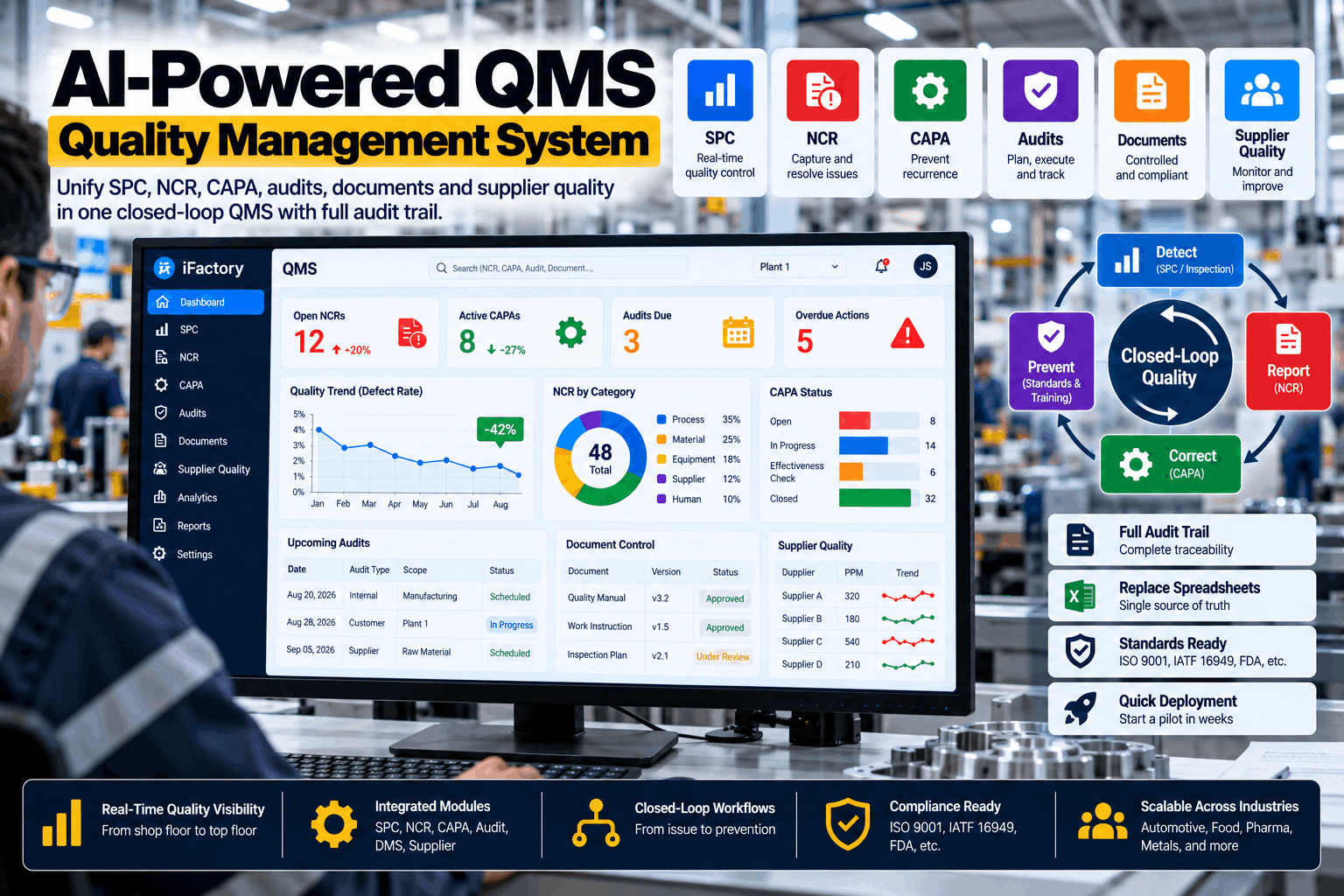
iFactory's Plant Copilot unifies SPC alarms, PLC faults, vision system alerts, MES exceptions, and SAP notifications into a single ranked Open Alerts view — purpose-built for the operations control room.
Why Twelve Dashboards Still Leave Your Control Room Blind
The modern plant control room is not short on data. It is short on unified visibility. Each operational technology layer—SCADA, MES, SPC, machine vision, and ERP—generates its own alert stream with its own priority logic, its own interface, and its own acknowledgment workflow. A PLC fault on a rolling mill drive might sit at "Critical" in the SCADA console while an SPC out-of-control signal on the same asset is buried on page three of the quality dashboard. Neither system knows the other's alert exists. The shift supervisor, switching between screens, is left to mentally reconcile two separate alarm hierarchies while simultaneously managing crew assignments and production schedules.
This fragmentation is not a minor inconvenience—it is a quantifiable operational liability. Industry data consistently shows that alarm overload is one of the leading contributors to delayed operator response in process manufacturing facilities. When operators must monitor multiple independent systems, critical alerts are missed, response times increase, and the compounding effect on quality and throughput is significant. iFactory addresses this at the architectural level by acting as an intelligent aggregation layer above all connected systems. Book a Demo to see how the aggregation layer works with your existing infrastructure.
SPC Alerts
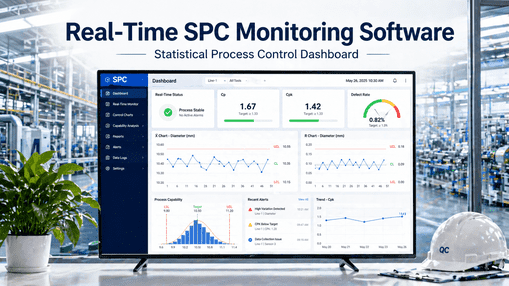
Out-of-control signals from statistical process control charts — Western Electric rule violations, Cpk degradation, and gauge drift — sourced from the quality monitoring system in real time.
PLC Faults
Drive trips, interlock activations, hydraulic pressure faults, and motor overcurrent events sourced directly from PLC tag streams via OPC-UA — the machine-level fault layer.
Vision System Alerts
Surface defect detections, dimensional non-conformances, and barcode read failures flagged by AI vision cameras deployed at inspection points across the production line.
MES & SAP Exceptions
Production order deviations, material non-conformance holds, WIP queue exceptions, and inventory shortfalls sourced from the Manufacturing Execution System and SAP in a single unified feed.
"Before iFactory, our shift supervisors were running four separate monitors just to cover SCADA, SPC, the vision line, and SAP. When a quality hold triggered in MES, it could be fifteen minutes before the control room connected it to the PLC fault that caused it, because those two systems had no relationship to each other. With the unified Open Alerts view, we ask one question and get the full picture — ranked by which alerts are actually affecting quality output right now. It changed how our entire control room operates within the first week."
How iFactory Builds the Unified Open Alerts View
The Plant Copilot's unified alert intelligence is not a simple screen-scraping aggregator. It is a structured data pipeline that ingests, normalizes, correlates, and ranks alert data from every connected system using a consistent quality-impact scoring model. Understanding the architecture helps control room teams and IT/OT integration engineers evaluate deployment fit.
Multi-Protocol Ingestion
iFactory edge connectors pull live data from every source simultaneously — OPC-UA and MQTT for PLC and SCADA layers, REST API for MES and SAP, and direct socket feeds for vision inspection systems. All connections are read-only, ensuring no disruption to existing control logic or ERP workflows.
Taxonomy Normalization
Each source system uses its own severity language. A SCADA "Priority 1" is not equivalent to an SPC "Rule 2 Violation" or a MES "Hold." iFactory's normalization engine maps every incoming alert to a unified severity taxonomy — Critical, High, Medium, Advisory — based on configured quality-impact rules defined by your engineering and operations team.
Cross-System Correlation
iFactory's AI engine links alerts from different systems that share an asset, a production order, or a time window. A PLC drive fault on Stand-4, an SPC out-of-control on rolling force, and a vision surface alert on the same coil are presented as a correlated event cluster — not as three unrelated notifications buried across three separate dashboards. Book a Demo to see correlation logic in a live plant scenario.
Quality-Impact Ranking
Every open alert is ranked not by the severity assigned by its source system, but by its calculated impact on quality output — gauge conformance, surface pass rate, dimensional yield, or production throughput. The shift supervisor sees, at the top of the list, the single alert that is doing the most damage to quality right now — not the loudest alarm in the noisiest system.
Plain-Language Delivery via Plant Copilot
The ranked Open Alerts view is delivered through the Plant Copilot interface — accessible on control room workstations, tablets, and mobile devices on the floor. Operators ask "What alerts are open right now?" and receive a structured, ranked list with source system, affected asset, quality impact estimate, and recommended action — in under three seconds.
Fragmented Dashboards vs. iFactory Unified Alert Intelligence
The performance gap between a fragmented multi-system alert environment and iFactory's unified Open Alerts view is measurable in response time, missed events, and quality yield. The following comparison maps the most common control room scenarios against both operational models to illustrate where the critical differences emerge.
| Control Room Scenario | Fragmented Dashboard Environment | iFactory Unified Open Alerts View |
|---|---|---|
| Shift supervisor asks "What's open right now?" | Must check SCADA console, SPC monitor, MES queue, and vision system independently — 10–20 minutes of manual reconciliation | Plant Copilot returns ranked Open Alerts list across all systems in under 3 seconds |
| PLC fault coincides with quality alert on same asset | Two separate notifications in two separate systems — connection is never made unless an engineer manually correlates timestamps | Both alerts automatically correlated into a single event cluster with shared asset context and timeline |
| Determining which alert requires immediate action | Operator prioritizes based on which dashboard is loudest — severity taxonomy inconsistent across systems | Every alert ranked by quality-impact score using a unified severity model configured by your operations team |
| SAP material hold triggered by MES non-conformance | ERP notification buried in SAP inbox; control room unaware until production planner calls | SAP exception surfaces in the unified Open Alerts view with production order context and affected coil list |
| Alarm fatigue and acknowledged-but-unresolved alerts | Operators acknowledge to clear screens; no tracking of whether action was taken or outcome recorded | Every alert carries an open/acknowledged/resolved status with timestamp and assignee — full audit trail maintained |
What Unified Alert Intelligence Delivers for the Operations Team
iFactory's Plant Copilot is not a passive aggregation display. It is an active intelligence layer that continuously processes alert data, applies quality-impact scoring, and delivers actionable context to the people who need it most. The following metrics reflect operational outcomes from control room deployments in U.S. manufacturing facilities. For a custom ROI projection based on your plant's alert volume and system landscape, Book a Demo with our solutions engineering team.
Alarm Rationalization Built Into the Unified Alert Model
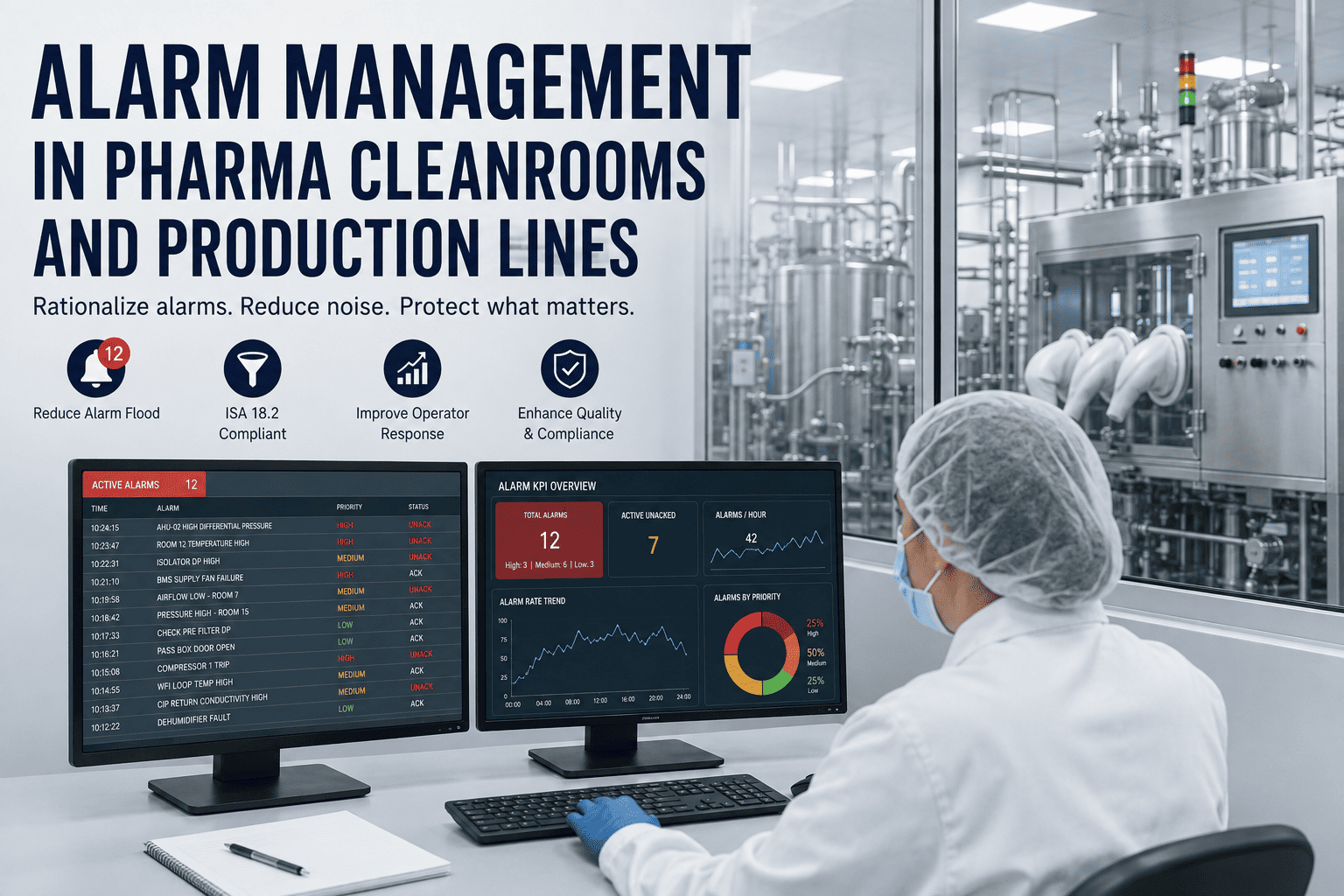
Alarm management best practices — including ISA 18.2 and EEMUA 191 — define alarm rationalization as an ongoing process, not a one-time configuration exercise. The core principle is that every alarm displayed to an operator must be actionable, prioritized correctly, and tied to a specific response. In practice, most manufacturing facilities inherit decades of uncurated alarm configurations where nuisance alarms outnumber meaningful ones, and operators develop the habit of ignoring entire categories of alerts to manage cognitive load.
ISA 18.2 guidance recommends no more than one alarm per operator per ten minutes as a manageable workload baseline. Facilities operating above this threshold — common in integrated manufacturing — see measurable degradation in response quality to legitimate critical events. iFactory's quality-impact ranking model automatically suppresses low-consequence, high-frequency nuisance alerts from the Open Alerts view while maintaining a full log for audit and analysis purposes.
A single transient exceedance on a rolling force parameter should not generate a Critical alert. iFactory applies configurable sustained-threshold logic — similar to ISA 18.2's "time-to-respond" classification — so that alerts only surface in the unified view when a condition has persisted long enough to warrant operator action. Your engineering team configures these rules through a no-code interface without PLC programming changes.
Open Alerts & Unified Control Room Intelligence — Frequently Asked Questions
Does iFactory replace our existing SCADA or MES alarm systems?
No — iFactory connects above your existing systems as a read-only intelligence layer, unifying their alert outputs without replacing or modifying any current control or enterprise software.
How does the quality-impact ranking model get configured for our plant?
Your operations and quality engineering team uses a no-code dashboard to define the quality-impact weight for each alert type and asset; iFactory applies those rules automatically across all connected sources.
Can the Plant Copilot be accessed on the plant floor, not just the control room?
Yes — the unified Open Alerts view is fully accessible on mobile devices and tablets, so shift mechanics and floor supervisors can query current alert status from anywhere in the facility.
How does iFactory handle alert acknowledgment and resolution tracking?
Every alert in the unified view carries an open, acknowledged, and resolved status with timestamps and assignee records, creating a full shift-level audit trail without manual logging.
Can iFactory integrate with SAP for enterprise-level exception visibility?
Yes — iFactory connects to SAP via bidirectional API, surfacing material holds, purchase exceptions, and production order deviations directly in the unified Open Alerts view alongside plant-floor signals.
The Control Room Deserves a Single Source of Alert Truth
The fragmentation of alert systems across the modern manufacturing control room is not a technology problem — it is an integration problem. Every individual system is doing its job. The SPC tool is monitoring the process. The SCADA console is reading PLC faults. The vision system is scanning every coil. The MES is tracking production conformance. But none of these systems was designed to talk to the others, and the burden of integration has historically fallen on the shift supervisor — the person who can least afford the cognitive overhead.
iFactory's Plant Copilot removes that burden entirely. By unifying SPC alerts, PLC faults, vision system detections, MES exceptions, and SAP notifications into a single Open Alerts view ranked by quality impact, the platform gives the operations control room something it has never had before: one answer to one question. For U.S. manufacturing facilities competing on quality, throughput, and operational efficiency, that unified intelligence is not a feature addition — it is the baseline for how a modern control room should operate. Book a Demo to connect your control room systems to iFactory's unified alert layer today.
Stop Managing Twelve Dashboards. Start Running One Control Room.
iFactory unifies SPC, PLC, vision, MES, and SAP alerts into a single ranked Open Alerts view — delivering the clarity your operations team needs to act fast and protect quality output every shift.