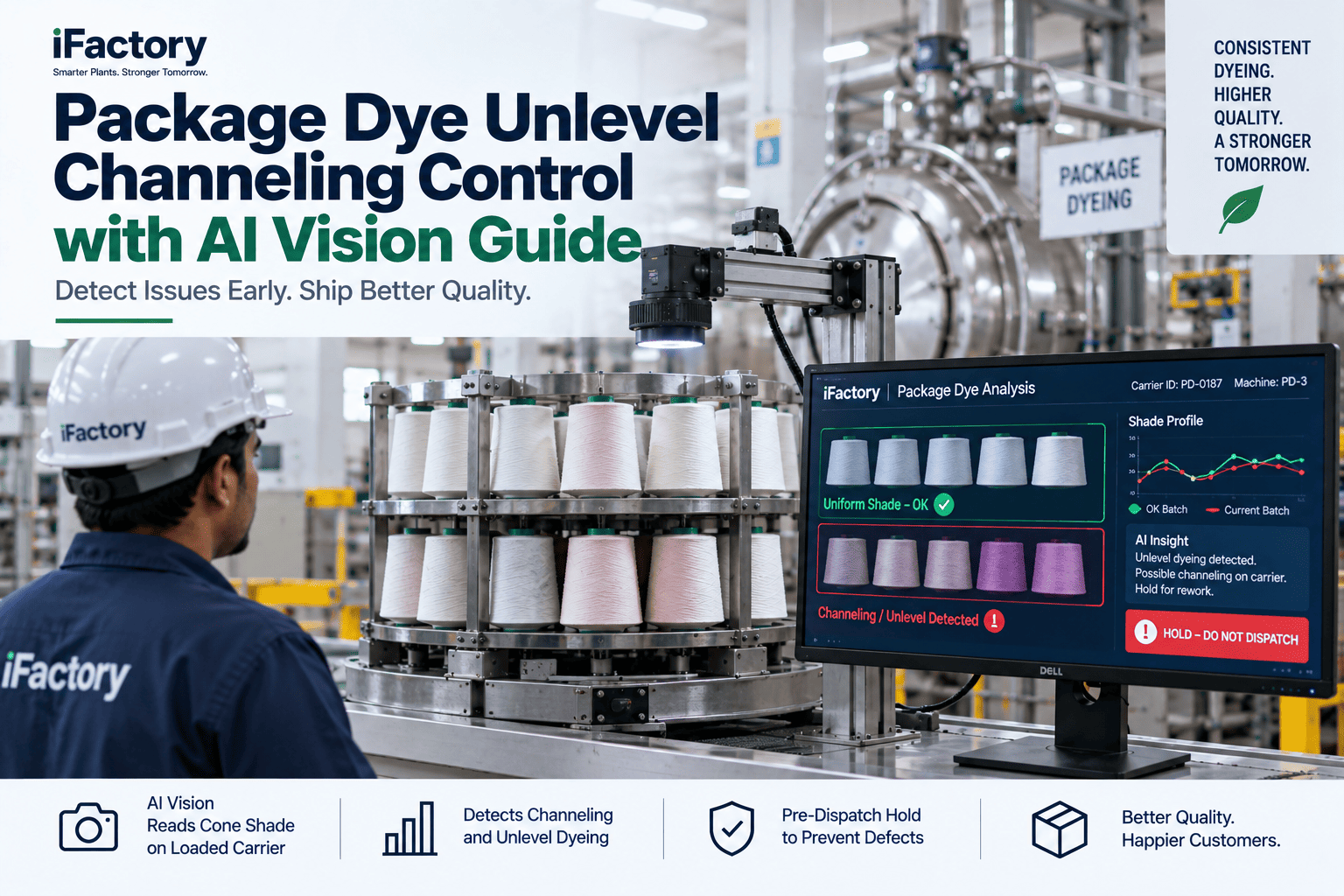
Package Dye Unlevel Channeling Control with AI Vision Guide
By James C on September 19, 2026
Channeling is the failure that hides until it is somebody else's problem. The liquor finds an easier path through a soft package or a badly seated spindle, some cones take more dye than others, and the carrier comes out looking broadly fine because nobody compares cone 4 with cone 17 under controlled light. The unlevel dyeing is discovered later, at rewinding, at knitting, or worst of all as barre in a finished panel — by which time the yarn has shipped and the conversation is about a claim rather than a re-dye. iFactory's carrier vision reads the shade profile across the whole loaded carrier as it comes off the machine and holds the suspect ones before dispatch.
AI Vision Quality Control for Package Dyeing
Package Dye Unlevel Channeling Control with AI Vision Guide
Vision AI reads the shade profile of every cone on the carrier, maps a deviation back to its spindle position, and holds the carrier before dispatch instead of letting unlevel dyeing be found at knitting.
The standard practice is to pull a few cones, look at them together, and release the lot. It is a reasonable use of an operator's time and it is structurally incapable of catching channeling, because channeling is positional. The affected cones sit where the flow was wrong — one column of spindles, the top tier, the outside row — and a random handful will usually miss them or, worse, catch one and be dismissed as a lighting effect. The result is a lot that is genuinely unlevel but has passed, and a defect that will surface at a stage where the yarn is worth several times more and is no longer yours to re-dye.
Read the Whole Carrier, Not a Sample
Imaging the loaded carrier under controlled lighting gives a shade value for every package in one capture. Because each position is known, a deviation is not just a bad cone — it is a bad location, and a location points at a mechanism.
Shade profile across the loaded carrier
A random deviation is a package problem. A whole column deviating is a flow problem, and the two need completely different responses. Position is what separates them, and position is exactly what a spot check throws away.
Unlevel Inside the Package Too
Channeling also happens within a single package, between the layers next to the tube and those at the surface. It is invisible on the outside of the cone and appears when the yarn is unwound, which is why it reaches the knitter so often. The deviation profile from inside to outside shows it directly.
Shade deviation from inside to outside of the package
The channeled package looks acceptable from the outside for most of its depth. The defect is in the relationship between layers, which is why it is only ever found by unwinding, unless something measures the profile deliberately.
A Carrier Decision Before It Leaves the Floor
The check produces one of three outcomes: release, rework, or investigate the machine. Each comes with the evidence behind it, so the operator is not being asked to take the system's word for it.
Carrier check — package dye machine 4, lot 2218
Carrier20 spindles · loaded from winder W2
Cyclecompleted, carrier unloaded
Cone to cone spreadbeyond limitwatch
Pattern of deviationone column, spindles 4 to 19watch
Inside to outside profiledeviating on those coneswatch
Flow and pressure during cycledifferential dropped mid-cyclewatch
Package density from windingwithin specOK
Hold the carrier and check that spindle column for a seating or blanking fault before the next load. The winding is not the cause here, so re-winding the packages would have wasted a shift.
What the Carrier Check Covers
Detection is only half of it. The other half is knowing which of the usual causes you are looking at.
Full carrier imaging
Controlled lighting and a shade value for every package, so the comparison is measured rather than judged by eye at the unloading bay.
Position mapping
Deviations tied to spindle and tier, which distinguishes a flow path problem from a handful of badly wound packages.
Process correlation
Flow, pressure differential, liquor ratio and winding density from the same lot, lined up against the pattern that was found.
Pre-dispatch hold
A suspect carrier is stopped while it is still a re-dye decision, not after it has been rewound, packed and shipped.
What Channeling Control Delivers
Finding unlevel dyeing at the machine rather than at the customer changes what the defect costs by an order of magnitude.
Caught
Before dispatch
at the carrier, not at knitting
Fewer
Barre claims
unlevel yarn never reaches fabric
Named
Spindle positions
repeat faults fixed at the source
Less
Unnecessary rework
only the affected cones re-dyed
Frequently Asked Questions
What actually causes channeling in package dyeing?
It is a flow problem: the liquor takes the path of least resistance instead of passing evenly through every package. The usual contributors are uneven winding density, packages that are too soft or too hard, poor seating on the spindle, missing or wrongly placed dummy packages, a blocked spindle, and flow or pressure that is too low for the load. Because several of these produce similar-looking results, the positional pattern on the carrier is the most reliable way to tell them apart.
Can vision detect shade differences an operator would miss?
Under controlled lighting, yes, and more importantly it detects them consistently. Human colour judgement at an unloading bay is affected by ambient light, by the sequence in which cones are viewed and by how long the shift has been. A calibrated camera compares every package against the same reference in the same conditions, and it does not become less sensitive at the end of the night shift.
Does it detect unlevel inside the package as well as between cones?
Between cones is read directly from the loaded carrier. Within the package, surface imaging tells you about the outer layers, and the inside-to-outside profile is established from unwound checks on sampled cones plus the correlation the model builds between surface pattern, position and process conditions. In practice, the carriers whose surface pattern and flow trace both look wrong are overwhelmingly the ones that turn out to be unlevel through the depth as well.
Where does the camera go, and does it slow unloading down?
At the unloading position, capturing the carrier as it comes out, which adds seconds rather than minutes and no handling steps. The carrier is already stationary at that point for unloading, so the capture fits into an existing pause. Where lighting at the bay is variable, a simple enclosure or controlled lamp set is part of the installation, because consistent lighting is what makes the measurement trustworthy.
How does this connect to the dye machine and our MES?
The carrier result is stored against the lot, the machine and the cycle, alongside the flow, pressure and temperature trace from that run, and the hold or release decision is posted to your MES or quality system so dispatch cannot pull a held lot. Over time that record is the most valuable part: it shows which machines, which spindle positions and which winding sources repeatedly produce unlevel carriers, which turns a recurring quality complaint into a maintenance job.
Find the Unlevel Carrier at the Machine.
See a Carrier Profile Read on Your Own Package Dye Line
Bring a lot you suspect and one you trust, plus the flow and pressure trace for both. We'll show the shade profile across the carrier, map the deviations to spindle positions, and line them up against the cycle data.
-—-mold-level-and-tundish-spc-for-slab-quality.png)