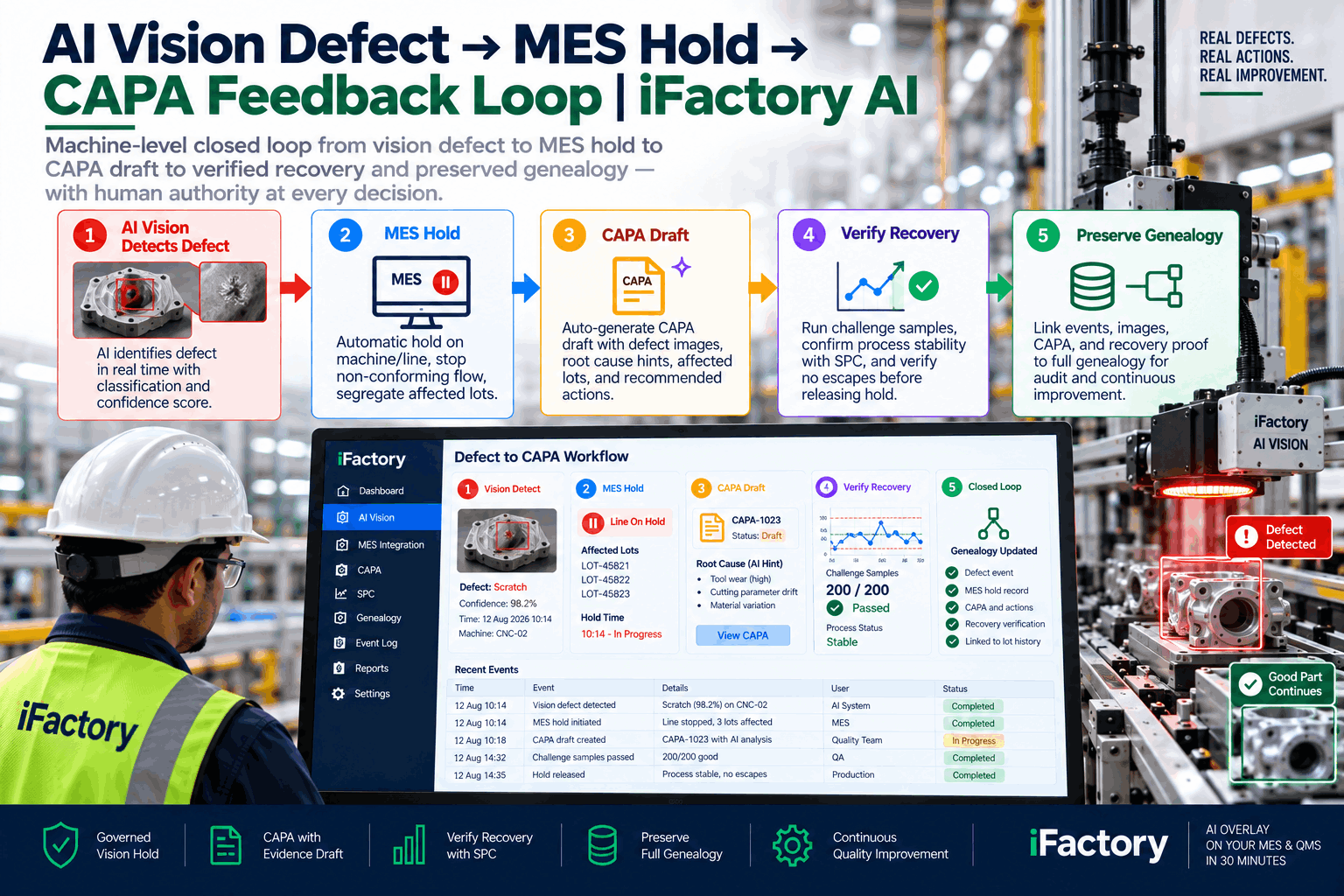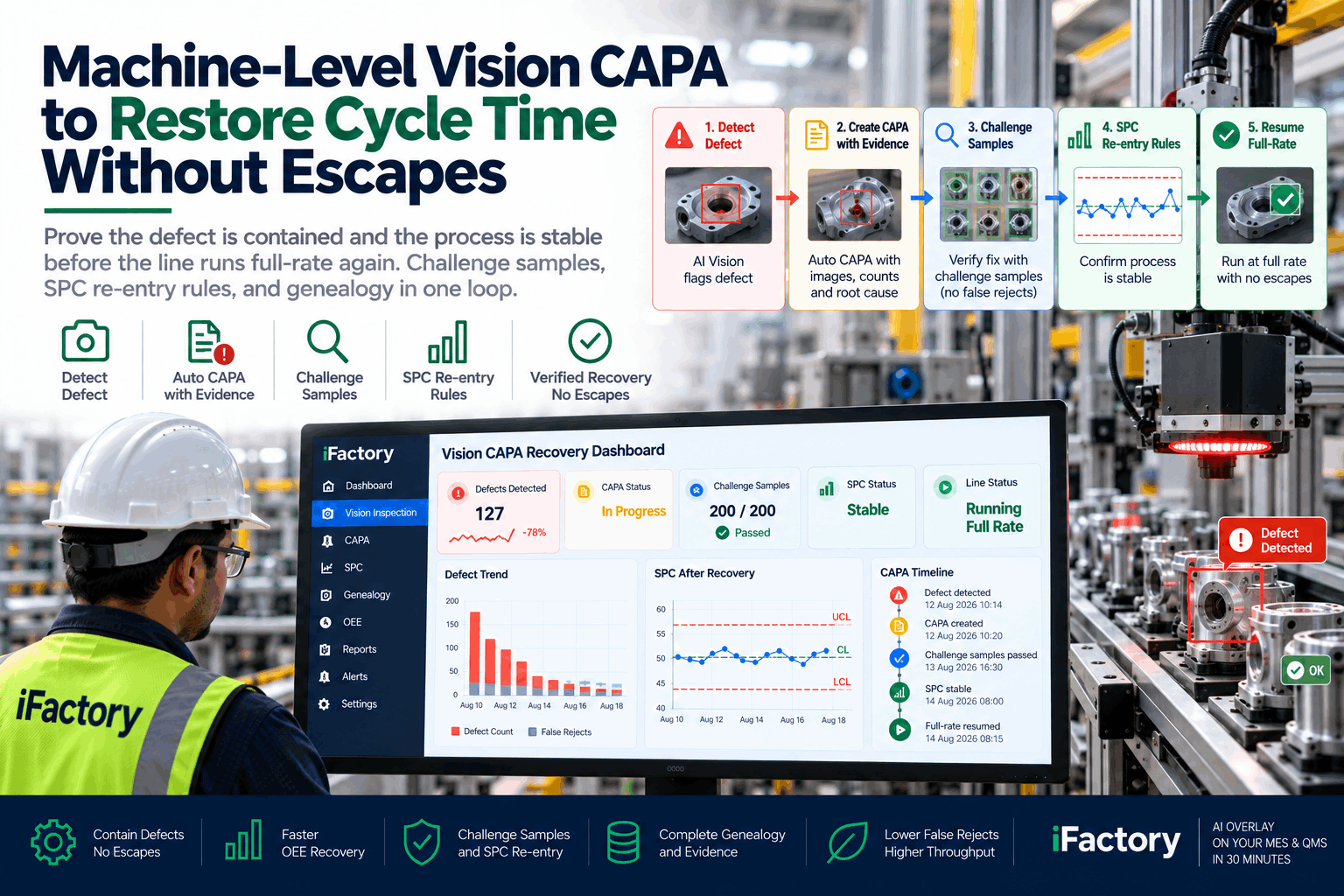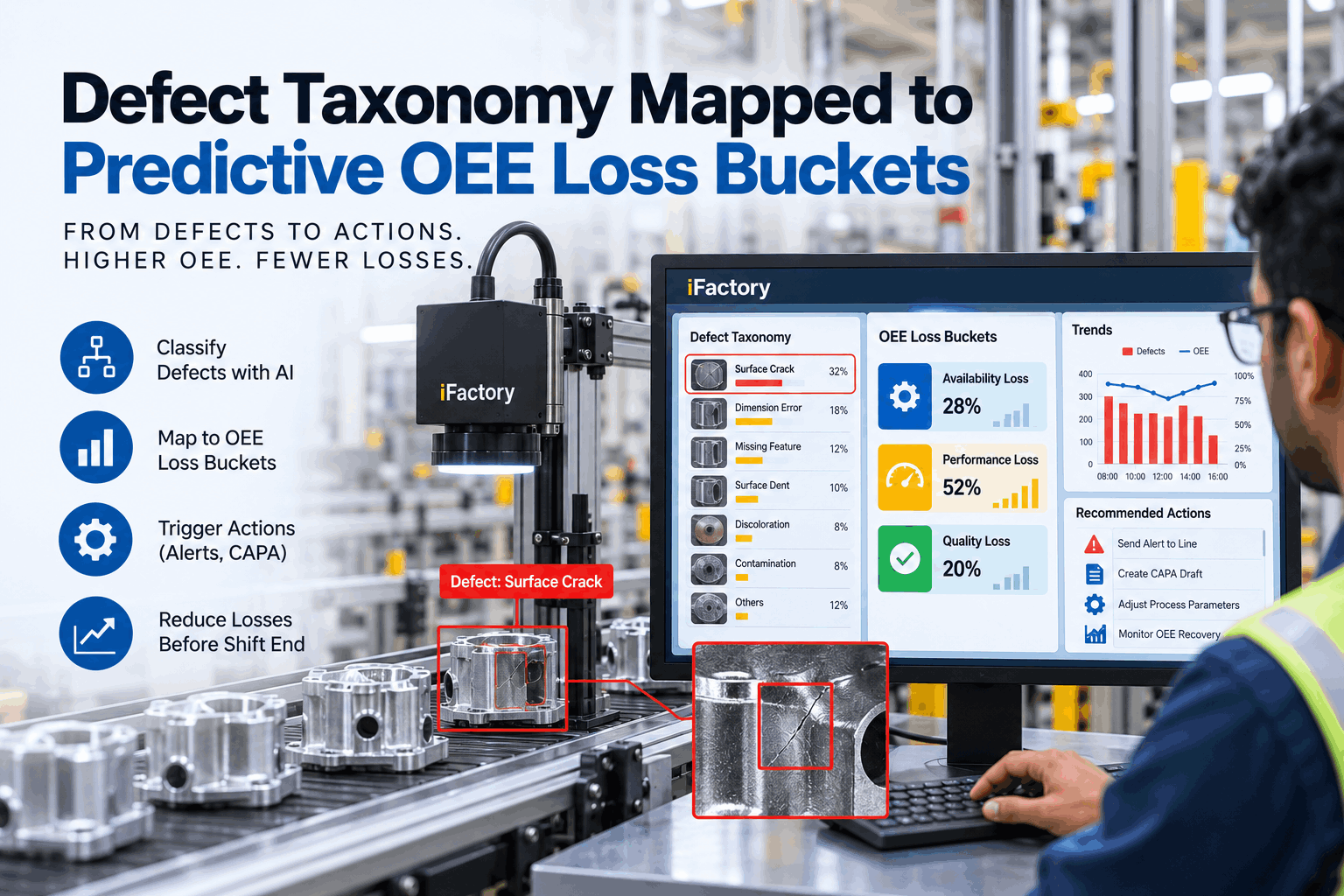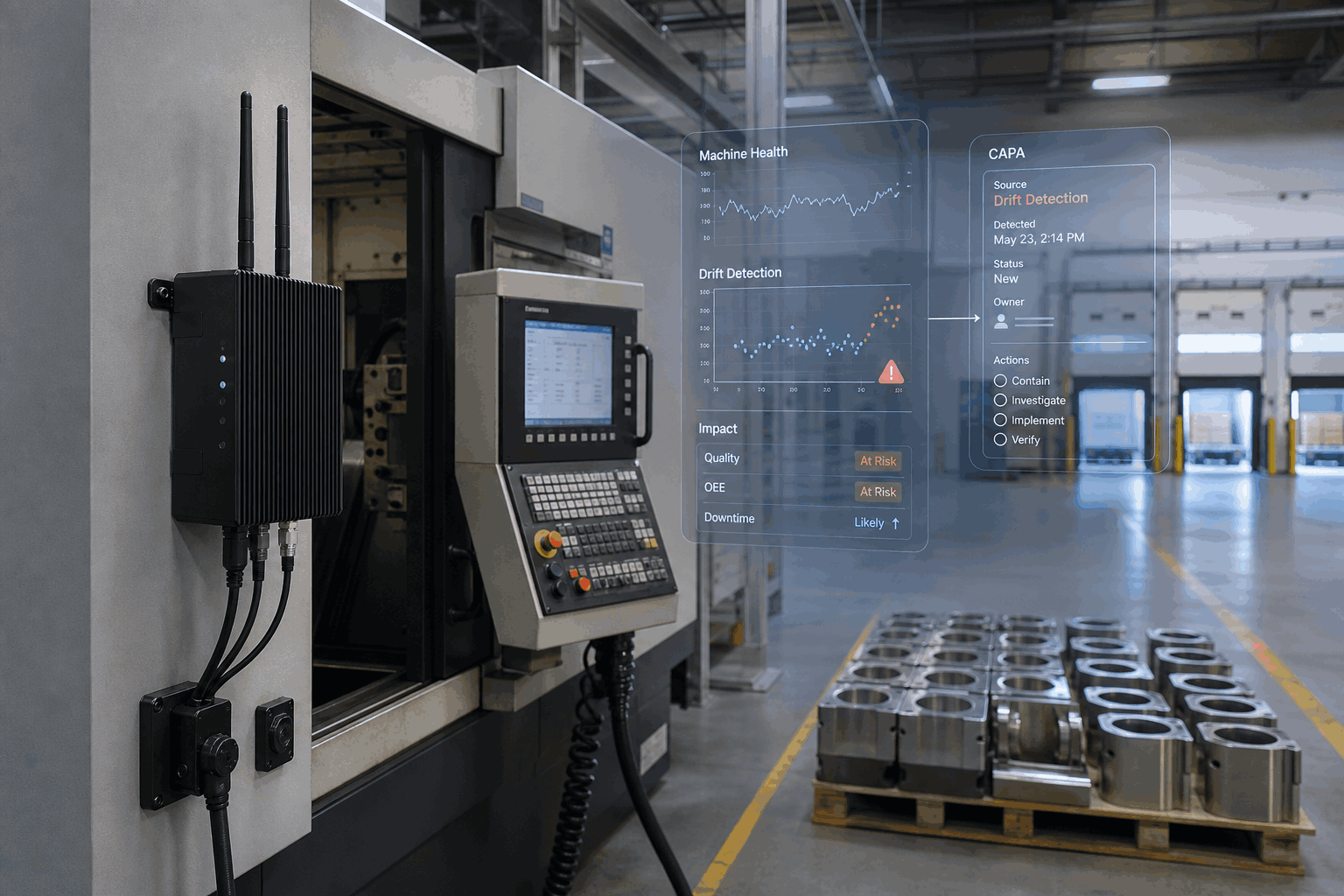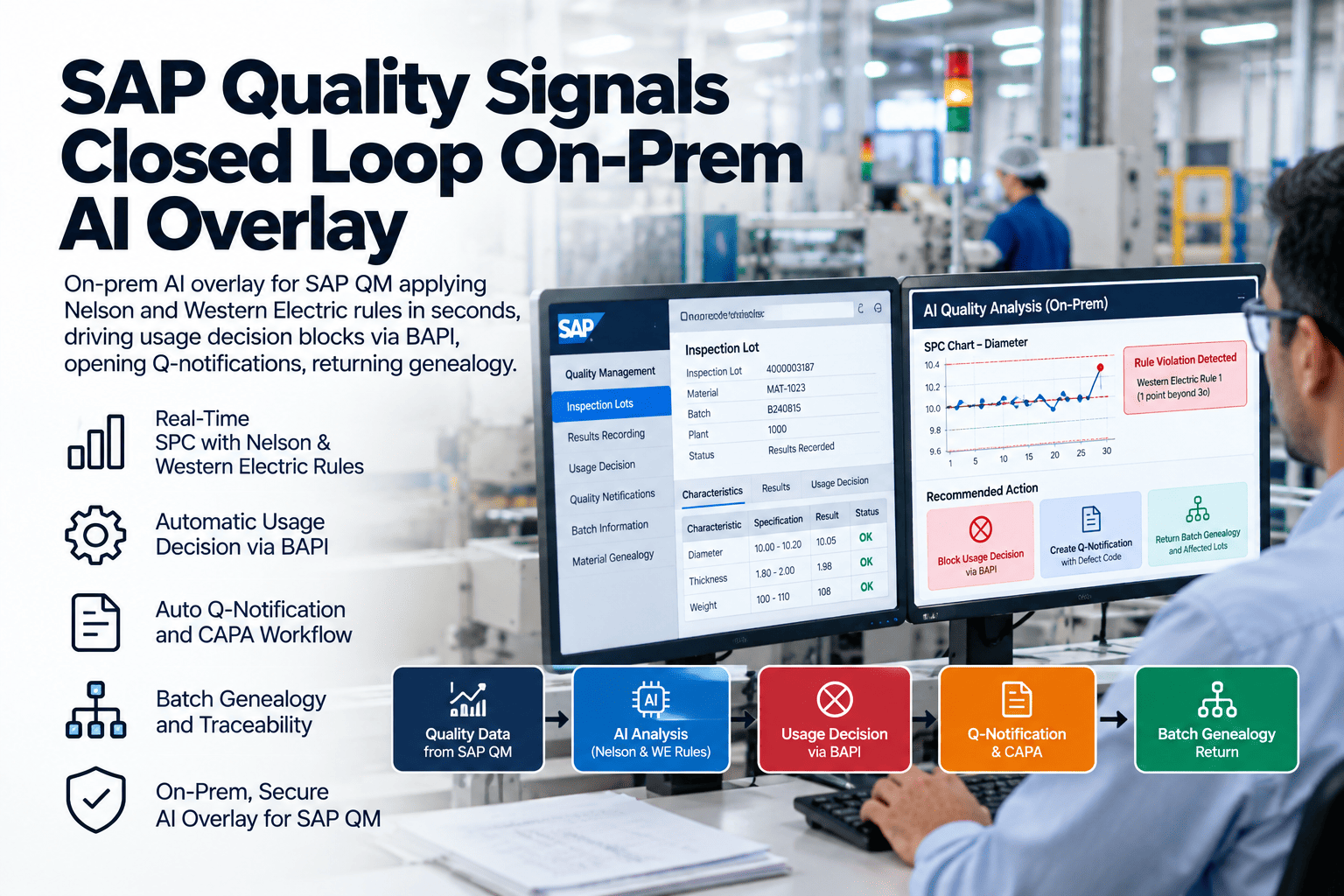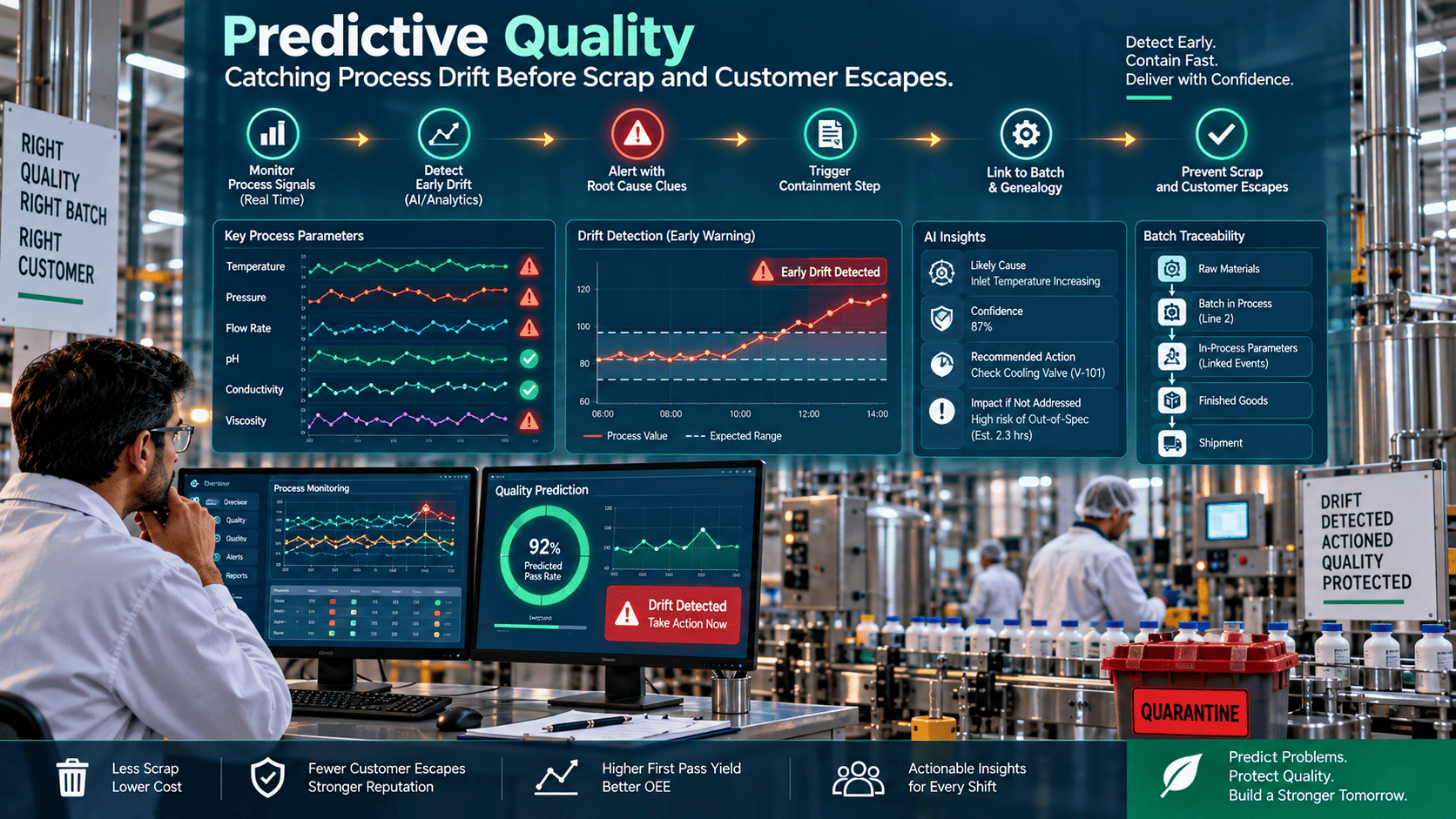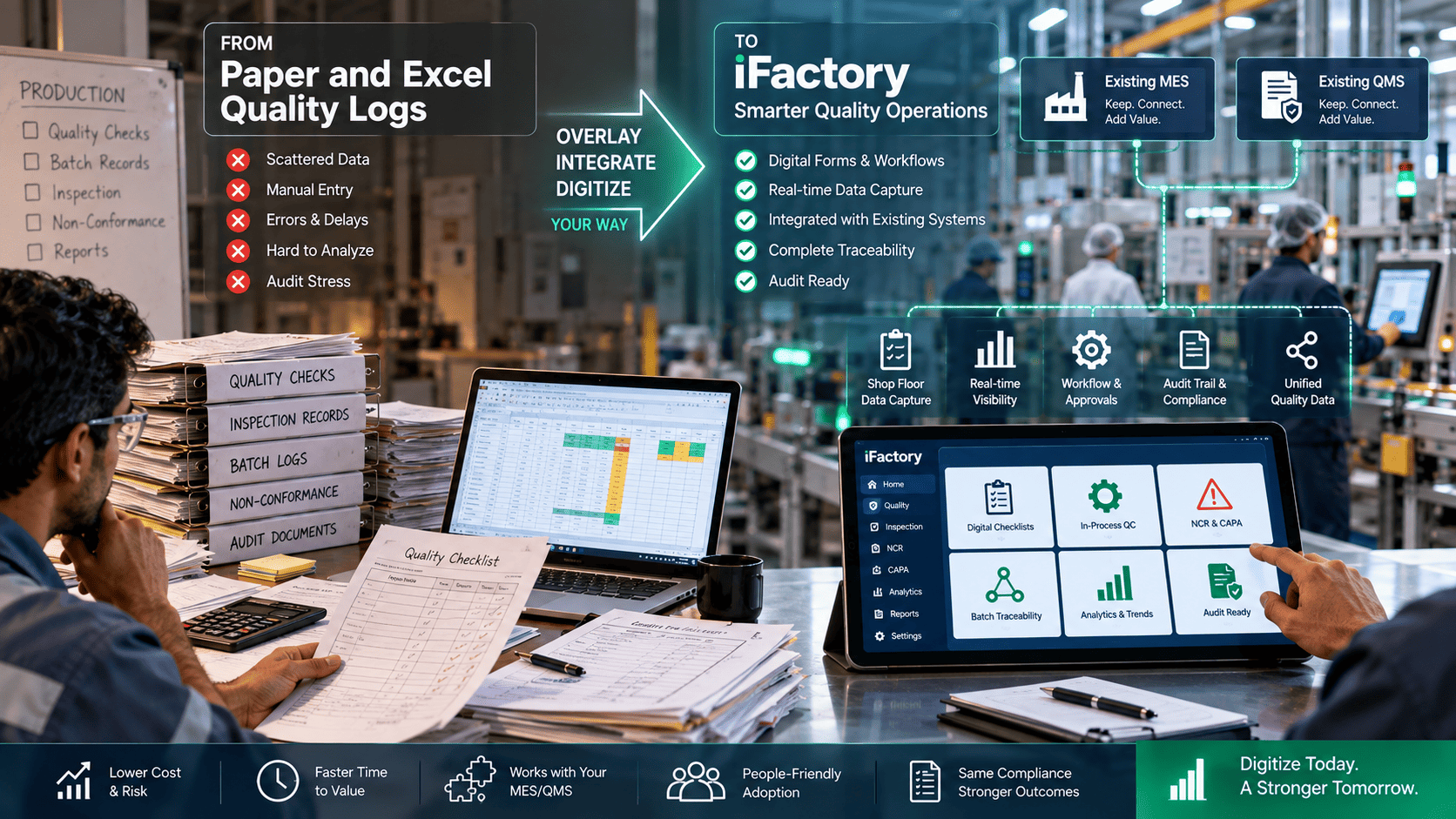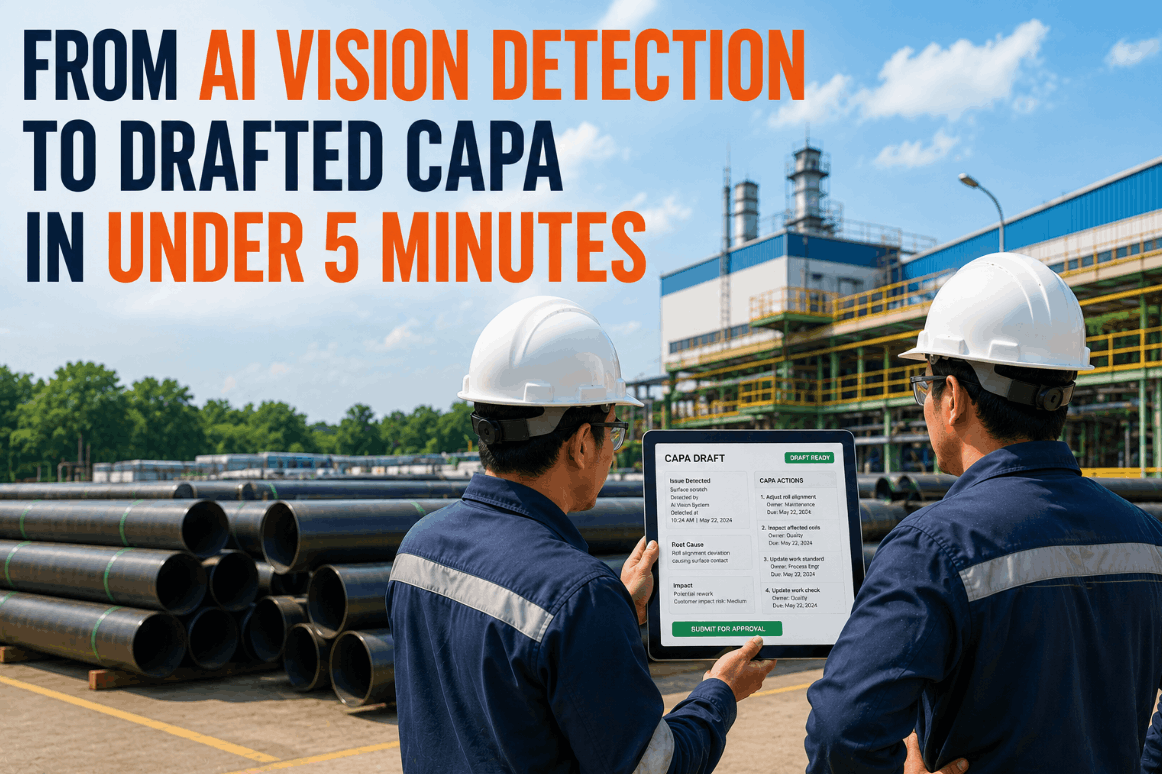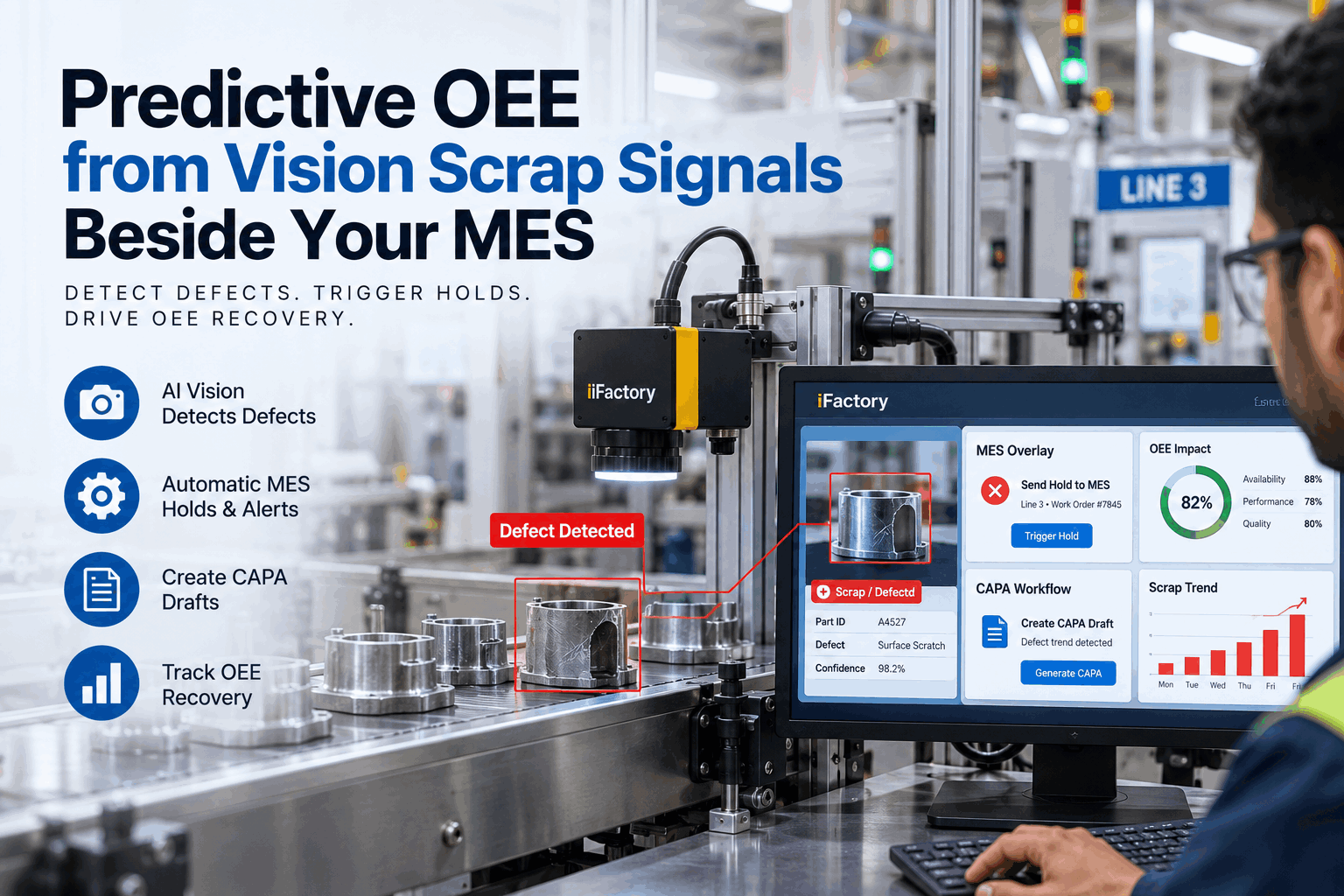
Your OEE may already be telling you the truth — just too late. When vision scrap rises before the MES module logs a quality loss, you get a narrow window to hold product, launch CAPA, and keep a defect trend from turning into a shutdown story. Predictive OEE from vision scrap signals is about closing that window faster, not by replacing your MES, but by turning vision detections into quality action while the line is still running. iFactory AI sits beside your MES and QMS as an intelligence overlay, converting the earliest defect trend into a governed hold, CAPA draft, verification step, and genealogy record before scrap becomes a shutdown story. See the overlay in a 30-minute walkthrough.
Turn early defect trends into governed holds, CAPA drafts, and verified recovery — without ripping out the MES that already runs the plant.
At a Glance
Why Scrap Becomes Predictive Before It Becomes an OEE Problem
Most plants already track scrap somewhere. The gap is that the scrap record often shows up after the damage is done, while the real signal was visible earlier in the vision stream. That is why AI vision matters as more than an inspection stage. A rising defect rate can point to a tool drifting, a camera or lighting issue, a supplier lot problem, a setup change, or an operator sequence that is no longer holding tolerance. If you only look at the final scrap report, you see the result. If you look at the trend, you see the warning.
That is the core of predictive OEE — not just reporting quality loss, but using defect patterns as a leading indicator of future loss. For a plant leader, this matters because quality problems do not stay inside one bucket. They spill into inspection overload, quarantine lag, rework congestion, blocked WIP, delayed releases, and slower recovery to normal cycle conditions. In other words, quality loss becomes performance loss, and performance loss becomes availability loss the moment the containment call is delayed.
Three Loss Stories Behind One OEE Number
OEE is often discussed as a single number, but in practice it is three different loss stories. When vision-driven predictive signals are used well, all three become more visible and more manageable at the same time.
- Stops, changeovers, starvation, blocking
- Quarantine lag
- Manual release approval delay
- Reinspection queues
- Slow cycles and microstops
- Extra verification steps
- Manual sorting or overrides
- Cautious workarounds after fix
- Scrap and rework
- False rejects
- Escapes to downstream
- Customer risk
A small but consistent rise in defect counts can be the first sign that the line is drifting into a broader OEE problem. Lagging scrap reporting tells you what was lost. Leading defect pattern detection tells you what may be lost next.
The Predictive OEE Closed Loop
A practical predictive OEE workflow should move in a closed loop where detection produces a governed action, not just an alert. Each step preserves evidence for the next one, so the plant can prove not only that the defect was seen but that containment worked and OEE actually recovered.
When the MES does not just receive a scrap count but a meaningful event — station, SKU, shift, timestamp, defect type, lot context, hold status, genealogy link — the signal becomes usable. That is what makes predictive OEE operational instead of theoretical.
Walk through how iFactory AI takes a defect signal and converts it into a machine-scoped hold, CAPA draft, and verified recovery — beside your existing MES.
What Breaks When Vision, MES, and Quality Stay Disconnected
The most common failure is not lack of data. It is lack of orchestration. A vision system may detect a defect pattern, but the MES still treats it like a separate dashboard event. Quality sees the issue, but the hold is manual. By the time someone decides to quarantine WIP, more material has already moved through the line.
- The vision event never becomes a formal quality record
- The hold happens late, if at all
- CAPA starts without full context
- Genealogy is fragmented across systems
- Verification is delayed
- The same loss repeats before root cause is understood
- Every vision event becomes a structured record
- Holds carry machine, lot, and time-window scope
- CAPA drafts inherit evidence automatically
- Genealogy stays intact from detect to release
- Verification confirms the fix before reopening
- Recurrence is caught before it becomes trend
The real miss is not lack of vision. It is lack of action orchestration. Quarantine lag becomes expensive because good product gets stuck behind bad information, while bad product keeps moving because the signal never reached the right workflow fast enough.
How iFactory AI Overlays Your MES and QMS
iFactory AI does not replace MES, QMS, historian, or SPC systems. It sits beside them and connects the events those systems already generate into a decision-ready quality workflow. That matters because plants do not want another migration project. They want the systems they already trust to become faster at moving from signal to action.
Ingest defect frames, pass/fail results, station context, operator context, and part or lot identifiers into a single event view.
Route the hold recommendation to the correct scope — unit, lot, or time window — with human approval preserved for release.
Assemble the evidence, defect pattern, and genealogy links into a review-ready record so quality is not starting from scratch.
Track post-fix defect rate, false rejects, and line speed so the team can prove the corrective action worked.
Every hold, release, rework, and disposition stays tied to the affected unit or lot record for audit and root cause.
Confirm availability, performance, and quality recovery together — not just that defects dropped for five minutes.
Frequently Asked Questions
Standard OEE tells you what was lost. Predictive OEE uses defect trends, vision signals, and process context as leading indicators so the team can act before the loss reaches the shift report.
No. iFactory AI works as an overlay beside your existing MES and QMS. It adds a decision layer that connects events into action, without touching your systems of record.
Genealogy defines the scope. If the defect maps to a unit, only that unit is held. If it maps to a lot or process window, the hold matches that boundary — with human approval before release.
SPC helps explain whether the process was drifting before the defect appeared. Combined with vision detection, it turns a single alarm into a pattern the team can act on with confidence.
By tracking post-action defect rate, false rejects, cycle time, and stop frequency together. Recovery is not complete until all three OEE buckets return to stable behavior.
Predictive OEE is not about better dashboards. It is about connecting the earliest quality signal to a governed hold, CAPA draft, verified recovery, and clean genealogy — beside the MES you already run.