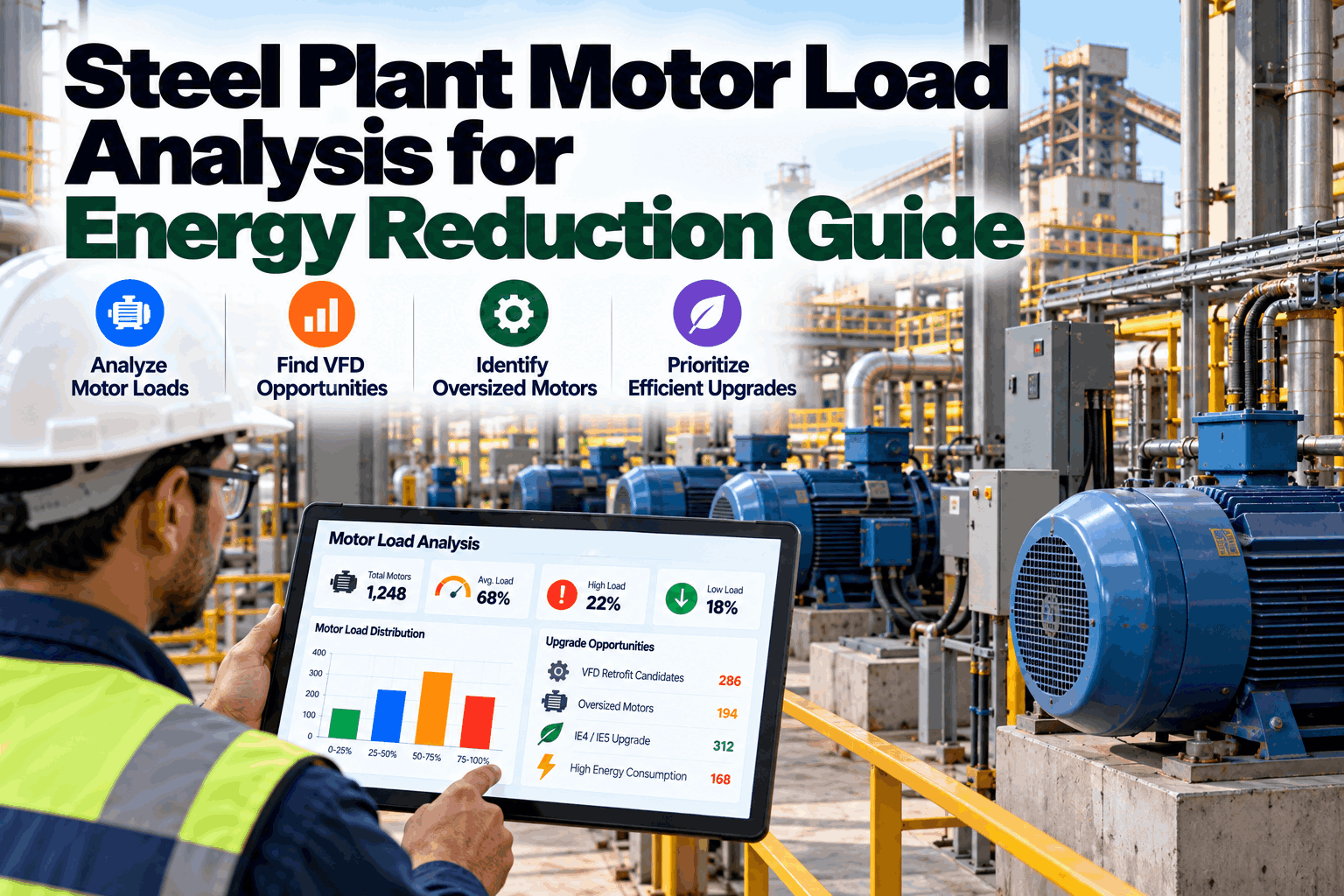
Motors quietly consume most of a steel plant’s electricity, from the megawatt-class sinter fans and blast furnace blowers to thousands of pumps, conveyors and auxiliary drives. Many run far below their rating, many fans and pumps are throttled instead of slowed, and failed motors are usually replaced like for like. A plant-wide motor load analysis finds the VFD retrofit candidates, the oversized motors and the IE4/IE5 upgrade priorities, often using data your historian already collects. Book a 30-minute motor fleet review with your own drive data.
Estimate the load of every large motor from data you already have, then right-size, add speed control or upgrade in the order that pays back first.
low load, long hours
high load, long hours
At a Glance
Why the Motor Fleet Deserves a Plant-Wide Analysis
A steel plant runs thousands of motors, from blast furnace blowers and sinter main exhaust fans rated in megawatts to small conveyor drives. A few hundred of them account for most of the electricity. They are often specified with generous margins, run for decades, and get replaced like for like when they fail. The result is a fleet where many motors run far below their rating, fans and pumps are throttled rather than slowed, and efficiency classes lag well behind what is available.
For motors that run most of the year, the electricity they use over their life costs many times their purchase price. A load analysis is how you decide where that energy is being wasted, and it can be done largely from data the plant already collects.
In most integrated plants the analysis starts with a short list of heavy hitters: blast furnace blowers, sinter main exhaust fans, furnace combustion air and induced-draft fans, descaling and cooling water pumps, compressors, and the main mill drives. A few dozen of these often account for more electricity than the thousands of smaller motors combined, so they get measured first.
Estimating Motor Load Without Stopping Anything
| Method | What you measure | Notes |
|---|---|---|
| Input power | Three-phase kW at the motor or drive | Most reliable; compare with rated input power |
| Current ratio | Running amps against nameplate full-load amps | Simple, but less accurate at low load, where current does not fall in proportion |
| Slip method | Shaft speed against synchronous and full-load speed | Quick field check; sensitive to voltage and nameplate tolerance |
| Drive and historian data | Power, torque or current reported by VFDs and protection relays | Often already logged; enables continuous load profiles rather than spot checks |
Spot measurements are a start, but load varies with production. A year of hourly data shows whether a motor is lightly loaded all the time, which points to right-sizing, or varies widely, which points to speed control.
Three Findings to Look For
Motors averaging well below half load. Efficiency and power factor typically fall away at low load, so a correctly sized motor, or a smaller one at the next replacement, saves energy continuously.
Centrifugal fans and pumps controlled by dampers, throttling valves or recirculation. Slowing them down follows the affinity laws, so power drops sharply with speed.
Motors with long hours and steady, high load. Moving from IE2 or IE3 to IE4 or IE5 yields a smaller percentage gain on a large, continuous consumption.
A Prioritized Action List
| Example motor | What the data shows | Recommended action |
|---|---|---|
| Sinter main exhaust fan | Damper-controlled, flow varies with strand speed and bed permeability | VFD feasibility study; among the largest single loads in the sinter plant |
| Cooling water pump | Throttled discharge valve, about 60% open on average | VFD, after checking static head on the system curve |
| Reheat furnace combustion air fan | Near-constant load around 40% | Right-size at next replacement; review inlet damper control |
| Main conveyor drive | 85% load, about 7,800 hours a year | IE4 or IE5 at next failure or planned overhaul |
| Overhead crane hoist | Intermittent duty, low annual hours | Leave as is; focus effort elsewhere |
Illustrative entries. In a real analysis each row carries annual kWh, estimated savings, capex and payback, so the list can be funded in order.
Replace, Rewind or Run to Failure
The cheapest time to upgrade a motor is when it has already failed. Plants that decide in advance what happens to each large motor at failure, whether to rewind, replace like-for-like or replace with a higher efficiency class or smaller rating, capture upgrades that would never be approved as standalone projects. Industry repair studies show that rewinds following good practice can maintain original efficiency, while poor practice can reduce it, so repair quality belongs in the policy too.
Motors whose replacement should be IE4 or IE5, or a smaller rating, are flagged in the CMMS before they fail.
Stocking higher-efficiency spares for critical drives avoids emergency like-for-like buys.
Rewind shops held to documented good-practice procedures, with efficiency checked after repair.
EU Ecodesign Regulation 2019/1781 requires IE4 for most three-phase motors from 75 to 200 kW, and the U.S. DOE rule raises the bar from June 2027.
What iFactory Delivers
Every large motor with rating, efficiency class, duty, hours and load profile.
Load estimated hourly from drive, relay and historian data, with no one-off survey needed.
Each motor sorted into right-size, VFD, efficiency upgrade or leave as is, with estimated savings.
Throttled and damper-controlled loads identified, with static-head checks flagged.
Pre-agreed upgrade decisions pushed into the CMMS for each motor.
Post-retrofit energy measured against a normalized baseline.
Share your motor list and a few months of drive or historian data. We estimate load, classify every large motor and rank the VFD, right-sizing and upgrade opportunities.
How Deployment Works
Server racked on site, historian, meter and production data connected, and metering gaps listed against the units that matter most.
Baselines and expected-energy models built per unit, then piloted with your energy and process engineers reviewing every finding.
Dashboards, alerts and reports rolled out plant-wide, teams trained, and 24×7 remote monitoring of the system in place.
Frequently Asked Questions
By comparing measured input power with rated input power, or using current ratio or slip methods. Drive and historian data often allow continuous load profiles without new instruments.
Centrifugal fans and pumps with variable demand that are currently controlled by dampers, throttling valves or recirculation, and that run long hours.
For friction-dominated fans and pumps, the affinity laws mean a 20% speed reduction cuts power by about 49%. Systems with high static head save less, so the system curve must be checked.
A motor that averages well below half of its rated load. Efficiency and power factor typically drop at low load, so right-sizing at replacement saves energy.
They are high efficiency classes defined by the IEC. In the EU, most three-phase motors from 75 to 200 kW have had to meet IE4 since July 2023.
It depends on size, hours and condition. A pre-agreed policy per motor, with good-practice rewind standards, lets the plant capture upgrades at failure when they cost least.
iFactory analyzes load across your motor fleet continuously and ranks VFD, right-sizing and upgrade opportunities by payback.