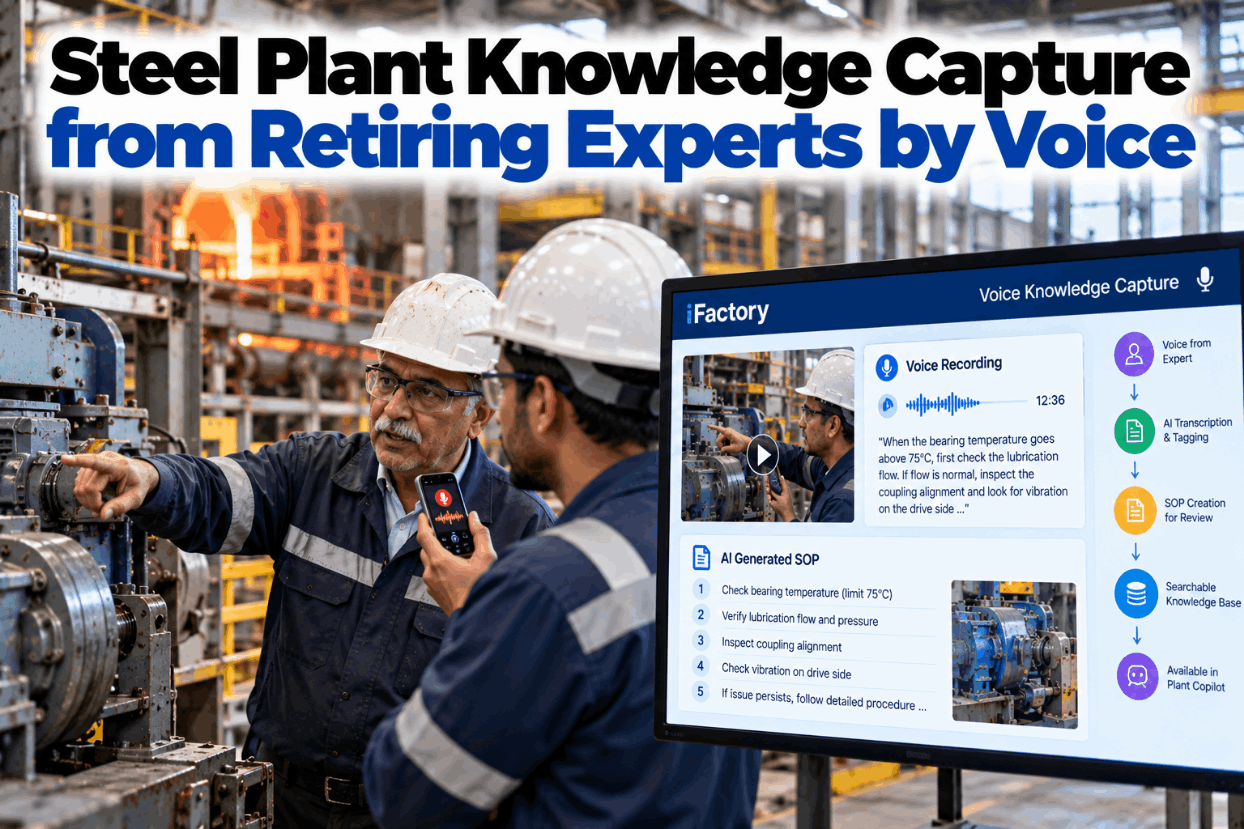
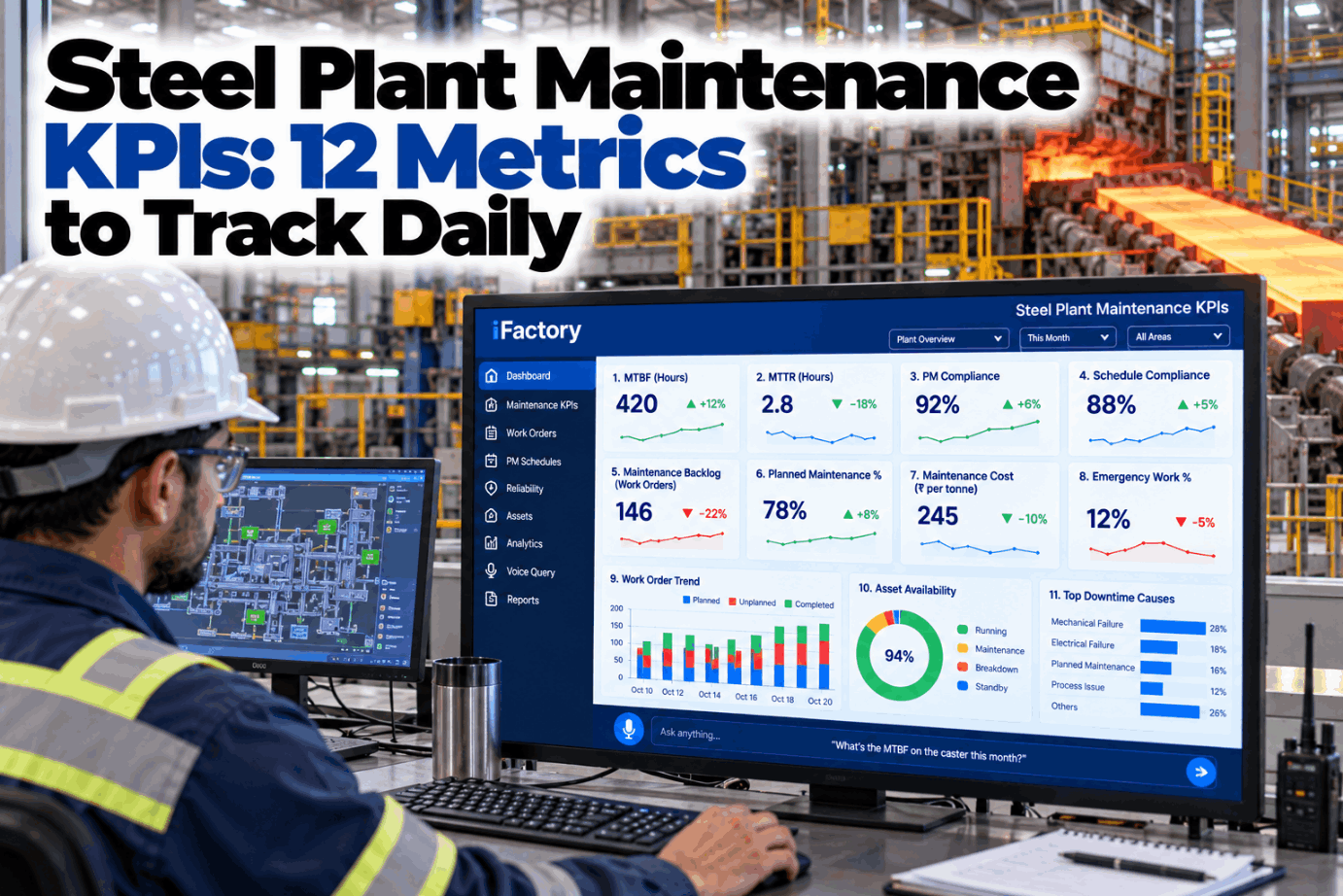
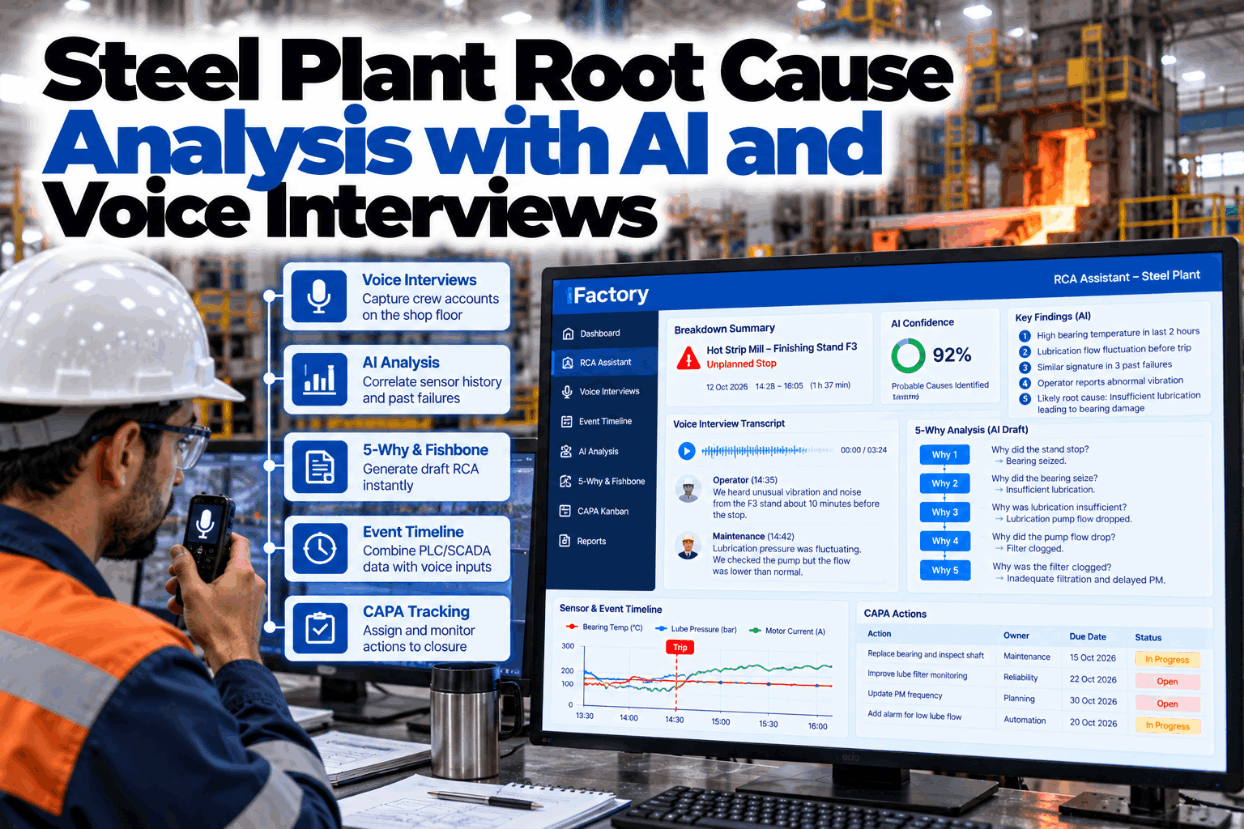
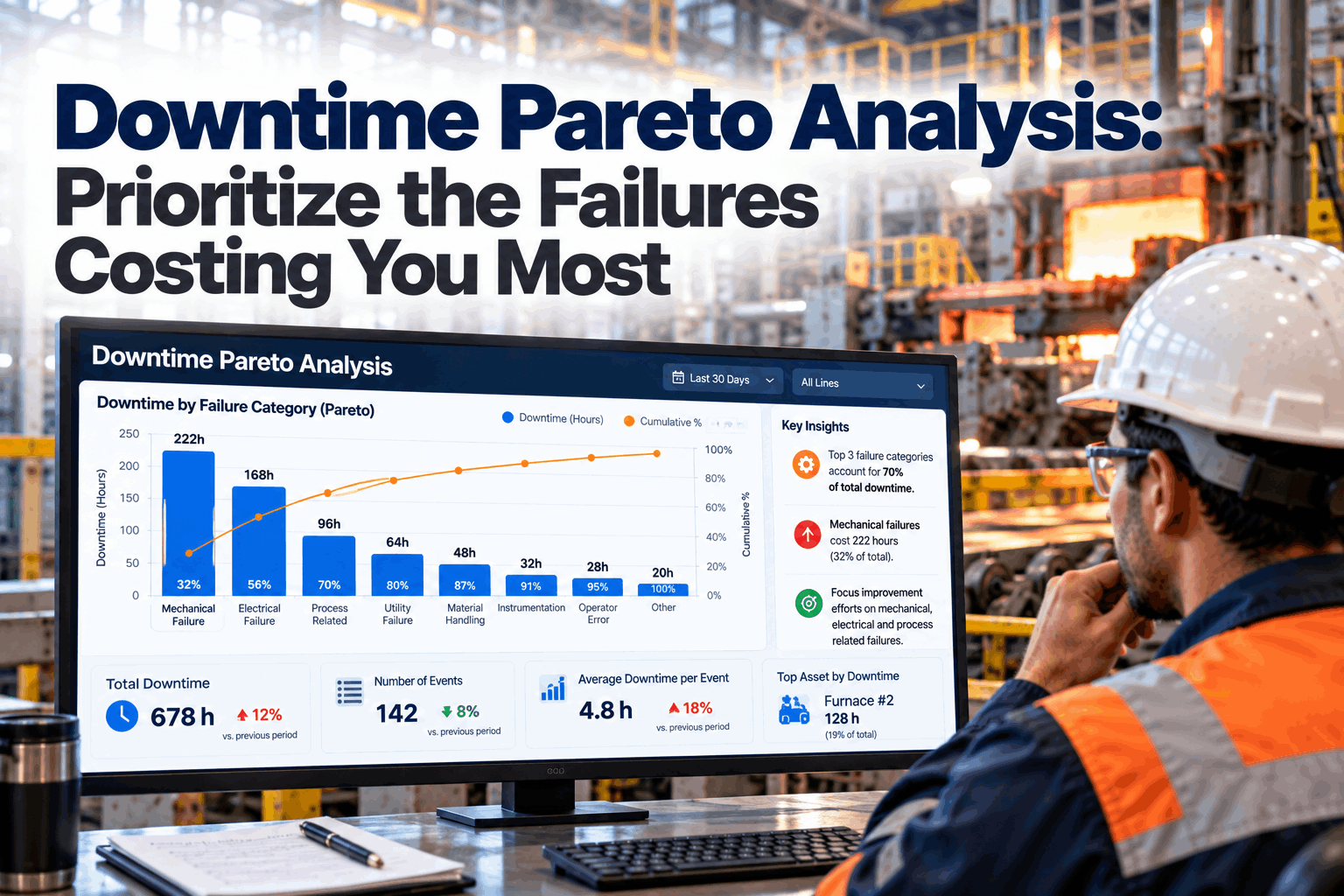
When the Stand 2 main drive trips at 02:00, the number that matters is mean time to repair. Most of that time is rarely spent with tools in hand. It goes into working out what the fault code means, finding who fixed it last, walking to the crib for a part that may not be there, and waiting for permits and hot steel to cool. AI diagnostics can shorten the first two. See the lookup in a fault copilot demo.
From Fault Code to Past Fix, Manual Page and Staged Parts in One Question
A technician asks the copilot by voice. It returns past work orders for that code on that asset, their root causes, the manual section and a spare already pulled to a crib bin. Permits, lockout and cooling take exactly as long as they need to.
One Average That Hides Five Separate Clocks
SMRP Best Practice Metric 3.5.2 defines MTTR as total repair time in a period divided by the number of repair events, and counts the functional check before the asset goes back to production. That single average hides five clocks. Software can shorten two of them, while physics and safety rules set the rest. Map your own clocks in a repair-time review.
Six Places a Mill Repair Stalls
Steel adds delays most plants never see: equipment too hot to touch, guards and cellars that take time to open, and drive faults whose codes differ from one drive family to the next. The matrix shows each delay, the clock it lands on and whether software can help. Ask our support team to compare it with your downtime log.
The same few causes often come back on the same drives and stands: a cable chafing at one guard, a connector loosening after roll changes, a servo valve fouling again. That repetition is what a history search finds, provided each fix was written down.
How a Spoken Fault Code Becomes Three Past Fixes and a Manual Page
The technician names the asset and the code. The copilot filters work orders for that code on that asset class, ranks them and attaches the manual section for that drive family. Code formats differ by vendor. Siemens SINAMICS faults are an F followed by five digits, while ABB ACS drives show four-digit hex codes, so the library is built per drive family. See the ranking in a short demo.
The code on this page is illustrative and does not belong to any one vendor. Your copilot answers with the real code text from your own drive manuals.
One Question at the Drive Cabinet, Three Answers Back
The technician keeps both hands free and eyes on the cabinet. The copilot answers with history and a manual reference, and leaves every safety call with the people doing the work.
The Copilot Is Only as Good as Last Year's Closeouts
Matching works on what technicians wrote when they closed the job. "Reset drive, OK" teaches the next shift nothing. A closeout with the code, the part, the cause and the time on each clock is what makes the next lookup useful, and voice closeout makes that quicker to record. Our support team can audit a sample of closed jobs.
- "Fixed" or "reset drive, running"
- No fault code on the work order
- Part fitted but never issued from the crib
- One total time with no split
- Fault code and asset recorded
- Root cause from a short pick list plus one free-text line
- Part numbers issued against the work order
- Time split into diagnose, parts, repair and test
Spares Waiting in a Bin Before the Crew Arrives, if the Count Is True
When past fixes for a code used the same parts, the copilot asks the storeroom to pull them to a named bin while the crew is still isolating the drive. That saves a walk only if the system count matches the shelf. A staging request against an empty bin wastes more time than no request. Plan the crib side in a stores walkthrough.
Cycle-count the spares that past drive and hydraulic fixes used most before switching staging on. Staging amplifies whatever accuracy the crib already has.
Report Waiting Time Beside MTTR, Never Buried in It
If cooling, permit waits and missing parts all sit inside one figure, a better diagnosis tool can look useless, or a lucky month can look like progress. IEC 60050-192 vocabulary treats logistic delay, the wait for resources, as distinct from active maintenance time. Use the same split. Our reliability support team can help write the clock rules.
A Month of Main Drive Repairs, Split by Clock
Here is one illustrative month on a hot strip mill with eight main drive repairs. The hours are invented to show the arithmetic and are not plant data. Waits for cooling and permits sit beside MTTR rather than inside it. Run your own month through it on a review call.
In this illustrative month, diagnose and parts make up 16.0 of the 30.4 repair hours, just over half. That is the share a copilot can work on. Repair and test hours, plus the 8.8 hours of waiting, need other fixes such as access kits, planned cooling and permit preparation.
What Shorter Diagnose and Parts Clocks Would Be Worth
This worksheet takes the month above and asks a what-if. Halving the diagnose and parts clocks is an assumption to test in a pilot, not a result. Mill time is only lost when a stop truly halts output, so use your own value per hour. Size it with our team.
Fault Diagnostics Readiness Checklist for One Mill Area
Work through these before switching the copilot on in a mill area. Most items are data housekeeping, and each one makes the first lookups better. Go through the list in a readiness session.
Copilot and Repair History Indexed on an NVIDIA Server Before It Ships
iFactory ships the Factory Copilot as one hardware and software delivery. A pre-configured NVIDIA AI server comes racked and ready to plug in. The copilot is loaded, and your fault code libraries and work order history are indexed before it leaves us. You rack it, plug in power and Ethernet, and the AI is live. Cabling, network work, PLC/SCADA integration, technician training and 24×7 remote monitoring are all in scope. Ask support for a scope.
- Pre-configured NVIDIA AI server, racked and ready
- Fault code libraries for each drive family
- Work order history indexed by code, asset and cause
- Manual sections linked to every fault code
- Crib staging requests built from past parts used
- Cabling, network and PLC/SCADA integration
- Technician training with 24×7 remote monitoring
Server installed, work orders and manuals loaded, drive alarms connected.
Copilot suggests on live faults while crews repair as usual, and every match is checked.
Voice access for all technicians, parts staging on, MTTR reported clock by clock.
An AI Troubleshooting Assistant That Leaves Safety Calls to People
iFactory speeds up the thinking and fetching parts of a repair and leaves isolation, permits and the fix itself with your crews. Try it on your own fault codes in a 30-minute call.
What Mill Maintenance Leads Ask About AI Diagnostics
Take the Guesswork Out of the Next Mill Breakdown
Fault codes matched to past fixes, the manual section attached and spares staged in the crib, with waiting time reported honestly. Shipped turnkey and running within 6 to 12 weeks.