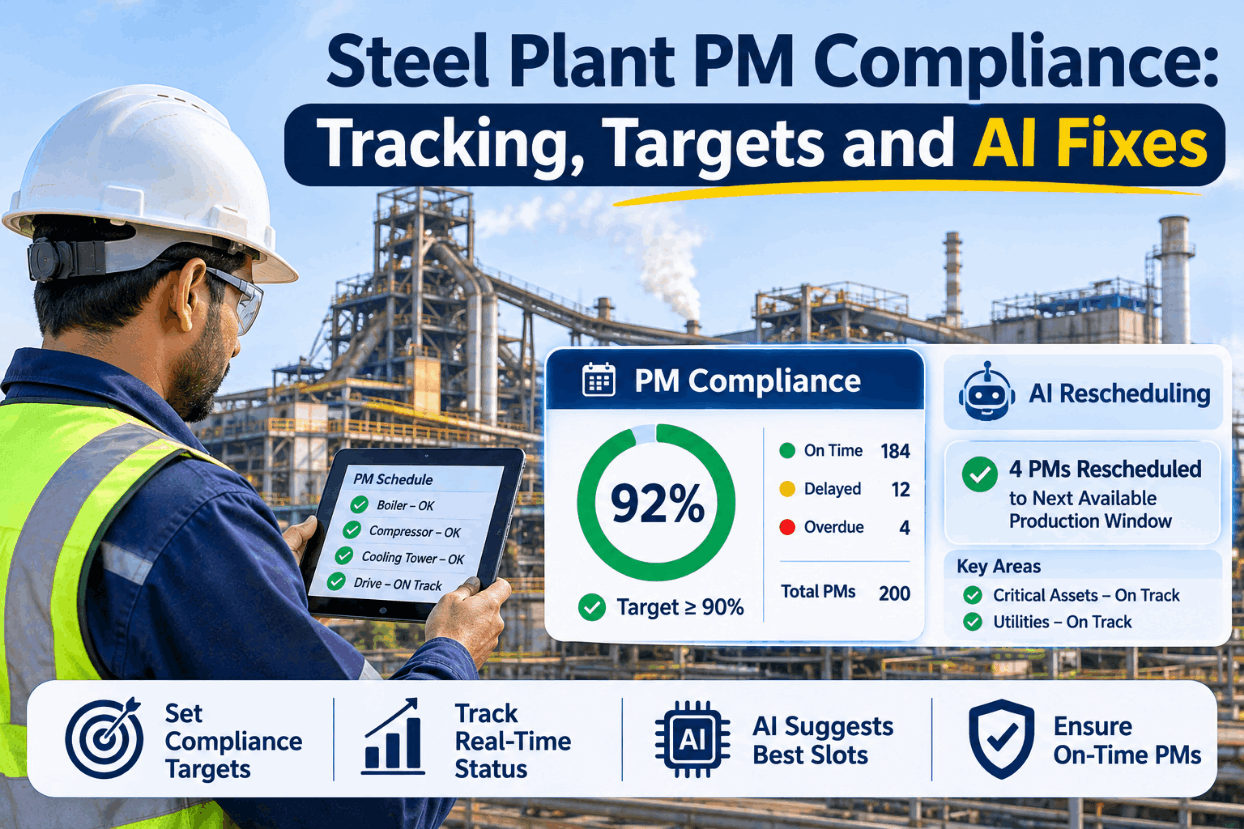
Steel plant PM compliance looks simple until someone asks what "on time" means. A 30-day lube route closed on day 41 still counts as done in many reports, and one slipped roll change can push a week of mill PMs out of their windows. This guide covers three ways to calculate it, the SMRP window rule, the target to set and how AI books at-risk PMs into real production gaps. See it in a short PM agent demo.
Move At-Risk PMs Into the Next Roll Change, Not Past Their Window
iFactory's PM agent checks every PM against its window, proposes other slots inside roll changes, caster turnarounds and planned stops, and reports compliance by area in a daily voice briefing. A critical PM never slips past its window without a named risk sign-off.
Simple, Windowed and Critical-Only: Three Numbers From One Month
The same month of PM records gives three answers depending on what you count. A simple rate counts every PM closed in the period. A windowed rate counts only PMs closed inside their on-time window, which is what protects the interval. A critical-only rate applies the windowed rule to the assets that can stop the plant. The figures are illustrative, from one assumed month of 200 PMs. Ask our support team which basis your CMMS reports.
Here 94.5% minus 86.0% leaves 8.5 points: 17 PMs that were done, but late. That gap is the stretch on your intervals, and it is invisible if the CMMS only reports completion.
Pick One On-Time Window and Write It Down
SMRP metric 5.4.14, PM and PdM Compliance, divides PM and PdM work orders completed by their due date by the work orders due. It allows three on-time tests: the required date, the required date plus one day, or the required date plus 20% of the PM frequency, capped at 28 days. Many plants use a stricter ±10% of interval rule, which keeps intervals even. Compare both against your frequencies in a window review.
Doug Stangier and Ricky Smith set it out in Preventive Maintenance Made Simple: a time-based PM done outside ten percent of its frequency is out of compliance. Note the annual row, where SMRP's 28-day cap is tighter on the late side than ±10%. Whichever rule you choose, SMRP asks for the same criteria every period.
Above 90% Is the Goal. An Honest 85% Beats a Paper 100%
SMRP lists above 90% as best in class for metric 5.4.14. It is a prescribed goal, not a measured industry average. Set it plant-wide for the windowed rate and track critical PMs on their own line, so a good month in utilities cannot hide a missed caster check. A perfect score deserves a closer look: it usually means a loose window, back-dated closeouts or routes signed without the work. Ask our reliability team how to audit a 100% month.
- PMs closed at the desk on the last day of the month
- Completion dates back-dated to the due date
- Routes signed with no readings recorded
- The missed slot never shows, so its cause never gets fixed
- Real completion date and time from the closeout
- A reason code on every late or missed PM
- Misses grouped by area and by cause
- A clear list for planners to fix next month
Six Reasons Mill PMs Slip Out of Their Windows
Steel plants rarely miss PMs through neglect. They miss them because the equipment is running when the PM falls due and the next stop has moved. Sequence plans, roll change timing and shutdown windows decide when crews can reach the equipment, while crew size, parts and permits decide whether the slot gets used. Walk through your own misses in a miss-cause review.
The Agent Asks Before Anything Leaves Its Window
When a PM no longer fits, the agent looks for the next real production gap. If no gap falls inside the window, it raises a deferral for a risk owner to sign rather than pushing the date quietly.
One Month of PM Compliance, Area by Area
Reporting by area shows where the window rule is breaking down. In this illustrative month the plant posts 86.0%, yet the steel shop and hot strip mill sit near 81% while ironmaking, the caster and cranes and utilities reach 89.5% or better. The plant figure comes from summed counts, 172 ÷ 200. Ask our support team to map your areas.
Age Every Late PM by How Far It Stretched the Interval
A count of late PMs hides how late they were. SMRP metric 5.4.10 works out an overdue variance for each PM: actual interval divided by planned frequency, times 100, minus 100. It recommends grouping results by variance range and criticality. A 90-day gearbox check done on day 117 has a 30% variance. See ageing bars on sample data in an overdue review.
A PM past 100% has missed a whole cycle. On a critical asset, anything past 50% belongs in a risk review, not just a scheduling meeting.
Three Kinds of Production Gap the Agent Books Into
The agent reads the production schedule and the PM list side by side. When a PM's window and its booked gap stop meeting, it looks for other slots inside the window and proposes the best fit, with crew, kit and permit status shown. A planner approves every move. Ask our planning support which schedule feeds you have.
A Deferral Sign-Off Checklist for Critical PMs
Sometimes no gap fits and a critical PM has to wait. That is a risk decision, so a person makes it. The agent never defers a critical PM on its own: it opens a deferral request, fills in what it knows and routes it to the named risk owner. Use the checklist on paper or in the agent. Walk through the flow in a sign-off demo.
A Short Spoken Briefing at Shift Start
Area managers spend shift start walking their area, not reading screens. The agent reads a short briefing per area: compliance so far this month, PMs at risk this week, moves waiting for approval and any deferral needing a signature. Managers can ask a follow-up question by voice. Ask our support team to set the briefing order.
Size the Value in Stop Hours You No Longer Request
The cleanest value to size is stop time you no longer ask production for, because PMs ride inside gaps that already exist. Every input below is assumed and shows the arithmetic only. Use your own counts and margin, and leave failure savings out unless your history supports them. Build the sum with your figures in a value session.
PM Agent, Schedule Connectors and AI Server Delivered Together
iFactory ships the Autonomous PM Agent with its hardware as one turnkey bundle. The pre-configured NVIDIA AI server arrives racked and ready, with the PM, scheduling and voice software already on it. You rack it, plug in power and Ethernet, and the AI is live. Scope of work covers cabling, network, PLC/SCADA integration, operator training and 24×7 remote monitoring. Our support team will size the package for your areas.
- Pre-configured NVIDIA AI server, racked and ready
- Two-way CMMS link for PM windows and closeout dates
- Production schedule feed for roll changes, turnarounds and stops
- PLC/SCADA integration for run hours and equipment state
- Cabling, network, operator training and 24×7 remote monitoring
- Deferral workflow with named risk owners
- Daily voice briefing by area
PM list, criticality and the window rule agreed. Server racked and schedule feed connected.
The agent proposes moves while planners keep booking as today. Proposals are compared each week.
Planner approval and deferral sign-off go live, and the daily briefing starts area by area.
Steel Plant PM Compliance Software That Asks Before It Moves
The agent does the watching and the slot-finding. Planners and risk owners keep every decision. See it run on your own PM list in a planning demo.
What Steel Maintenance Managers Ask About PM Compliance
Report a Compliance Number You Can Defend
One written window rule, honest closeout dates, critical PMs booked into real production gaps and a daily briefing by area. Shipped turnkey, with the agent live inside 6 to 12 weeks.