Most cement plant AI projects do not fail on the model. They fail on the months before the model runs: a hardware order that waits on procurement, an integration plan that needs three departments, a data-sharing review that never closes, and a pilot that starts long after the budget conversation has cooled. The kiln and mill keep running without AI in the meantime. iFactory Turnkey NVIDIA AI Server removes that wait. We ship a server pre-configured for your cement plant, your team racks it and plugs in power and Ethernet, and kiln and mill AI go live inside a 6-week pilot, with full delivery in 12 weeks.
iFactory Turnkey NVIDIA AI Server - Cement Plant Deployment
Turnkey AI for Cement Plants: 6-Week Pilot, 12-Week Delivery
A pre-configured NVIDIA AI server arrives at your plant ready to rack. Plug in power and Ethernet and the kiln and mill AI start working on your own data, on your own site.
6 weeks
to a working pilot with kiln and mill AI active
12 weeks
to full delivery across the agreed scope
Rack and plug
power and Ethernet are the two physical connections
On site
the AI runs on a server inside your plant network
Why Cement Plant AI Projects Take Longer Than They Should
The delay in a cement plant AI deployment is almost never the algorithm. It is everything around it. These are the six places time is lost before a single prediction is made.
01
Hardware sourcing
Specifying, quoting and ordering GPU servers separately from the software means two procurement cycles that rarely finish together.
02
Cloud data approvals
Sending kiln and mill process data to an external cloud triggers security and legal review that can outlast the project plan.
03
Environment setup
Drivers, containers, models and dependencies installed by hand on site take weeks and are hard to repeat at the next plant.
04
Integration scope creep
A plan to connect every system first delays the first result. Value arrives late because the first use case waits for the last interface.
05
Plant team bandwidth
Process, maintenance and IT teams are already running a plant. A project that needs weeks of their time competes with production and loses.
06
Proof arrives too late
When the pilot shows results only after most of the budget year has gone, the expansion decision is made on promise rather than evidence.
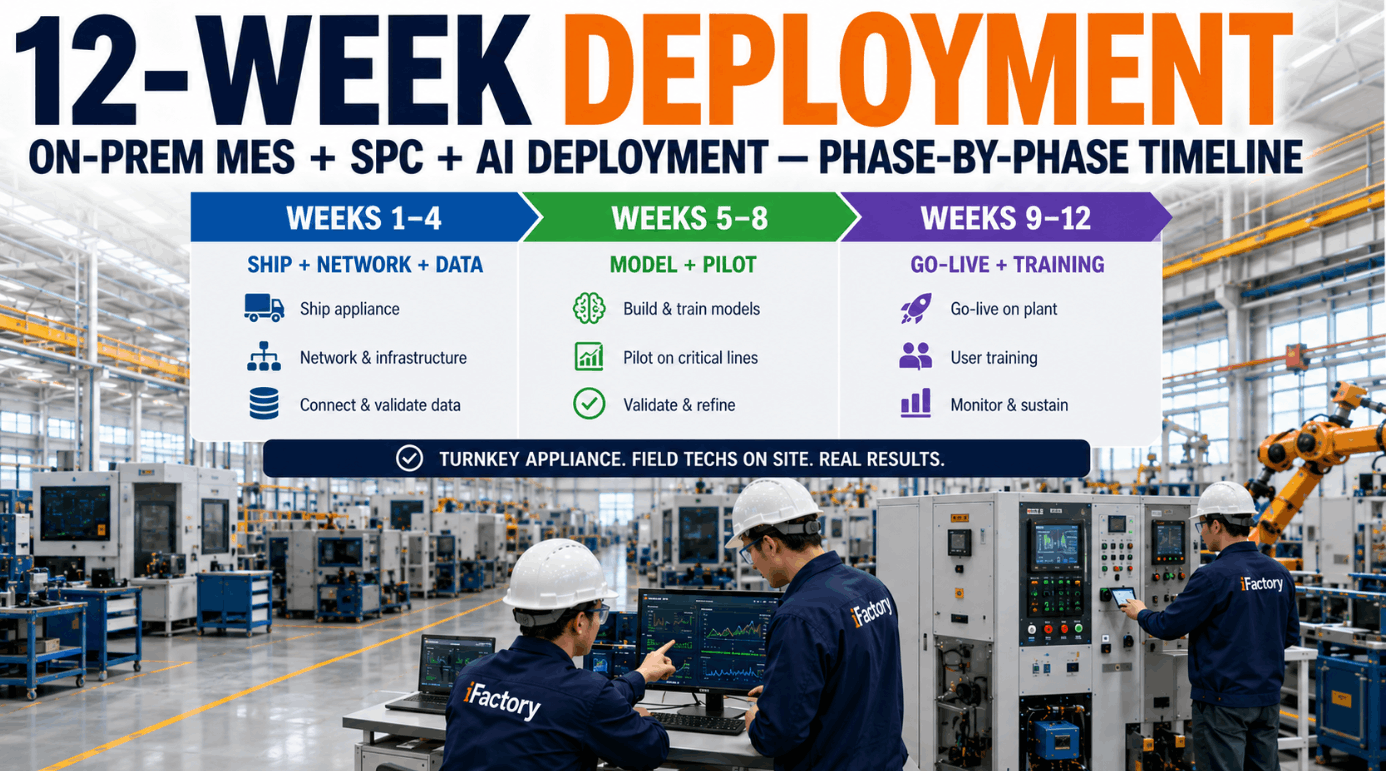
The 12-Week Timeline - From Shipment to Full Delivery
The deployment is planned as a fixed sequence, so every phase has an owner, a plant effort and a visible result. The pilot completes at week 6, and the remaining weeks extend the same server to the full agreed scope.
Phase
Weeks
Plant effort
AI live
Milestone
What happens
1 - Scope and ship
0 to 1
Low
No
Server dispatched
Use cases, data sources and site access agreed; server configured for your plant
2 - Rack and connect
2
Low
No
Server online
Your team racks the server and connects power and Ethernet; iFactory completes setup remotely
3 - Data and baseline
3 to 4
Medium
Partial
Baselines set
Kiln, mill and agreed data sources connected; models learn your normal operating range
4 - Pilot live
5 to 6
Medium
Yes
Pilot review
Kiln and mill AI active; alerts and recommendations reviewed with your operators
5 - Extend scope
7 to 12
Medium
Yes
Full delivery
Additional use cases, users and dashboards added to the same server
Total
12 weeks
Low to medium
From week 5
Pilot at week 6
Evidence from your own plant before most of the schedule has run
What Arrives at Your Plant
The server is delivered configured, not as a parts list. Hardware, software and connectivity are prepared before dispatch, which is why site work is limited to racking and cabling.
Hardware
NVIDIA AI server
Sized for the kiln and mill workloads agreed at scoping
Rack-ready
Standard rack mounting, with rails and cables supplied
Single delivery
One shipment, one supplier, one point of contact
Software
Pre-installed platform
iFactory software, models and dependencies loaded and tested before shipping
Cement process models
Kiln and mill AI configured for your plant, then tuned to your data
Remote setup
iFactory engineers complete configuration without a site visit
Connectivity
Power and Ethernet
The two physical connections your team makes
Inside your network
The server sits on your plant network under your IT policy
Agreed data sources
Only the systems named at scoping are connected
What Your Team Does on Site - Five Tasks
The plant effort is deliberately small and clearly defined. These are the five tasks your team owns, and none requires AI or data science expertise.
1
Prepare a rack position
Identify space in the control room or server room with suitable power and cooling, agreed at scoping.
Example: Server room rack, one free slot
2
Rack the server
Mount the delivered server using the supplied rails. The work follows standard IT procedure.
Example: Mounted and labelled on delivery day
3
Plug in power and Ethernet
Connect the two cables. The server then becomes reachable by iFactory engineers through the access method your IT team approves.
Example: Power connected, network port assigned
4
Grant access to agreed data sources
Provide read access to the kiln and mill data named at scoping, such as historian or PLC tags.
Example: Read-only access to kiln and raw mill tags
5
Review results with iFactory
Process and maintenance leads join short reviews to confirm that alerts and recommendations match plant reality.
Example: Weekly review from week 5
Want a deployment plan for your plant? Book a demo - tell us your kiln and mill setup and we will map the 6-week pilot and 12-week delivery to your site.
How the Turnkey Model Works - Five Stages
Each stage replaces a typical source of delay with a fixed, repeatable step.
01
Scope
Use cases, data sources and success measures agreed before anything ships.
02
Ship
A pre-configured NVIDIA AI server is dispatched as one tested unit.
03
Connect
Your team racks it and plugs in power and Ethernet. iFactory finishes remotely.
04
Pilot
Kiln and mill AI run on your data and are reviewed with your operators by week 6.
05
Scale
The same server extends to the full scope by week 12.
What the Turnkey Deployment Delivers
The benefit is speed to evidence. Plants see AI working on their own process earlier, with less effort from their own teams and a clearer basis for the decision to expand.
6 weeks
Pilot with real results
kiln and mill AI active on your own data
12 weeks
Full delivery
same server, wider agreed scope
Two cables
Minimal site work
power and Ethernet after racking
One supplier
Hardware and software
a single point of accountability
Frequently Asked Questions
Does our process data leave the plant?
The AI runs on a server installed inside your plant network, so kiln and mill data is processed on site. What leaves the network, if anything, such as remote access for iFactory engineers or software updates, is agreed with your IT team during scoping and follows your security policy.
What does our IT team need to provide?
A rack position with power, a network connection, and an approved method for iFactory engineers to complete setup remotely. Read-only access to the agreed data sources is also needed. We share these requirements at scoping so IT approvals can run in parallel with shipping.
What is live at the end of the 6-week pilot?
The kiln and mill AI agreed at scoping, running on your own data, with alerts and recommendations reviewed by your operators. The pilot is meant to give your team evidence from your own plant, so the decision to extend scope does not rest on a demonstration alone.
What happens between week 6 and week 12?
The same server is extended to the remaining agreed scope, which can include additional use cases, more users and wider dashboards. Because the hardware and platform are already in place, the later weeks are spent on adding value rather than on setting up infrastructure.
Stop waiting months for cement plant AI to start.
Plan Your 6-Week Pilot With a Turnkey NVIDIA AI Server
Tell us your kiln, mill and data setup. We will map the pilot, the 12-week delivery and exactly what your team needs to do on site.