AI Copilot for Operator Training: Simulation & Competency
By James Smith on August 7, 2026
The traditional model for training a new manufacturing operator is shadow the experienced worker for two to six weeks, absorb whatever tribal knowledge that person happens to remember to share, and hope the gaps get caught before they become a safety incident or a quality escape. This model has always been slow and inconsistent, but it is becoming genuinely unsustainable as experienced operators retire faster than plants can replace them, and as product mix complexity increases the volume of scenario-specific knowledge a new operator needs before they are truly competent. AI copilot training replaces tribal-knowledge transfer with structured, scenario-based simulation — giving every new operator the same rigorous exposure to normal operation, edge cases, and failure scenarios regardless of which mentor they happened to be paired with, and compressing the path to full competency from months to weeks. Book a session with the iFactory training systems team to see how simulation-based AI copilot training changes operator onboarding.
AI Copilot · Operator Training & Competency
AI Copilot for Operator Training: Simulation-Based Learning That Compresses Months of Shadow Training Into Weeks
Scenario-based simulation, personalized learning paths, and objective competency assessment — replacing inconsistent tribal-knowledge transfer with a structured training system every new operator experiences identically.
Basis: entry-level operator, moderate process complexity, standard shift rotation.
The Shadow Training Problem
Why Tribal Knowledge Transfer Is Structurally Unreliable
Shadow training depends entirely on the knowledge, teaching ability, and availability of whichever experienced operator a new hire happens to be paired with — three variables that are almost never controlled for, and that produce measurably different training outcomes depending on the pairing. This is not a criticism of experienced operators, who are typically skilled at their own job and rarely trained as instructors. It is a structural limitation of a knowledge transfer method built entirely on informal, unstructured mentorship.
Inconsistent Coverage
Different mentors emphasize different aspects of the job based on their own experience and preferences — one operator teaches thorough troubleshooting, another focuses purely on throughput. New hires trained by different mentors emerge with meaningfully different skill profiles for the identical role.
Rare Scenario Exposure Gap
A new operator can only be exposed to the specific failure modes, edge cases, and abnormal conditions that happen to occur during their shadow training window. A critical fault that occurs once a quarter may never be witnessed during a four-week shadow period, leaving the operator unprepared when it eventually happens on their own shift.
No Objective Competency Measure
Readiness to work independently is typically judged subjectively by the mentor or supervisor — "they seem ready" — rather than through a structured, repeatable assessment against defined competency criteria, making the sign-off decision inconsistent across trainees and difficult to defend if a post-certification incident occurs.
Mentor Capacity Bottleneck
Experienced operators are also the plant's most productive workers — every hour spent shadow-training a new hire is an hour of reduced mentor productivity, creating a structural tension between training capacity and production output that limits how many new hires can be onboarded simultaneously.
Simulation Architecture
How AI Copilot Simulation Builds Realistic, Scenario-Rich Training Without Production Risk
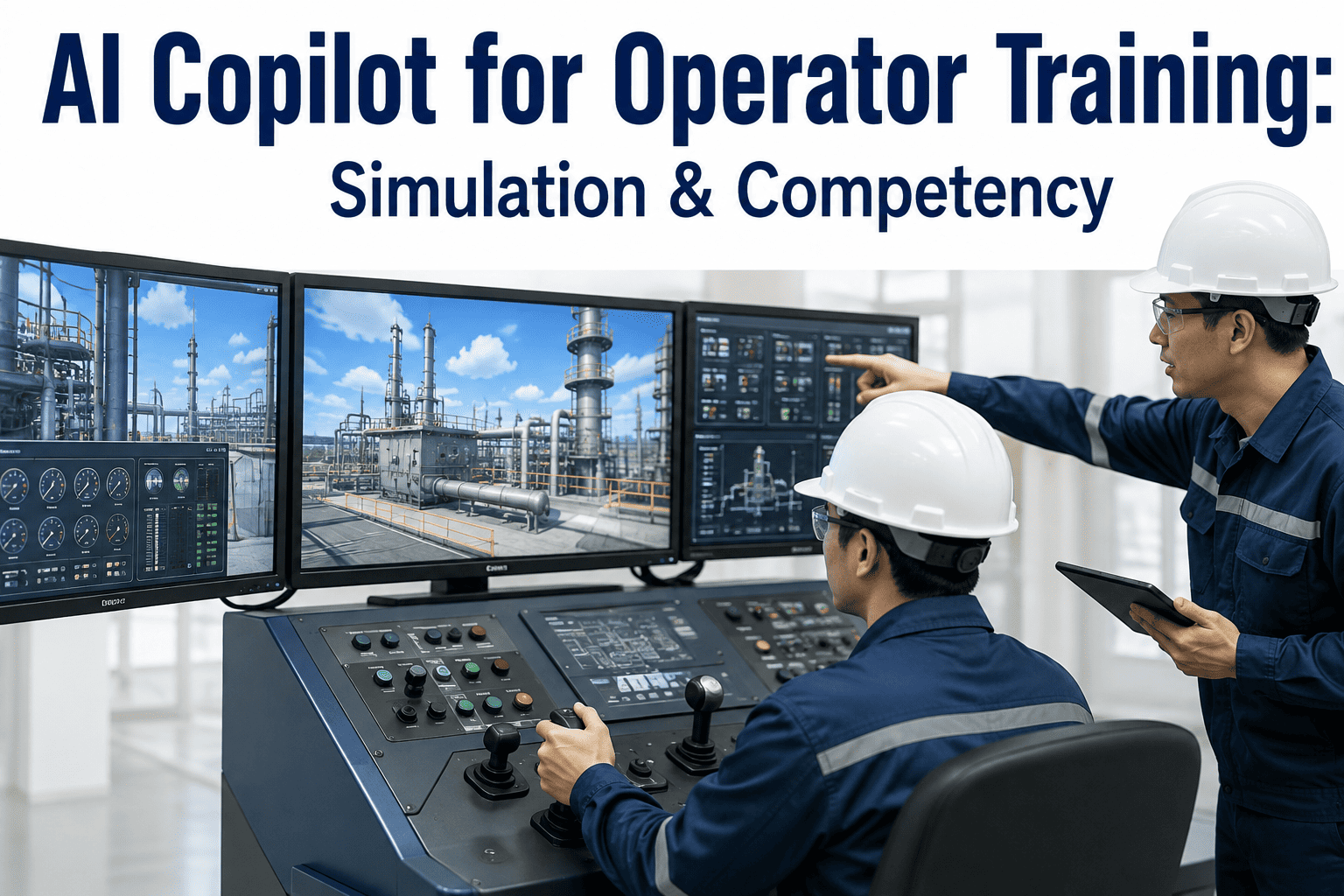
AI copilot training simulation recreates the operator's actual work environment — control interfaces, process behavior, and the decision points a real shift presents — in a training environment where mistakes carry no production, safety, or quality consequence. The simulation is built from real process data and real historical events, not generic training scenarios, so what the operator practices closely mirrors what they will actually encounter.
Digital Twin Interface Replication
The training simulation replicates the actual HMI, control panel layout, and process visualization the operator will use on the real line — not a generic simplified training interface. Muscle memory and interface familiarity built during simulation transfers directly to the production floor.
Historical Event Library
Real fault conditions, quality deviations, and abnormal scenarios drawn from the plant's actual historical data become simulation scenarios — the rare failure mode that occurs once a quarter in production can be practiced repeatedly in simulation, closing the exposure gap that shadow training cannot address.
Progressive Difficulty Sequencing
Scenarios are sequenced from basic normal-operation familiarity through increasingly complex fault conditions and multi-variable troubleshooting, ensuring the trainee builds foundational competency before facing the scenarios that would overwhelm an unprepared new operator.
Real-Time Copilot Guidance
During simulation, an AI copilot layer provides contextual guidance — explaining why a specific action is correct or incorrect, surfacing the relevant process knowledge at the moment it is needed rather than requiring the trainee to recall a separate training manual, and adapting explanation depth to the trainee's demonstrated understanding.
See the Simulation Environment Built From Your Own Process Data
iFactory Builds Training Simulations From Your Actual Historical Events — Not Generic Scenarios
Most training simulations use generic industry scenarios that only loosely resemble what your operators actually face. iFactory builds simulation scenarios from your plant's own historical fault data, HMI configuration, and process behavior — training operators on the actual conditions they will encounter, not a hypothetical approximation.
Adapting the Training Path to Each Trainee's Demonstrated Strengths and Gaps
Every trainee arrives with a different baseline — some have prior manufacturing experience, some are entirely new to industrial environments, and each individual learns different skill categories at different rates. A fixed, uniform training curriculum wastes time on material a fast learner has already mastered while under-serving areas where a specific trainee genuinely needs more repetition. AI-driven personalization continuously adjusts the training path based on demonstrated performance rather than a fixed calendar schedule.
01
Baseline Assessment
Before structured training begins, an initial assessment establishes the trainee's existing knowledge and skill level across core competency areas — identifying where the training path can move quickly and where foundational work is needed before progressing.
02
Adaptive Scenario Selection
As the trainee progresses through simulation scenarios, the system continuously evaluates performance and selects the next scenario to target the specific skill gaps demonstrated — a trainee struggling with a particular fault diagnosis pattern receives additional scenarios targeting that pattern rather than moving on regardless of mastery.
03
Pace Adjustment
Training duration is not fixed to a calendar schedule — a trainee demonstrating rapid mastery progresses to advanced scenarios and potential early certification, while a trainee needing more time receives it without the artificial pressure of a fixed graduation date that shadow training programmes typically impose.
04
Learning Style Adaptation
The copilot's guidance format adapts based on what has proven effective for the individual trainee — some respond better to detailed written explanation, others to visual demonstration, others to being allowed to attempt and fail before receiving explanation. The system tracks which format produces better retention for each trainee and weights accordingly.
The transition from "the mentor thinks they're ready" to a structured, objective competency assessment is one of the most significant improvements AI copilot training delivers — not just for training speed, but for the defensibility and consistency of the certification decision itself.
Competency Domain
Assessment Method
Certification Threshold
Re-assessment Trigger
Normal operation proficiency
Simulated shift performance vs. target cycle time and quality
>95% task completion accuracy
Process or equipment change
Fault diagnosis and response
Scenario-based fault identification and corrective action
>90% correct diagnosis, target response time
New fault pattern introduced to process
Safety procedure compliance
Simulated safety-critical scenario response
100% — zero tolerance threshold
Annual recertification minimum
Quality inspection accuracy
Defect identification against known-answer image/scenario set
>92% classification accuracy
New product or defect type introduced
Certification data is retained as a permanent, auditable record — providing documentation of demonstrated competency that supports both internal quality assurance and any external audit or incident investigation requiring evidence of proper operator qualification.
Deployment Path
From Simulation Certification to Supervised Production — Managing the Transition
Simulation-based training does not eliminate the value of supervised production experience — it compresses the time needed before that supervised experience begins and makes it more productive, since the operator arrives at the production floor with foundational competency already demonstrated rather than starting from zero.
Phase 1 — Simulation Certification
Trainee completes the adaptive simulation curriculum and passes competency assessment across all required domains. No production floor time required during this phase — training can begin before a trainee even has floor access, reducing onboarding lead time.
Phase 2 — Supervised Production
Certified trainee begins working the actual line under direct supervision, but with foundational competency already established — supervision time focuses on real-environment nuance and confidence-building rather than teaching basic task execution from scratch, substantially reducing required supervision duration.
Phase 3 — Independent Operation with Copilot Support
Operator works independently, with the same AI copilot available in production as a real-time reference and guidance tool for infrequent or unfamiliar scenarios — extending the training relationship into ongoing operational support rather than ending abruptly at certification.
Training Programme KPIs
Six Metrics That Define AI Copilot Training Programme Effectiveness
Time to Full Competency
Target: <6 weeks
Duration from training start to independent certification. The primary programme value metric — directly translates to faster new-hire productivity and reduced dependency on mentor availability.
Cross-Cohort Competency Consistency
Target: <10% variance
Variance in assessed competency scores across different training cohorts and mentors. Low variance confirms the training programme delivers consistent outcomes regardless of who trains when — directly addressing the inconsistency problem of shadow training.
First 90-Day Incident Rate
Target: below tenured operator baseline
Safety and quality incident rate for newly certified operators during their first 90 days of independent operation, compared against the plant's baseline. A key outcome validation metric confirming simulation-based certification translates to genuine production readiness.
Mentor Time Recovered
Trend: increasing
Reduction in experienced operator hours consumed by shadow training, freed for direct production work. Directly addresses the mentor capacity bottleneck and provides a quantifiable productivity offset against training programme investment.
Rare Scenario Exposure Coverage
Target: 100% of critical fault library
Percentage of the plant's documented critical fault and edge-case scenario library that every certified operator has practiced in simulation. A metric with no equivalent in traditional shadow training, since real-world exposure to rare events cannot be guaranteed.
Recertification Compliance Rate
Target: 100% on schedule
Percentage of operators completing required periodic recertification (particularly safety-critical competencies) on schedule. Automated tracking and simulation-based recertification removes the administrative burden that often causes recertification compliance to lapse under manual tracking systems.
From the Training Floor
“
The conversation I have most often with plant leadership considering AI copilot training is some version of "will this replace our experienced operators as trainers?" And the honest answer is that it should not, and in the programmes I have seen work well, it does not — what it replaces is the assumption that shadow training alone is sufficient, and the reliance on whichever experienced operator happens to be available that week to transfer an entire body of tacit knowledge informally. The best implementations I have seen use simulation to build the foundational competency and expose trainees systematically to the full range of scenarios the job requires, and then use the experienced operator's time for what only a human mentor can provide — judgment calls in ambiguous situations, workplace culture, and the kind of nuanced troubleshooting intuition that comes from years of pattern recognition a simulation cannot fully replicate yet. When you free experienced operators from teaching the same basic material to every new hire from scratch, their remaining training time becomes dramatically more valuable, focused on the genuinely advanced material that actually requires their specific expertise. That reallocation, more than the simulation technology itself, is where the real transformation happens.
Odalys Feinberg-Achterberg
Learning & Development Director · Manufacturing Training Systems Specialist · 18 years designing operator training and competency programmes across automotive and heavy industrial manufacturing · Former VP Talent Development, multi-plant manufacturing group · Specialist in simulation-based technical training design
Training Team Questions
AI Copilot Operator Training — Frequently Asked
Does AI copilot simulation training actually transfer to real production performance, or does it just teach operators to pass a simulated test?
Transfer of training from simulation to real production performance depends heavily on simulation fidelity — how closely the simulated environment, interface, and scenarios match actual production conditions. Low-fidelity generic training simulations do carry a legitimate risk of teaching operators to succeed within the simplified simulation without adequately preparing them for real-world complexity. High-fidelity simulation built from the plant's actual HMI configuration, real historical process data, and genuine fault scenarios (rather than generic industry training content) substantially closes this transfer gap, because the trainee is genuinely practicing the actual decisions and interface interactions they will use in production, not an abstracted approximation. The first 90-day incident rate KPI referenced earlier exists specifically to validate transfer empirically — comparing newly certified operators' real production performance against the baseline rather than assuming simulation certification guarantees production readiness. Programmes should track this validation metric continuously and adjust simulation fidelity or curriculum content if the data reveals a transfer gap. For a discussion of simulation fidelity requirements specific to your process complexity, book a session with the iFactory training systems team.
How much of our historical process and fault data do we need to provide to build a useful training simulation?
A useful initial simulation can be built from a more modest dataset than most teams initially assume — typically requiring HMI screen configuration and layout documentation, a representative set of normal operating sequences and cycle data, and documentation of the plant's most common fault conditions and their correct response procedures, which most plants already maintain in some form through existing SOPs, work instructions, and maintenance records even if not previously organized for training purposes. Richer historical fault event data (actual historian records of past fault occurrences, including the sequence of events and successful resolution) meaningfully improves simulation realism and allows the rare-scenario library to be built from genuine plant history rather than generic industry scenarios, but building this richer dataset can occur progressively after initial simulation deployment rather than being a strict prerequisite for getting started. Contact our support team for a data readiness assessment specific to your current documentation and historian systems.
How do we handle the tacit knowledge and judgment calls that experienced operators have but that are difficult to formally document for a simulation?
This is a genuine and important limitation of simulation-based training that should be acknowledged directly rather than overstated as fully solvable. The most effective programmes treat simulation as covering the structured, documentable portion of operator competency — standard procedures, common fault diagnosis, safety protocols, quality standards — while deliberately preserving human mentorship time for the genuinely tacit, judgment-intensive aspects of the role that resist full documentation: reading subtle equipment sounds or behaviors that precede a fault, making judgment calls in truly novel situations not covered by any procedure, and absorbing workplace culture and team dynamics. A structured approach to capturing tacit knowledge — having experienced operators narrate their decision-making during specific scenarios, which can then inform both simulation scenario design and be documented for future reference — helps close this gap over time, but complete elimination of the tacit knowledge transfer role for experienced mentors is neither realistic nor advisable in the near term. The goal is redirecting mentor time toward this higher-value tacit knowledge transfer rather than repetitive basic instruction, not eliminating the mentor role entirely.
Can this training approach work for highly manual, tactile skills where simulation cannot fully replicate the physical sensation of the task?
Simulation-based training is most directly applicable to cognitive and procedural competencies — process understanding, fault diagnosis, decision-making sequences, safety protocol knowledge — and is genuinely limited for purely tactile physical skills where muscle memory and physical sensation (feeling correct torque resistance, sensing material feed tension, fine motor coordination for manual assembly) are central to competency. For roles combining both cognitive and tactile elements, which describes most manufacturing operator positions, the recommended approach uses simulation to build the cognitive and procedural foundation — process knowledge, decision sequences, safety protocols — while physical, tactile skill development continues through hands-on practice, potentially on offline training equipment or during a compressed supervised production phase focused specifically on the tactile elements rather than starting the physical skill-building from a position of zero process knowledge. This hybrid approach still compresses total training time meaningfully, because the physical practice phase is far more efficient when the trainee already understands the procedural context and decision-making framework rather than learning both simultaneously from scratch.
How do we measure ROI on an AI copilot training programme investment relative to our current shadow training approach?
The ROI calculation centers on three quantifiable value streams. First, mentor time recovered — calculate current shadow training hours per new hire multiplied by the mentor's fully loaded hourly cost and the annual new hire volume, compared against the reduced supervision time required under a simulation-first approach. Second, faster time-to-productivity — the value of new operators reaching full productive output weeks earlier than under traditional shadow training, calculated as the production value of the compressed onboarding period. Third, reduced incident and error costs — comparing quality escape rates, safety incidents, and rework attributable to undertrained new operators before and after programme implementation, informed by the first 90-day incident rate KPI. Programme cost includes simulation platform licensing or development, initial content build investment, and ongoing content maintenance as processes evolve. Most manufacturing training programmes implementing this approach see payback within the first 6 to 12 months, driven primarily by mentor time recovery and accelerated productivity, with quality and safety incident reduction providing additional value that compounds over subsequent cohorts. Book a session to build an ROI model specific to your current training costs and new hire volume.
Every Operator Deserves the Same Quality of Training — Not Whoever They Happened to Shadow
Build a Consistent, Data-Driven Path from New Hire to Certified Operator
iFactory's AI copilot training platform builds simulation environments from your actual HMI configuration and historical process data, adapts the learning path to each trainee's demonstrated strengths and gaps, and provides objective, auditable competency certification — freeing your experienced operators to focus their mentorship time on the judgment and tacit knowledge that only they can teach.