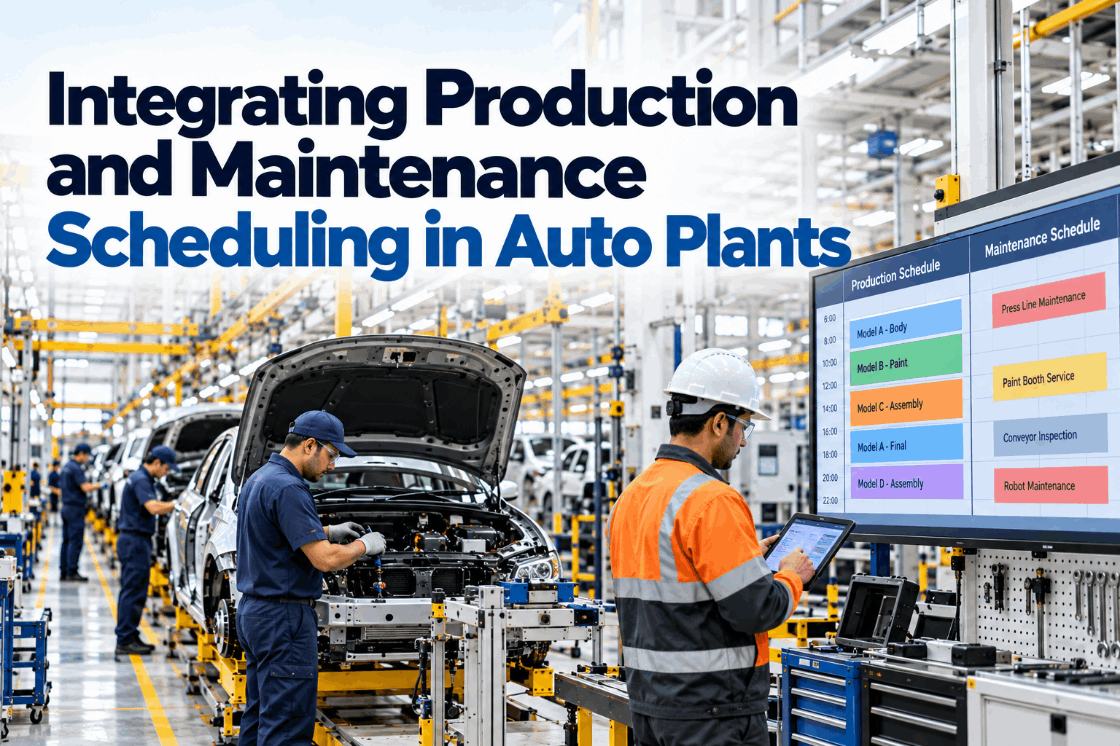
In most automotive plants, production and maintenance plan separately and meet in conflict. Production wants every hour for jobs per hour. Maintenance wants windows for preventive work, inspections and repairs. The result is familiar: maintenance deferred until something breaks, or production interrupted at the worst moment. Integrated scheduling ends the fight by putting both on one plan, built from shared data, with clear rules for who gets which window and why. This guide explains where the conflict comes from, the windows automotive plants actually have, how to prioritize work by risk and production impact, how to measure success and how to run joint planning week by week. To see integrated scheduling, book a short walkthrough.
Integrating Production and Maintenance Scheduling in Auto Plants: One Plan Instead of a Fight
Maintenance work matched to real production windows and ranked by risk, so JPH is protected and critical equipment gets serviced before it fails.
Why Production and Maintenance Keep Colliding
Production and maintenance usually have separate systems, separate plans and separate targets. Production schedules live in MES or APS; maintenance plans live in the CMMS. Each department sees the other’s plan late, if at all. When output is under pressure, preventive work is postponed. When equipment fails, production loses hours it never planned to lose.
The stakes are high. Siemens’ True Cost of Downtime 2024 report puts one hour of downtime in automotive at about $2.3 million, double the 2019 figure. The same report notes that hours lost to unplanned downtime in automotive have halved in five years as predictive maintenance spreads. The plants gaining most are those that act on early warnings by fitting repairs into planned windows.
The conflict is rarely about bad intentions. It is about each side seeing only half the picture. A shared plan, with shared data, changes the conversation from who wins to what is best for the plant.
Integrated scheduling makes those windows visible to both sides and allocates them by value. We can review your current planning process on a call.
Where the Conflict Really Comes From
Most production and maintenance conflicts trace back to a few structural issues.
Automotive lines make the conflict sharper than in many industries. A body shop or trim line is a tightly coupled chain, so a stop at one station can stop the whole line within minutes once buffers empty. A maintenance task that looks small on one robot can therefore cost full line output. That is why the timing of work, not just its content, has to be planned jointly.
Each of these can be fixed with shared data and agreed rules. None needs heroics from planners. We help set the rules in a joint planning workshop.
The Windows Automotive Plants Actually Have
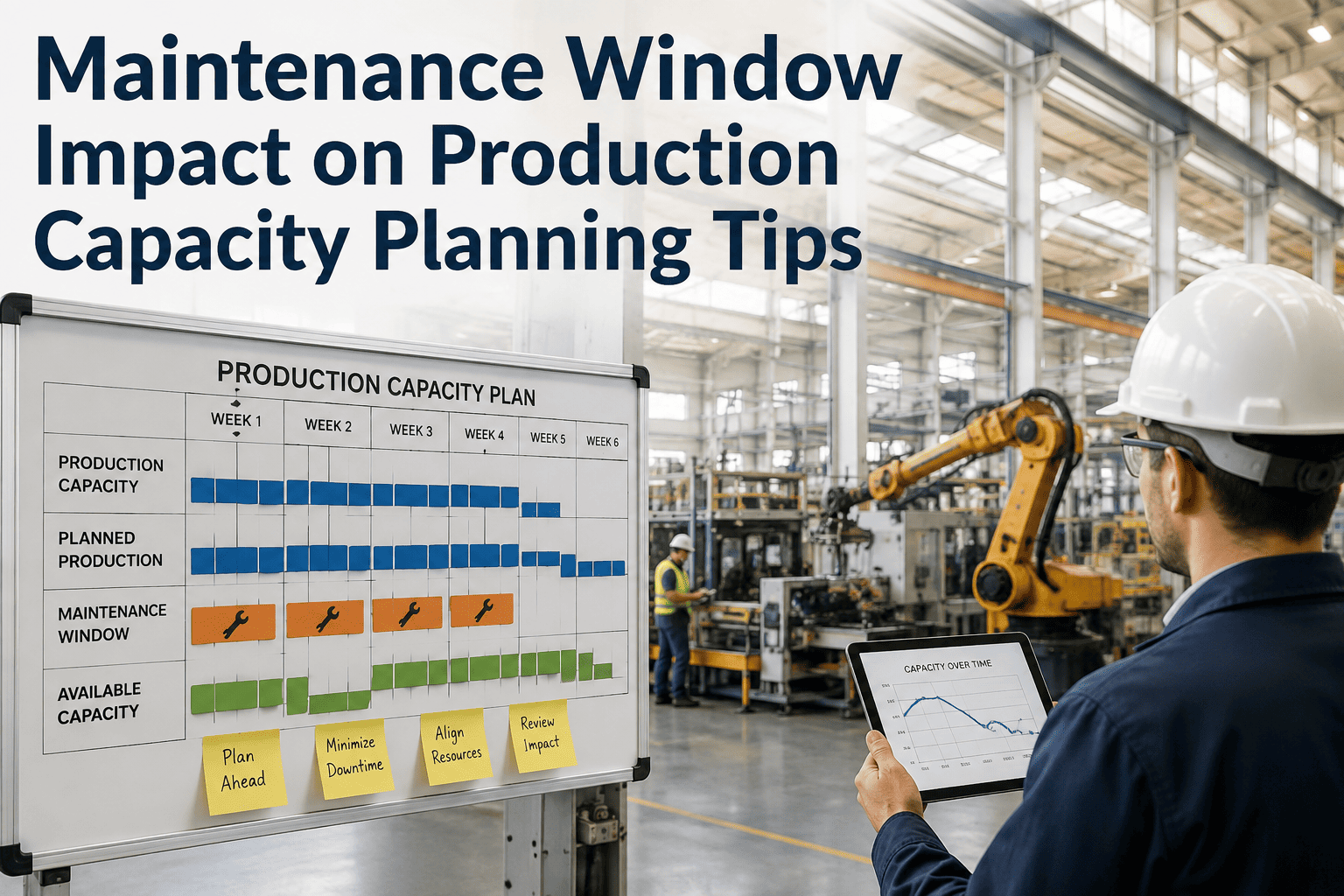
Plants often have more maintenance time than they think. It is hidden in stops that are already planned or predictable.
The main window, but limited and often overbooked.
Press die changes and model launches stop equipment; maintenance can share the time.
Short windows for quick inspections and lubrication.
Useful for checks where lines pause.
Known shortages or upstream stops leave equipment idle.
Long windows for major work.
Micro-windows add up. A 20-minute break used for a lubrication route, repeated daily, removes a task from the overloaded weekend. Changeovers used for inspections avoid separate stops altogether.
Making all windows visible in one calendar is usually the first step in integration. See a combined calendar in a demo.
Ranking Work by Risk and Production Impact
Not all maintenance work deserves production time. A simple ranking by risk and impact settles most disputes.
| Risk if deferred | Needs a stop | Fits a free window | Decision |
|---|---|---|---|
| High: failure likely soon, safety or major loss | Yes | No window in time | Take production time, planned |
| High | Yes | Window available | Use the window |
| Medium: failure possible within weeks | Yes | Window within weeks | Schedule into that window |
| Medium | No, can run | Any | Do while running |
| Low: routine, little risk if delayed | Yes | Only production time | Defer to next free window |
Condition data makes the risk column concrete. A vibration trend that predicts bearing failure in three to five weeks is medium risk today and high risk in three weeks. Knowing the window in advance lets planners book the repair into a changeover or weekend before it becomes urgent.
Duration and access also matter. A job that needs eight hours cannot fit a six-hour changeover, and a job that needs the press guarding removed may conflict with die setting work in the same window. The ranking decides priority; the window finder then checks that the job physically fits.
Agreeing this ranking between production and maintenance heads, in advance, removes most daily arguments. Our planners help draft it with both teams.
Measuring Integrated Scheduling Success
Integration succeeds when both sides improve at once. A few shared measures show it.
Illustrative. The target is to raise this share while keeping deferred critical work at zero.
Pair that with unplanned downtime hours and preventive maintenance compliance on critical equipment. If free-window share rises, unplanned downtime falls and critical PM compliance stays high, integration is working.
Track deferred work carefully. Deferring routine tasks is fine; deferring critical ones is where breakdowns come from. A rising backlog of deferred critical work is an early warning that the plan is too tight.
Over time, the share of work done in lost production time should shrink toward a small, deliberate residue: only urgent, high-risk jobs with no suitable window.
These measures should be reviewed jointly, not by each department alone. We provide a shared weekly view in every rollout.
Running Joint Planning Week by Week
Integration becomes routine through a regular joint planning rhythm.
Production schedule and maintenance backlog visible in one place.
Weekends, changeovers, breaks and predictable waits identified.
Backlog ranked by risk and production impact using agreed rules.
Tasks booked into windows by duration, skills and parts.
Any work needing production time agreed by both heads.
Last week’s plan versus actual reviewed together.
Weekly joint planning, with a short daily check for condition alerts, is enough for most plants. The key is that both sides see the same plan and agree the exceptions face to face.
Condition alerts need a faster path than the weekly meeting. A short daily check, often at the morning production meeting, lets planners slot urgent condition-based work into the next suitable window, such as a planned break extension or the next changeover, rather than waiting a week or letting it become a breakdown.
Parts and people must be ready too: a window is wasted if the spare or the technician is not. Ask our team how readiness checks are built in.
Integrated Scheduling Checklist
Use this checklist to start integrating production and maintenance scheduling.
The first quick win is usually using changeovers for maintenance. Most plants find several hours a week there. Find yours in a window review.
What Integration Is Worth
Integration pays on both sides of the argument.
With automotive downtime around $2.3 million an hour on Siemens’ figures, even a small reduction in unplanned stops or maintenance-caused production loss is significant. The exact value depends on your line and margins.
A review of last quarter’s downtime and maintenance timing usually shows the size of the opportunity. Book one with our advisors.
How iFactory Delivers Integrated Scheduling
Production, changeovers, breaks and maintenance together.
Free time identified across every line.
Backlog ordered by condition, risk and impact.
Parts and technicians confirmed before windows.
Production time requests agreed by both heads.
Free-window share, downtime and deferred work.
It works with your MES, APS and CMMS. Share a month of schedules and backlog and we will show your free windows in a session.
Move Maintenance Out of Production Time
Start with one line. We join its production schedule and maintenance backlog, find the free windows and show how much work can move out of lost production time.
Vibration trend points to bearing wear within 3–5 weeks. Saturday’s planned die change leaves a 6-hour window with no volume loss.
A Repair Fitted Into a Planned Stop
This exchange shows how a maintenance planner might use iFactory.
iFactory ships as a pre-configured NVIDIA AI server, racked and ready with the integrated production and maintenance scheduling models loaded. Rack it, plug in power and Ethernet, and the AI is live on your network. Our scope covers sensors and data connections across body, paint, assembly and utility systems, PLC/SCADA, MES, CMMS and ERP integration, cabling and network setup, operator and quality team training, and 24×7 remote monitoring.
Server installed, PLC, MES and ERP links live, historical production, quality and maintenance data loaded.
Models calibrated on your own lines, then run in advisory mode on one line or area with your planners and engineers reviewing every output.
Rollout to the agreed lines under your change management, planner, supervisor and engineer training, and 24×7 remote monitoring in place.
Software, server and integration come as one package. For pricing on your plant, contact our sales team.
Frequently Asked Questions
Planning production and maintenance on one shared schedule, with free windows identified and maintenance work ranked by risk and impact, so equipment is serviced with minimum production loss.
Weekends, model and tooling changeovers, shift breaks, shift changes, predictable material waits and planned shutdowns.
By risk if deferred and whether the work needs a stop. High-risk work gets time; medium-risk work goes into the next suitable window; low-risk work waits for free windows.
Share of maintenance done in free windows, unplanned downtime hours, critical PM compliance and deferred critical work, reviewed jointly by production and maintenance.
No. It links existing systems so both plans are visible in one place, with shared rules and measures.
A first line can typically be integrated within a 6–12 week rollout, starting with the shared calendar and ranking rules. Plan it with our planners.
One Plan for Production and Maintenance
iFactory puts both plans on one calendar, finds the free windows and books critical work into them before it becomes a breakdown, protecting JPH and equipment at the same time.
Illustrative. The goal is to move work into free windows and out of lost production time.