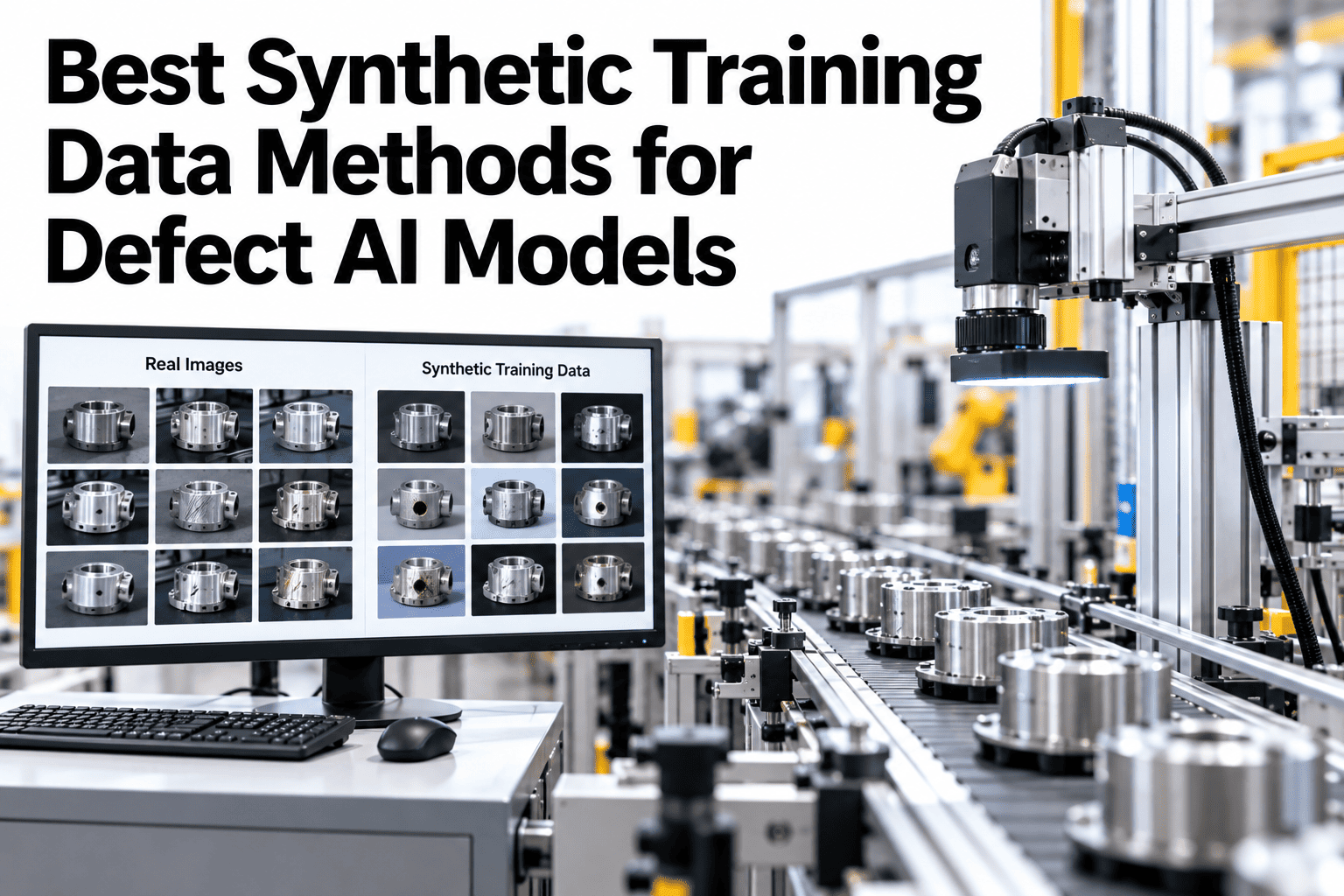
Rare defects are rare in your training dataset for exactly the same reason they're expensive on the line: they don't happen often. A model trained mostly on common, everyday flaws will be excellent at catching those and quietly weak on the defect that shows up twice a year and causes the costliest recall. Synthetic training data exists to fill that specific gap, generating and augmenting examples of rare defect classes so a model sees enough of them to learn the pattern before it meets the real thing in production. Data science leads can discuss synthetic data strategy for a specific defect class with the iFactory AI team to see what's practical for their own model.
Rare Defects Are Rare in Your Dataset for the Same Reason They're Expensive
Synthetic training data fills the gap left by rare defect classes, so a model learns the pattern before meeting it for real.
Why Imbalanced Datasets Are the Default, Not the Exception
Everyday flaws naturally accumulate far more training examples.
The defect that matters most for safety or cost is the hardest to collect.
Collecting enough real examples naturally can take months or years.
Without correction, a model optimizes for the common case and misses the rare one.
Three Approaches to Filling the Gap
| Approach | How It Works | Main Tradeoff |
|---|---|---|
| Data augmentation | Transforms existing rare examples: rotation, lighting, cropping | Limited by how few original examples exist |
| Generative synthesis | Creates new synthetic defect images from a learned model | Risk of generating unrealistic or biased examples |
| Simulation-based generation | Renders defects on a 3D model of the part under varied conditions | Requires accurate part geometry and defect physics |
Scope a Synthetic Data Approach for Your Hardest Defect Class
Bring your rarest, most costly defect type to a 30-minute session and discuss which approach fits.
Validation: The Step That's Easy to Skip
Produce synthetic examples using the chosen method.
Confirm examples resemble real defect characteristics, not artifacts.
Mix synthetic and real examples at a tested ratio, not all synthetic.
Validate performance against real examples the model never trained on.
Synthetic Data Done Well vs Done Carelessly
A Composite Scenario: The Defect Class That Never Had Enough Examples
Picture a defect class so rare that eighteen months of production has produced only a dozen confirmed real examples, nowhere near enough to train a reliable classifier.
Augmenting those dozen examples and generating additional synthetic variations, then validating performance against a small held-out set of the real ones, can get a model to a usable starting accuracy far sooner than waiting for enough real-world occurrences to accumulate naturally.
Where iFactory AI Fits
Identifies the gap
Flags which defect classes are underrepresented in your current training data.
Supports augmentation
Applies standard transformation techniques to expand limited real examples.
Validates against real data
Tests synthetic-trained models against held-out real examples before deployment.
Tracks the result in production
Monitors whether synthetic training actually improved real-world detection.
Expert Review
A computer vision research perspective, reviewed for accuracy before publication: synthetic data is a genuinely useful tool for rare defect classes, and it's also one of the easiest techniques to misuse by skipping validation against real examples. A model that looks great on synthetic test data and has never been checked against real held-out defects is a model nobody should trust yet. Scoping validation alongside generation from the start is what separates a useful approach from a false sense of confidence. Specific capabilities should be confirmed against the actual tooling available for your project.
Frequently Asked Questions
How many real examples do we need before synthetic augmentation is useful?
There's no fixed universal threshold, since it depends on the defect's visual complexity and how much variation the generation method needs to learn from. A small number of real examples, even a handful, can sometimes be enough to seed useful augmentation, but validation against additional real data is essential regardless of the starting count. See an assessment of what's practical for your own rare defect count in a short session.
Can a model trained entirely on synthetic data work in production?
This is generally risky without validation against real-world data, since synthetic generation methods can introduce subtle artifacts or miss real-world variation that a model trained purely on synthetic examples wouldn't be prepared for. Blending with at least some real examples, and always validating against held-out real data, is the more reliable path. Ask for a review of an appropriate synthetic-to-real ratio for your use case.
Which generation method should we use: augmentation, generative synthesis, or simulation?
This depends on your defect type, how much real data exists already, and whether you have access to accurate 3D geometry of the part. Simple augmentation is often the fastest starting point for a modest data shortage, while simulation-based generation tends to suit cases with well-understood part geometry and defect physics. Explore which method fits your specific defect and available data.
How do we know if our synthetic examples are realistic enough?
A domain expert review of generated examples is a useful first check, followed by the more rigorous test of whether a model trained on them actually performs well against real held-out examples. If performance on real data is weak despite strong performance on synthetic test data, the synthetic examples likely aren't capturing the real defect's full character. Try a validation review comparing synthetic and real model performance.
Does synthetic data introduce bias into a defect model?
It can, if the generation process over-represents certain variations of a defect and under-represents others, which is part of why validation against diverse real examples matters so much. Being deliberate about covering the realistic range of how a defect actually appears, rather than just generating more of the easiest variation, helps reduce this risk. Join a session on designing generation to avoid this kind of bias.
Give Your Rarest Defect Class a Fair Chance in Training
Discuss synthetic data generation, augmentation and validation for your hardest defect classes with the iFactory AI team.