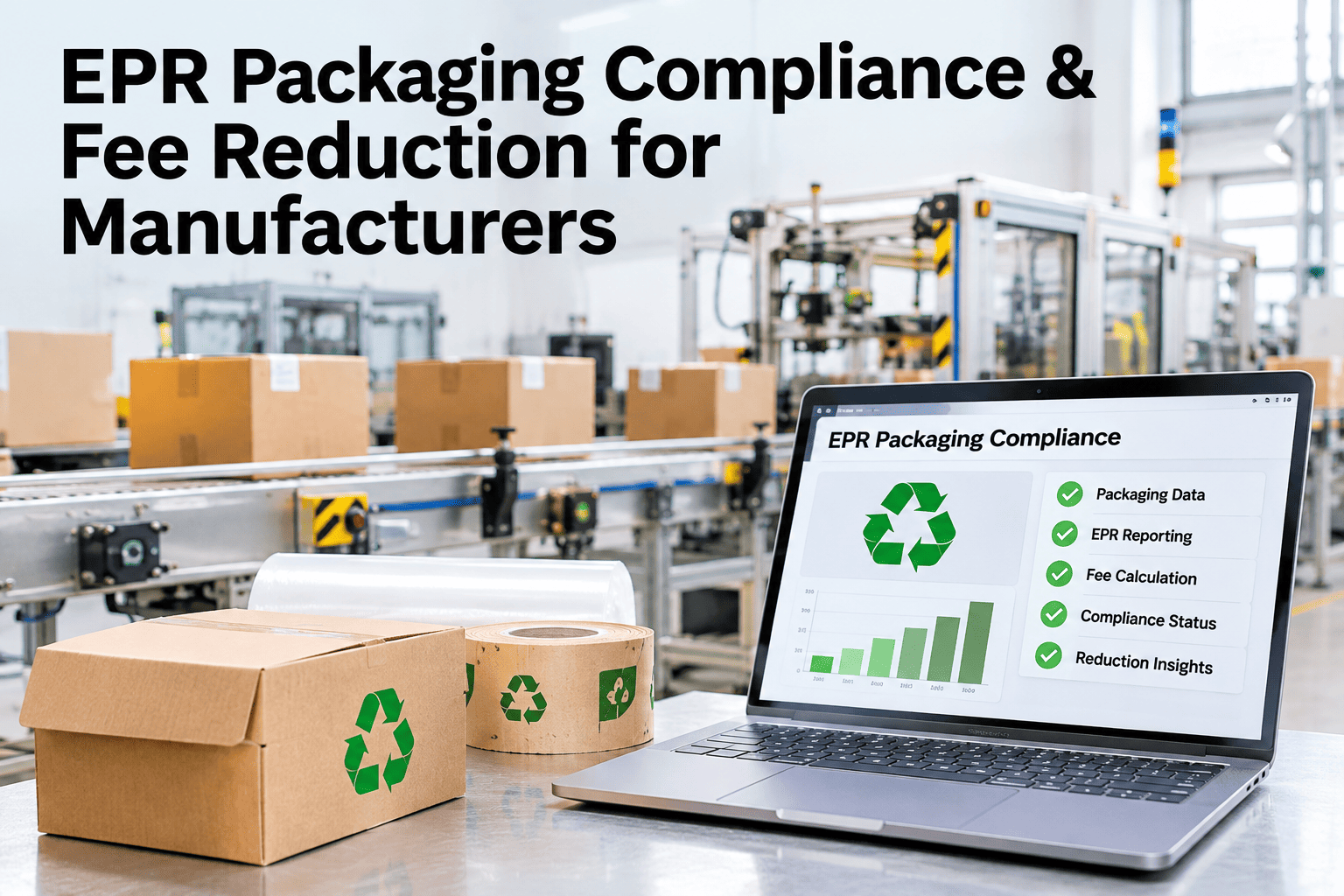
Seven US states now have enacted extended producer responsibility laws for packaging — Maine, Oregon, Colorado, California, Minnesota, Maryland, and Washington — and each one charges producer fees calculated from packaging weight, material type, and recyclability (state EPR law tracking, 2026). California alone is projected to generate an estimated $21 to $36 billion in producer fees over five years once its program is fully live (industry EPR analysis, 2026). Eco-modulation is the mechanism built into most of these programs that rewards or penalizes a specific packaging design: materials that are easier to recycle carry lower fees, hard-to-recycle materials carry higher ones. That means a packaging decision made before the artwork is finalized can determine a fee line item years before anyone in finance sees the invoice. iFactory, an on-premise AI platform with ESG and compliance reporting built in, helps packaging teams track material data against the states they sell into. Teams that want to see what their current packaging mix would cost under eco-modulation can review an EPR fee estimate with our team.
Packaging EPR · Seven-State Compliance Map, 2026
Seven States Now Charge Packaging Fees Based on Material, Not Just Weight
iFactory AI tracks packaging data at the SKU level against each state's EPR requirements, so a material decision made at design time does not become a surprise fee years later.
MaineOregonColoradoCaliforniaMinnesotaMarylandWashington
How the fee is set
Eco-Modulation Prices the Material Choice, Not Just the Weight
Most packaging EPR programs are administered by a state-approved Producer Responsibility Organization, which sets fees from the material and recyclability data producers report each year. Several states layer eco-modulation on top of the base fee.
| Packaging attribute | Typical fee effect | Why it matters for design |
|---|
| Readily recyclable material | Lower modulated fee | Rewards single-material, widely-collected formats |
| Hard-to-recycle material | Higher modulated fee | Penalizes composite films, certain multi-layer laminates |
| Post-consumer recycled content | Lower modulated fee in several states | Creates a direct cost incentive to specify PCR |
| Low-volume producer status | Reduced or waived fee | Oregon, Maine, and potentially Colorado offer thresholds |
What is actually required
Three Obligations Every Covered Producer Faces
Registration
Join the state's approved Producer Responsibility Organization — Circular Action Alliance administers six of the seven current state programs.
Supply data reporting
Report packaging type, material, and weight supplied into the state during the reporting year, by SKU.
Fee payment
Fees are calculated from that report and are enforceable by the state agency even though the PRO sets them.
The compliance calendar
Deadlines Are Already Staggered Across States
24
Colorado registration deadline
October 1, 2024 — already passed for most producers selling into the state.
25
Oregon operational
July 1, 2025 — fees are being actively collected.
26
California & Maryland supply reports
May 31, 2026 — baseline supply data due for both states.
27
California fees live
January 1, 2027 — initial producer fees due under SB 54.
Dates are drawn from state program schedules current as of 2026 (state EPR law tracking, 2026); several states have adjusted deadlines before and could again, so producers should confirm the current date against the relevant PRO.
Find Out Which States Your Packaging Already Owes Fees In
Share your current SKU list and the states you sell into, and iFactory AI will map your obligations against each program's current deadlines.
Design vs reaction
Why Packaging Redesign Pays Off Before the Fee Schedule Is Set
Reacting after fees are published
Fee schedule applied to an already-finalized design
Redesign cycle competes with production demands
Eco-modulation savings left on the table for years
Designing against the fee structure
Material choice evaluated against modulated fee before artwork is locked
Redesign timed to normal packaging refresh cycles
Lower fee bracket captured from the first reporting year
Expert review
What a Packaging Manager Checks First
EPR fee exposure is manageable when packaging data is tracked at the SKU level across every state a company sells into, not reconstructed once a year under deadline pressure.
Verdict
Strong when material and recyclability data are captured at the point of packaging spec, not after the fact.
Watch for
Treating the seven states as one program — registration deadlines, PROs, and fee formulas differ by state.
Do next
Confirm which of the seven states your current distribution footprint actually sells into before the next reporting deadline.
Frequently asked questions
What Manufacturers Ask About Packaging EPR
Which US states currently have packaging EPR laws?
What is eco-modulation and how does it affect our fees?
Who administers these programs — the state or a private organization?
Most states designate a Producer Responsibility Organization, with Circular Action Alliance currently serving as the PRO in six of the seven enacted states, while state agencies retain enforcement authority.
Discuss registration requirements for your states.
Is there a small-producer exemption?
What is the penalty for missing a reporting deadline?
Penalties vary by state and program, with some published non-compliance penalties running into daily per-violation amounts, so confirming the exact figure for each state with the relevant PRO is essential.
Walk through deadline risk for your SKUs.
Design against the fee structure, not after it
Track Your Packaging Data Before the Next Reporting Deadline
Book a session with iFactory AI to map your SKU-level packaging data against the states you sell into and the fees each one applies.
{"@context":"https://schema.org","@type":"FAQPage","mainEntity":[
{"@type":"Question","name":"Which US states currently have packaging EPR laws?","acceptedAnswer":{"@type":"Answer","text":"Seven states have enacted packaging EPR laws as of 2026: Maine, Oregon, Colorado, California, Minnesota, Maryland, and Washington."}},
{"@type":"Question","name":"What is eco-modulation and how does it affect our fees?","acceptedAnswer":{"@type":"Answer","text":"Eco-modulation adjusts the base producer fee up or down based on a packaging format's recyclability and recycled content."}},
{"@type":"Question","name":"Who administers these programs, the state or a private organization?","acceptedAnswer":{"@type":"Answer","text":"Most states designate a Producer Responsibility Organization, with Circular Action Alliance serving as the PRO in six of the seven enacted states."}},
{"@type":"Question","name":"Is there a small-producer exemption?","acceptedAnswer":{"@type":"Answer","text":"Several states include reduced or low-volume producer fee structures, with thresholds that vary by state."}},
{"@type":"Question","name":"What is the penalty for missing a reporting deadline?","acceptedAnswer":{"@type":"Answer","text":"Penalties vary by state and program, with some published non-compliance penalties running into daily per-violation amounts."}}
]}