A food plant cannot staff a shift by headcount alone. The person on the metal detector must be trained to verify it. The operator signing off an allergen changeover must hold a current qualification. The CIP cycle must be started by someone competent to start it. When a planner builds a roster from a spreadsheet, every one of these rules lives in someone's memory, and the first absence of the week is when one of them gets missed. The result is familiar: a line that runs short because the only certified operator is on leave, a last-minute swap that puts an unqualified person on a critical control point, or overtime stacked on the same few trusted people until they leave. Trained operators are scarce and getting scarcer, so the plants that cope best are not hiring faster. They are planning shifts against a live record of who is qualified for what, when each certificate expires, and what each line needs on each shift. Workforce planning in a food plant is not a rota exercise. It is a constraint problem, and food safety is the first constraint. This guide covers what to plan against, how to build certification rules into the roster, and how to roll it out. iFactory Production Scheduling connects shift planning to the production plan, so staffing follows demand and qualification together.
iFactory Production Scheduling - Food and Beverage Workforce
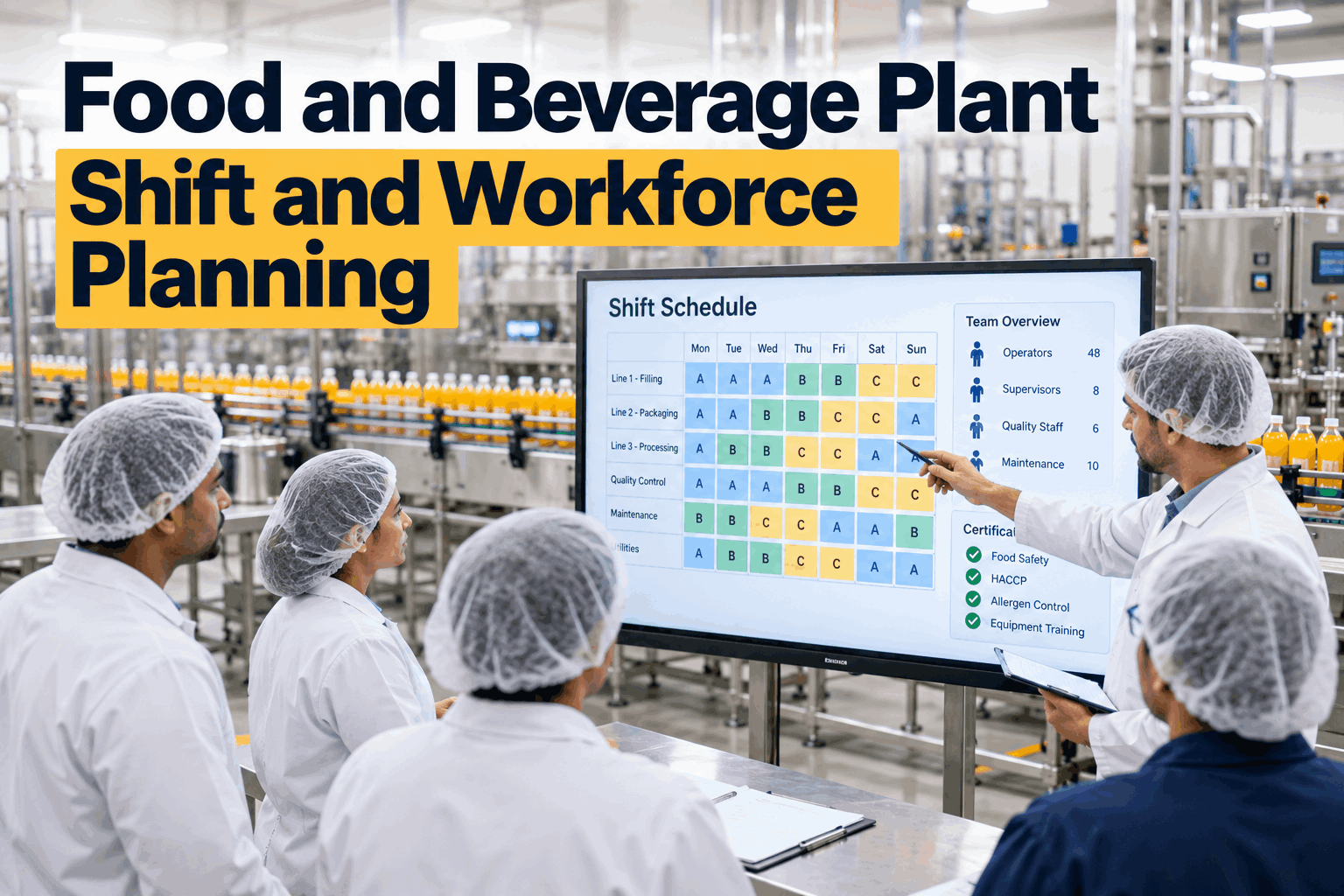
Food and Beverage Plant Shift and Workforce Planning
Build rosters that match the production plan and respect certification, hygiene, and working-hour rules, so every critical task is covered by someone qualified to do it.
0
critical tasks assigned to an unqualified operator
60 days
advance warning on certificate expiry
70%
less planner time spent building weekly rosters
1 view
of skills, shifts, and production demand
How Food Plants Plan Shifts Today
Most planning teams know their roster is fragile, but not how fragile. These four stages show where a plant stands and what changes at each step.
Stage 1
Whiteboard and spreadsheet
One supervisor holds the rota in a spreadsheet or on paper. Skills and certificates are known by memory. Changes are made by phone call the evening before.
Recognition signal: "Ask Ramesh, he knows who can run Line 2" - and Ramesh is on leave.
Stage 2
Headcount rostering
The roster ensures enough people per shift but treats them as interchangeable. Qualification checks happen at the line, after the shift has started.
Recognition signal: "We had eight on shift" - but only one could verify the metal detector.
Stage 3
Skills-aware roster
A skills matrix exists and the planner consults it. Certificate expiry is tracked in a separate file and checked periodically, not at the moment of scheduling.
Recognition signal: "The certificate lapsed in March" - found during the audit, not before.
Stage 4
Rule-driven, demand-linked
Roster rules enforce qualification, hours, and hygiene status. Demand comes from the production plan. Gaps and expiries are flagged weeks ahead, with training scheduled to close them.
Recognition signal: "The system would not let us assign it" - and showed who could cover instead.
What a Food Plant Roster Has to Satisfy
A workable roster balances four groups of constraints at once. Planners who handle only one or two of them produce schedules that look complete and fail in practice. These are the groups, with typical items in each.
Qualification
Food safety and HACCP training status
Critical control point monitoring authority
Allergen handling and changeover sign-off
CIP and sanitation competence
Equipment and line-specific training
Hygiene and health
Medical fitness and annual health check
Illness reporting and exclusion periods
Zone access, such as high-care areas
Cross-zone movement restrictions
Uniform and induction compliance
Working hours
Daily and weekly hour limits
Minimum rest between shifts
Overtime caps and approvals
Night shift and weekly off patterns
Contract, agency, and permanent rules
Production demand
Lines and products scheduled per shift
Crew size per line and speed
Changeover and sanitation windows
Seasonal and promotion peaks
Planned maintenance stoppages
Certification Rules That Should Block a Bad Assignment
The rule is not that every task needs a certificate. It is that tasks tied to food safety must not be assigned to someone who lacks the current qualification, and the roster should enforce this at the moment of planning rather than at the line. This is a typical rule set, to be agreed with your food safety and QA teams.
Task or station
Required qualification
Renewal
Roster rule
When a gap appears
Critical control point monitoring
Food safety and HACCP training with CCP authority
Annual refresh
Hard block
Reassign to a qualified operator or call in cover
Metal detector or x-ray verification
Equipment verification training
Annual or on equipment change
Hard block
Swap with certified operator on adjacent line
Allergen changeover sign-off
Allergen management training and authorisation
Annual refresh
Hard block
Schedule changeover into a shift with a signatory
CIP cycle start and verification
CIP operator competence
Every two years
Hard block
Move CIP to a shift with a trained operator
High-care zone access
Induction and zone hygiene training
Annual refresh
Hard block
Assign to low-risk zone until induction complete
Filler or packing line operator
Line-specific operator training
On change or after long absence
Warn and approve
Pair with an experienced operator
Forklift and cold store handling
Equipment licence and cold store induction
Per licence validity
Hard block
Cover from the warehouse pool
General packing and inspection
Basic hygiene induction
Annual refresh
Flag only
Schedule refresher within the month
The Live Workforce View for Planners
A planner needs four answers at any moment: is tomorrow's shift covered, whose certificates are about to expire, who is in training, and who is close to an hours limit. Here is what that view looks like in a running plant.
Shift B - Packing Hall
Tomorrow, 2 PM to 10 PM
1 gap
Headcount46 of 482 open positions
Critical coverageLine 4 gapno metal detector verifier
Suggested cover2 operatorsqualified, within hour limits
Demand match98%against production plan
Certificate Watch
Next 60 days
9 expiring
Expiring in 30 days4 peopleCCP and allergen authority
Expiring in 60 days5 peoplehygiene and forklift
Sessions booked6 of 93 still to schedule
Shift impactLowcover remains above minimum
Training Pipeline
Cross-skilling programme
On track
In training12 peopleacross 3 skills
Allergen sign-off+3qualified this quarter
Single-person skills2 leftdown from 7
Flexibility index78/100rising each month
Hours and Overtime
Current week
3 near limit
Near weekly limit3 peopleexcluded from extra shifts
Rest rule conflict1 swapblocked, alternative offered
Overtime share7.4%of total hours
SpreadBalancedno single-person dependence
A 90-Day Plan for Workforce Planning
The programme succeeds when the skills record is trusted before the roster depends on it. This sequence builds the data first, then the rules, then the live schedule.
Phase 1
Foundation - Days 1 to 30
Week 1 to 2
Skills and certificate register
Consolidate training records, certificates, and authorisations into one register per person. Mark the tasks that carry a food safety requirement.
Week 3 to 4
Line crew requirements
Define minimum crew and required skills per line, product, and shift pattern. Agree which tasks are hard blocks with the QA and food safety team.
Phase 2
Rules - Days 31 to 60
Week 5 to 6
Roster rules and hour limits
Configure working-hour, rest, and overtime rules, and link the demand view to the production plan so required crew follows scheduled lines.
Week 7 to 8
Parallel run
Run the new roster alongside the existing one for two weeks. Compare the gaps it finds with what actually happened on shift.
Phase 3
Live - Days 61 to 90
Week 9 to 10
Go live and expiry alerts
The new roster becomes the working schedule. Expiry alerts start, and training sessions are booked from the gap list.
Week 11 to 12
Review and cross-skilling plan
Review coverage gaps, planner time, and overtime. Build a cross-skilling plan around the skills held by only one or two people.
Want to see your own shifts checked against your certification rules? Book a demo - bring your current roster, your skills matrix, and the list of tasks that need a certificate, and we will show the gaps in the first session.
What Rule-Driven Workforce Planning Delivers
These are the outcomes plants should track after the first few months of running rosters against live certification and demand data.
0
Unqualified critical assignments
because the roster enforces the rules at planning time
60 days
Expiry visibility
so retraining is scheduled before a certificate lapses
70%
Less planning effort
on building and amending weekly rosters
Fairer
Overtime spread
so the same trusted operators are not overloaded
Frequently Asked Questions
Does this replace our HR or attendance system?
No. HR and attendance systems remain the record for contracts, pay, and leave. The workforce planning view reads that data and adds what those systems usually lack: a per-person record of food safety qualifications, line skills, and authorisations, linked to the production plan. The goal is a roster that is correct for production and food safety, not a second payroll record.
How do we handle agency and contract workers with different induction levels?
Each worker carries the same record as permanent staff: induction, hygiene training, and any task authorisations. Rules then apply equally. For example, an agency operator without high-care induction can be assigned only to low-risk zones, and the roster shows what training would unlock additional tasks. This also makes it clear which agency workers are worth investing in.
What happens when someone calls in sick and the roster has to change at short notice?
The planner or supervisor marks the absence, and the system proposes replacements who hold the required qualification, are not over their hour limits, and have the rest period required. Where no one qualified is available, it flags the line or task that cannot be covered, so the decision to reschedule production or call in cover is made early rather than at the start of the shift.
Can the rules reflect our own standards and customer requirements?
Yes. The rule set is configured with your QA and food safety team. Which tasks are hard blocks, which only warn, and what refresh intervals apply is set to match your food safety plan, certification scheme, and customer requirements. The system enforces the rules you define and keeps the record. Your food safety team remains responsible for what the rules should be.
Staff the shift for the line, not just the headcount.
See iFactory Workforce Planning Running on Your Shifts
Bring your current roster, your skills matrix, and the last three shifts that ran short or with a last-minute swap. We will map the certification rules, show the gaps they would have caught, and plan the cross-skilling that closes them.
0
unqualified critical tasks
Linked
to production plan
90-day
rollout to live roster