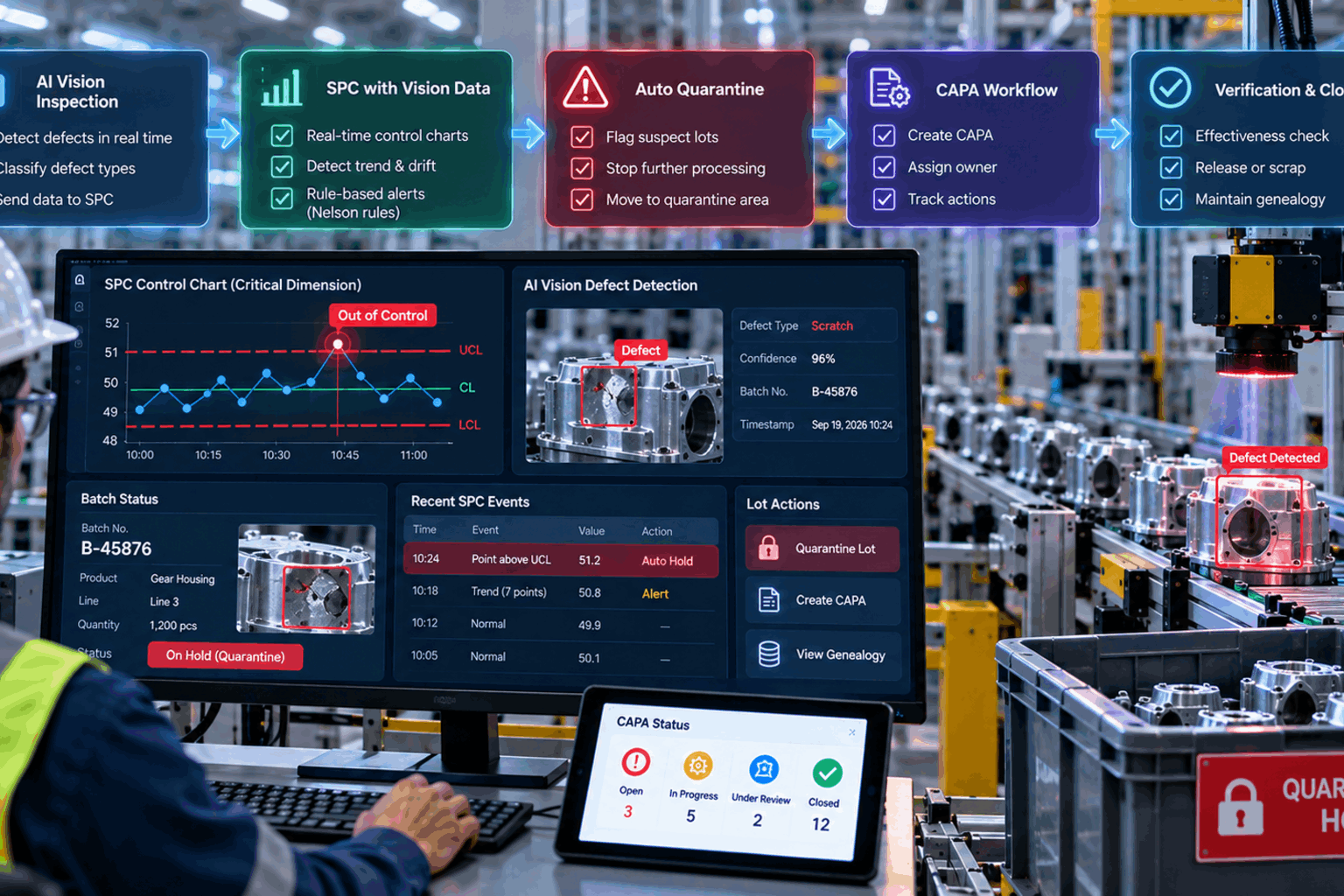
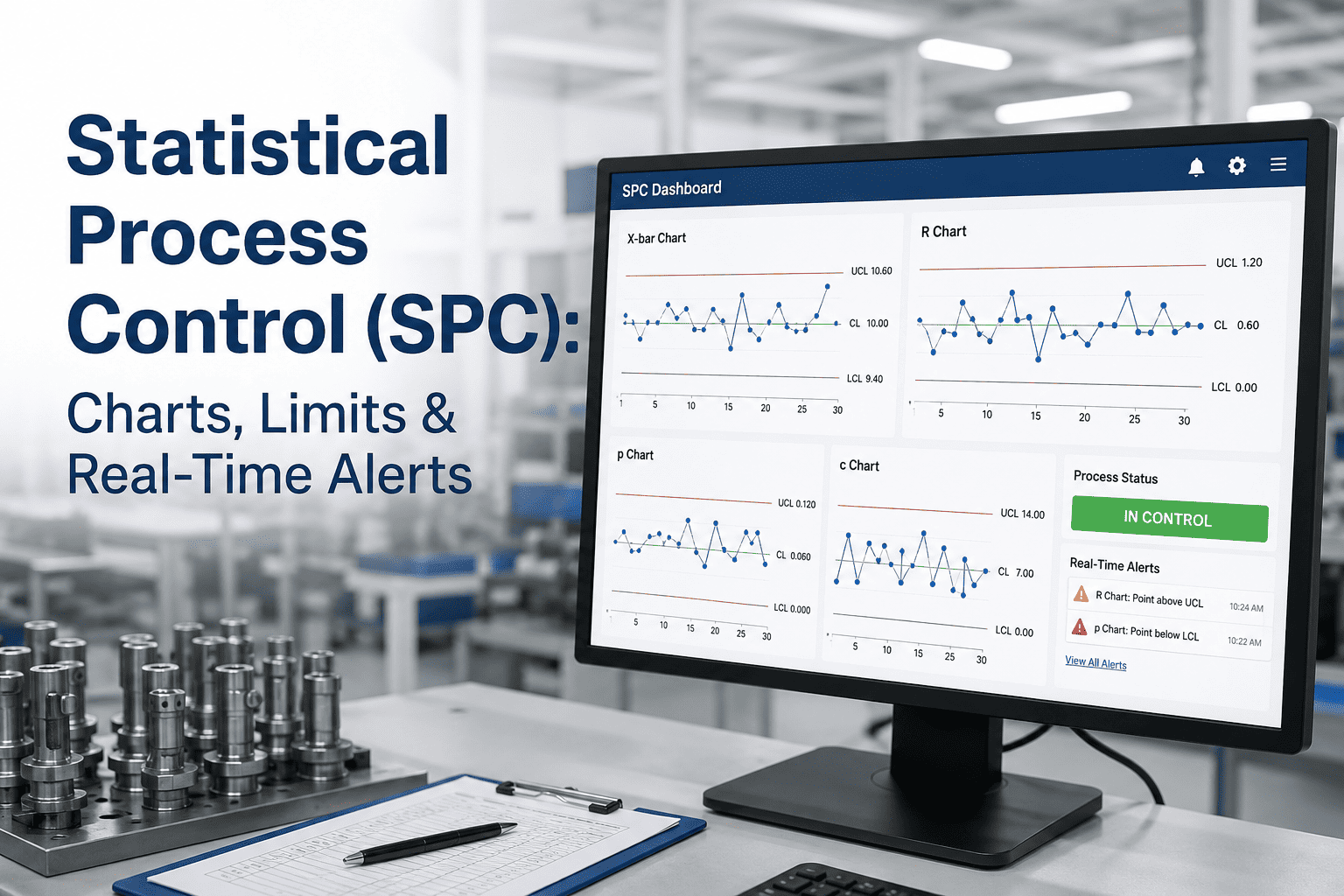
If your control chart updates after the lot is already moving to packout, you are not preventing defects — you are documenting them. Sample-based SPC is often too slow for short runs, fast lines, and defects that move between manual checks. iFactory AI turns AI vision into a live SPC data stream so control charts detect drift and auto-hold suspect lots before shipment — closing the loop from real-time detection to quarantine, CAPA, and genealogy. That is the difference between measuring variation after the fact and stopping suspect output before it escapes. See real-time vision-fed SPC hold suspect lots in a demo.
Vision-Fed SPC · Real-Time Containment
Real-Time SPC Charts That Hold Suspect Lots Before Shipment
Every part becomes a data point. Every threshold breach becomes an enforced hold. Every hold becomes a scoped quarantine with genealogy tied to the original signal — not another retrospective report.
Detect
→
Hold
→
CAPA
→
Verify
→
Genealogy
At a Glance
01
What It Is
SPC AI vision statistical process control quarantine uses AI vision as a live quality data source so control charts detect drift and trigger holds before shipment.
02
Why It Matters
Sample-based SPC is often too slow for short runs, fast lines, and defects that move between manual checks.
03
Closed-Loop Path
Detect → Hold/Quarantine → CAPA → Verify → Genealogy — one path from signal to controlled disposition.
04
Best Fit
Quality leaders, process engineers, and manufacturing teams that need faster containment and tighter traceability.
05
iFactory AI Role
Overlay beside your current quality stack to feed vision data into real-time SPC, hold actions, and investigation workflows.
Why Sample-Based SPC Is Too Late for Fast-Moving Production
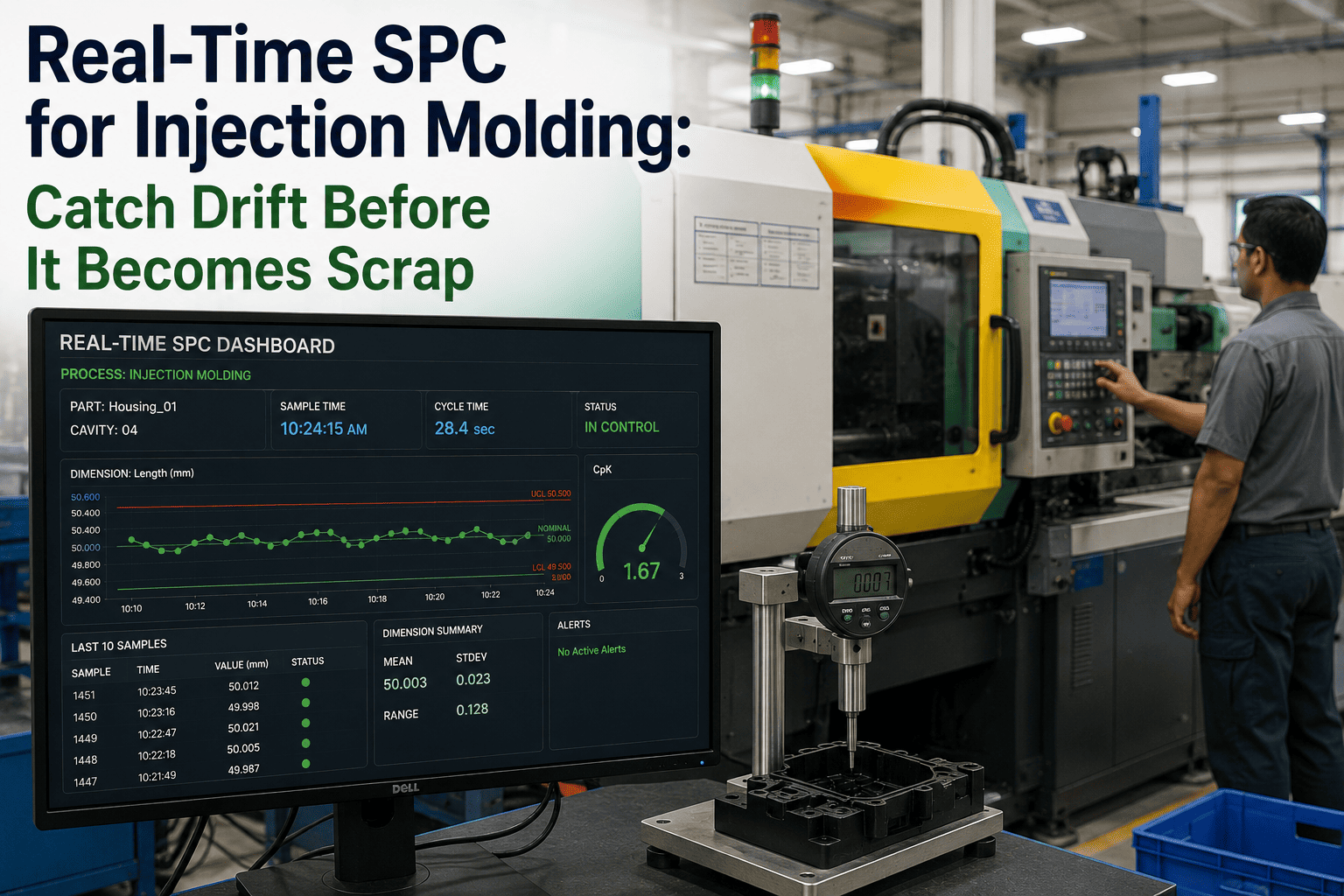
Traditional SPC still relies on sampling frequency, manual input, and delayed review. That can work when a process changes slowly. It fails when drift happens inside one shift, one setup, or one short production window. A lot can happen between samples — and by the time someone sees the signal, suspect material may already be blended into good inventory.
A tool begins to wear — dimension drift starts
A seal shifts out of position — leak paths open
A label walks off center — appearance drift begins
Fill level trends downward — underfill risk builds
A missing-component defect appears — after a changeover
That is why the commercial outcome that matters most is not “more charts.” It is faster containment: hold suspect lots before they ship, narrow the quarantine, and keep the line moving with less uncertainty. See how vision-fed SPC changes the containment window.
Siemens and P&G Show Where the Market Is Heading
Vendor-reported market context supports the shift toward live inspection. In a 2026-09-16 ManufacturingTomorrow report, Siemens and P&G were described as scaling AI visual inspection on Industrial Edge to speed commissioning and reduce scrap, with reported scrap cuts in the 10–20% range. That is not a universal result and should be read as vendor-reported context, not a promise. But it does reinforce the same thesis: large manufacturers are moving inspection closer to the machine and closer to the decision.
→
Vision is becoming a live control input
→
Decisions are moving earlier in the flow
→
Closed-loop SPC is replacing slow, retrospective review
In other words, the future is not inspection-only dashboards. It is inspection that can trigger action.
How AI Vision Becomes an SPC Data Stream
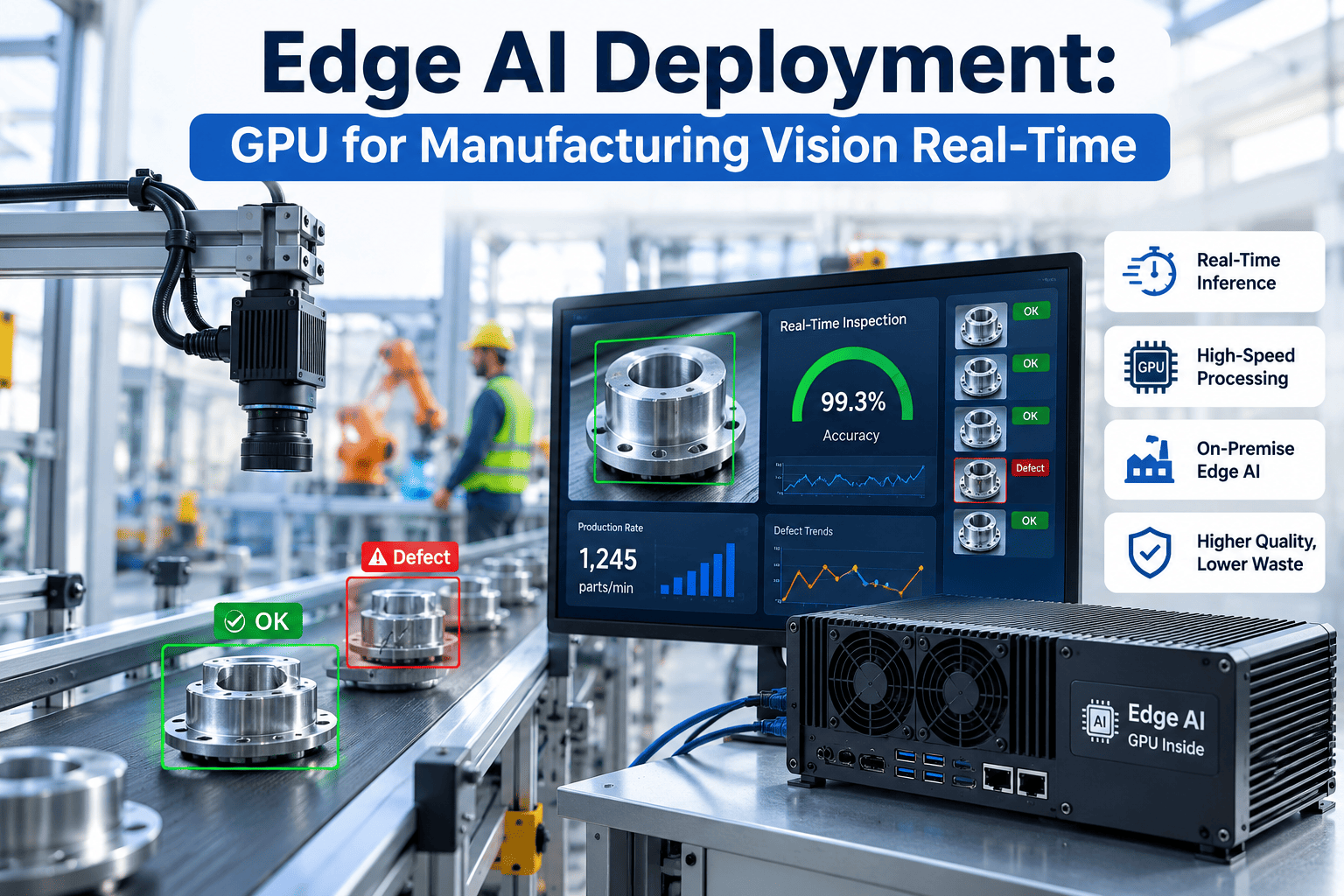
AI vision turns inspection events into chartable quality data. Cameras capture part images at line speed. AI evaluates the image for the attribute, feature, or defect you care about. The result is time-stamped and pushed into the quality workflow.
01
Camera Captures
Part image at line speed
»
02
AI Evaluates
Attribute, feature, or defect
»
03
Result Time-Stamped
Written to SPC chart continuously
»
04
Chart Signals Action
Threshold breach triggers hold
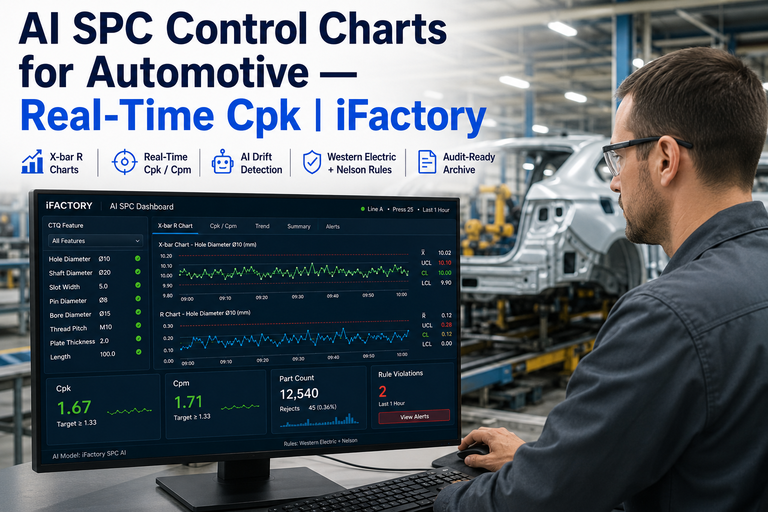
SPC can now monitor a much richer set of signals — both attribute and variable-like — without waiting for a technician to sample, inspect, enter results, and review the chart.
Dimension trends
Edge wear patterns
Fill-level variation
Label placement drift
Missing-component patterns
Surface or seal defects
Pass/fail attributes
Cycle-time variability
This matters because AI vision can feed both attribute and variable-like signals. It does not replace validated metrology where precision requirements are strict, and it does not replace engineering judgment. Control plans still matter. FAI, PPAP, and acceptance criteria still matter. What changes is the speed and density of the data.
Detection to Containment
A Chart That Detects Drift Ten Minutes Earlier Is Helpful. A Chart That Auto-Holds the Suspect Output Is Transformative.
Quarantine is the bridge between analytics and quality action. iFactory AI turns vision-fed SPC into that bridge — without asking you to rip out MES, QMS, or existing metrology.
Closed-Loop SPC Path — Detect, Quarantine, CAPA, Verify, Genealogy
The real value of SPC AI vision statistical process control quarantine is not just earlier detection. It is the ability to turn detection into a closed-loop response — every ring closing before the next opens.
Ring 01
Detect
AI vision identifies drift, defects, or threshold breaches immediately. Control charts update in near real time, so the system can react before the next batch is made or the next lot is released.
Ring 02
Quarantine / Hold
Once a threshold is breached, suspect units, lots, or batches can be flagged for hold. Scope by serial number, lot, station, shift, machine, or line. Containment based on evidence, not guesswork.
Ring 03
CAPA
Quality and operations receive the alert with context: images, timestamps, station ID, line, shift, and genealogy. That evidence routes into nonconformance process and supports root-cause analysis.
Ring 04
Verify
After the fix, the system keeps watching. Verification is a post-action check to confirm the process has returned to control and stayed there long enough to trust the correction.
Ring 05
Genealogy
Genealogy ties the signal back to part, batch, line, machine, operator, and time. That traceability narrows hold scope, supports audit readiness, and speeds disposition.
Mini Use Case — Catching Drift Before a Full Lot Is Packed
Consider a mid-volume packaging line running mixed SKUs. The defect is subtle: label placement begins to drift after a roll change, but the variation is still within what a quick visual spot-check might miss. Traditional SPC only captures sampled units, so the issue could continue until the next review window.
The Scenario
A mid-volume packaging line, mixed SKUs, label placement drift after a roll change. Variation within what a spot-check would miss. Traditional SPC review window: 45 minutes away.
1
Camera monitors continuously. Vision model detects the drift pattern in the label placement feature.
2
Event enters SPC immediately. Control chart updates in near real time.
3
Rule threshold crossed. System flags the related serials and lot range for hold.
4
Quality team receives evidence. Image, timestamp, genealogy context — all in the existing workflow.
The Outcome
Only
The affected window quarantined
Kept
Good product outside the hold
Faster
Investigation dispatch
Avoided
Broad shutdown from unclear containment
Why Quarantine Matters More Than Faster Detection
Many teams ask for better detection when the real problem is delayed containment. A chart that detects drift ten minutes earlier is helpful. A chart that detects drift ten minutes earlier and automatically places suspect output on hold is much more valuable.
Detection Alone
Finding More Defects
Better charts. Faster alerts. But suspect material still moves downstream while the team decides what to do about it. The signal is captured — the escape is not prevented.
VS
Detection + Quarantine
Keeping Defects From Escaping
Threshold breach triggers scoped hold. Suspect material stops moving. Investigation runs while good product continues. That is the commercial value of vision-fed SPC.
Lower rework
Less scrap
Fewer line disruptions
Smaller quarantine scope
Faster disposition
Shorter time from detection to containment
The goal is not simply to find more defects. The goal is to keep defects from escaping.
SPC as an Overlay Beside MES and QMS
One of the most important implementation points is this: AI vision should not be framed as a replacement for your quality system. iFactory AI is designed to overlay beside existing MES, QMS, inspection management, and traceability workflows. It strengthens execution without asking you to rip out established controls.
What Still Governs
01Control plans still define what gets checked
02FAI still validates the first part or first run
03PPAP still sets approval expectations
04Metrology still governs precision-critical measurements
05Engineering still owns process limits and acceptance criteria
AI vision adds a higher-frequency layer of evidence. It helps the quality team see what is happening now, not what happened by the time the sample was entered.
Implementation Outcomes — What Teams Usually Improve First
A good deployment usually starts narrow and expands with proof. The first wins are often operational, not dramatic — but they compound into meaningful long-term impact.
01
Earlier drift detection
02
Tighter quarantine scope
03
Fewer defective lots mixed into good inventory
05
Cleaner evidence for investigations
06
Less time reconciling spreadsheets, images, and manual logs
07
Better alignment between production and quality on what happened, when, and where
A Simple Integration Example
1Camera captures the part
2AI classifies the defect or attribute
3The result is written to the SPC chart
4If a rule is breached, the lot is flagged for hold
5The hold event routes to QMS/CAPA with images and genealogy
6Quality reviews the evidence and disposition follows the normal approval path
Why This Matters Now
Manufacturing is moving toward faster, edge-based decision loops. That creates pressure on traditional SPC models that depend on delayed measurement and manual chart review. The opportunity is not to abandon statistical process control — it is to feed it better data.
When Every Part Becomes a Data Point
SPC stops being a retrospective report and becomes a live containment system. That is the promise of vision-fed statistical process control: real-time charts, immediate quarantine, structured CAPA, and traceability that supports faster decisions before defective lots ship.
30-Minute Demo Agenda
See how iFactory AI can connect vision data to real-time SPC, auto-hold suspect lots before shipment, and support your existing MES/QMS workflows.
0–10 min
Your current inspection and SPC flow
10–20 min
Where vision-fed data can trigger hold and CAPA
20–30 min
Integration points for genealogy and traceability
Book your 30-minute live SPC demo.
Frequently Asked Questions
Does AI vision replace traditional SPC?
No. It feeds SPC with continuous data and improves response time, but control plans and engineering oversight still matter. The role of AI vision is to add a higher-frequency evidence layer — not to bypass validated quality controls.
See vision-fed SPC in action.
Can AI vision trigger quarantine automatically?
Yes. It can flag suspect units, lots, or batches and route them into hold or review workflows — with scope defined by defect signature so containment stays narrow instead of stopping the whole line.
See auto-hold routing in a live demo.
How does this work with MES and QMS?
iFactory AI overlays beside MES and QMS to connect detection, containment, CAPA, and traceability. Systems of record stay in place; iFactory AI orchestrates the workflow across them.
Walk the overlay pattern with our team.
Is AI vision enough for FAI or PPAP?
What improvement should we expect first?
Earlier drift detection, tighter quarantine scope, and fewer defective lots escaping into downstream operations. The first wins are usually operational rather than dramatic — but they compound as more lines join the loop.
Book a scoping call to size the first pilot.
Live Path From Detection to Containment
Turn Inspection Into Action — Hold Suspect Output Before It Reaches the Customer
SPC AI vision statistical process control quarantine gives quality teams something traditional sampling cannot: a live path from detection to containment. iFactory AI turns inspection into action so suspect output can be held, investigated, corrected, and verified before it ships.
Real-Time Vision-Fed SPC
Auto-Hold Suspect Lots
Scoped Quarantine
MES / QMS Overlay
Genealogy Preserved