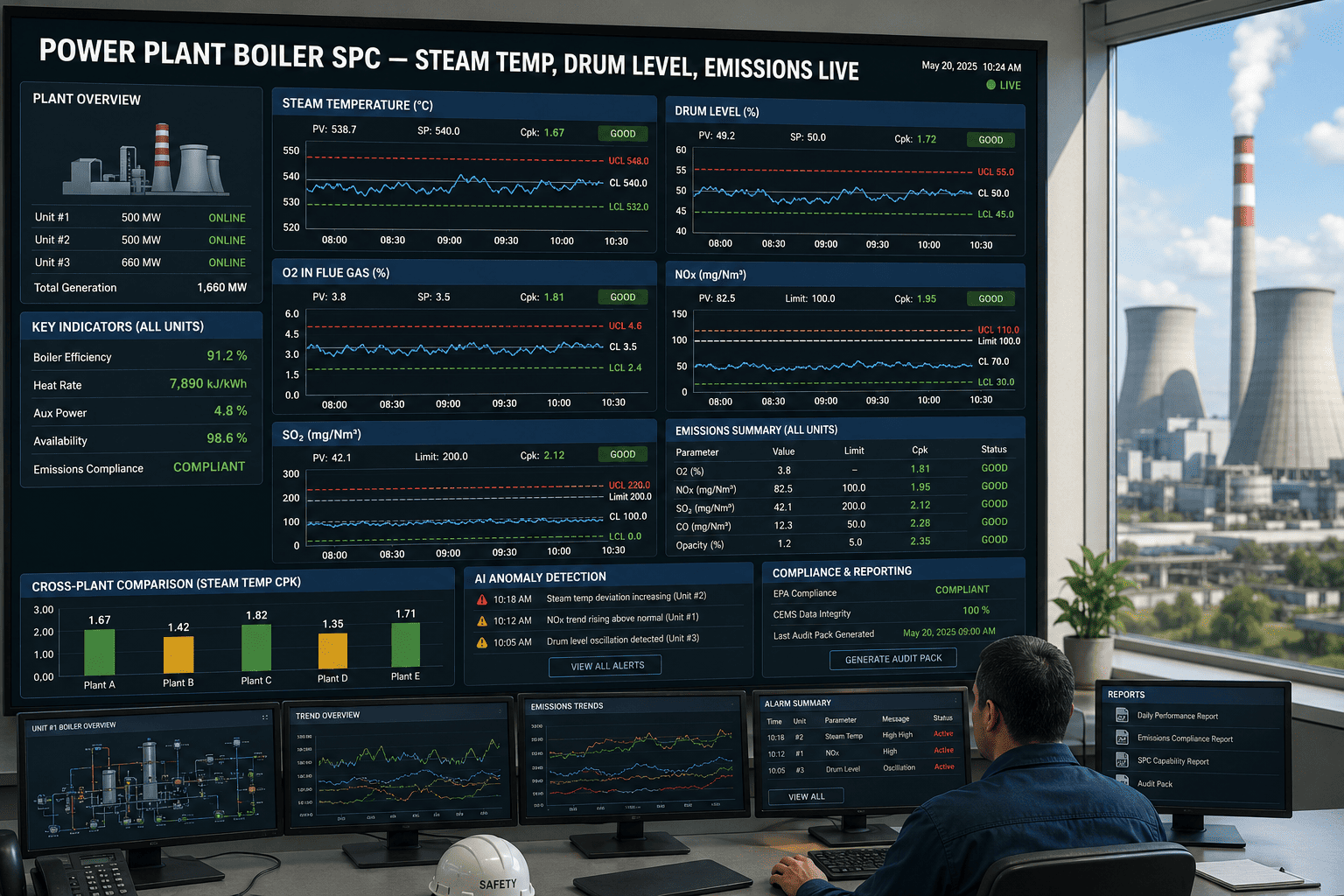
Every megawatt-hour a thermal plant loses to inefficiency, it loses the same way: not in one dramatic failure, but in a thousand small wobbles. Steam temperature drifting five degrees here, excess oxygen creeping up a point there, drum level hunting around its setpoint all shift. None of it trips an alarm. All of it quietly taxes your heat rate. The plants that pull ahead are not the ones chasing every wiggle — they are the ones that learned which wiggles are noise and which are signal, and tightened the band around the variables that actually move the bill. That is what statistical process control does, and an iFactory analytics layer is where it runs across the whole unit at once.
iFactory · Power Plant Process Control
How SPC Narrows the Variation That Quietly Eats Your Heat Rate
Variability is the tax on every thermal plant. Steam temperature, drum level, combustion air — tighten the band on each and the efficiency comes back. Here is how statistical process control turns scatter into stability, variable by variable.
~1.4 pt
efficiency gain from tighter excess-O2 control
23.5°C
steam temp deviation cut by better control
1.33+
Cpk target for a capable process
1-3%
stack O2 sweet spot to hold steady
The Variability Tax Nobody Puts on the Balance Sheet
A plant can hit its targets on average and still bleed money, because efficiency does not respond to averages — it responds to scatter. Run main steam temperature ten degrees below its design point to "stay safe" from overshoot, and you give away heat rate every single hour. The reason crews run that conservative margin is variation: if the temperature swings wildly, you have to back off the setpoint to keep the peaks away from metal limits. Narrow the swing and you can push the average back up toward design. The width of your variation literally sets how close to optimal you are allowed to operate. SPC is the discipline that measures that width, tells you whether it is shrinkable, and proves it shrank.
Wide variation
operating point forced low
Big safety margin needed. Average pushed far from design. Heat rate lost every hour.
Tight variation
operating point near design
Small margin needed. Average runs close to design. Efficiency recovered.
The One Idea That Makes SPC Work: Noise vs Signal
The whole method rests on a distinction Walter Shewhart drew in the 1920s and that still governs every control room decision today. Every process has two kinds of variation, and treating them the same is the single most expensive mistake an operator can make.
Common cause
The background noise
The natural, random hum of a stable process — minor coal quality shifts, small ambient swings, ordinary sensor jitter. It is always there, it is predictable, and it lives inside the control limits.
Rule: leave it alone. Reacting to noise only adds variation.
Special cause
The real signal
An assignable, identifiable disturbance — a fouled burner, a sticking damper, a drifting transmitter. It pushes points outside the limits or into non-random patterns. Something genuinely changed.
Rule: investigate and fix. This is where the variation actually comes from.
Deming proved the cost of getting this wrong with his funnel experiment: an operator who "corrects" every random deviation drives the process further from target, not closer. Over-adjustment manufactures variability. The control chart exists precisely so the control room knows when to act and when to keep its hands off the setpoint.
What a Control Chart Tells the Control Room
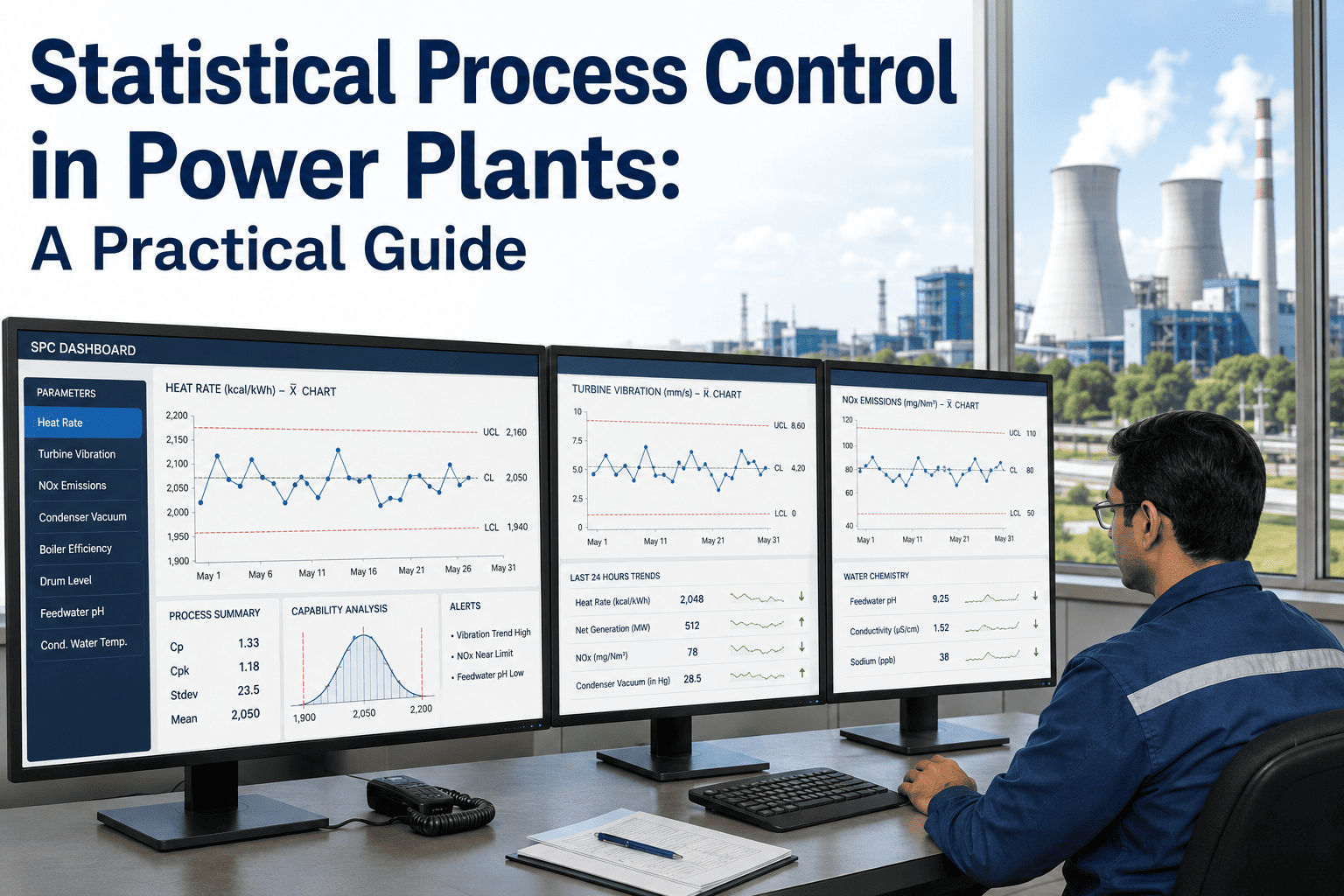
A control chart is just the process variable plotted over time, with a centerline and two statistically derived limits. But reading it correctly is the entire game. Below is what the same variable looks like before and after SPC discipline — and what each pattern is telling the operator.
Before: process out of control
Points breach the limits and swing without pattern. Special causes are present. The process is unpredictable — and the operator cannot trust the setpoint.
After: process in control
Points cluster tight around the centerline, all inside the limits, no patterns. Only common cause remains. Now the setpoint can be pushed toward design with confidence.
Want to see your own steam temperature or excess-O2 data plotted as a live control chart? Talk to a process control specialist and we will set it up on your tags.
The Three Variables Where SPC Pays First
You do not chart everything at once. You start where variation costs the most heat rate and the most equipment life. On a thermal unit, three controlled variables sit at the top of that list — and each one tells a slightly different story through the chart.
Main Steam Temperature
Sets how close to design you can run
What variesSwings from load changes, soot, spray-water lag
Why it costsWide swings force a low, safe setpoint — lost efficiency
SPC catchesDrift and oscillation invisible in a single reading
The winTighter band, then push the average up toward design
Combustion Air / Excess O2
The biggest stack-loss lever you have
What variesExcess oxygen drifting with damper play and air leakage
Why it costsToo much air sends heat up the stack; too little risks CO
SPC catchesCreep above the 1-3% target band over a shift
The winHold O2 steady near the floor for points of efficiency
Drum Level
Stability that protects the unit, not just the bill
What variesHunting around setpoint from swell, shrink, feed lag
Why it costsExcursions risk trips, carryover, and tube stress
SPC catchesGrowing oscillation amplitude before it trips
The winSteadier level, fewer trips, longer asset life
From Scatter to Stability: The Five-Step Loop
SPC is not a one-time study — it is a loop the plant keeps running. Each turn of the loop tightens the band a little more and surfaces the next assignable cause to chase.
1
Measure
Pull the variable straight from the historian — steam temp, O2, drum level — at a consistent interval.
2
Chart
Build the control chart, set limits from the process's own stable history, not from the spec.
3
Separate
Read noise from signal. Flag the special-cause points and the non-random patterns.
4
Act
Hunt the assignable cause behind each signal and remove it. Leave the common-cause noise alone.
5
Verify
Recheck capability. Cpk climbing toward 1.33 proves the band tightened. Then start again.
Want this loop running across every critical tag on your unit, automatically? Book a demo and we will scope it to your historian.
Frequently Asked Questions
How is SPC different from the alarms and limits we already have?
Alarms tell you a value crossed a fixed threshold — usually a safety or spec limit set by engineering. SPC control limits are different: they come from the process's own stable behavior, so they catch a variable drifting or oscillating long before it ever reaches an alarm. SPC sees the trouble building; the alarm only sees it arrive.
Does reducing variability actually improve efficiency, or just consistency?
Both, and they are linked. Tighter variation lets you run the average closer to the optimal operating point instead of holding a conservative margin against the peaks. On combustion air, for example, holding excess oxygen steady near the low end of its band rather than letting it creep high recovers measurable points of efficiency — heat that was going straight up the stack.
What is Cpk and why does 1.33 keep coming up?
Cpk is a capability index — it compares how much room your specification allows against how much your process actually varies, while accounting for how centered the process is. A Cpk of 1.33 is the common industry threshold for a process that is both stable and comfortably inside its limits. It is the number you watch climb as SPC tightens the band.
Won't operators just react to every point on the chart?
That is exactly the trap SPC is designed to prevent. The control limits draw a clear line between common-cause noise, which you leave alone, and special-cause signals, which you act on. Reacting to noise — over-adjusting — provably adds variation. The chart gives the control room permission to keep its hands off the setpoint when nothing real has changed.
Do we need new instrumentation to start?
Usually not. The signals SPC needs — steam temperature, excess oxygen, drum level, fuel and air flows — are already in your historian. The work is in pulling them at a consistent cadence, building the charts, and putting the noise-versus-signal logic in front of the control room. An analytics layer over your existing data is typically where plants start.
Stop paying the variability tax shift after shift.
See Your Plant's Variation Turned Into a Control Chart
Bring one variable — main steam temperature, excess O2, or drum level. We will pull it from your historian, build the live control chart, separate the noise from the real signals, and show you exactly how much band there is to tighten. Turnkey analytics over your existing data: pre-configured, integrated to your tags, live in weeks not quarters.
3
variables that pay back first
1.33+
Cpk target, tracked live
~1.4 pt
efficiency on the table
Weeks
to live on your historian