Stamping press cycle time decides how many panels a press shop makes each shift. It is usually quoted as strokes per minute, and a single extra stroke on a tandem or transfer line can mean hundreds more parts a day. But speed has limits: the transfer has to clear the die, the material has to form without splitting, and the press and tooling have to survive. This guide explains what sets stamping cycle time, typical rates by line type and how to raise them without shortening die life. To see your press data analyzed, book a short walkthrough.
Stamping Press Cycle Time Optimization in Automotive: More Strokes, Same Die Life
Find the strokes per minute each die has already proven it can run, see what is holding the line below that and protect the press and tooling while you close the gap.
It is set by transfer motion, forming-speed limits and press loads, not by tonnage alone.
The gap between today’s rate and the die’s best proven rate is the easiest capacity to recover.
Changeover time does not change the stroke rate, but it decides daily output.
Reverse tonnage and die temperature rise with speed and shorten press and die life.
What Decides Stamping Press Cycle Time?
Cycle time in a press shop is the stroke rate the whole line can hold, part after part.
How many times the press slide completes a full stroke each minute. On a tandem or transfer line, every press and every transfer must keep the same rate.
The transfer needs time to enter, grip, move and clear before the slide comes down.
Each material has a speed above which it splits, wrinkles or springs back badly.
Slide speed at contact, die cushion response and reverse tonnage.
Die temperature and lubrication film at higher speed.
Destacking, washing, oiling and centering blanks.
Inspection and racking must keep up.
The slowest of these sets the line rate. Raising any other limit changes nothing until that one moves.
Finding the true limit for each die is the first step. We can review a line’s data on a call.
Typical Strokes per Minute by Press Line Type
Published figures show a wide range, depending on line type and part.
| Line type | Published rate | Source |
|---|---|---|
| Automated tandem line | Typically 12–15 SPM | SEYI; The Fabricator |
| Servo tandem line | 18–20 SPM | AIDA |
| Servo press line, large panels | 16–23 SPM by model | Schuler ServoLine |
| OEM servo line, steel and aluminum | Up to 18 SPM steel, 15 SPM aluminum | Automotive Design and Production, FCA Warren |
| Large servo transfer press | 30 SPM, 35 in pendulum mode | Automotive Manufacturing Solutions |
| Press hardening line | About 4.5–7.5 strokes per minute, several parts per stroke | Schuler |
Hot stamping is slower per stroke because the part must cool in the die. Trade sources give cycle times of 8–30 seconds, with two to four parts per stroke.
Above about this rate on tandem lines, one press maker says a servo press becomes the preferred choice.
These are line capabilities, not targets for every die. Compare your own dies in a demo.
Transfer Motion: The Usual Speed Limit
On most automotive lines, the transfer or press-to-press automation runs out of time before the press does.
- Clearance. The transfer can only enter once the upper die has risen far enough.
- Travel. Larger panels need longer moves and gentler acceleration.
- Grip and release. Vacuum cups need time to build and release hold.
- Part stability. Thin outer panels flutter if moved too fast.
- Dwell. Extra waiting time added after a mis-feed often stays in the program.
That last point is common. A technician lengthens a dwell to solve a problem, the problem is fixed elsewhere, and the slower motion stays for years.
Tracking motion curves by die shows what changed and when. Our specialists set this up with your controls team.
Forming Speed Limits and Servo Presses
Stronger steels need slower forming, which is where servo presses earn their place.
On mechanical lines the same logic applies in reverse: know each material’s limit and do not chase speed past it. Ask our team how limits are recorded per part.
Tonnage and Reverse Tonnage
Tonnage does not set cycle time directly, but the loads that come with speed can.
Also called snap-through. When material fractures in blanking or piercing, stored energy releases and loads the press in the opposite direction.
- Guideline. The Fabricator advises keeping reverse tonnage to 10–15% of rated tonnage on general-purpose presses.
- Upper figure. AIDA cites a 20% limit.
- Speed effect. Running faster raises reverse tonnage.
- Damage. Severe reverse loads damage the press and die over time.
- Servo effect. In one AIDA example, a blanking die read 9 tons of reverse load on a mechanical press and 2.6 tons on a servo-mechanical press.
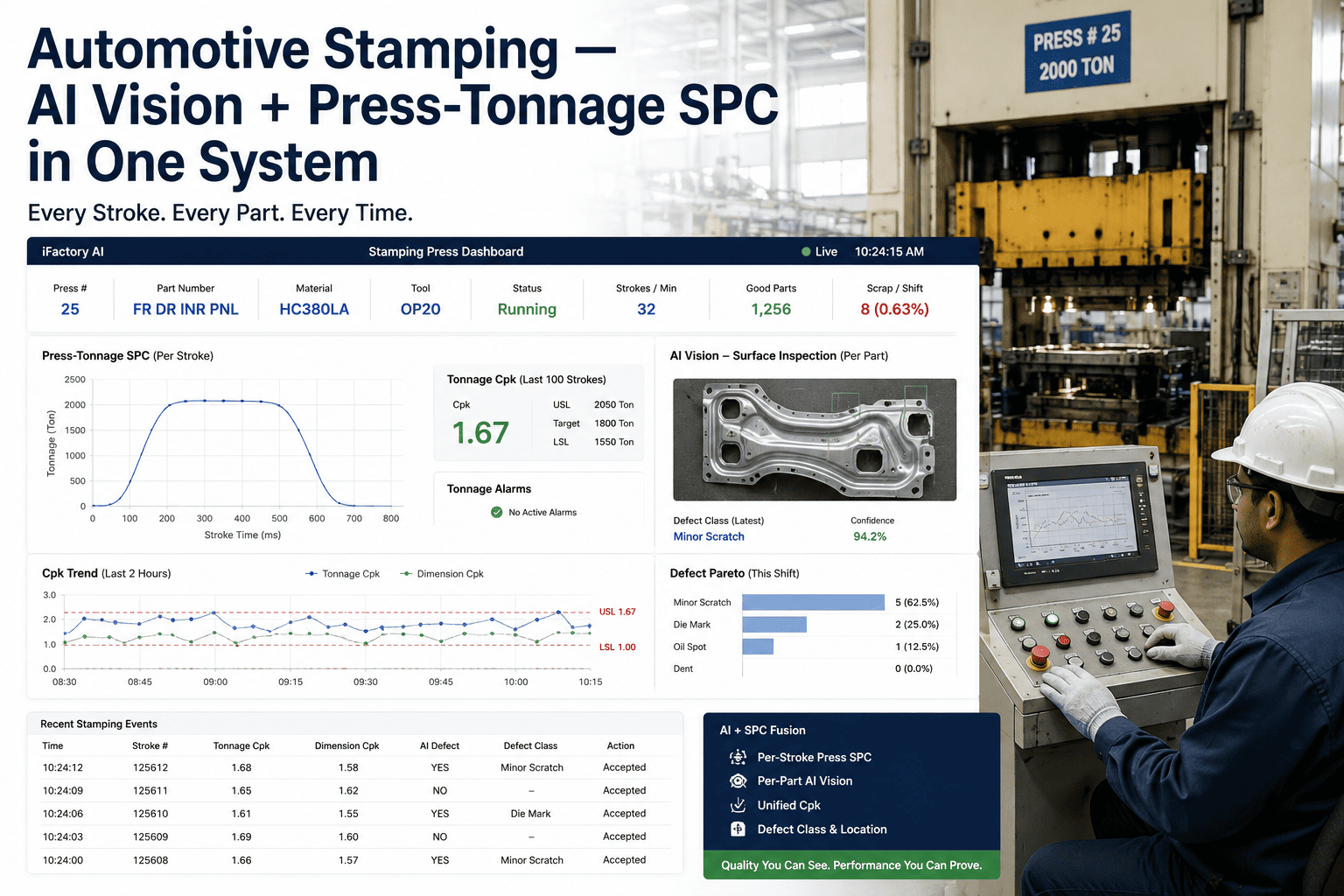
Tonnage monitors record the load curve on every stroke. A changing curve is an early sign of die wear, a material change or a problem with the cushion.
Linking load curves to stroke rate shows how far each die can safely go. We include it in every rollout.
Speed, Heat and Die Life
Pushing stroke rate without watching the tooling trades output today for die repairs later.
Die surface temperature reached after only 10 cycles on galvannealed dual-phase steel in one study, with zinc powdering.
- Heat builds with rate. Less time between hits means less time to cool.
- Lubricant thins. Hotter dies break down the lubricant film sooner.
- Galling and scoring follow. High-strength and coated steels are most at risk.
- Cooling helps. The same study found die cooling reduced scoring.
The practical rule is to raise speed in steps and watch three things at each step: load curve, die temperature and part quality.
Our engineers can help define step tests for your critical dies.
Die Change Time: How Much of the Rate You Keep
Die change does not change cycle time, but it decides how many of those cycles you get in a shift.
| Example | Die change time | Source |
|---|---|---|
| Toyota, 1960s to 1970s | Hours cut to 15 minutes, then 3 minutes | SMED history |
| Older OEM tandem line | More than 20 minutes | Automotive Design and Production |
| FCA Warren servo line | Under 4 minutes | Automotive Design and Production |
| JLR Halewood servo line | Under 5 minutes, against up to 55 on the largest mechanical line | Automotive Manufacturing Solutions |
| Schuler ServoLine | 3 minutes, fully automatic | Schuler |
Illustrative. Shorter changes also allow smaller batches and less inventory.
SMED stands for single-minute exchange of die, meaning a change in under ten minutes. See changeover tracking in a session.
Turning Strokes per Minute Into Parts per Day
Small rate gaps add up quickly across a day.
Illustrative. Each die is compared with its own best sustained run on the same line.
Illustrative. No new equipment, only the rate the die has already run.
At FCA’s Warren plant, a new servo line was reported to add up to 12,000 hits a day. Existing lines hold smaller but real gains in the gap to their own best runs.
Ranking dies by that gap tells the press shop where to start. We can produce the ranking in a working session.
How to Raise Stroke Rate Safely
Raise speed in small steps, with the press, die and part all watched at each step.
Record current SPM, load curve, die temperature and quality.
Identify which factor is holding the rate.
Tune transfer motion or slide profile; change one thing.
Increase by one stroke a minute.
Compare loads, temperature and defects with baseline.
Save the settings as the new standard for that die.
- Rate raised across all dies at once
- No record of loads or temperature
- Problems found as splits or die damage
- Settings differ shift to shift
- Gains lost at the next changeover
- One die at a time, biggest gap first
- Load, heat and quality tracked each step
- Limits found before damage
- Best settings saved per die
- Gains kept run after run
Saved settings per die are what make a gain permanent. Discuss your first dies with our advisors.
Press Cycle Time Checklist
A quick check for any automotive press line.
Most press shops know their SPM but not each die’s best rate. A press review fills that in.
How iFactory Optimizes Press Cycle Time
iFactory records every stroke by die, finds the gap to each die’s best run and shows what is limiting the rate.
SPM for every run, compared with best demonstrated.
Transfer, forming, load or feed identified.
Tonnage and reverse tonnage curves per stroke.
Temperature and load trends linked to repairs.
Die change and first-good-part times.
Best settings stored per die.
It runs on premises and connects to press and transfer controls. Share a week of press data and we will rank your dies in a pilot.
Find the Strokes Your Dies Have Already Proven
Share a month of press line data. We compare every die with its own best run and show which settings are holding the rate down.
Running at 14 strokes a minute against 16 achieved last month on the same die. Transfer dwell at station 2 was lengthened after a mis-feed and never restored.
Two Strokes a Minute Recovered
This is how a press shop manager might use the analysis.
iFactory ships as a pre-configured NVIDIA AI server, racked and ready with the press line analytics models loaded. Rack it, plug in power and Ethernet, and the AI is live. Scope covers data connections across press, body, paint, assembly and machining areas, PLC/SCADA, MES, CMMS and ERP integration, cabling and network setup, team training and 24×7 remote monitoring.
Server installed, PLC, MES and CMMS links live, history loaded.
Models tuned on your own lines, then piloted in one area with your team reviewing every output.
Rollout to the agreed lines, team training done, 24×7 remote monitoring in place.
Software, server and integration come as one package. For pricing, contact our sales team.
Frequently Asked Questions
Automated tandem lines typically run 12–15 strokes per minute. Servo press lines reach 16–23, and large servo transfer presses about 30.
Usually transfer motion, then material forming speed, reverse tonnage, die heat and blank feeding. The slowest of these sets the line rate.
Not the per-stroke cycle. It affects how much running time a shift has, and so daily output. Modern lines change dies in 3–5 minutes.
The snap-through load when material fractures. Guidance is to keep it to about 10–15% of rated tonnage, with 20% cited as an upper limit.
It can. Faster running raises die temperature and reverse loads. Raising speed in steps while watching load, heat and quality protects the tooling.
A first press line is typically live within 6–12 weeks. Plan it with our specialists.
More Parts From the Presses You Have
iFactory compares every die with its best proven rate, shows what is limiting speed and watches press loads and die health while you close the gap.
Illustrative. The gap to each die’s own best run is the fastest capacity to recover.