A dyeing machine failure rarely just stops a line, it usually ruins a batch of fabric that was already partway through a color cycle, and that lost dye lot costs far more than the repair itself. Jet dyeing machines, jiggers, winches, and beam dyeing units each wear differently, and a single vibration alarm tuned for one type means almost nothing on another. Mills running mixed fleets of dyeing equipment often rely on an operator noticing a strange sound or a slow cycle time, long after the wear has already started. Predictive maintenance built around each machine type's real failure pattern catches pump cavitation, nozzle clogging, and heater degradation before a batch is at risk. Teams running a mixed dyeing floor can map their machine fleet with the iFactory AI team before the next color run.
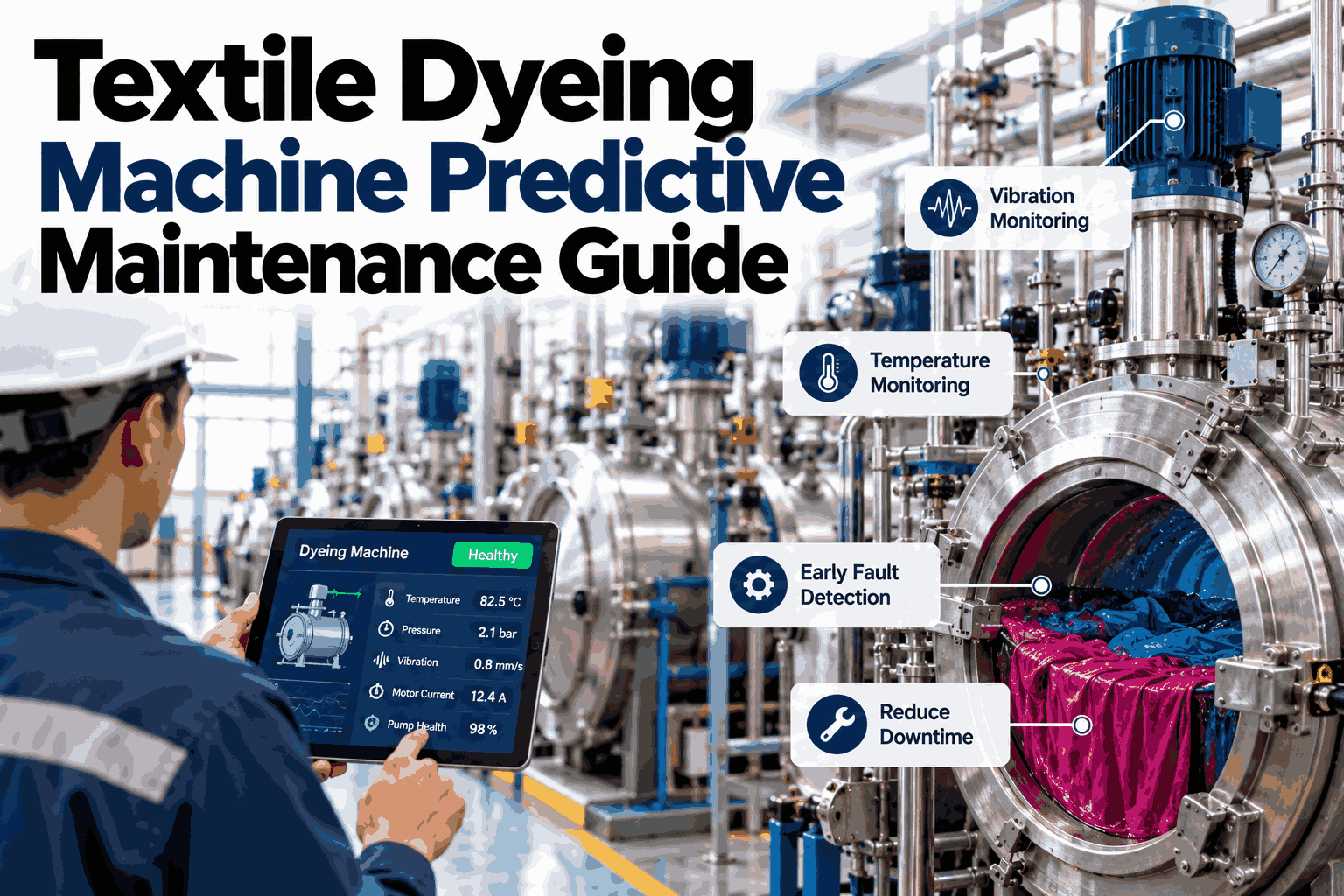
Textile Dyeing Machine Predictive Maintenance Guide
iFactory AI reads pump, heater, and bearing signals across jet, jigger, winch, and beam dyeing machines to flag wear before a batch is at risk.
Why Dyeing Machines Wear Differently
A dyeing machine runs wet, hot, and under chemical load for hours at a stretch, which creates failure patterns that generic vibration monitoring was not built to catch.
Chemical and Thermal Load
Dye liquor, temperature cycling, and chemical exposure degrade seals, valves, and heating elements faster than dry mechanical wear alone.
A Batch Is Already Committed
Unlike a dry process, a dyeing cycle mid-run cannot simply be paused and resumed later without risking shade variation or fabric damage.
Machine Types Fail Differently
A jet machine's circulation pump, a jigger's roller drive, and a beam machine's liquor distribution system each have their own dominant wear path.
A single downtime number across a mixed dyeing floor hides which machine type is actually driving most of the lost batches.
Which Machine Type Is Prone to Which Failure
Fleet-wide monitoring only works once each machine type's dominant failure risks are mapped, rather than treating every unit the same.
A filled dot marks a failure mode that commonly drives downtime on that machine type. An open dot marks one that is comparatively rare there. The exact pattern should be confirmed against your own fleet's maintenance history.
Map Your Dyeing Fleet's Real Failure Pattern
Book a 30-minute session and bring your machine list. iFactory AI will show which units carry the highest risk of a mid-batch stop.
Signals That Catch Wear Before a Batch Is at Risk
Each failure mode has a specific signal that moves well before the machine actually stops, giving a maintenance team a real window to act.
| Component | Leading Signal | Instrument | Typical Lead Time |
|---|---|---|---|
| Circulation Pump | Vibration and flow rate drift | Vibration sensor and flow meter | Days to weeks |
| Spray Nozzles | Pressure drop across the nozzle bank | Differential pressure sensor | Days |
| Heating Elements | Slower heat-up rate per cycle | Temperature ramp logging | Weeks |
| Reel and Roller Bearings | Vibration signature change at running speed | Vibration sensor | Weeks to months |
| Liquor Control Valves | Response lag between command and position | Valve position feedback | Days to weeks |
| Chemical Dosing Pumps | Dosing volume drift from setpoint | Flow totalizer comparison | Days |
Lead time depends on how early thresholds are set, and tighter thresholds trade earlier warning for more alerts a technician has to review.
Rollout Path Across the Dyeing Floor
A mixed fleet is not instrumented all at once. The strongest rollouts move machine type by machine type, proving the model before expanding.
Instrumenting every machine type on day one usually stalls a rollout, since each type needs its own validated threshold before it can be trusted.
A Composite Scenario: Twenty Jet Machines, One Dye Season
A mid-size mill running twenty jet dyeing machines moved its highest-value units onto predictive monitoring ahead of a peak color season. Figures below are an illustrative composite, indexed to a starting point of 100.
The biggest win was not fewer repairs overall, it was catching the ones that would have happened mid-batch during the season's highest-value color runs.
Operator Instinct vs Signal-Based Monitoring
Experienced operators catch a lot by ear and by feel, but that knowledge is hard to scale across shifts and impossible to apply to a machine nobody is standing next to.
Operator Instinct
Signal-Based Monitoring
The strongest floors keep experienced operators reviewing flagged units, pairing their judgment with a signal history they did not have before.
What iFactory AI Adds to Dyeing Floor Maintenance
iFactory AI is smart manufacturing and industrial software that builds a failure model specific to each dyeing machine type, not one generic alarm for the whole floor.
iFactory AI arrives pre-configured on an NVIDIA server that ships racked and ready with software pre-loaded. Rack it, connect power and Ethernet, and machine signals start flowing. Scope covers cabling, network, ERP and MES integration, team training, and 24x7 remote monitoring.
Dyeing Floor Readiness Self-Check
Use these checks to see how ready your dyeing floor is for a predictive maintenance pilot.
Each unchecked box is a place where a batch is still at risk of a mid-cycle surprise.
Frequently Asked Questions
Which dyeing machine type should be instrumented first?
Most mills start with the machine type carrying the highest combination of downtime history and batch value, which is commonly jet dyeing units on mixed floors, though the right starting point depends on your own fleet data. Ask how to rank your own fleet.
Can an alert tell whether a batch is actually at risk?
Yes, alerts are built to flag trend severity against the remaining cycle length, so a planner can see whether a machine can safely finish its current batch or needs attention sooner. See how batch-aware alerts work on your cycles.
Does this work across different machine brands and ages?
Yes, sensors are added to the machine rather than depending on the manufacturer's own control system, which means older equipment can be monitored alongside newer units on the same floor.
How does chemical exposure affect the sensors themselves?
Sensors are selected and mounted for the wet, chemical, and thermal environment of a dyeing floor, and placement is reviewed during the site walkthrough so readings stay reliable over time. Talk through sensor placement for your floor.
How long before the first machine type shows results?
Most pilots move from installation to a validated, live alert within the 6 to 12 week turnkey window, with shadow mode duration depending on how often the machine type naturally fails. Plan a pilot timeline for your floor.
Protect Your Next Dye Batch Before It Starts
iFactory AI builds failure models specific to each dyeing machine type and ties confirmed alerts to work orders. Book a walkthrough using your own fleet list.