Point-to-point integration between manufacturing systems works fine for the first few connections, then quietly becomes a maintenance nightmare as the tenth, twentieth, and thirtieth connection gets added, each one another custom link that has to be maintained separately. Unified Namespace architecture solves this by treating data differently from the start — instead of systems talking directly to each other, every system publishes to and reads from a single, structured namespace organized around how the plant actually operates. Teams looking to move away from brittle point-to-point integration can Book a Demo to see how iFactory implements Unified Namespace architecture using MQTT.
Why Point-to-Point Integration Breaks Down at Scale
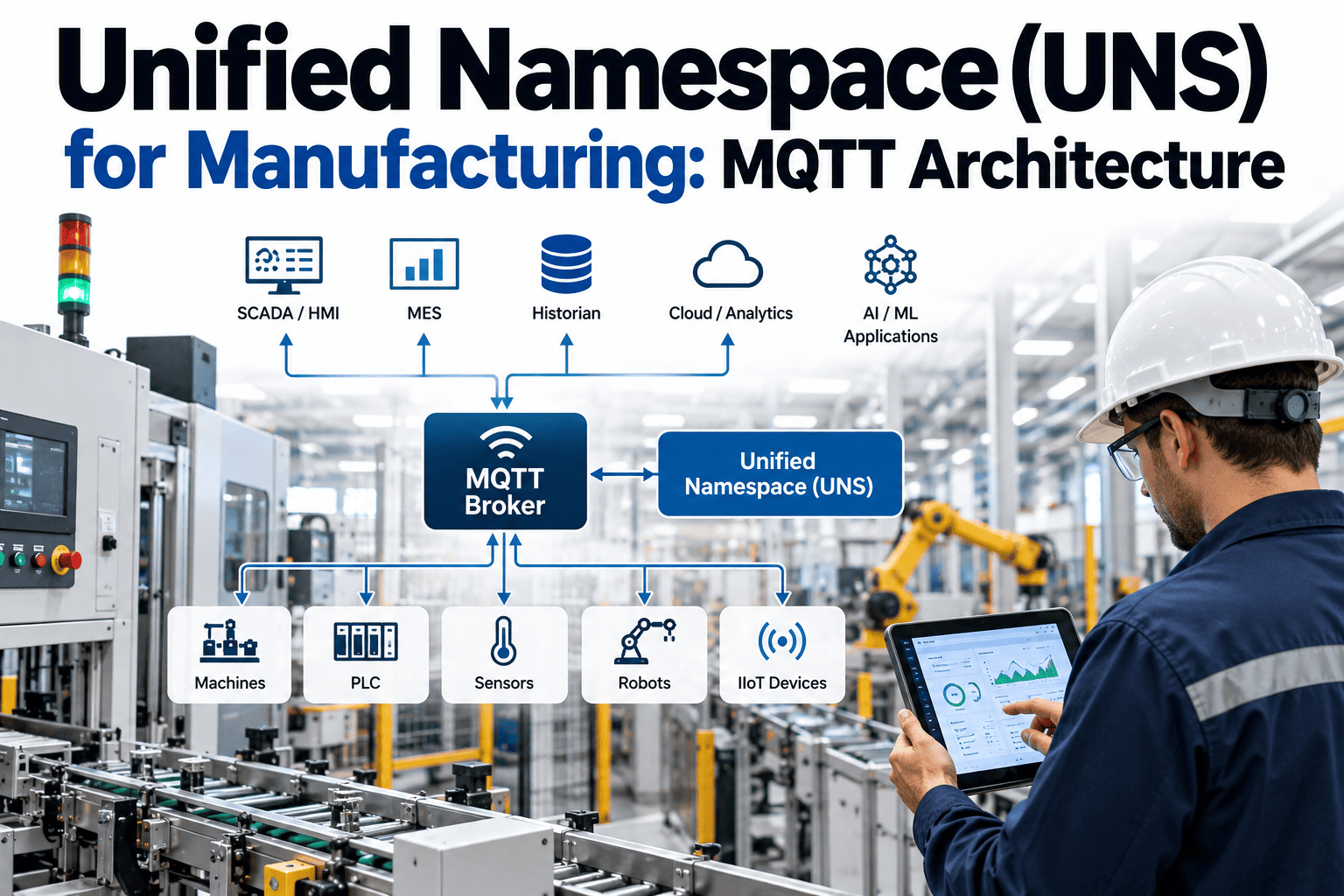
Connecting System A directly to System B is simple. Connecting System A to B, C, and D, while B also connects to C and E, quickly turns into a tangle of custom point-to-point links, each with its own protocol translation, its own failure points, and its own maintenance burden. Adding a new system to this tangle means building yet another set of direct connections to every system it needs to share data with, and the complexity compounds with every addition rather than growing in a straight line. Unified Namespace architecture avoids this entirely by having every system connect to one central broker instead of to each other directly.
The Namespace Hierarchy: Organizing Data the Way the Plant Actually Works
A Unified Namespace organizes data into a topic hierarchy that mirrors the physical and organizational structure of the enterprise, rather than the arbitrary structure of whichever system originally produced the data. This hierarchy typically flows from the broadest organizational level down to the most granular equipment level, giving every piece of data a predictable, logical address that any authorized consumer can subscribe to without needing to know which underlying system originally generated it.
Why MQTT Fits This Architecture Well
MQTT is a lightweight, publish-subscribe messaging protocol originally designed for constrained networks, and its core design principle — publishers send data to a topic without needing to know who's listening, subscribers receive data from a topic without needing to know who published it — is exactly the decoupling that makes Unified Namespace architecture practical. A new consumer of plant data can simply subscribe to the relevant topic and immediately start receiving live updates, without any changes needed to the systems that originally published that data.
| Characteristic | Point-to-Point Integration | MQTT-Based Unified Namespace |
|---|---|---|
| New system onboarding | Requires a custom connection to every existing system it needs data from | Connects once to the broker and immediately accesses relevant topics |
| Data timeliness | Often batch-based or polling-driven | Event-driven, near real-time by design |
| Maintenance complexity | Grows non-linearly as systems are added | Grows linearly since each system connects once to the broker |
Designing a Namespace Structure That Will Actually Hold Up
The value of a Unified Namespace depends heavily on the quality of the hierarchy design decided at the outset, since restructuring a namespace after many systems and consumers have built around it is significantly more disruptive than getting the structure right early. A well-designed hierarchy anticipates how the organization is likely to grow — new sites, new production lines, new equipment types — and builds enough consistent structure to accommodate that growth without requiring a redesign every time something new gets added.
Sparkplug B: Adding Payload Standardization on Top of MQTT
MQTT itself defines how messages move between publishers and subscribers, but it doesn't dictate what those messages actually contain — two systems could both use MQTT correctly and still structure their payloads completely differently. Sparkplug B addresses this gap by defining a standardized payload format and a set of session-state conventions specifically designed for industrial data, including a defined way to signal whether a device is currently online, which plain MQTT doesn't handle natively. Adopting Sparkplug B alongside MQTT gives a Unified Namespace a consistent payload structure in addition to a consistent transport, closing a gap that otherwise has to be solved through custom convention.
Common Pitfalls When Implementing a Unified Namespace
Several recurring mistakes show up across Unified Namespace implementations, and most trace back to underestimating the design discipline the architecture requires up front. Publishing raw, unstructured data into the namespace without a clear naming convention quickly recreates the same inconsistency a unified architecture is meant to solve. Treating the namespace as a one-time project rather than an ongoing standard that every future system addition must follow leads to drift within a year or two. And failing to plan for broker scalability before connecting a large number of high-frequency data sources can create performance problems that are far more disruptive to fix after the fact than to plan for at the outset.
Inconsistent Topic Naming
Publishing data without following the established hierarchy convention recreates fragmentation inside the supposedly unified namespace itself.
Treating the Namespace as a One-Time Project
Without an ongoing governance process, new systems get added inconsistently and the namespace drifts from its original design intent.
Underestimating Broker Load
High-frequency data sources connected without capacity planning can overwhelm a broker sized for a smaller initial deployment.
Frequently Asked Questions: Unified Namespace for Manufacturing
Does implementing a Unified Namespace require replacing existing SCADA or MES systems?
No — existing systems typically connect to the Unified Namespace through an edge gateway or native MQTT client that publishes their data into the appropriate namespace topics, meaning the underlying systems continue operating as they always have while gaining a new, structured way to share their data with the rest of the organization. Teams can Book a Demo to see how existing systems connect into a namespace architecture.
How does a Unified Namespace handle systems that don't natively support MQTT?
Many legacy systems communicate through other industrial protocols entirely, so an edge gateway or protocol converter typically sits between the legacy system and the MQTT broker, translating its native protocol into MQTT messages published to the correct namespace topic without requiring any modification to the legacy system itself.
What happens if the MQTT broker itself goes down — does the whole architecture fail at once?
A single point of failure risk is a legitimate concern with a centralized broker architecture, which is why production deployments typically use a clustered or highly available broker configuration rather than a single instance, along with local buffering at the edge so systems can continue operating and queue their data briefly even during a brief broker interruption.
How much of the namespace hierarchy should be designed upfront versus built incrementally?
The top levels of the hierarchy — enterprise, site, and area — benefit from careful upfront design since they're the hardest to change later without disrupting many downstream consumers, while the lower levels closer to individual equipment can often be extended incrementally as new lines or machines come online, provided they follow the established naming conventions set at the higher levels.
Can a Unified Namespace coexist with some remaining point-to-point integrations during a transition period?
Yes — most organizations transition gradually rather than replacing every integration simultaneously, keeping certain point-to-point connections in place for systems not yet migrated while new integrations and analytics use cases are built against the Unified Namespace from the start, which reduces disruption risk compared to an all-at-once cutover. Contact iFactory Support for guidance on sequencing a gradual migration.