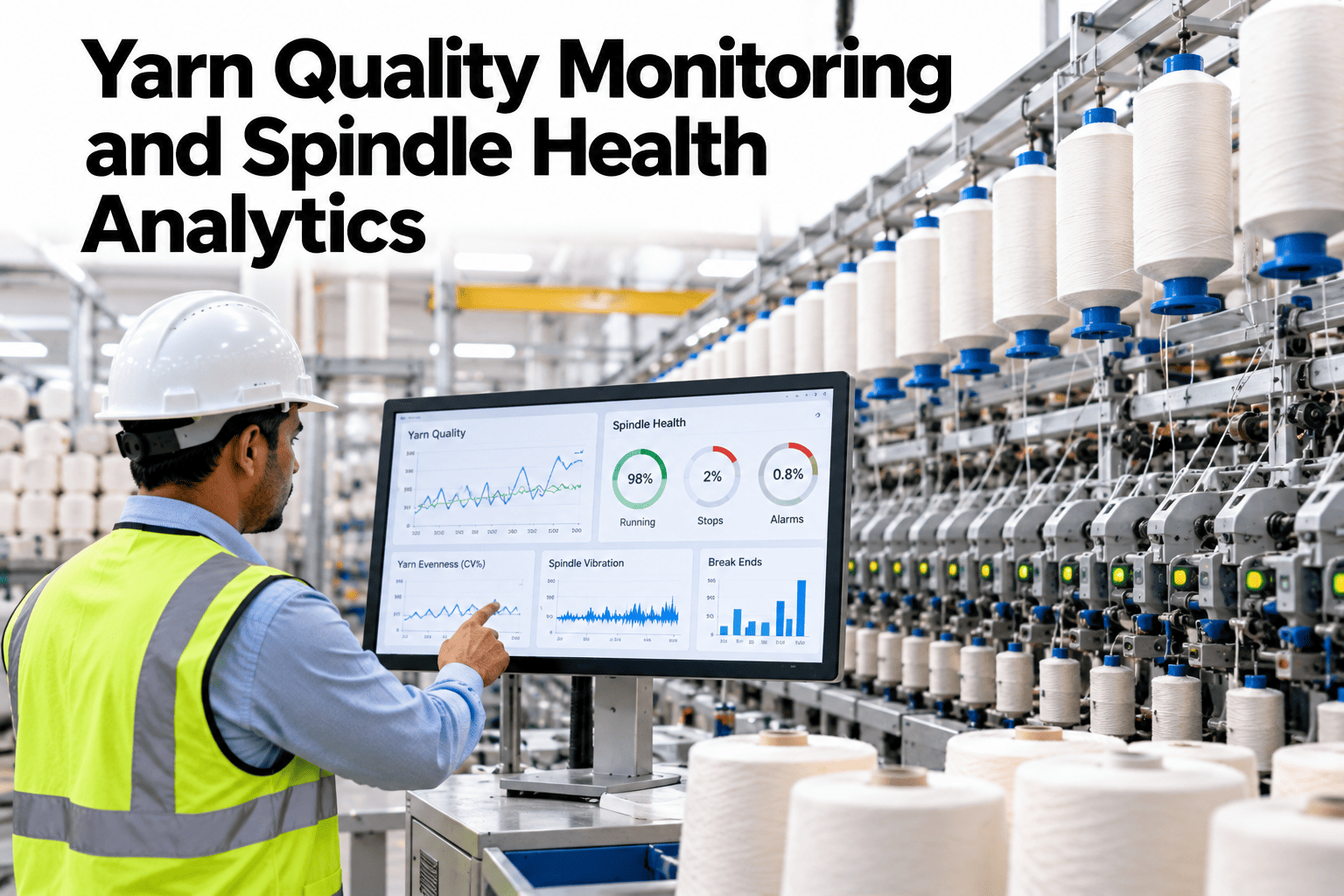
A single end break on a ring frame barely registers as a problem; multiply it across a thousand spindles running continuously and the lost production adds up to a real efficiency drain that most mills still measure the wrong way. A plant-wide break rate hides exactly the information a spinning manager needs: which specific spindles are breaking far more often than the rest, which is usually where the real gain is sitting, not spread evenly across the whole frame. Spindle-level monitoring finds the handful of problem spindles responsible for a disproportionate share of breaks, instead of sending maintenance to recheck an entire frame that is mostly running fine. Spinning managers rethinking this approach can see spindle-level break data identify the actual problem spindles live before the next frame-wide maintenance sweep.
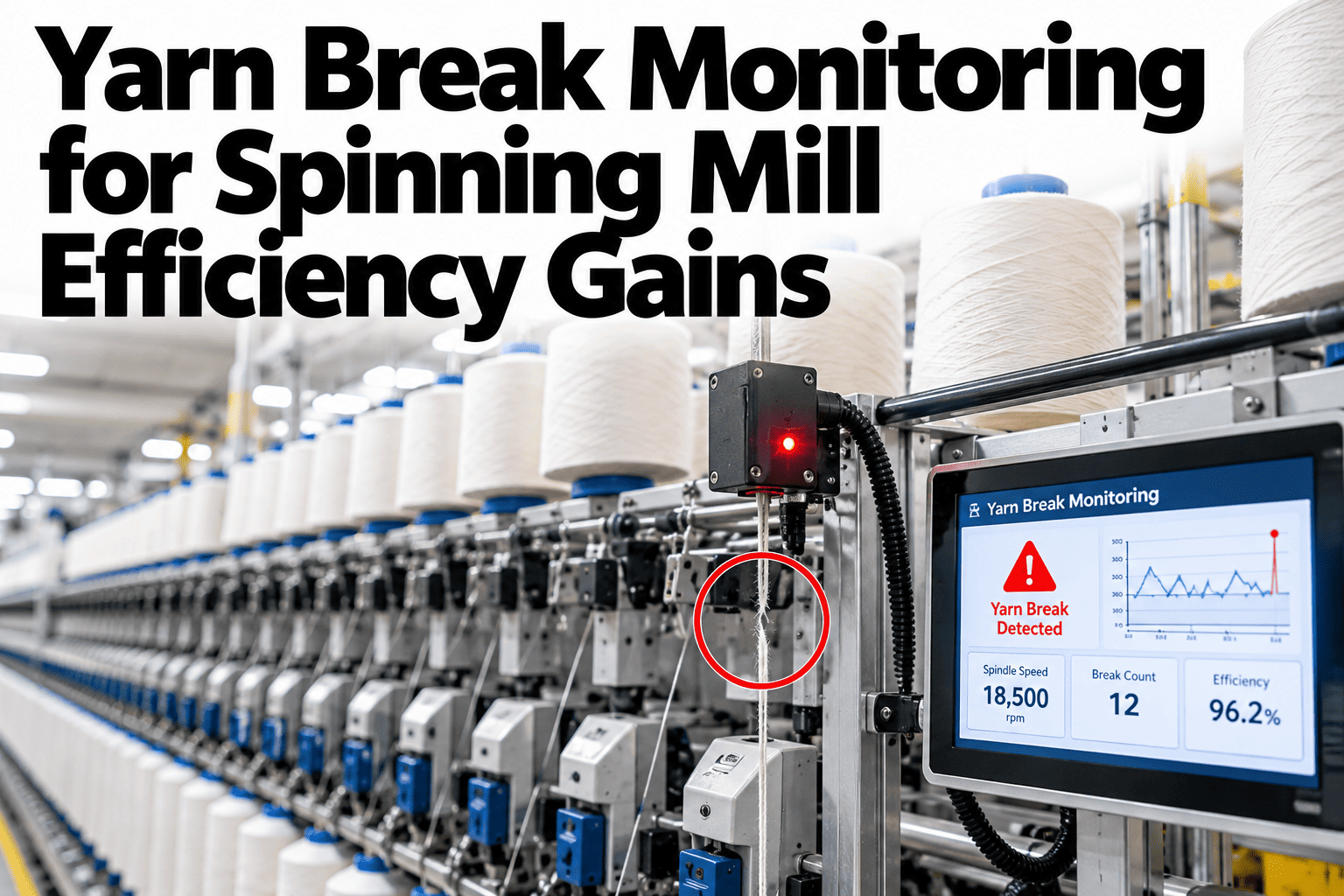
Yarn Break Monitoring for Spinning Mill Efficiency Gains
Problem spindles located individually, instead of a plant-wide break rate that hides where the loss actually sits.
Illustrative frame: break rate isolated to a small number of spindles
Why a Frame-Wide Rate Sends Maintenance to the Wrong Place
A plant-wide or frame-wide break rate treats every spindle as equally likely to be the cause, which is rarely true.
A handful of chronically bad spindles get smoothed into a frame average that looks only mildly elevated.
Maintenance ends up rechecking an entire frame when the issue sits on two or three spindles.
A recurring problem spindle gets treated as a one-off each time, never flagged as a pattern.
Spindle-level data turns a vague "this frame runs a bit high" into a specific, fixable list.
What Spindle-Level Data Reveals
Breaking the rate down to the individual spindle surfaces patterns a frame average cannot show.
| Pattern | What It Usually Indicates |
|---|---|
| One spindle, consistently high | A mechanical issue specific to that spindle position |
| A cluster of adjacent spindles | A shared airflow, humidity or roving condition in that zone |
| Breaks tied to a specific doffing cycle | A tension or winding issue introduced during that stage |
See Which Spindles Are Actually Driving Your Break Rate
Book a 30-minute session and bring your current break log. iFactory AI will show the spindle-level breakdown behind your frame average.
What iFactory AI Supports
Break data is tracked and ranked at the spindle level, continuously, not sampled periodically.
Spindle-Level Tracking
Every spindle's break rate is tracked individually, not blended into a frame average.
Problem Spindle Ranking
Spindles are ranked by break contribution, surfacing the few that matter most.
Pattern Detection
Clustered or cycle-linked break patterns are flagged automatically.
Realization Loss Tracking
Break impact on yarn realization is quantified, not just counted as an event.
iFactory AI connects to existing ring frame monitoring systems. Scope covers data integration, spindle-level model setup, team training and ongoing support.
Expert Review
Mills that move to spindle-level tracking are consistently surprised by how concentrated the break rate actually is. A frame that looks moderately elevated on average often turns out to have the vast majority of its breaks coming from fewer than ten percent of its spindles.
Cluster patterns deserve more attention than single-spindle issues in most mills, since a shared airflow or humidity condition across adjacent spindles can be fixed once and resolve a dozen problem spindles at the same time.
Frequently Asked Questions
Does this require new sensors on every spindle?
Many modern ring frames already have spindle-level break detection built into the frame's own monitoring system, which can be connected to directly. Older frames may need additional sensors to reach spindle-level granularity. Ask about your specific frame's current capability in a working session.
How many breaks does it take before a spindle is flagged as a problem?
The threshold is tuned against the frame's own baseline break distribution rather than a fixed number, since what counts as elevated varies by yarn count and material. Ask support about setting a threshold for your specific products.
Can this distinguish between a spindle issue and a roving quality issue?
Yes, a single consistently high spindle points toward a mechanical cause, while breaks correlated with a specific roving lot across multiple spindles point toward a material issue, and the system surfaces both patterns separately. Request a demo distinguishing the two patterns.
Does this integrate with our existing maintenance scheduling?
A ranked list of problem spindles can feed directly into maintenance scheduling, so technicians target specific positions rather than a general frame inspection. Contact support about connecting to your maintenance workflow.
How long before spindle-level ranking is reliable enough to act on?
Most frames have a reliable ranking within six to nine weeks of continuous data collection, enough to distinguish a genuinely problem spindle from normal statistical variation. Book a session to estimate your own timeline.
Fix the Spindles That Are Actually Driving Your Break Rate
iFactory AI ranks every spindle individually, so maintenance targets the right few, not the whole frame. Book a walkthrough.