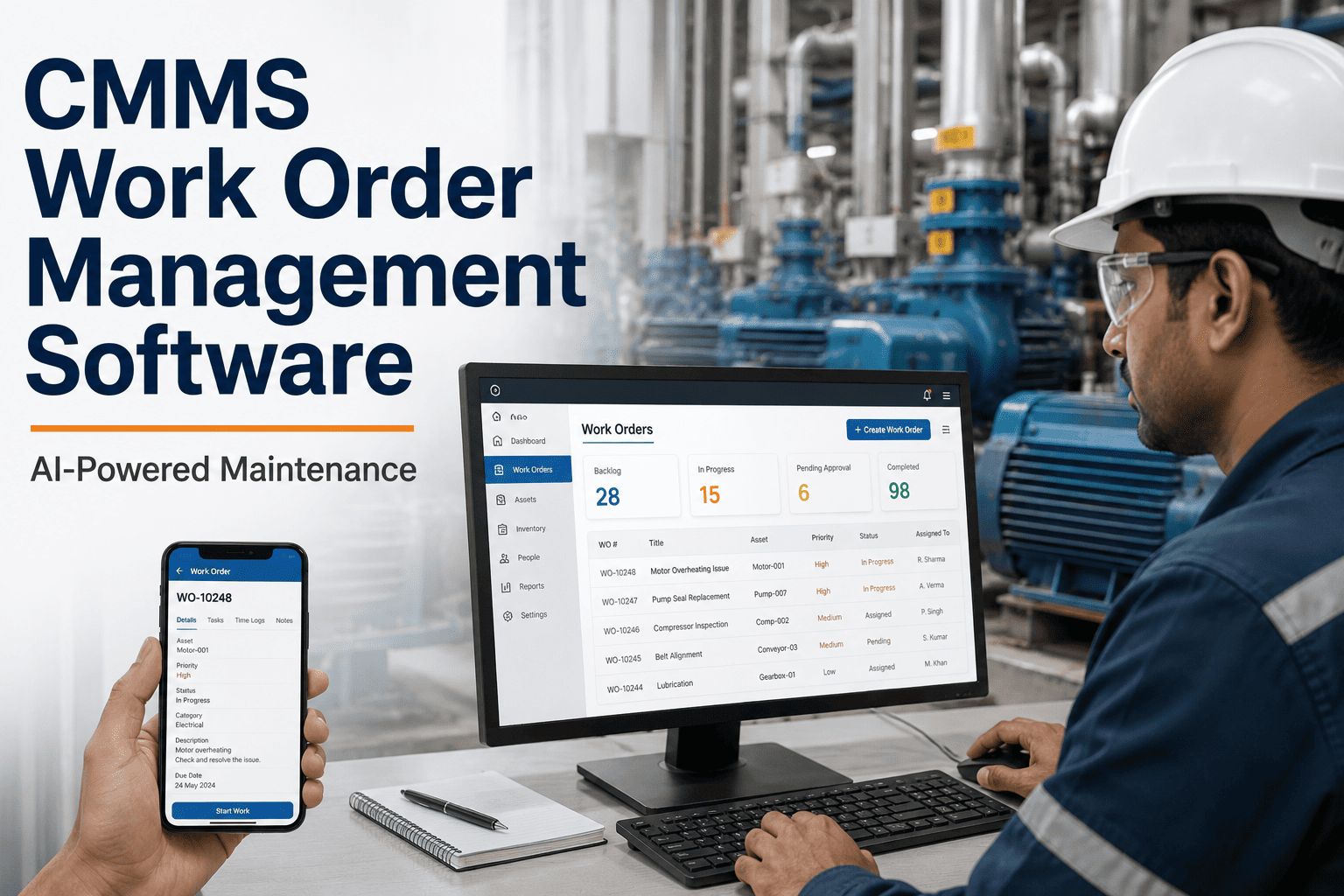
Industry 4.0 and the Government of India's SAMARTH Udyog Bharat 4.0 initiative are jointly reshaping the foundation on which Indian manufacturers manage their assets — and the impact on CMMS adoption is both direct and structural. Industry 4.0, defined by the convergence of IoT, artificial intelligence, machine learning, robotics, and big data analytics, transforms CMMS from a record-keeping system into a predictive intelligence engine: sensors relay live equipment data into the CMMS, AI models interpret that data to forecast failures before they occur, and automated work orders reach technicians before a line stops. SAMARTH — Smart Advanced Manufacturing and Rapid Transformation Hub — is India's government-led programme to make this transformation accessible to every segment of Indian manufacturing, not just large enterprises with dedicated digital budgets. Launched by the Ministry of Heavy Industries under the Scheme for Enhancement of Competitiveness in the Indian Capital Goods Sector, SAMARTH has established four nationwide Industry 4.0 demonstration and development centres — at CMTI Bengaluru, C4i4 Lab Pune, IITD-AIA Foundation IIT Delhi, and CSIR-CMERI Durgapur — that provide MSMEs with hands-on access to smart manufacturing technology, digital maturity assessments, and training in IoT, AI, and connected asset management. For plant managers and reliability engineers evaluating what this policy and technology environment means for their maintenance strategy, the practical question is not whether to modernise — it is how to deploy CMMS intelligently within this accelerating Industry 4.0 context. To see how iFactory's AI Vision Camera accelerates this transition for your specific asset environment, Book a Demo with the iFactory engineering team.
A detailed analysis of how India's Industry 4.0 policy environment and the SAMARTH initiative are driving CMMS evolution — covering predictive maintenance, IoT integration, digital twin deployment, and how iFactory's AI Vision Camera fits into India's smart factory transformation.
What SAMARTH Udyog Bharat 4.0 Actually Does — and Why It Matters for CMMS
SAMARTH Udyog Bharat 4.0 stands for Smart Advanced Manufacturing and Rapid Transformation Hub. It is a Pan-India, demand-driven initiative under the Ministry of Heavy Industries, designed specifically to close the digital maturity gap between India's large enterprises and its vast MSME manufacturing base. The programme recognises that India's competitiveness under Make in India, Atmanirbhar Bharat, and the National Mission on Manufacturing depends not just on building new factories — but on transforming the intelligence level of the existing ones. SAMARTH addresses this through four pillars: awareness programmes that introduce manufacturers to Industry 4.0 concepts, demonstration centres where MSMEs can experience connected smart machines in operation, digital maturity assessments that map each facility's readiness and transformation path, and training programmes in IoT, data analytics, AI, and smart manufacturing practices. The four nationally sanctioned SAMARTH Centres — CMTI Bengaluru, C4i4 Lab Pune, IITD-AIA Foundation IIT Delhi, and CSIR-CMERI Durgapur — operate as technology transfer hubs where Indian manufacturers can see Industry 4.0 working in practice before committing their own capital. The direct implication for CMMS is significant: SAMARTH's Digital Maturity Assessments consistently identify maintenance management as one of the earliest and highest-ROI digitalisation levers available to Indian manufacturers — because CMMS with IoT integration addresses the unplanned downtime problem that limits production output before any other technology intervention is required.
How Industry 4.0 Is Changing What CMMS Must Do
The CMMS that India's manufacturing sector relied on through the 2010s was fundamentally a scheduling and record-keeping tool: maintenance teams logged work orders, tracked spare parts inventory, and documented completed tasks. Industry 4.0 has rendered this model structurally insufficient. When IoT sensors on motors, conveyors, compressors, and pumps stream live telemetry data continuously, a CMMS that waits for a technician to enter a reading is already operating at a fraction of its potential. The Industry 4.0-era CMMS is a real-time intelligence platform: IoT devices relay equipment health data directly into the CMMS, AI models detect anomalous vibration signatures, thermal trends, and current draw patterns before any threshold alarm fires, and the system automatically generates a prioritised work order with failure mode classification and corrective action recommendation before the degradation compounds into a failure event. Research across IoT-integrated CMMS deployments confirms the performance gap: facilities combining IoT condition monitoring with AI-driven CMMS achieve up to 97% equipment uptime while reducing maintenance costs by 25 to 30%, compared to the reactive and calendar-based maintenance approaches that characterised pre-Industry-4.0 operations.
In an Industry 4.0 CMMS, vibration sensors, temperature probes, current transducers, and pressure transmitters feed equipment health data directly into the maintenance management platform in real time — eliminating the manual rounds and paper logs that created a 6 to 12 hour detection lag in conventional systems. SAMARTH's demonstration centres use interconnected smart machinery to show Indian manufacturers exactly how this data flow works before they deploy it in their own facilities.
Industry 4.0 CMMS platforms use machine learning models trained on historical failure data to predict when a specific asset will require intervention — replacing fixed-interval preventive maintenance schedules that either service healthy assets unnecessarily or miss deteriorating ones entirely. Condition-based maintenance driven by AI analytics reduces unnecessary maintenance labour by 25 to 35% while simultaneously preventing the unplanned failures that reactive schedules cannot catch. Book a Demo to see how iFactory's AI Vision Camera delivers continuous condition data for exactly this model.
An IoT-connected CMMS can automatically schedule and assign maintenance tasks the instant sensor data suggests a potential malfunction — without human oversight triggering the process. Work orders are pre-populated with asset ID, failure mode, severity classification, recommended corrective action, and component parts reference, reaching the assigned technician's mobile device before the issue escalates further. This eliminates the risk of human oversight and prevents small issues from compounding into major production-halting events.
Industry 4.0 CMMS platforms increasingly integrate with digital twin models — live virtual replicas of physical assets that mirror real-time sensor data. SAMARTH's CMTI Bengaluru and IIT Delhi centres have established cyber-physical labs specifically to demonstrate digital twin capabilities to Indian manufacturers. For maintenance management, digital twins enable failure scenario simulation, capital planning optimisation, and remaining useful life projection that static maintenance records cannot support.
A core Industry 4.0 principle is the convergence of Operational Technology (OT) — PLCs, SCADA systems, machine controllers — with Information Technology (IT) enterprise systems like ERP and MES. An Industry 4.0 CMMS serves as the bridge between these layers, ensuring that every AI-generated predictive work order flows into SAP PM, Oracle EAM, or equivalent enterprise systems with full data traceability — removing the manual translation layer that historically caused maintenance data quality to degrade at the IT-OT boundary.
SAMARTH's Impact on CMMS Adoption Across Indian Industry Segments
The SAMARTH initiative's practical impact on CMMS adoption varies by industry segment, reflecting the different entry points and ROI drivers each sector faces. CMTI Bengaluru has developed advanced smart machines for the laser and foundry sectors for MSMEs across Gujarat, providing direct demonstration of how sensor-integrated CMMS manages precision equipment health in small-batch production environments. C4i4 Lab Pune has conducted Digital Maturity Assessments for multiple MSMEs, generating tailored Industry 4.0 transformation plans where maintenance digitalisation consistently appears among the top three priority interventions. The 10 Industry 4.0 Experience Centres being established across India under the Hub-and-Spoke model by C4i4 Lab will extend this assessment and demonstration capability to Tier II and III manufacturing clusters where CMMS adoption rates remain significantly below Tier I city levels. IIT Delhi's cyber-physical labs at Hauz Khas and Sonipat are advancing digital twin and connected maintenance research that directly informs how next-generation CMMS platforms should process multi-sensor data streams for Indian equipment types and operating conditions. The table below maps SAMARTH's influence against the specific CMMS adoption shifts occurring across India's key manufacturing sectors in 2026.
| Sector | SAMARTH Influence | CMMS Shift Driven | Key Outcome |
|---|---|---|---|
| Automotive & Auto-Components | C4i4 Pune digital maturity assessments; OEM qualification documentation | Reactive PM to AI-driven condition-based maintenance; full OEE integration | PLI production target protection; OEM audit readiness |
| Capital Goods & Engineering | CMTI Bengaluru smart machine development; laser and foundry sector programmes | Manual maintenance logs to IoT sensor-integrated CMMS; predictive work order generation | Unplanned downtime reduction; asset lifespan extension |
| MSMEs (Cross-Sector) | 10 Hub-and-Spoke I4.0 Experience Centres; Digital Maturity Assessments | Paper-based PM schedules to cloud-based CMMS with mobile technician workflows | Maintenance cost reduction 25–30%; Champion MSME qualification evidence |
| Pharmaceuticals & Chemicals | SAMARTH training in IoT and data analytics for regulated manufacturing | Compliance-only CMMS to AI CMMS with automated GMP maintenance documentation | Batch-level maintenance traceability; audit-ready records without manual aggregation |
| Energy & Utilities | CSIR-CMERI Durgapur infrastructure asset management programmes | Calendar-based grid maintenance to condition-based monitoring with predictive alerts | Grid asset uptime improvement; outage prevention for expanding power infrastructure |
How iFactory's AI Vision Camera Fits Into India's Industry 4.0 CMMS Architecture
The most significant practical limitation of CMMS deployments across Indian manufacturing — identified consistently in SAMARTH Digital Maturity Assessments — is equipment condition data quality. Work orders and maintenance logs are only as current as the last manual inspection round or the last sensor reading, and most Indian factories still have large portions of their machinery base without any condition monitoring in place. iFactory's AI Vision Camera resolves this gap by delivering continuous, vision-based equipment health monitoring that feeds CMMS work order queues with real-time condition data — without requiring any modification to the monitored equipment. The camera deploys against any asset regardless of age, vintage, or original connectivity, establishing a visual and thermal baseline within two to four weeks of installation. When the AI model detects a deviation — abnormal motion patterns, thermal hotspots, visual deterioration, or mechanical misalignment signatures — it automatically generates a prioritised CMMS work order pre-populated with asset ID, failure mode, severity score, and recommended corrective action. This closes the Industry 4.0 data loop that SAMARTH's demonstration centres illustrate in theory: sensor intelligence flows into the CMMS, the CMMS generates a work order, the technician executes the intervention, and the outcome is captured back into the model — continuously improving prediction accuracy over time. Facilities completing this deployment through iFactory's five-week programme are building exactly the 12 to 18 months of quality CMMS data that analysts identify as the prerequisite for reliable AI predictive maintenance. Book a Demo and receive a site-specific deployment assessment aligned to your Industry 4.0 readiness level.
iFactory AI Vision Cameras establish a visual and thermal baseline for every monitored asset without equipment modification or production shutdown. Anomaly detection runs at sub-second resolution, identifying degradation patterns weeks before any SCADA threshold would fire — delivering the continuous condition data that Industry 4.0 CMMS architectures require but that Indian manufacturing's aging machinery base has historically lacked.
Every anomaly detection automatically triggers a CMMS work order pre-populated with asset ID, failure classification, severity rating, recommended corrective action, and component parts reference — reaching the assigned technician's mobile device without any manual dispatcher involvement. This removes the data entry lag that degrades CMMS data quality over time and ensures the maintenance record accurately reflects when the degradation was detected, not when it was manually logged.
iFactory integrates with existing PLCs and SCADA systems via OPC-UA and Modbus protocols, and connects to SAP PM and enterprise EAM systems for closed-loop work order management. This OT-IT integration is the core Industry 4.0 architectural principle that SAMARTH demonstration centres illustrate in their cyber-physical labs — and iFactory delivers it without infrastructure replacement, connecting to the systems already present on the production floor.
iFactory continuously generates audit-ready maintenance records linked to production batch IDs, asset serial numbers, and timestamped visual evidence — satisfying PLI audit verification, OEM qualification documentation, ISO 50001 Energy Performance Indicator requirements, and ESG reporting frameworks without any manual aggregation. For facilities operating under SAMARTH's digital transformation pathway, this automated compliance posture is one of the measurable outcomes that demonstrates industrial competitiveness improvement. Book a Demo to see the compliance documentation layer in a live production environment.
What iFactory Delivers Inside India's Industry 4.0 CMMS Architecture
iFactory's AI Vision Camera and CMMS integration platform is built for the operational realities of Indian manufacturing — deployable in five weeks, operational without infrastructure overhaul, and generating continuous condition data from week one of baseline learning.
From camera installation to full CMMS integration and live predictive dashboard — no equipment modification required.
ML models trained on your specific equipment fingerprints deliver validated anomaly detection accuracy against your asset base.
Condition-based scheduling replaces fixed-interval PM rounds, reducing unnecessary maintenance labour while preventing unplanned failures.
All PLI audit records, ISO 50001 dashboards, and ESG compliance documentation auto-generated without manual aggregation.
Frequently Asked Questions
iFactory connects to your factory through existing cameras and PLCs — no infrastructure replacement, no equipment modification, live in five weeks with continuous condition monitoring from day one.