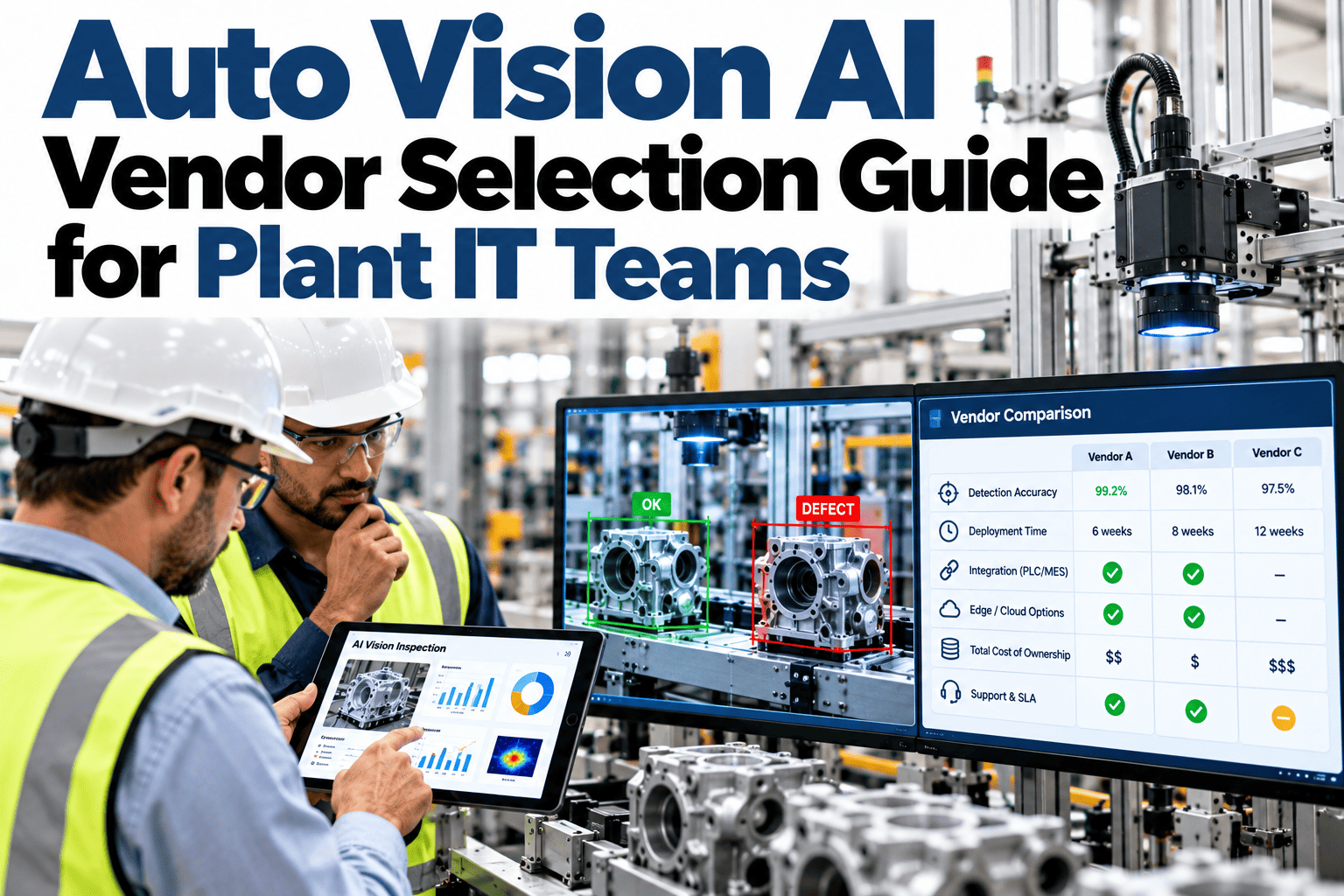
Plant IT teams evaluating vision AI vendors usually start with a demo and a defect-accuracy claim, and that is exactly where the real questions get skipped. Accuracy on a vendor's own demo footage says little about whether the model can be retrained in-house, whether it runs on-premises if a contract requires it, or whether it will talk to the OEM systems already running the plant. Those three gaps are the ones that surface eighteen months in, usually after the contract is signed and switching costs have climbed. A proper vendor shortlist checks model portability, deployment flexibility and integration ecosystem before price ever enters the conversation. IT teams building a shortlist can walk through iFactory AI's portability and integration answers directly before ranking vendors.
Auto Vision AI Vendor Selection Guide for Plant IT Teams
Model portability, on-prem vs SaaS, and OEM-integration ecosystem mapped for a real vendor shortlist.
Where Vendor Shortlists Usually Go Wrong
A demo-first evaluation tends to miss three questions that matter far more over a multi-year contract.
Can the trained model and its data be exported if the plant switches vendors later?
Does the platform run on-prem if an OEM contract restricts cloud processing?
Does it connect to the MES, ERP and quality systems already running the plant?
None of these show up in a standard demo. They show up when the contract is already signed and the plant is locked into one vendor's way of doing things.
Model Portability: Questions to Ask Every Vendor
Portability determines whether switching vendors later is a project or a crisis.
Score a Current Vendor Against This Checklist
Book a 30-minute session and bring your shortlist. iFactory AI's team will walk through each criterion with you directly.
On-Prem vs SaaS: Matching Deployment to Contract Terms
Use this table to check which deployment model satisfies OEM data residency and uptime requirements.
| Requirement | On-Prem Fit | SaaS Fit |
|---|---|---|
| OEM data residency clause | Strong fit | Needs contract review |
| Fast multi-plant rollout | Slower per site | Strong fit |
| Offline line continuity | Strong fit | Needs local fallback |
| Centralized model updates | Needs manual push | Strong fit |
What iFactory AI Supports
iFactory AI is built to answer the portability, deployment and integration questions directly, not around them.
Exportable Models and Data
Trained models and labeled data remain exportable, with a documented export process.
On-Prem and Hybrid Options
Deployment can run fully on-site, fully cloud, or split by station as requirements demand.
MES and ERP Connectors
Pre-built connectors link quality data to the systems already running the plant floor.
OEM-Aligned Reporting
Quality records export in formats common OEM quality portals already accept.
iFactory AI ships on a pre-configured NVIDIA server, racked and ready with software pre-loaded. Scope covers MES and ERP integration, deployment model setup, team training and 24x7 remote monitoring.
Expert Review
The vendor questions plant IT teams skip are almost always the ones that matter most at renewal time. Portability and data ownership rarely come up in a sales conversation, yet they decide how much leverage a plant has two years into a contract.
On-prem versus SaaS is not really a technology debate; it is a contract-terms debate first. Checking OEM data residency clauses before evaluating any platform's accuracy claims saves teams from shortlisting vendors that were never going to be compliant.
Frequently Asked Questions
What does model portability actually cost if we need it?
A documented export process typically has no extra cost if it was built into the contract from the start, but can be expensive or impossible to negotiate after the fact. This is why portability terms should be checked before signing, not after a vendor relationship sours. Ask about export terms directly in a live session.
Can one plant run on-prem while another on the same contract runs SaaS?
Yes, a hybrid contract structure lets different plants or even different stations within a plant run the deployment model that fits their specific OEM or network requirements. This is common for groups with plants under different OEM contracts. Ask support about hybrid contract structures for a multi-plant group.
How long does MES or ERP integration usually take?
A pre-built connector to a common MES or ERP platform typically takes a few weeks to configure and validate, while a custom integration to a legacy or in-house system can take longer. Asking for a vendor's list of existing connectors early narrows the shortlist quickly. Request a connector list for your current systems.
Should we weight portability higher than accuracy in a shortlist?
Both matter, but accuracy differences between credible vendors are usually small while portability differences can be enormous over a multi-year contract. A useful approach is to set a minimum accuracy bar all finalists must clear, then differentiate on portability, deployment flexibility and integration. Contact support for a sample scoring template.
What happens to historical defect data if we switch vendors?
If the contract includes a documented export process, historical defect records, images and labels can move to the new vendor or an internal archive. Without that clause, this data is often difficult or impossible to retrieve, which is one of the strongest arguments for checking portability early. Book a session on data export terms before finalizing a contract.
Shortlist Vendors on Terms That Still Matter in Year Three
iFactory AI answers the portability, deployment and integration questions directly. Book a walkthrough against your own checklist.