A customer complaint lands on a Tuesday afternoon and the clock on an 8D response has already started ticking. Somewhere between forming the team, containing the problem, and actually finding the root cause, most of that clock gets eaten by searching for the right batch records, chasing down the operator who ran the line that day, and reformatting the same fishbone diagram for the fifth time this quarter. None of that is root cause analysis, it is administrative drag on a process that is supposed to be fast precisely because a customer is waiting on an answer. AI-assisted 8D work does not replace the investigation, it removes the drag around it, pulling relevant production data automatically and keeping the report timeline visible so nothing quietly slips past a due date, which is why quality teams are asking to see this 8D workflow before their next complaint arrives.
AI-ASSISTED 8D PROBLEM SOLVING
Move From Complaint to Verified Root Cause Faster
Automate the data pull, timeline tracking, and report structure around your 8D process while your team focuses on the actual root cause investigation.
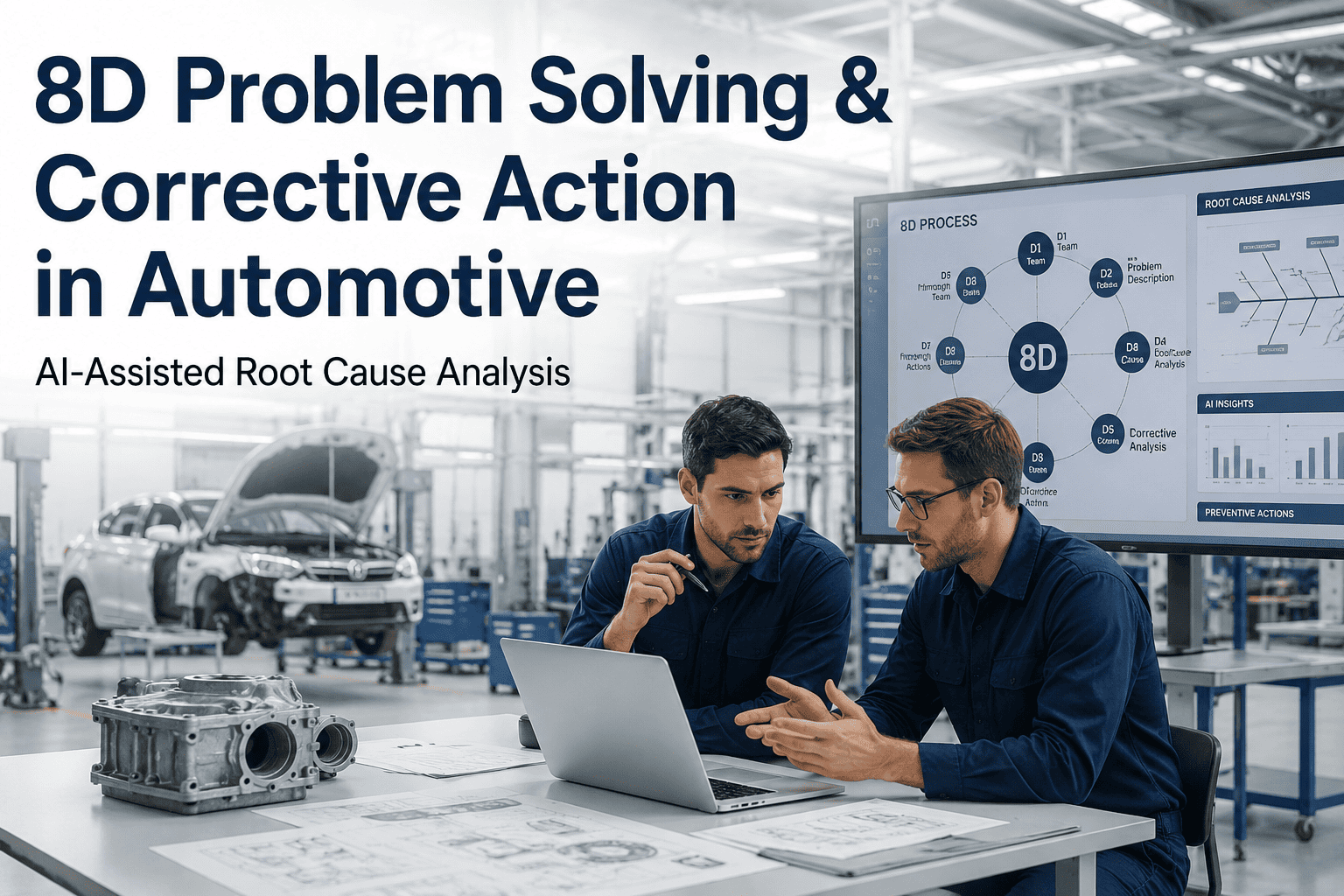
Eight Disciplines, One Connected Timeline
Each discipline stays linked to the ones before and after it, so a change made during root cause analysis automatically flags any containment action that may need to be revisited.
D1
Form the Cross-Functional Team
Team members are assigned based on the affected process and part, with ownership visible to everyone from the first day of the investigation.
D2
Describe the Problem
Batch records, inspection data, and complaint details are pulled together automatically to build a fact-based problem statement instead of a guess.
D3
Implement Interim Containment
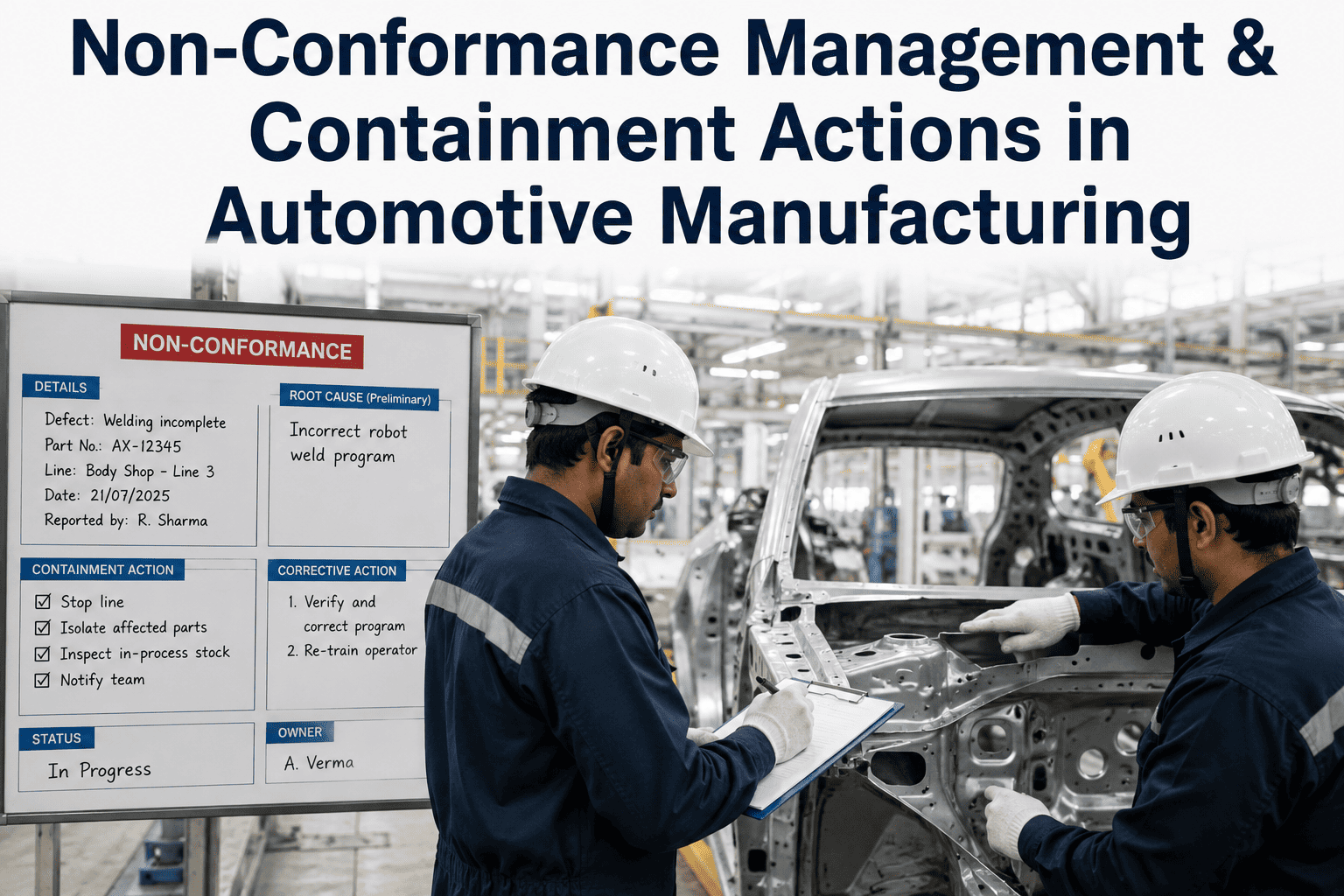
Containment actions are logged with an owner and a verification step, protecting the customer while the deeper investigation continues underneath.
D4
Identify Root Cause
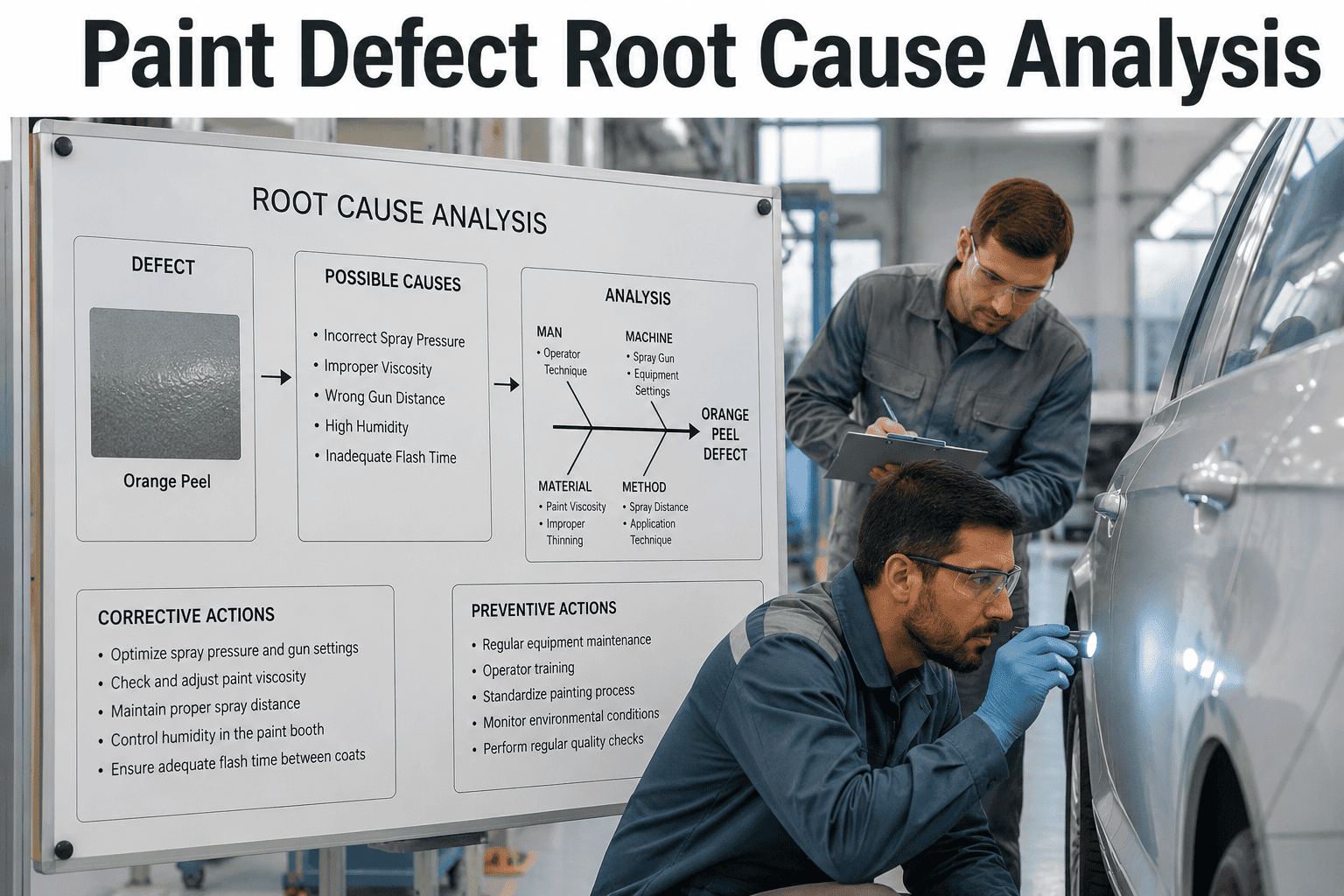
Fishbone and 5 Whys analysis are built directly against the relevant production data, cutting down the time spent reconstructing what actually happened.
D5-D6
Verify and Implement Permanent Corrective Action
Corrective actions are tested against the confirmed root cause before rollout, with containment actions only released once verification is complete.
D7-D8
Prevent Recurrence and Close the Report
Lessons learned update the relevant FMEA and control plan automatically, so the same failure mode does not resurface on a different program later.
Manual 8D Reporting vs AI-Assisted Investigation
| Step |
Manual Process |
AI-Assisted Process |
| Problem Description |
Manually gathered from multiple systems |
Auto-compiled from linked production data |
| Timeline Tracking |
Tracked in a spreadsheet or email thread |
Live status against customer deadline |
| Root Cause Documentation |
Rebuilt from scratch each time |
Structured template with data attached |
| Recurrence Prevention |
Depends on manual FMEA follow-up |
Linked update pushed to FMEA and control plan |
See an 8D Report Assembled From Your Own Data
Bring a recent complaint and see how much of the report structure and data pull can be automated end to end.
Where the Time Savings Actually Show Up
Faster Containment Sign-Off
Containment actions move from proposal to verified status faster when the supporting data is already attached to the report.
Fewer Repeat Complaints
Connecting D7 prevention steps directly to FMEA updates closes the loop that most manual 8D processes leave open.
Consistent Report Quality
Every 8D follows the same structured template regardless of which engineer is leading the investigation that week.
On-Time Customer Response
Deadline tracking against customer-specific timing requirements reduces the number of late or incomplete submissions.
Frequently Asked Questions
Does AI-assisted 8D replace the cross-functional team's investigation work?
No, the team still performs the actual root cause investigation, evaluates evidence, and makes the engineering judgment calls that a complex failure requires. What changes is how much time is spent assembling supporting data and formatting the report, since batch records, inspection results, and prior related complaints are pulled together automatically instead of requested one system at a time. Teams can review exactly what data sources connect to their process during a
walkthrough session.
How does the system distinguish between the root cause of the problem and the root cause of the escape?
Both are tracked as separate fields within the D4 discipline, since a defect and the reason it was not caught by existing controls are two different questions that require two different corrective actions. Keeping them distinct prevents the common mistake of fixing why a defect occurred while leaving the detection gap that let it reach the customer completely unaddressed, which is one of the most frequent findings in a repeat 8D review.
Can containment actions be tracked separately from the permanent corrective action?
Yes, D3 containment actions are logged and tracked independently from the D5 and D6 permanent corrective actions, including their own verification step and a defined release condition once the permanent fix is confirmed. This separation matters because containment is meant to protect the customer immediately, while the permanent fix often takes longer to verify, and conflating the two timelines is a common source of confusion in manual 8D tracking.
How are 8D deadlines tracked against different customer-specific requirements?
Customer-specific response timing, such as an initial response within 24 hours or a full report within a set number of days, is configured per customer so the countdown reflects the actual contractual requirement rather than a single default timeline. This is particularly useful for suppliers responding to multiple OEMs at once, where missing one customer's specific deadline format can affect the supplier scorecard even if the investigation itself was thorough. Specific customer timing setups can be reviewed through
support.
Does closing an 8D automatically update the related FMEA?
Yes, once a root cause is confirmed and a permanent corrective action is verified, the relevant occurrence and detection ratings in the associated FMEA can be updated to reflect the real-world data gathered during the investigation. This keeps the FMEA a living document that reflects actual field and line performance rather than a static file created once during APQP and rarely revisited afterward.
STOP LETTING REPORT DRAG EAT YOUR RESPONSE WINDOW
Bring Structure and Speed to Your 8D Process
Get an 8D workflow built around your customer response timelines and existing quality data.