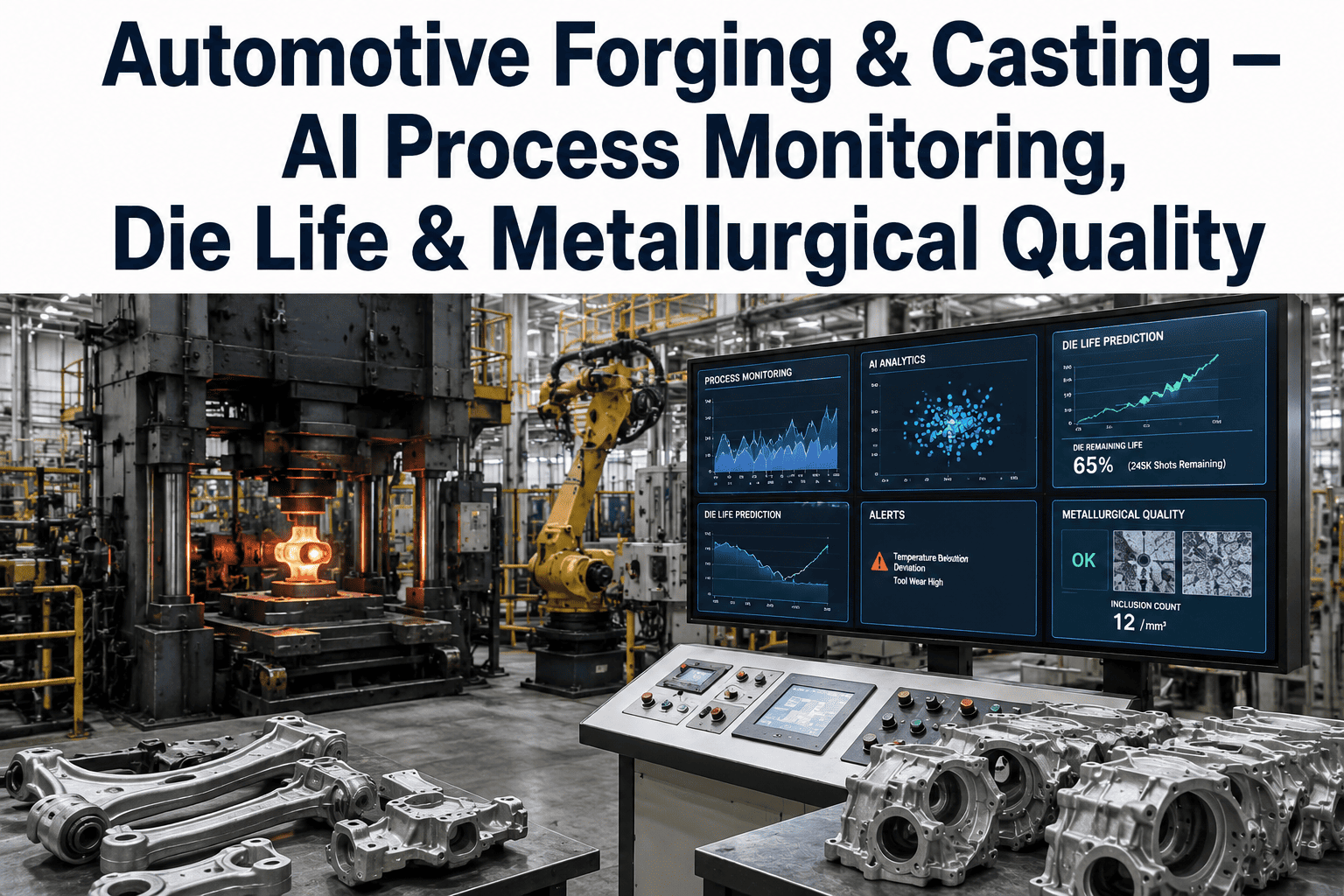
A casting defect and a forging defect don't look the same, don't originate the same way, and don't get caught by the same inspection method — which is exactly the problem for a process engineer running both processes under one roof. Porosity hides inside an aluminum casting until an x-ray or CT scan reveals it. A forging die losing its edge shows up gradually, as a slow drift in part dimensions that's easy to miss until a batch fails final tolerance. Both failure modes are expensive precisely because they're invisible until measured. This piece breaks down where forging and casting quality actually gets decided, what the EV lightweighting shift is doing to demand for both processes, and how AI process monitoring closes the gap between a die or press event and the defect it eventually produces. A short walkthrough shows how it applies to your own process mix.
Automotive Forging & Casting
Predicting Die Wear and Porosity Before They Become Scrap
Press force drift and mold-fill turbulence both leave a trail before they show up as a defect. See how AI process monitoring catches it early.
EV Lightweighting Is Reshaping Demand for Both Processes
The global automotive casting market is valued at roughly $87.99 billion in 2026 and projected to reach $150.06 billion by 2034, growing at a 6.9% compound annual rate, with electric vehicle adoption cited as the primary driver behind that growth. Total aluminum content in North American light vehicles is on track to reach 514 pounds per vehicle in 2026, a 12% increase from 2020 levels, as automakers chase every available gram of weight savings — a documented 10% reduction in overall vehicle weight can extend an EV's range by roughly 5 to 8%. That demand doesn't flow entirely to one process. Forging holds a structural advantage for fatigue-critical, load-bearing components since forged parts carry no internal porosity by nature of the process, while die casting wins on complex, thin-walled geometries at high volume, particularly for battery housings and motor enclosures where design freedom matters more than fatigue life.
$87.99B
global automotive casting market size in 2026
6.9%
CAGR for automotive casting through 2034
514 lbs
average aluminum content per light vehicle in North America, 2026
5-8%
EV range gain per 10% reduction in vehicle weight
Two Processes, Two Distinct Defect Signatures
Casting and forging fail in fundamentally different ways, and treating them under one generic "metallurgical quality" umbrella tends to miss the specific mechanism each one needs monitored.
Casting: Porosity Is the Central Risk
Gas porosity — smooth, spherical voids from trapped air, die-lubricant steam, or dissolved hydrogen, worsened by high injection speeds and turbulent mold filling.
Shrinkage porosity — jagged, sponge-like voids where molten metal solidifies without adequate feed metal, typically in thick sections, bosses, and ribs far from the gate.
Detection method — x-ray NDT and CT scanning against standards such as ASTM E505, since porosity is invisible from the surface.
Forging: Die Wear Is the Central Risk
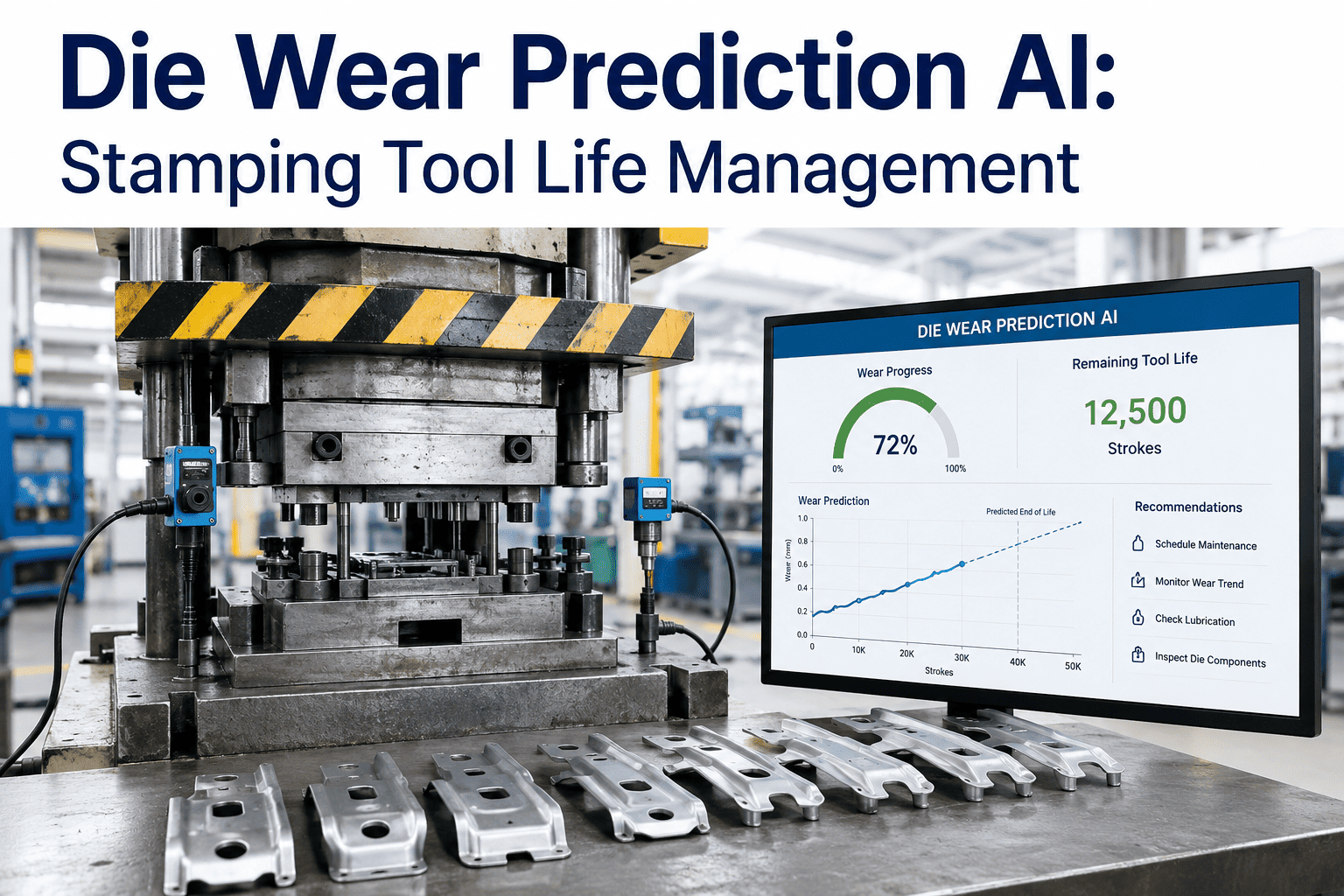
Die wear — gradual dimensional drift as the die surface degrades under repeated press cycles, often invisible until parts fail tolerance.
Press force variation — inconsistent forging force produces incomplete fill or flash variation that affects fatigue strength.
Detection method — dimensional CMM sampling and press-force logging, since forging's key advantage is the absence of internal porosity by process design.
Map Your Defect Risk
See Which Process Is Actually Driving Your Scrap Cost
A demo reviews your casting and forging data to isolate where quality risk is concentrated across your process mix.
Choosing Between Forging and Casting by Volume and Load
The process decision isn't purely a metallurgical one — production volume and tooling economics shape it just as much. At batch sizes under roughly 50,000 units, forging tends to win on tooling cost and design-change flexibility. Between 50,000 and 500,000 units, the decision depends heavily on part geometry, with simpler shapes favoring forging. Above 500,000 units, large thin-walled integrated parts typically favor die casting on cost, though structural, load-bearing components often still call for forging regardless of volume, given the fatigue-life requirement.
| Consideration | Forging | Die Casting |
|---|
| Internal porosity | None by process design | Requires active porosity control |
| Fatigue performance | Higher, favored for structural loads | Lower unless porosity is tightly controlled |
| Design complexity | Limited for thin walls, internal cavities | High, supports complex geometries |
| Tooling cost at low volume | Lower | Higher |
| Typical mold development cycle | 10-14 weeks (drawing freeze to PPAP) | Varies by complexity, often longer |
Where Monitoring Actually Prevents the Defect
The value of real-time process monitoring in both forging and casting comes from catching the drift before it produces a defective part, rather than catching the defect after the part is already made. That distinction matters because both processes involve die or mold tooling that degrades gradually, which means the failure mode is rarely a sudden event — it's a slow trend that's easy to miss without continuous data.
Press force and injection speed monitoring
Flags the turbulent mold-filling conditions and injection-speed variation that drive gas porosity in die casting.
Die temperature and wear trend tracking
Catches gradual dimensional drift in forging dies before parts start failing tolerance checks.
Melt chemistry verification per batch
Confirms alloy composition at the point of melt, catching a chemistry deviation before it's cast into hundreds of parts.
Cross-process traceability
Links a specific die, mold, or melt batch to downstream defect data, closing the loop between a process event and its eventual quality outcome.
Common Mistakes That Undercut Forging and Casting Quality
01
Relying on sampled x-ray inspection alone. Porosity is invisible from the surface, and sampling-based NDT misses defects in the units that weren't selected for scanning.
02
Tracking die wear only through scheduled tooling audits. Dimensional drift between audits can produce a run of parts that fail final tolerance before anyone notices the die itself has degraded.
03
Applying one porosity standard across all part types. Critical sealing and mounting zones on EV battery housings need porosity-free requirements that don't apply uniformly to every casting on the same line.
04
Choosing forging or casting on unit cost alone. A process selected purely on per-part cost, without accounting for fatigue requirements or volume-specific tooling economics, often costs more once warranty and requalification are factored in.
Frequently Asked Questions
Why does forging eliminate internal porosity while casting doesn't?
Forging shapes metal by pressing a solid billet under high force, which compacts the material's internal grain structure rather than pouring molten metal into a cavity. Casting fills a mold with liquid metal, which creates the opportunity for trapped gas or inadequate feed metal to leave voids as the metal solidifies. That structural difference is why forged parts are typically specified for fatigue-critical, load-bearing automotive components.
A demo can walk through which of your parts might benefit from monitoring on each process.How early can die wear actually be detected before it affects part quality?
Continuous dimensional and force trend tracking can typically flag a die entering its wear-drift phase well before parts begin failing final tolerance, since the underlying press-force or temperature signature shifts gradually and measurably ahead of the dimensional failure itself. Audit-only schedules miss this window because they only check at fixed intervals rather than continuously.
Does this apply the same way to aluminum and steel forgings or castings?
The underlying monitoring principle applies to both, though the specific parameters differ — aluminum casting monitoring focuses heavily on injection speed and gas porosity, while steel forging monitoring focuses more on press force consistency and die temperature. The right configuration depends on the specific alloy and process combination running on a given line.
What's the typical rollout timeline for adding process monitoring to an existing die casting or forging line?
Is this relevant for a plant that hasn't added EV-specific parts yet?
Yes. The porosity and die-wear monitoring principles apply to any forging or casting operation, regardless of whether the parts are EV-specific. That said, plants expecting to add EV battery housings, motor brackets, or structural components in the near term benefit from building this monitoring capability before those tighter-tolerance parts arrive on the floor.
Ready When You Are
Catch Die Wear and Porosity Before They Reach a Customer
Book a session and see how AI process monitoring handles your specific forging and casting process mix.