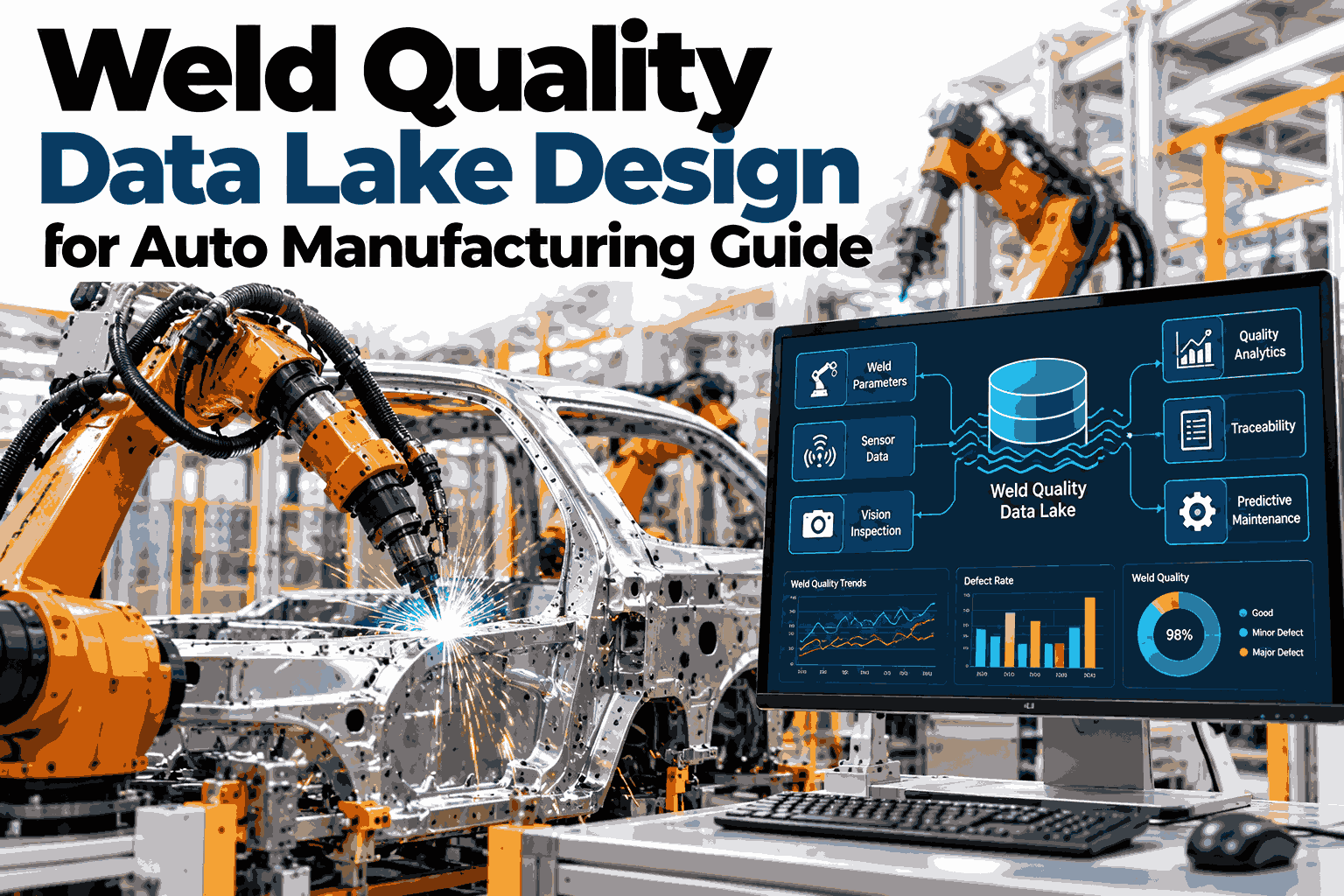
Every automotive plant now generates data from OT sensors, MES transactions, and ERP records fast enough that dumping it all into cloud storage and calling it a data lake feels like progress. Eighteen months later that same lake is usually a swamp: nobody trusts the schema, timestamps do not align across sources, and the one dashboard everyone needs takes a data engineer three days to rebuild after every schema drift. The difference between a lake and a swamp is not the storage technology, it is whether the architecture enforces structure as data moves through it. iFactory builds that structure directly into the pipeline from day one, and you can book a demo to see a lakehouse architecture mapped against your own OT, MES, and ERP sources.
DATA ARCHITECTURE FOR AUTOMOTIVE PLANTS
A Data Lake Without Structure Is Just a Very Expensive Place to Lose Data
iFactory architects a layered lakehouse that ingests raw OT, MES, and ERP data, then progressively structures it through validated and business-ready layers instead of leaving every consumer to interpret raw data alone.
BRONZE
Raw ingested data, untouched
SILVER
Cleaned, validated, deduplicated
GOLD
Business-ready, joined and modeled
HOW LAKES BECOME SWAMPS
The Predictable Way a Data Lake Turns Into a Data Swamp
The pattern below repeats across almost every plant that skips structure in favor of speed during the initial build-out.
01
Every new data source gets dumped in with its own schema, timestamp format, and naming convention, with no shared standard enforced.
02
Analysts write one-off queries that only they understand, and when they leave, that logic leaves with them.
03
Nobody can say with confidence which dataset is the current source of truth for a given metric like OEE or scrap rate.
04
New dashboard requests take days instead of hours because every request starts with reverse-engineering the raw data again.
SOURCE MAP
What Actually Feeds a Plant Data Lake Across OT, MES, and ERP
A well-architected lakehouse treats each source type differently at ingestion, since their update frequency, volume, and structure differ substantially.
| Source Type | Examples | Update Frequency | Ingestion Pattern |
|---|
| OT / SCADA | PLC tags, sensor telemetry, alarms | Sub-second to seconds | Streaming ingestion |
| MES | Work orders, genealogy, quality events | Transactional, event-driven | Change data capture |
| ERP | Purchase orders, inventory, finance | Batch, hourly to daily | Scheduled batch load |
| Historian | Long-term time series archives | Continuous, high volume | Bulk backfill plus streaming |
Raw Data Sitting in Storage Is Not the Same as Data You Can Trust a Decision On
iFactory architects a bronze-to-gold lakehouse pipeline that enforces schema, validation, and business logic as data moves through it, so every dashboard pulls from a source everyone trusts. Book a demo to see it mapped against your own OT, MES, and ERP sources.
THE THREE LAYERS
What Each Layer of a Lakehouse Actually Does, in Plain Terms
The bronze-silver-gold pattern is not arbitrary naming. Each layer exists to answer a specific question about the data as it moves from raw to trustworthy.
BRONZE LAYER
Question It Answers
What did the source system actually send, exactly as it sent it?
Who Uses It
Data engineers debugging pipeline issues, rarely business users
SILVER LAYER
Question It Answers
Is this data clean, deduplicated, and validated against expected ranges?
Who Uses It
Data scientists building models, analysts doing deep investigation
GOLD LAYER
Question It Answers
What is the trusted, business-ready number for this metric right now?
Who Uses It
Plant managers, dashboards, and any report leadership relies on
GOVERNANCE
The Governance Practices That Keep a Lakehouse From Drifting Back Into a Swamp
Architecture alone does not prevent swamp formation. These operating practices are what keep the structure enforced over years, not just at initial build.
✓
Schema registry enforced at ingestion so any source sending unexpected fields is flagged before it reaches the silver layer.
✓
Single owner assigned per gold-layer table so there is always one accountable person when a metric definition needs to change.
✓
Data quality checks run automatically on every batch and streaming load, with failures routed to an alert rather than silently passing through.
✓
Documentation lives next to the data in a catalog, not in a separate wiki that goes stale within months of being written.
ARCHITECTURE READINESS
Data Lakehouse Readiness Checklist Before Ingesting Your First Source
Confirm these fundamentals before connecting OT, MES, or ERP sources into a new lakehouse architecture.
All planned data sources inventoried with owner, update frequency, and format documented
Schema standards defined for timestamps, unit conventions, and naming across sources
Bronze, silver, and gold layer boundaries and ownership assigned before ingestion begins
Data quality validation rules defined for each critical metric before go-live
Access governance defined for who can query each layer and under what conditions
Pilot source selected to validate the pipeline before onboarding the full source list
FREQUENTLY ASKED QUESTIONS
Questions Data Engineers Ask About Plant Data Lake Architecture
We already have a data lake that has become a swamp. Can it be restructured or do we start over?
Most existing lakes can be restructured rather than rebuilt from scratch, since the raw data typically still has value even if it lacks structure. The process usually involves treating existing raw data as the bronze layer, then building silver and gold layers on top with proper validation and schema enforcement going forward, rather than re-ingesting everything from source systems again.
Book a demo to assess whether your existing lake can be restructured.
How do we handle OT data that arrives faster than our current infrastructure can process it?
High-frequency OT streams typically need a streaming ingestion layer that buffers and batches data before it hits the bronze layer, rather than trying to write every individual sensor reading directly into long-term storage. This is a standard pattern in lakehouse architecture and does not require replacing existing historians, which can continue operating alongside the new pipeline.
Contact support to review streaming architecture options for your OT data volume.
Who should own data quality rules — IT, OT, or the plant engineering team?
Data quality rules work best when owned jointly, with OT and plant engineering defining what a valid range or expected value looks like for their equipment, and IT or data engineering implementing and enforcing those rules technically within the pipeline. Ownership that sits entirely with one side tends to produce either technically correct but operationally meaningless rules, or operationally sensible rules nobody enforces consistently.
Book a demo to see how shared ownership works in practice.
Does a lakehouse architecture replace our historian or work alongside it?
In most implementations the historian continues operating as the system of record for long-term time series storage, while the lakehouse ingests from the historian as one of several sources feeding into the bronze layer alongside MES and ERP data. This avoids a disruptive migration of years of historian data while still enabling cross-source analysis the historian alone cannot provide.
Contact support to review historian integration options.
How long does it take to go from raw data sources to a trustworthy gold layer?
A pilot covering one or two priority use cases, such as OEE or scrap rate reporting, typically reaches a trustworthy gold layer within six to ten weeks, with most of that time spent on schema standardization and validation rule definition rather than the technical pipeline build itself. Expanding to the full source list across a plant is a longer, incremental process measured in months rather than weeks.
Book a demo to scope a realistic timeline for your priority use cases.
Stop Rebuilding the Same Dashboard Every Time the Schema Drifts
iFactory architects a structured, governed lakehouse that turns raw OT, MES, and ERP data into a gold layer your whole plant can trust. Book a demo to see it mapped against your own data sources.