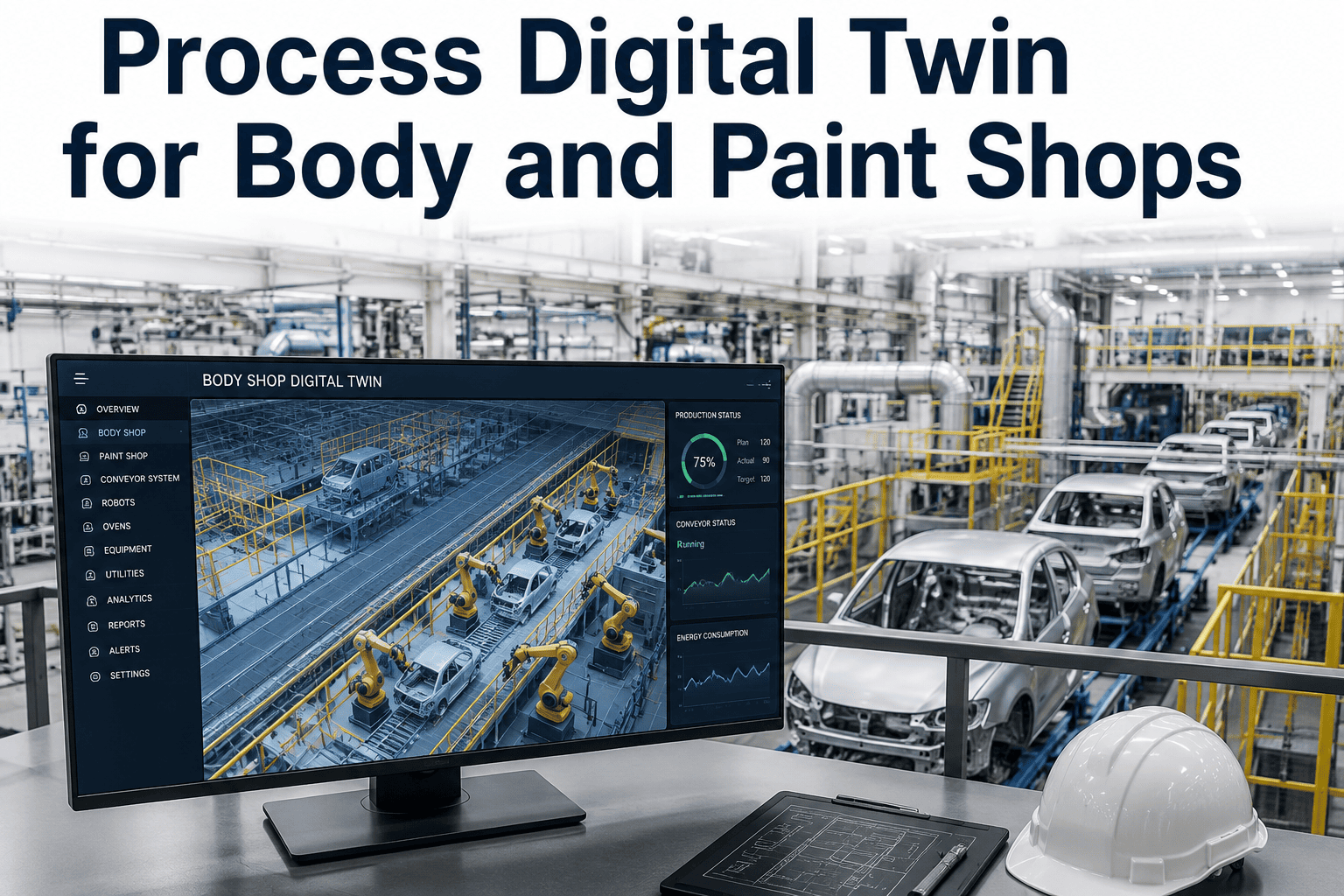
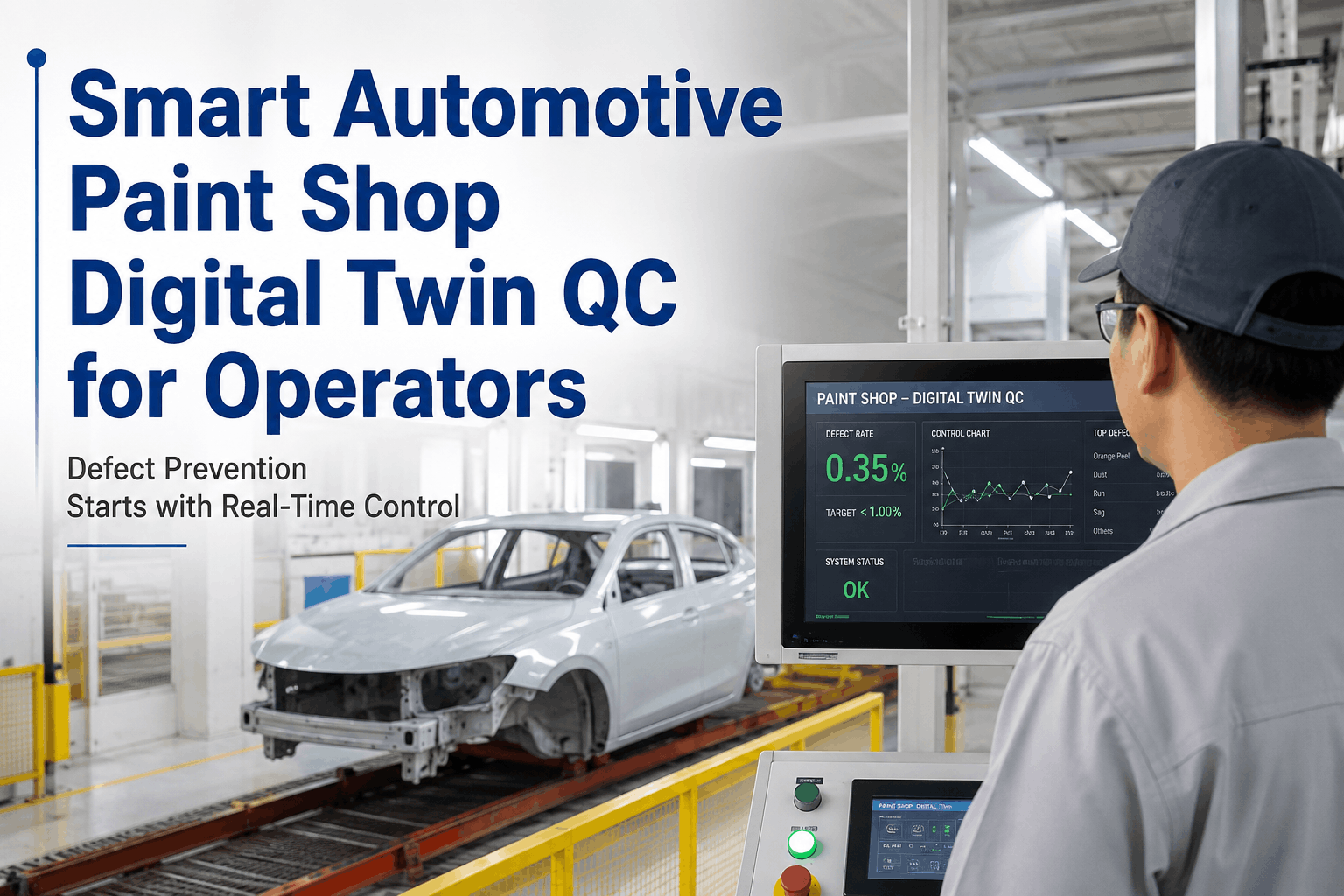
A Tier-1 automotive supplier operating a 4-stage paint shop for mid-size vehicle bodies discovered during a routine production audit that their spray booth climate control system was consuming 42% more compressed air than specification predicted but nobody had modeled the actual process to understand why. The compressed air cost $8,400 per month. The root cause: booth exhaust dampers were not sequencing properly during color changeovers, creating negative pressure zones that the system compensated for by running blowers at 120% capacity. A digital twin of the paint booth air dynamics revealed the sequencing failure within minutes of activation. A digital twin that simulates every process stage, predicts quality defects before they occur, and optimizes energy consumption across booth climate control, conveyor speed, cure oven temperature profiles, and drying sequences could unlock $400K to $800K in annual savings through defect reduction, energy efficiency, and throughput optimization. Schedule a demo to model paint shop digital twin ROI for your facility.
Why Paint Shops Are the Hidden Profit Center Most Automotive Plants Ignore
Paint shops are the most energy-intensive, most defect-sensitive, and least optimized operation in automotive manufacturing. A typical automotive paint facility consumes 8 to 12% of total plant electrical load for booth climate control alone. Defect rates at paint stage — orange peel, runs, sag, overspray, color mismatch — account for 25 to 40% of all rework and warranty costs. Yet most plants manage paint operations using procedures written 10 to 20 years ago, operator experience, and trial-and-error material handling. No real-time visibility into spray booth pressure dynamics, paint atomization patterns, cure temperature profiles, or conveyor speed optimization. No modeling of how changes in one process parameter — air velocity, spray gun distance, oven set point — cascade through downstream stages. When problems occur, the response is reactive: investigate, adjust, hope the fix sticks. A digital twin changes this completely. A virtual replica of the entire paint shop — spray booths, conveyor dynamics, cure ovens, drying chambers, quality sensors — creates a testable model where operators and engineers can simulate process changes weeks before they are physically implemented, predict defects before they occur, and optimize energy consumption stage by stage.
Typical automotive paint shop defect rates: 2 to 5% of bodies requiring rework or scrap. At 140 vehicles per day across 5 days, that is 14 to 35 bodies per week requiring rework or scrap. Rework cost per body: $400 to $800 (stripping, repainting, quality inspection, delays). Annual defect/rework cost at a mid-size paint shop: $290K to $1.46M. Root causes: spray booth air velocity drift, paint viscosity variation, oven temperature zone misalignment, humidity excursions, operator technique variability. Digital twin predicts these conditions 2 to 8 hours before defects manifest, enabling preventive action.
Paint shop energy costs: booth climate control 35%, cure ovens 42%, conveyor drives 8%, compressed air 15%. At a mid-size facility: $180K annually. Optimization opportunities in booth exhaust sequencing, oven zone staging, conveyor idle-time elimination, and air compressor load shedding can reduce energy consumption 18 to 28% without impacting throughput or quality — saving $32K to $50K annually. A digital twin identifies these opportunities by modeling energy flow across all stages and correlating with production rate and defect metrics.
Paint shop line stalls — unplanned stops lasting 5 minutes to 2 hours — cost $500 to $3,000 per event in lost production. Causes: spray gun failures, conveyor alignment faults, oven temperature control failures, paint supply interruptions, humidity excursions triggering automatic shutdowns. A typical facility experiences 2 to 5 stalls per week. Digital twin monitors all critical parameters in real time and predicts 80 to 95% of failures 4 to 24 hours in advance, enabling preventive maintenance before stalls occur.
Paint shop process improvements typically require trial-and-error testing on the live line — risking production disruption, scrap, and delay. Testing conveyor speed changes, oven temperature profiles, or spray booth pressure setpoints requires stopping production or running expensive test batches. A digital twin enables what-if modeling weeks before physical implementation, predicting impact on throughput, quality, and energy consumption with high accuracy.
The Paint Shop Process: Where Digital Twins Unlock Value
Automotive paint shops are multi-stage sequential processes where each stage impacts downstream quality and efficiency. Understanding the process stages is essential to identifying where digital twins deliver the highest value.
Process: Vehicle body enters wash stage — alkaline cleaning removes oils, greases, and foreign material. Water rinsing and drying precedes paint application. Key Parameters: wash temperature (45-55°C), chemical concentration (2-4%), rinse water quality (conductivity <100 ppm), air dry duration (90-120 sec). Defect Risk: Inadequate cleaning causes paint adhesion failure, blistering, and premature corrosion. Digital Twin Value: Real-time monitoring of wash chemical concentration, rinse water quality, and dry chamber air velocity predicts cleaning quality before paint application. Early warning of wash solution degradation enables maintenance scheduling before defects occur.
Process: Body is immersed in charged paint bath — electrostatic attraction deposits uniform coating on all surfaces (5-25 microns). Bath temperature maintained 25-32°C, voltage 200-400V. Key Parameters: bath conductivity (1,500-2,500 µS), paint solids content (15-25%), immersion time (2-4 min), bath temperature stability. Defect Risk: Paint bath degradation causes uneven coating, buildup on parts, short circuits. Bath conductivity drift indicates resin depletion or solvent loss. Digital Twin Value: Continuous bath quality monitoring (conductivity, solids content, temperature trending) predicts when bath requires reconditioning before defects manifest. Correlates bath parameters with downstream quality metrics to quantify impact on cure time and final finish.
Process: Body passes through spray booth — atomized primer applied to all surfaces at controlled pressure and velocity. Cure oven with staged temperature profile (60°C, 80°C, 120°C zones over 8-12 min) cures primer film. Key Parameters: spray booth air velocity (0.3-0.5 m/s), spray pressure (2-4 bar), paint viscosity (17-20 sec via Ford cup), oven setpoint per zone, conveyor speed (2-4 m/min). Defect Risk: Air velocity too high causes overspray and material waste; too low causes sag and runs. Paint viscosity drift causes orange peel or thin film. Oven temperature zones misaligned causes insufficient cure or paint burn. Digital Twin Value: Models spray booth air dynamics and paint trajectory — identifies conditions that produce overspray, sag, or runs 2-4 hours before defects appear. Optimizes oven temperature ramp rates and conveyor speed for fastest cure with zero defects. Predicts energy consumption across oven zones under different parameter combinations.
Process: Identical spray and cure as primer but with harder topcoat paint and more critical quality requirements. Final finish quality directly perceived by customer. Key Parameters: spray booth pressure (2.5-4 bar), spray distance (15-25 cm), paint viscosity (18-22 sec), oven profile (60°C, 100°C, 140°C zones over 10-15 min), color consistency. Defect Risk: Color mismatch (metallics/pearls highly sensitive to spray pressure and air velocity), orange peel, runs, sag, overspray, gloss uniformity loss. Small variations in viscosity or spray pressure cause visible defects. Digital Twin Value: Maintains color consistency across production batches by modeling spray booth conditions and correlating with color spectroscopy data. Predicts orange peel defects from air velocity and paint viscosity combinations. Optimizes oven cure profile to achieve fastest cycle time with zero topcoat defects.
Process: Inspectors (manual) or AI vision cameras (automated) assess paint finish for defects. Acceptable bodies exit to next manufacturing stage. Defect bodies route to rework or scrap. Key Parameters: defect detection accuracy, false rejection rate, rework capacity, scrap rate. Defect Risk: Manual inspection variability (inspector fatigue, subjectivity) causes missed defects or false rejections. Backlog of rework bodies consumes capacity and delays shipments. Digital Twin Value: Predicts defects before inspection stage, enabling root-cause correction upstream rather than reactive rework. Correlates process parameters (spray pressure, oven temp, conveyor speed) with inspection outcomes to continuously improve paint process. Quantifies impact of process changes on defect rate and rework capacity requirements.
Model Paint Shop Digital Twin Optimization for Your Facility
Paint shop digital twins enable process simulation, defect prediction, and energy optimization. Financial impact varies by facility size, current defect rate, and energy efficiency baseline. Model digital twin ROI specific to your paint shop.
Digital Twin Use Cases: Paint Shop Defect Reduction
Baseline: 3.2% defect rate from orange peel and overspray. Spray booth air velocity running at 0.48 m/s constant setpoint (historical setting from 2008).
Digital Twin Analysis: Modeled spray booth air dynamics and paint atomization across baseline and alternative velocity setpoints. Identified that humidity-dependent paint viscosity changes require corresponding air velocity compensation. Low humidity (30-40%) requires 0.42 m/s for atomization; high humidity (70-80%) requires 0.54 m/s to prevent runs. Baseline constant 0.48 m/s was overspraying in low humidity and undershooting in high humidity.
Implementation: Programmed spray booth controller to adjust air velocity setpoint based on real-time humidity input. No capital investment. Operator training: 4 hours.
Baseline: Primer cure oven running 3-zone profile: 60°C, 80°C, 120°C, 8-minute cycle. Energy consumption 142 kWh per 1,000 bodies (8 hour shift, 140 bodies/day).
Digital Twin Analysis: Modeled primer cure chemistry kinetics across temperature profiles. Identified that Zone 2 (80°C) was unnecessarily high for initial solvent flash-off — 70°C was sufficient. Zone 3 (120°C) was undershooting true cure requirement — 130°C required only 1 additional minute. Tested profile: 60°C (2 min), 70°C (2 min), 130°C (3 min) = 7-minute cycle with better cure uniformity.
Implementation: Updated oven controller setpoints. Validated with coupon cure testing and topcoat adhesion checks. Production validation: 3 days.
Baseline: Conveyor speed 2.8 m/min constant across all paint stages. Primer and topcoat viscosity manually adjusted each shift based on operator observation (target 19-20 sec Ford cup). Defect rate 2.1%, throughput 134 bodies/day (18 min cycle time).
Digital Twin Analysis: Modeled paint flow dynamics, cure kinetics, and defect probability across different conveyor speeds and viscosity combinations. Identified that primer stage could run faster (3.2 m/min) without affecting cure if viscosity increased slightly (21 sec), while topcoat required slower speed (2.6 m/min) with thinner paint (18 sec) to prevent color shade variation. Humidity compensation algorithm automated viscosity adjustment.
Implementation: Stage-specific conveyor speed setpoints, automated viscosity controller linked to humidity, operator training. Capital investment: $12K (variable frequency drive retrofit on primer conveyor). Payback: 4 months.
Paint Shop Digital Twin Implementation: 8-Week Roadmap
Install or integrate existing sensors across paint shop: spray booth pressure (3-5 points), air velocity probes, oven temperature sensors (3-5 zones per oven), paint viscosity sensors, humidity/temperature probes, conveyor speed encoders. Integrate with PLC/SCADA systems. Establish baseline data collection at 1-minute intervals. No production disruption.
Build physics-based models of spray booth air dynamics, paint atomization patterns, oven cure chemistry kinetics, and conveyor dynamics. Validate models against 2-4 weeks of baseline data. Calibrate model parameters to match actual process behavior. Model accuracy target: predicted values within 5% of actual measurements.
Train defect prediction models using historical defect data correlated with process parameters. Develop optimization algorithms that recommend parameter adjustments (spray pressure, viscosity, conveyor speed, oven setpoints) to minimize defect rate and energy consumption. Create what-if simulation interface for testing parameter changes virtually before live implementation.
Deploy digital twin to paint shop control systems. Implement 1-2 quick-win optimizations (humidity-compensated air velocity, oven zone adjustment) based on simulation results. Train operators on digital twin dashboards and alerts. Monitor real-world performance and validate that predicted improvements match actual results. Enable continuous refinement of digital twin models as new operational data accumulates.
Paint Shop Digital Twin Financial Impact Model
Model Paint Shop Digital Twin ROI for Your Facility
Financial projections vary by paint shop size, current defect rate, energy baseline, and equipment. iFactory models digital twin ROI specific to your facility using actual process data.
Frequently Asked Questions: Paint Shop Digital Twins
Why Automotive Plants Choose Digital Twins for Paint Shops
Predict orange peel, runs, sag, and overspray 4-24 hours before they occur. Reduce rework by 50-70% through early correction instead of reactive rework.
Optimize booth exhaust sequencing, oven temperature profiles, and conveyor idle times. 18-28% energy reduction without impacting throughput or quality.
Test parameter changes virtually weeks before live implementation. Eliminate trial-and-error and production risk.
ROI in 2-4 months from defect reduction and energy savings alone. Additional throughput benefits extend value beyond initial payback.
Start Your Paint Shop Digital Twin
Paint shop digital twins deliver measurable ROI within 8 weeks through defect reduction, energy optimization, and throughput improvement. Model digital twin value specific to your facility. Schedule a demo to see simulation results on automotive paint data similar to your processes.