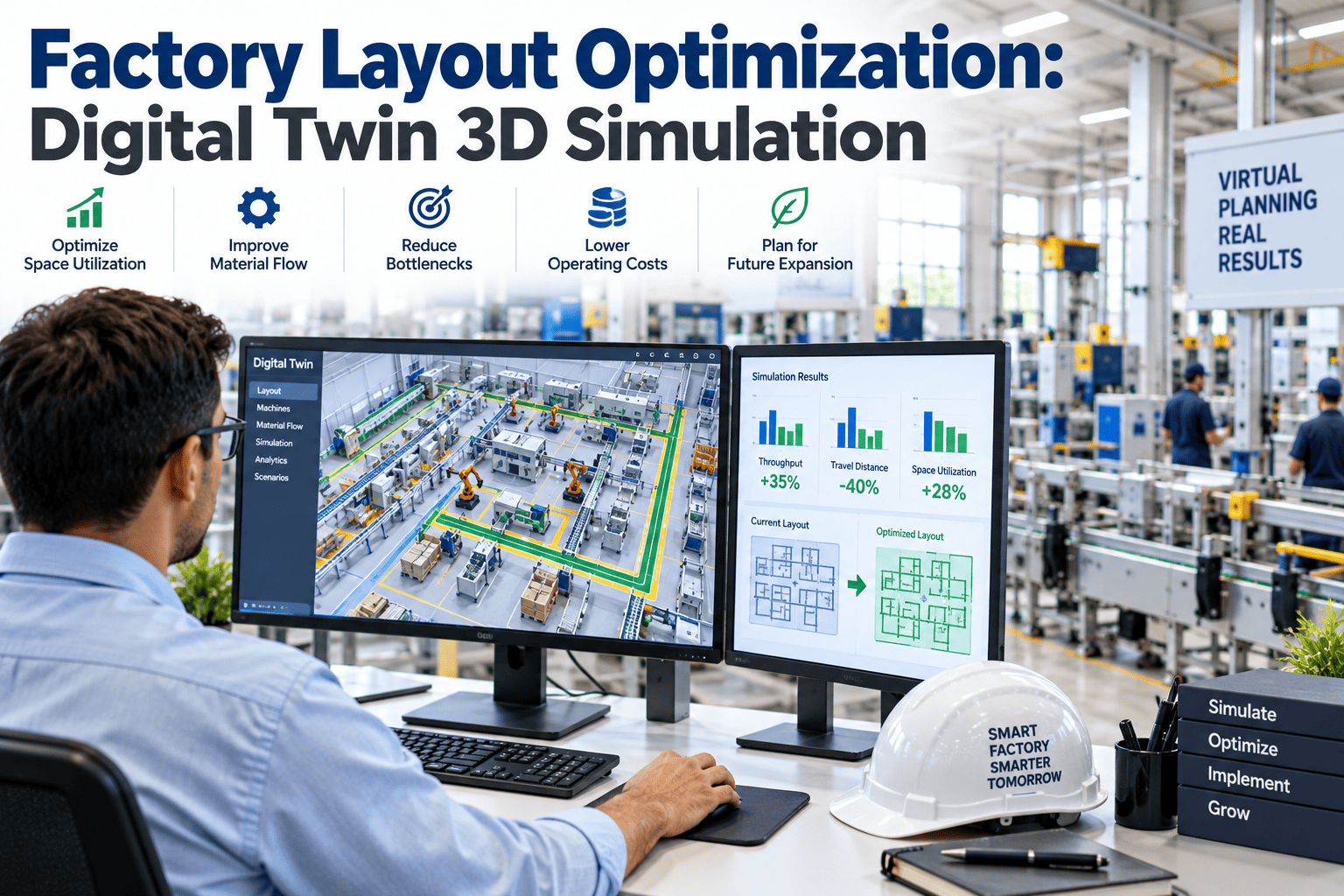
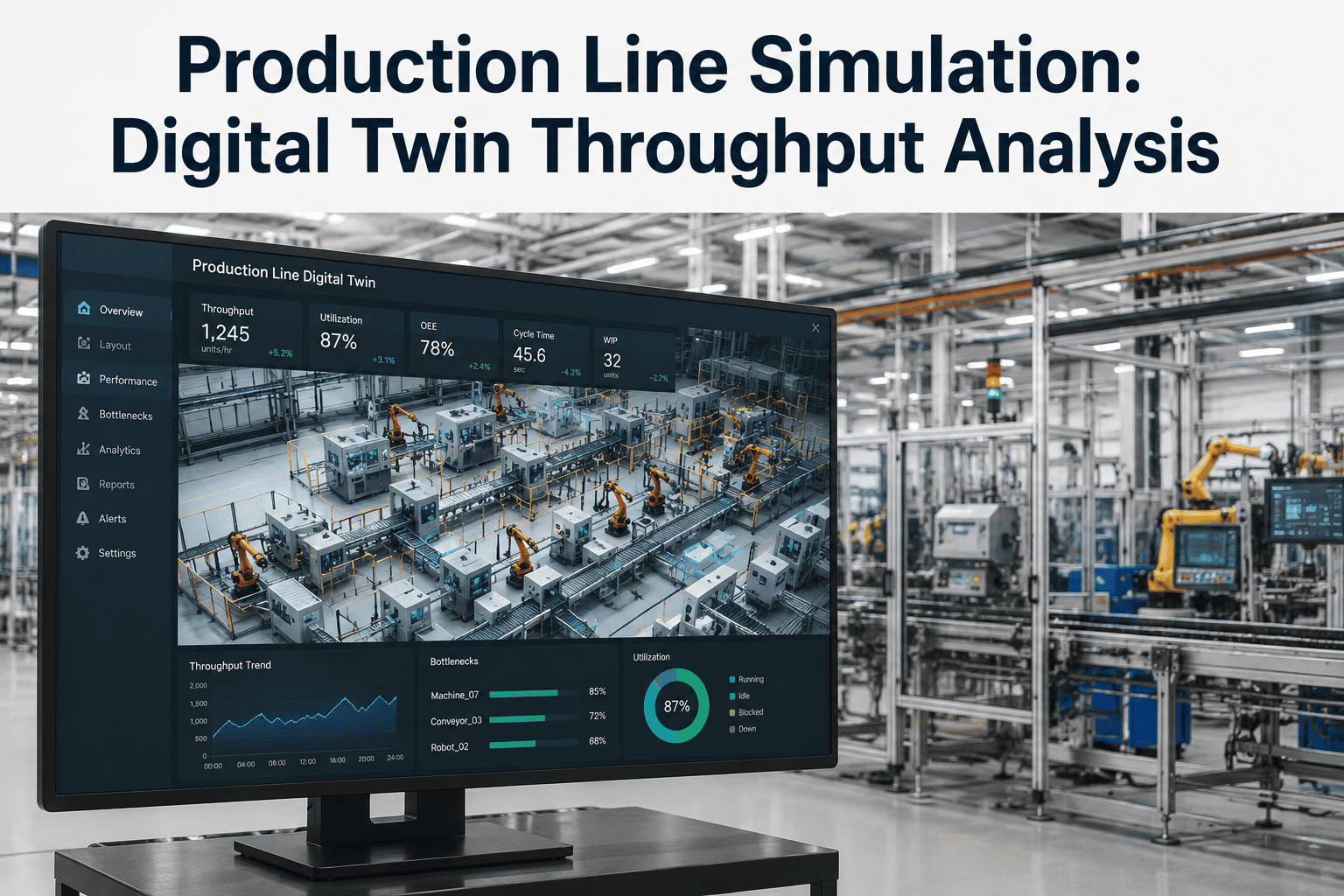
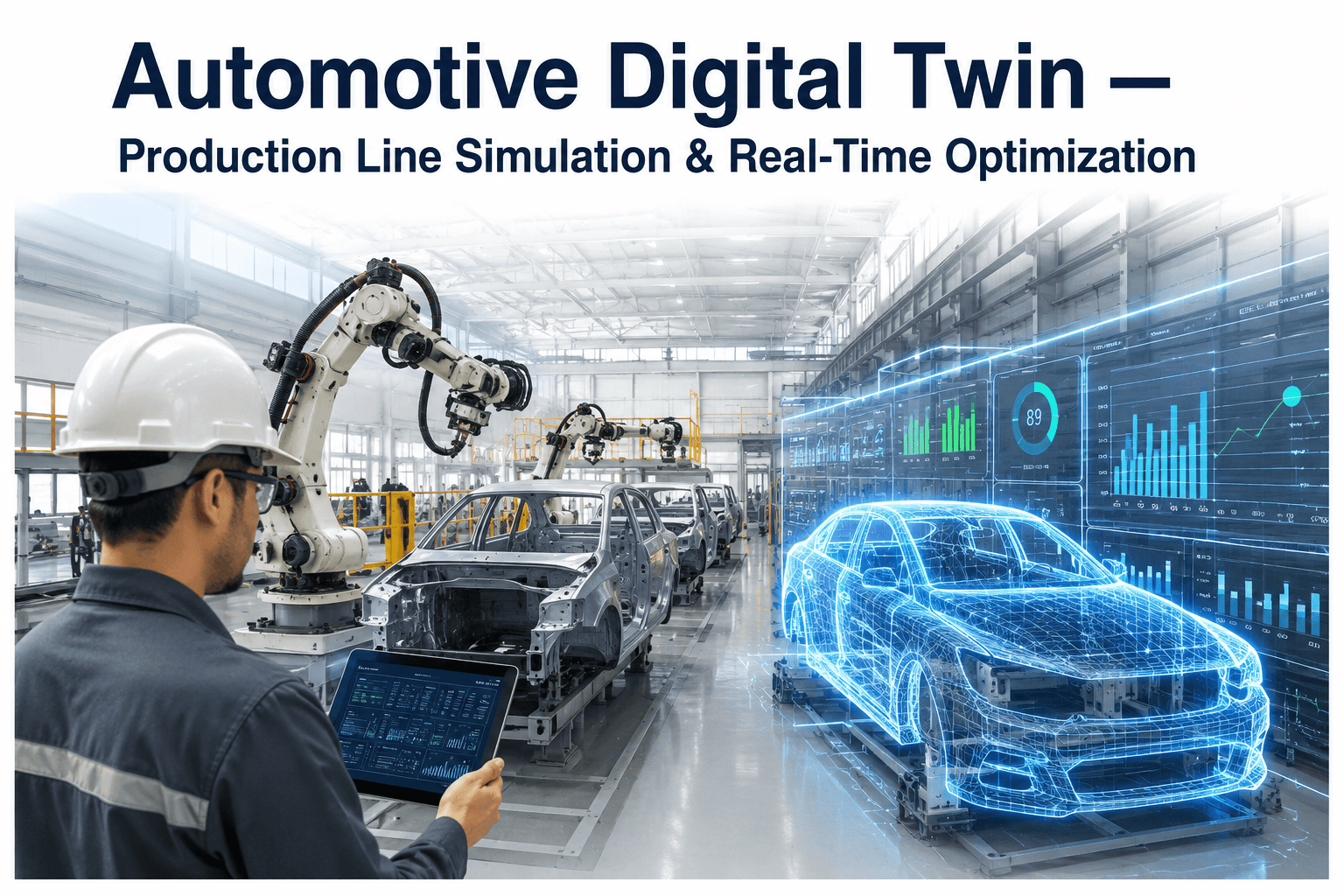
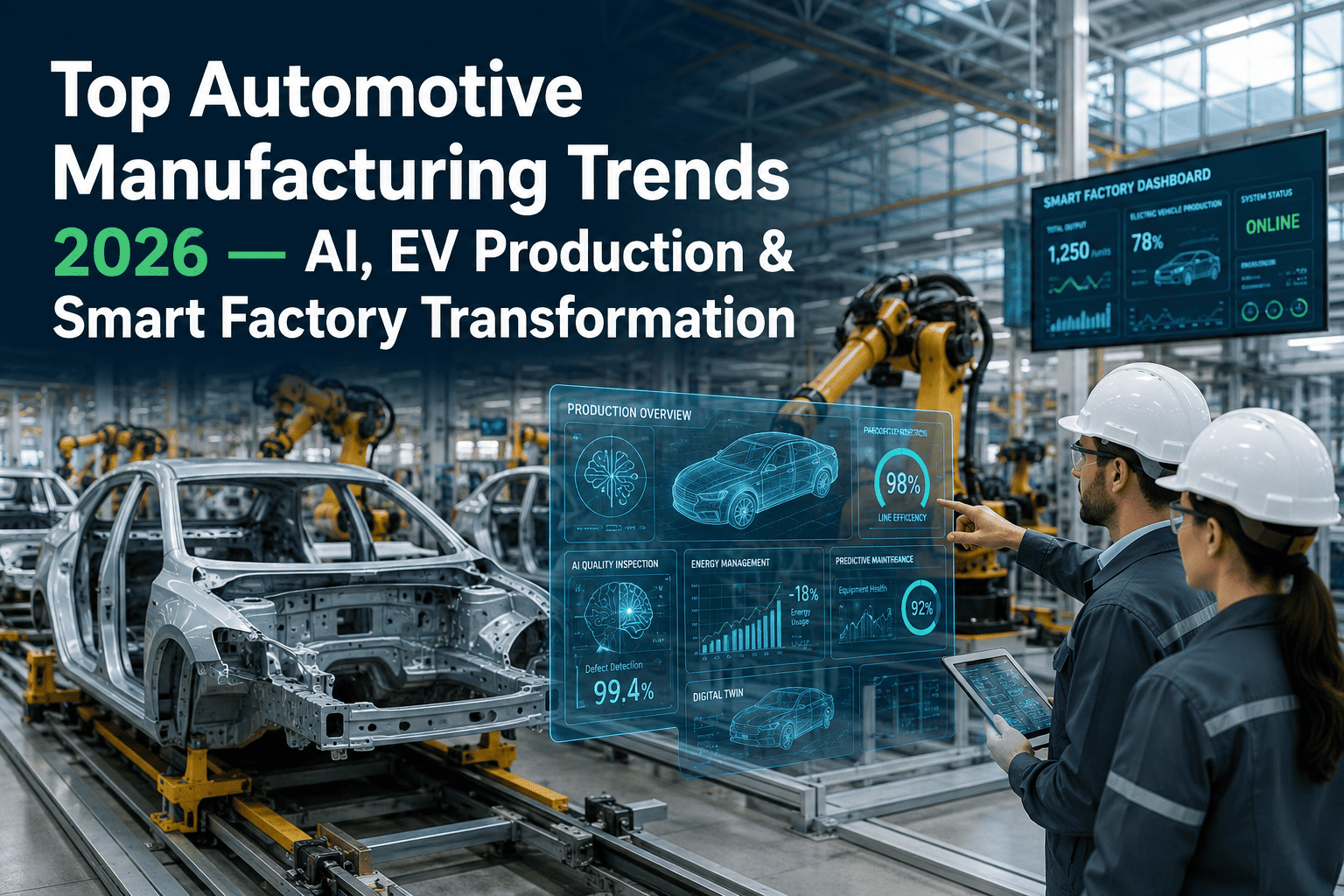
In automotive manufacturing, production downtime costs $850 per minute on average. A single unplanned line stoppage that lasts just 4 hours results in $204,000 in lost revenue. Yet 89% of manufacturing plants still rely on reactive maintenance and spreadsheet-based planning. The hidden cost: 6 to 8 hours of production delay per month due to equipment failures that could have been prevented. Modern automotive plants handle assembly sequences with tolerances measured in hundredths of millimeters. Stamping presses run at 1,500 strokes per minute. Robotic welding stations perform 10,000+ spot welds per vehicle with zero margin for error. When a single sensor goes unmonitored or a maintenance window is missed, the consequences cascade through the entire supply chain. For decades, automotive manufacturers have used traditional plant simulation tools to model production processes. But simulation built on historical data alone cannot predict where failures will occur. That's where digital twin technology differs fundamentally and why leading automakers are making the shift. This article compares digital twin and traditional plant simulation head-to-head across the metrics that matter most to automotive operations: predictive capability, integration complexity, deployment speed, and ROI.
What Is Traditional Plant Simulation?
Traditional plant simulation is a modeling approach that uses historical operational data, predefined equipment specifications, and static process parameters to create a virtual representation of a manufacturing facility. These tools (such as Arena, Plant Simulation, or proprietary ERP modules) map the physical layout of your plant, the sequence of production steps, and the timing constraints of each operation.
A traditional simulation in an automotive stamping shop might model: press cycle times, material feed rates, die change intervals, scrap rates, and labor availability. The simulation runs through thousands of scenarios — "What if we increase line speed by 5%?" or "What if a press requires 3 days of maintenance?" — and projects the impact on overall production throughput.
Strengths of Traditional Plant Simulation
Design engineers can evaluate "what-if" scenarios without disrupting live operations. Run 10,000 iterations overnight to optimize batch sizes, buffer strategies, or buffer planning.
Tools like Siemens Plant Simulation and AutoMod have 20+ years of integration experience. Training materials, consultants, and best practices are readily available.
Identify bottlenecks in multi-stage production (stamping → welding → paint → assembly). Understand system-wide impact of layout changes before investing in equipment moves.
Justify equipment purchases and production line redesigns by modeling ROI scenarios. Answer "Will a third press increase throughput by 15%?" with data before spending $1.2M.
Critical Limitations of Traditional Plant Simulation
What Is a Digital Twin?
A digital twin is a live, AI-powered virtual replica of your physical manufacturing facility that continuously ingests real-time sensor data, machine logs, and operational metadata. Unlike static simulation, the digital twin is perpetually synchronized with your plant — when a robot stops moving, the twin reflects that within seconds. When temperature in a stamping die rises 2°C, the twin detects it. When a press misses a cycle, the twin logs it.
The twin uses machine learning to establish behavioral baselines for every asset. It learns what "normal" looks like for each machine under different conditions (warm-up phase, steady-state production, high-speed mode). It then monitors live data against those baselines and alerts operators to anomalies before they become failures.
Strengths of Digital Twin Technology
AI detects equipment degradation 7–14 days before failure occurs. Servo drive voltage creep, seal wear patterns, alignment drift — all detected through pattern recognition on live data before production impact.
The twin updates every few seconds with fresh sensor data. No manual model updates. No lag. You see your plant as it actually is — not as it was when the simulation was built.
Machine learning models improve as they see more data. The twin's accuracy at predicting failures increases week-to-week as it learns your specific equipment behavior, your operators' techniques, and your material variations.
Digital twins connect directly to PLC, SCADA, MES, and ERP systems. No middleware. No manual data export. Real-time bidirectional sync means alerts can automatically generate work orders in your CMMS.
Connect your equipment sensors, grant API access to your MES, and the twin begins learning in under 48 hours. No 4-week modeling cycle. No discrete event simulation experts required.
Where Digital Twins Have Trade-offs
Head-to-Head Comparison: Digital Twin vs Traditional Simulation
| Capability | Traditional Plant Simulation | Digital Twin (iFactory) |
|---|---|---|
| Predictive Maintenance | No. Predicts average failure rates only. Cannot pinpoint which asset will fail next. | Yes. AI detects degradation patterns 7–14 days before failure. Works asset-by-asset. |
| Real-Time Monitoring | No. Batch process. Data refreshed on schedule, not live. | Yes. Continuous sync with PLC, SCADA, sensors. Updates every 5–15 seconds. |
| Deployment Timeline | 4–8 weeks. Requires detailed plant mapping, vendor interviews, and parameter tuning. | 48 hours to 2 weeks. Connect sensors and APIs; learning begins immediately. |
| Model Maintenance | Manual. Every equipment change, line redesign, or parameter shift requires model updates. | Automatic. Twin continuously learns and adapts to equipment changes in real time. |
| Scenario Testing (What-If) | Excellent. Offline scenario modeling is the tool's core strength. | Good. Simulation capability available within twin. Requires additional setup. |
| OEE Optimization | Yes. Identifies bottlenecks and throughput constraints in designed scenarios. | Yes. Continuous real-time optimization with live cycle time and reject rate data. |
| Equipment Downtime Prediction | No. Cannot predict when existing equipment will fail unexpectedly. | Yes. 47% reduction in unplanned downtime through early warning system. |
| Compliance & Audit Trail | Yes. Historical simulation runs can be documented for capital justification. | Yes. Complete timestamped record of all asset behavior, alerts, and work orders. |
| Integration Complexity | High. Requires manual data export, ETL processes, and custom connectors. | Low. Native PLC, SCADA, MES, ERP connectors. Plug-and-play integration. |
| Cost (Year 1) | $150K–$400K (software licenses + consulting + internal FTE) | $80K–$200K (includes PLC integration, initial training, first-year support) |
Why Automotive Plants Choose Digital Twins
Use Case 1: Stamping Shop — Early Warning for Press Failures
A tier-1 automotive supplier operates 12 stamping presses producing 8,000 parts per day across 5 product lines. Each unplanned press shutdown costs $42,000 in lost throughput and expedited logistics.
With traditional simulation, the plant could model "press reliability at 95%," but could not predict which press would fail on Tuesday at 2 PM. With iFactory's digital twin:
How it works: iFactory ingests pressure sensor data, vibration telemetry, and die temperature readings from each press. Machine learning establishes the normal degradation curve for each die across its 100,000-part lifespan. When vibration amplitude increases 8% or pressure stability drops below threshold, the system alerts maintenance with a 9-day buffer. Maintenance schedules the replacement during a planned window instead of during peak production.
Use Case 2: Assembly Line — Real-Time OEE Tracking and Anomaly Detection
A major OEM's final assembly line runs 60 vehicles per hour with 850+ work stations across 8 stages (body build, powertrain integration, electronics, quality gates). Each 1% loss in OEE = $180K in monthly revenue.
Traditional simulation could model "what-if we change shift length?" but cannot tell why OEE dropped from 91% to 87% at 3 PM on a random Wednesday. With iFactory's twin:
The twin ingests cycle time data, reject flags, changeover duration, and idle time from MES. It learns the "normal" cycle time distribution for each station and each vehicle variant. When a robotic welder consistently exceeds target cycle by 2.3 seconds, the system alerts. When first-pass yield drops below 96% for body assembly, correlation analysis identifies whether the root cause is upstream (material issue) or localized (station drift). This real-time insight enables operators to intervene within minutes rather than discovering the problem in quality reporting hours later.
Use Case 3: EV Battery Pack Production — Thermal and Electrical Anomaly Detection
EV battery manufacturing is the highest-precision automotive process: cell-level voltage tolerance of ±0.1V, thermal stratification below 2°C across a 100-cell module, and electrical isolation testing at 1,500V. A single bad cell cascades to an entire pack rejection and $3,200 rework cost.
Traditional simulation cannot model the real-time electrochemical signatures that indicate an incoming defect. A digital twin can:
iFactory's twin ingests voltage, impedance, and temperature data during cell balancing and formation cycles. It learns the electrical signature of each cell manufacturing line and correlates voltage drift with downstream test failures. When a cell's voltage-vs-time profile deviates from the learned baseline, the pack is diverted before completing 8 hours of assembly and integration labor.
Implementation Roadmap: Digital Twin for Automotive Plants
Inventory all critical assets: stamping presses, welding robots, conveyor systems, quality gates, assembly stations. Document existing sensor infrastructure (PLC inputs, SCADA tags, IoT devices). Identify data sources: MES cycle logs, ERP work orders, historian logs.
Deploy iFactory connectors to PLC (via Modbus, Ethernet/IP, OPC-UA), SCADA historians, MES API, and ERP systems. Validate data flow. Set polling intervals (5–15 second cadence for critical equipment). Test redundancy for network failures.
Twin ingests 2–4 weeks of continuous operational data. Machine learning algorithms establish "normal" behavior profiles for each asset under different production modes. Build anomaly thresholds without manual tuning.
Configure alert thresholds for each asset class (press, robot, conveyor). Connect twin to CMMS to auto-generate work orders for predicted maintenance. Set up dashboards for operations and maintenance teams. Configure alert routing (SMS, email, Slack).
Analyze twin-generated alerts vs actual failures. Tune sensitivity to reduce false positives. Expand anomaly detection to multi-asset correlations (e.g., "conveyor slowdown leads to press backlog"). Add OEE optimization rules.
Extend twin to secondary production lines. Add predictive energy consumption modeling. Implement scenario simulation for capacity planning. Integrate with supply chain systems for raw material lead time optimization.
ROI Analysis: Digital Twin Deployment in Automotive
Based on implementations across 45+ automotive manufacturing facilities:
Comparison with Competitors
Other digital twin and process simulation vendors address parts of this challenge. Here's how iFactory compares on the criteria that matter most to automotive manufacturers:
| Vendor | Predictive Maintenance | Real-Time Sync | Deployment Speed | Automotive Integration | OEE Optimization | Compliance Tracking | Ease of Use |
|---|---|---|---|---|---|---|---|
| iFactory | ✓ Industry-leading | ✓ 5–15 sec | ✓ 2 weeks | ✓ Native PLC/SCADA | ✓ Real-time | ✓ IATF 16949 ready | ✓ No-code dashboards |
| Siemens Plant Simulation | ✗ No | ✗ Batch only | ✗ 6–8 weeks | ✓ Integration available | ✓ Yes | ✓ Yes | ✗ Requires simulation experts |
| Tulip Connective Platform | ✗ No | ✓ Yes | ✓ 3–4 weeks | ✓ Yes | ✗ Limited | ✓ Yes | ✓ Visual builder |
| Parsec (Dude Solutions) | ✗ No | ✓ Real-time | ✓ 2–3 weeks | ✗ Generic OT focus | ✓ Basic | ✗ Limited | ✓ Mobile-first |
| IBM Maximo + Digital Twin | ✗ Add-on only | ✓ Yes | ✗ 8–12 weeks | ✓ Enterprise capable | ✓ Yes | ✓ Excellent | ✗ Complex implementation |
| GE Digital Predix | ✓ Strong | ✓ Yes | ✗ 6–10 weeks | ✓ Industrial heritage | ✓ Yes | ✓ Yes | ✗ Steep learning curve |
Digital Twin Deployment in Different Automotive Segments
| Region / Segment | Top Challenges | Compliance Standards | How iFactory Solves |
|---|---|---|---|
| North America (OEM) | Unplanned downtime, supply chain responsiveness, labor shortage, EV transition | IATF 16949, ISO 9001, ISO 45001 | Real-time downtime prediction reduces line stoppage by 47%. Automated work order generation integrates with existing MES. AI-driven resource scheduling addresses labor constraints. EV battery process monitoring detects defects 48 hours early. |
| Europe (Tier 1 & 2) | Energy cost management, equipment aging, stringent quality gates, sustainability reporting | IATF 16949, GDPR (data residency), ISO 50001 | Compressed air leak detection and regenerative conveyor monitoring reduce energy by 18–24%. Predictive maintenance extends equipment life by 8–12 months. Full audit trail for compliance reporting. Data stored in EU data centers. |
| Mexico & South America | Legacy equipment reliability, operator skill variability, raw material inconsistency | IATF 16949, local labor regulations | Digital twin learns idiosyncratic behavior of older equipment (non-networked machinery retrofitted with sensors). Operator performance monitoring and standardization. Material batch variation detection before assembly impact. Mobile app for field technicians with low connectivity. |
| Asia-Pacific (High-Volume EV) | Extreme throughput demands, rapid product changes, supply chain velocity, cost compression | IATF 16949, local EV standards, automotive cyber-security regulations | Twin handles rapid changeovers between 8+ product variants without manual recalibration. Real-time supply chain visibility triggers upstream vendor alerts. Multi-facility optimization across regional plants. Cyber-hardened architecture for connected vehicle manufacturing. |
| Middle East (New Capacity) | Greenfield ramp-up, workforce onboarding, climate stress on equipment | IATF 16949, local energy efficiency mandates | Digital twin deployed before production launch to establish baselines on new equipment. Operator training monitoring detects skill gaps in real time. Thermal stress modeling for high-temperature ambient conditions (50°C+). Predictive insights guide capacity scaling investment decisions. |
Why This Matters: The Convergence of Digital Twin and Automotive 4.0
Automotive manufacturing is at an inflection point. For 70 years, production has been optimized for volume and cost. Traditional plant simulation served that era well — model the line once, optimize the batch size, run for 5 years. But the industry is changing:
EV Transition: Battery pack manufacturing introduces new failure modes (cell balancing errors, thermal stratification, voltage anomalies) that traditional failure rate models cannot predict. Digital twins detect these anomalies hours before final test.
Supply Chain Volatility: Material shortages and logistics unpredictability mean production schedules change 5–8 times per week. A static simulation built on historical data is obsolete by Wednesday. Digital twins adapt in real time to upstream changes and alert downstream about timing impact.
Competitive Margin Compression: OEMs operate at 3–5% net margins. A 2% improvement in OEE or a 3-week reduction in equipment life maintenance interval is a 40–60% profit swing. Digital twins are becoming the source of that margin.
Labor Scarcity: Experienced maintenance technicians are retiring faster than younger engineers can be trained. Digital twins amplify the effectiveness of remaining staff by telling them exactly where to focus, eliminating guesswork and reactive firefighting.
Getting Started: Digital Twin for Your Plant
Frequently Asked Questions
Yes. iFactory deploys IoT retrofit sensors (vibration, temperature, power draw) to legacy equipment. These connect via wireless mesh or wired to your PLC. We've deployed twins on stamping presses from the 1980s and welding robots without integrated connectivity. The initial sensor deployment takes 5–7 days per line.
iFactory costs $80K–$200K in Year 1 (includes software, integration, training, and 12-month support). Traditional simulation tools like Siemens Plant Simulation cost $60K–$150K in software licenses alone, plus $200K–$400K in consulting and internal FTE for model building. iFactory reaches ROI in 6–9 weeks; traditional simulation takes 6–12 months to produce first actionable insights.
Yes. iFactory has native connectors for SAP, Oracle, Infor, Microsoft Dynamics, Salesforce, and 80+ CMMS platforms. We support real-time bidirectional sync — the twin reads live production data from MES and automatically generates work orders in your CMMS when maintenance is predicted. No custom middleware required.
iFactory achieves 87–94% recall on failure prediction (detects 87–94 of 100 actual failures 7–14 days in advance) with a false positive rate of 12–18% in the first 6 weeks. False positives drop to 6–9% after 3 months as the AI learns your specific equipment behavior. The system is intentionally tuned toward sensitivity (favor catching a failure) over specificity, reducing catastrophic downtime risk.
iFactory maintains full audit trails for IATF 16949, ISO 9001, ISO 45001, ISO 50001, and SOX compliance. All sensor data, alerts, and maintenance actions are timestamped and retained per your policy (default 7 years). Dashboards and reports are exportable for third-party audits. The system is certified for GDPR data residency and SOC 2 Type II.
First preventive maintenance actions occur by Week 5–8. Measurable downtime reduction (8–12%) is visible by Week 8. Full impact (40–47% unplanned downtime reduction, 3–6% OEE improvement) is reached by Week 17–26. Most plants see positive ROI within 6 weeks and full payback by Week 16.