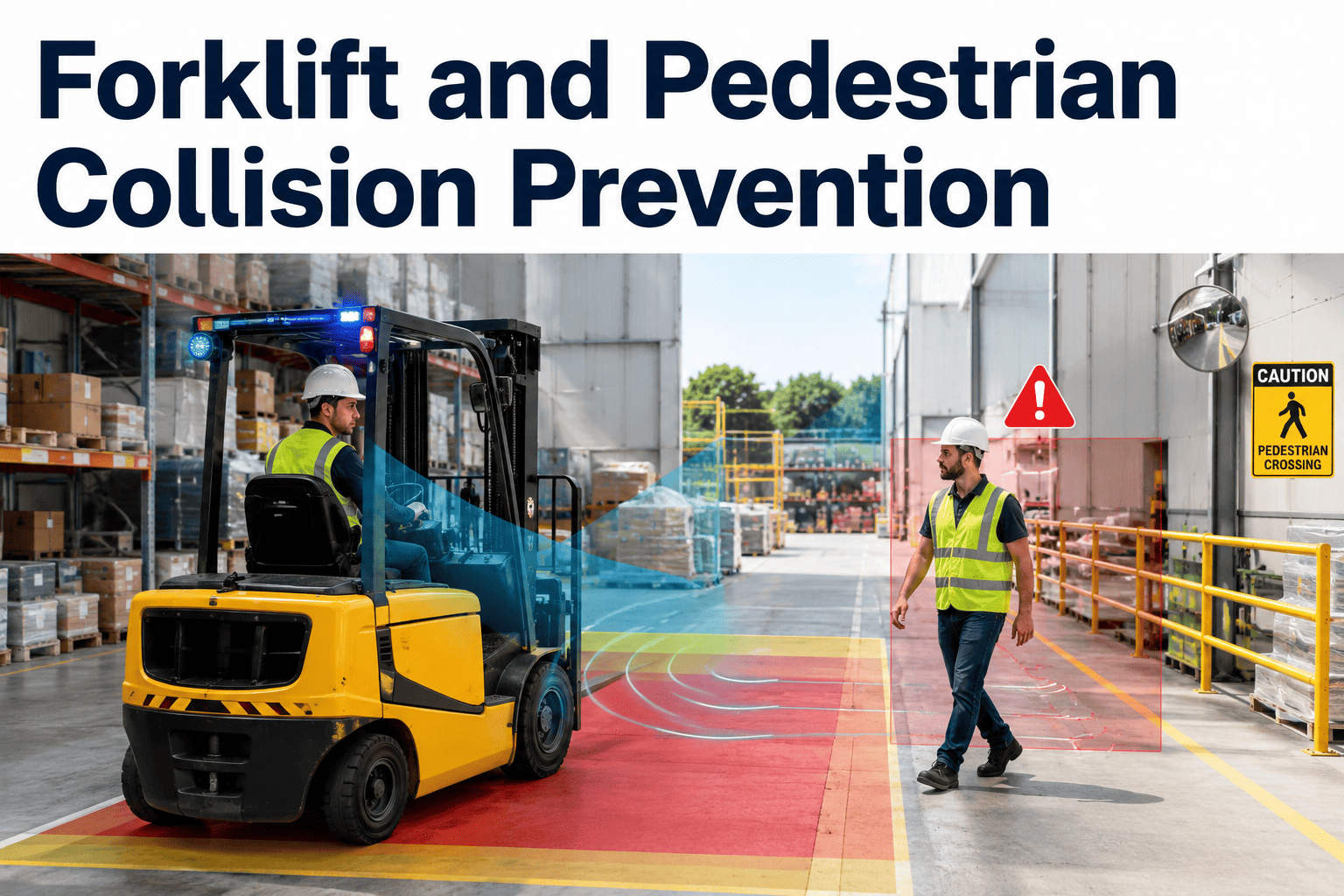
A forklift backing out of a narrow parts aisle and a technician walking the same path with a clipboard in hand rarely see each other until they are already close, because blind corners, stacked racking, and ambient noise all work against early awareness. Mirrors and painted walkways help, but they depend on both people looking at the right moment, and a busy shift gives plenty of moments where that does not happen. AI-based proximity and vision detection removes that dependency by watching the aisle continuously and warning both sides before a near miss becomes a collision, and you can book a demo to see it running in your own material handling areas.
FORKLIFT SAFETY · PEDESTRIAN DETECTION · COLLISION PREVENTION · MATERIAL AISLES
Forklift-Pedestrian Incidents Happen in the Half-Second Neither Side Was Looking
iFactory combines vision detection and proximity sensing to spot a pedestrian or forklift approaching a blind zone and alert both sides before they are close enough for a near miss to become a collision.
THE BLIND-CORNER PROBLEM
Racking, Noise, and Task Focus All Work Against Seeing Each Other in Time
Material handling aisles are full of exactly the conditions that make human awareness unreliable: tall racking blocking sightlines, ambient plant noise masking a horn, and both the driver and the pedestrian focused on their own task rather than scanning constantly for each other. Painted walkways and convex mirrors help, but they are passive measures that only work if someone happens to look at the right instant.
Top 3
Cause of Severe Plant Injury
Forklift-pedestrian incidents rank among the most serious injury categories reported across manufacturing and warehousing floors
<1 sec
Reaction Window at a Blind Corner
Typical time either party has to react once they become visible to each other at a blocked intersection
Most
Incidents at Intersections
Majority of forklift-pedestrian incidents occur at aisle intersections and dock crossings rather than open floor space
PASSIVE VS ACTIVE DETECTION
Why Mirrors and Painted Lines Are Not Enough on Their Own
Passive Safety Measures
Mirrors and painted walkways depend on someone looking at the right moment
No warning is given if attention is on a different task
Effectiveness varies by lighting, weather, and visibility conditions
No record exists of a near miss unless someone reports it
Active AI Detection
Vision and proximity sensing watch the aisle continuously
Both driver and pedestrian receive an alert before they are close
Detection performance is consistent regardless of lighting conditions
Every near miss is logged automatically for safety review
See Blind-Corner Detection Running in Your Own Aisles
iFactory identifies your highest-risk intersections and shows how continuous detection changes the outcome at each one.
WHAT THE SYSTEM DETECTS
Layered Detection Across Every Stage of an Approaching Interaction
Pedestrian Presence Detection
Vision sensing identifies a person entering a monitored aisle or intersection, even when partially obscured by racking or parked equipment.
Forklift Proximity Sensing
Onboard or infrastructure-mounted sensors track forklift position and speed relative to known intersections and blind corners across the facility.
Dual-Side Alerting
Both the driver and the pedestrian receive a warning as they approach a shared blind zone, rather than relying on only one side noticing the other.
Near-Miss Logging
Every alert event is logged with location and time, giving safety teams a data-driven view of which intersections need a physical layout change.
ALERT ESCALATION
How Warnings Escalate as a Forklift and Pedestrian Get Closer
| Zone |
Distance Band |
System Response |
| Awareness |
Approaching a monitored intersection |
Ambient light or display indicator activated |
| Alert |
Both parties within the same aisle segment |
Audible and visual alert sent to both sides |
| Stop |
Immediate collision risk detected |
Speed limiter or stop signal engaged where equipped |
MEASURED RESULTS
Outcomes Reported After Deploying Active Detection at Blind Intersections
62%
Reduction in recorded near-miss events at monitored intersections
3.4x
More near-miss events logged for safety review compared to self-reporting alone
0.4 sec
Average additional warning time gained before the point of mutual visibility
18%
Fewer forklift speed violations recorded in monitored zones
GETTING STARTED
Deploying Detection at Your Highest-Risk Intersections First
Step 1
Map High-Risk Zones
Historical near-miss reports and aisle layout are reviewed together to identify the intersections carrying the most risk.
Step 2
Install Detection Hardware
Vision sensors and proximity hardware are installed at priority intersections without requiring changes to existing racking layout.
Step 3
Calibrate Alert Thresholds
Distance and speed thresholds for each alert zone are tuned to the specific geometry and traffic pattern of each intersection.
Step 4
Review Near-Miss Data
Logged events feed a regular safety review, guiding decisions on layout changes, speed limits, or added signage where patterns emerge.
FREQUENTLY ASKED QUESTIONS
Questions Safety Managers Ask About Collision Prevention Systems
Does this require retrofitting every forklift in our fleet with new hardware?
Not necessarily, since detection can be deployed as fixed infrastructure at high-risk intersections, as onboard forklift sensors, or as a combination of both depending on your facility layout and traffic patterns. Many plants start with infrastructure-based detection at the busiest intersections and expand to onboard sensors on specific vehicles only where the assessment shows it adds meaningful additional coverage.
Book a demo to review the right mix of hardware for your facility.
Will constant alerts create alarm fatigue for drivers and pedestrians?
Alert thresholds are calibrated per intersection so that warnings trigger only when an actual proximity risk exists, rather than firing on every routine pass through a monitored area, which is what causes alarm fatigue in poorly tuned systems. The escalation model also means most interactions only reach the lower-intensity awareness stage, with the louder alert reserved for genuine close-approach situations.
Contact support to review threshold tuning for your specific aisles.
How does the system perform in low-light areas or during night shifts?
Detection combines vision sensing with proximity-based methods that do not depend solely on ambient lighting, so performance is designed to remain consistent across day, night, and mixed-lighting areas of the facility. Camera placement and sensor selection are reviewed as part of the site assessment specifically to account for each intersection's lighting conditions across all shifts.
Book a demo to see performance data from low-light deployments.
Can the near-miss data be used for anything beyond immediate alerting?
Yes, every logged event includes location, time, and approach speed, which safety teams typically use to build a data-driven case for layout changes, speed limit adjustments, or added signage at intersections that show a recurring pattern. This turns what used to be anecdotal safety concerns into a documented trend that supports capital requests for physical changes.
Contact support to see a sample near-miss trend report.
Does this integrate with our existing forklift fleet management or telematics system?
In most cases yes, since the platform is built to export alert and near-miss data to common fleet management and telematics systems already used in warehousing and plant environments, avoiding a separate standalone reporting tool your team has to check independently. Where a specific integration is not already supported, our team can assess a custom connection during the initial planning phase.
Book a demo to discuss integration with your current fleet system.
Stop Relying on a Mirror to Prevent the Next Near Miss
iFactory watches your busiest intersections continuously and warns both sides before a collision risk becomes real.