A cloud round-trip takes anywhere from 200 to 800 milliseconds by the time a signal leaves the plant, gets processed, and returns with a decision. A press line running at full speed cannot wait that long before a defect becomes ten defects, and a vision system guiding a robotic arm cannot wait that long before the arm has already moved. This is why the digital roadmap for 2026 inside most automotive plants has quietly shifted away from cloud-first thinking toward on-premise inference running a few feet from the equipment it protects. If your team is mapping out where AI workloads should physically live on the floor, book a demo to see an on-prem architecture built for automotive lines.
Architecture Brief
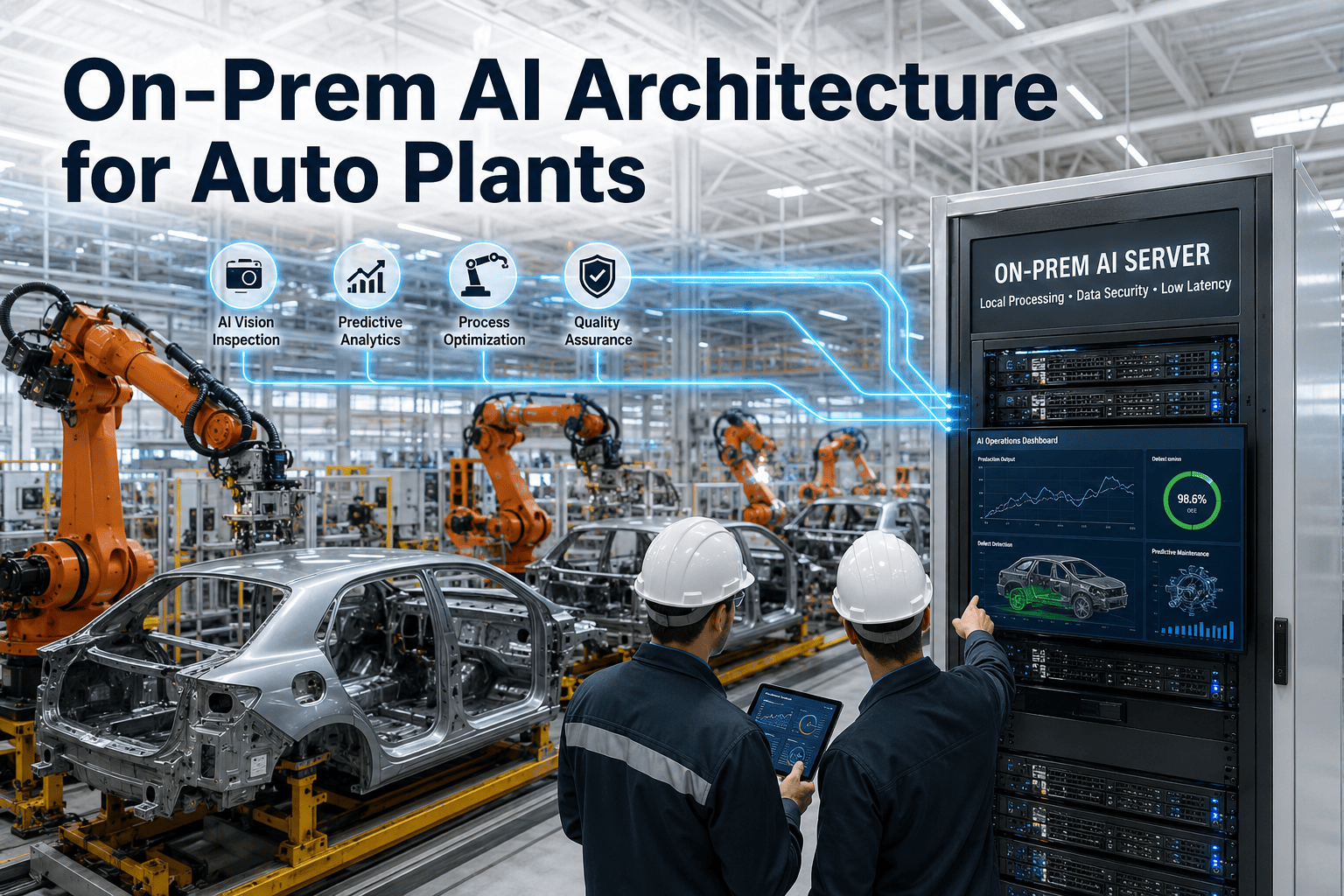
On-Prem AI Architecture for Automotive Plants
Why line-side decisions need millisecond latency, air-gapped security, and full data sovereignty that cloud-only AI cannot deliver at automotive scale
Sub-15ms
Typical on-prem edge inference latency
80%
Of industrial AI inference expected to run locally by year-end 2026
The Physics Problem Cloud AI Cannot Solve
Automotive plants are not choosing on-prem AI as a preference. They are choosing it because a press, a weld robot, or a vision-guided pick station simply cannot tolerate a network round trip on the critical path.
01
Round-Trip Distance
A cloud data center a thousand miles away adds unavoidable transit time before any AI insight even begins processing, regardless of how fast the model itself runs.
02
Network Variability
Plant networks share bandwidth with ERP traffic, video feeds, and remote access sessions, so cloud latency is never a fixed number — it spikes exactly when the line is busiest.
03
Connectivity Risk
Any AI decision that depends on an internet connection stops working the moment that connection drops, and a stalled quality gate is worse than no gate at all.
The On-Prem Stack: What Runs Where
A production-grade automotive AI architecture is layered by design. Each layer has a job, a latency budget, and a reason it lives where it lives.
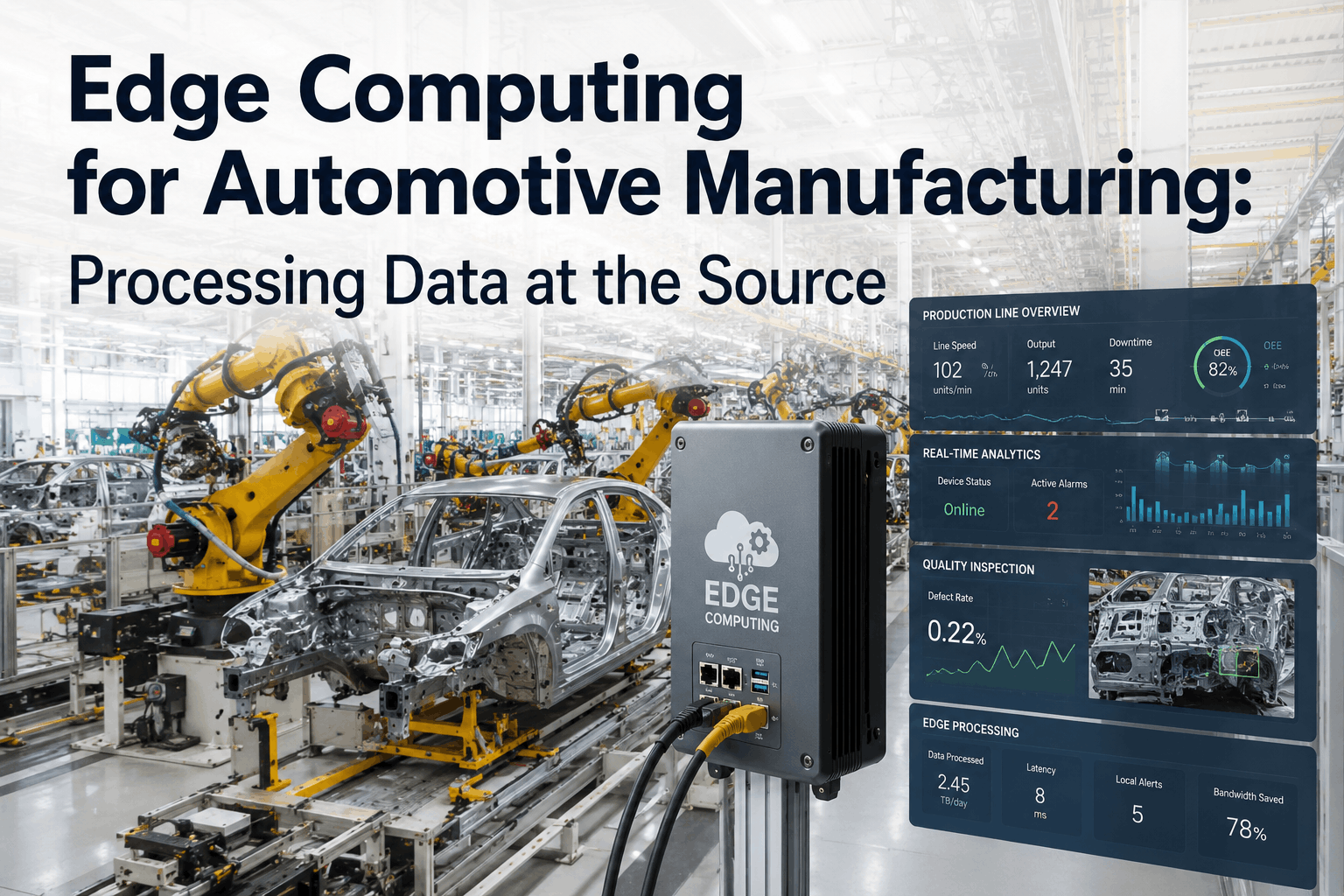
Line-Side Edge
Cameras, sensors, PLCs. Raw signals captured directly at the station.
<1 ms
On-Prem GPU Server
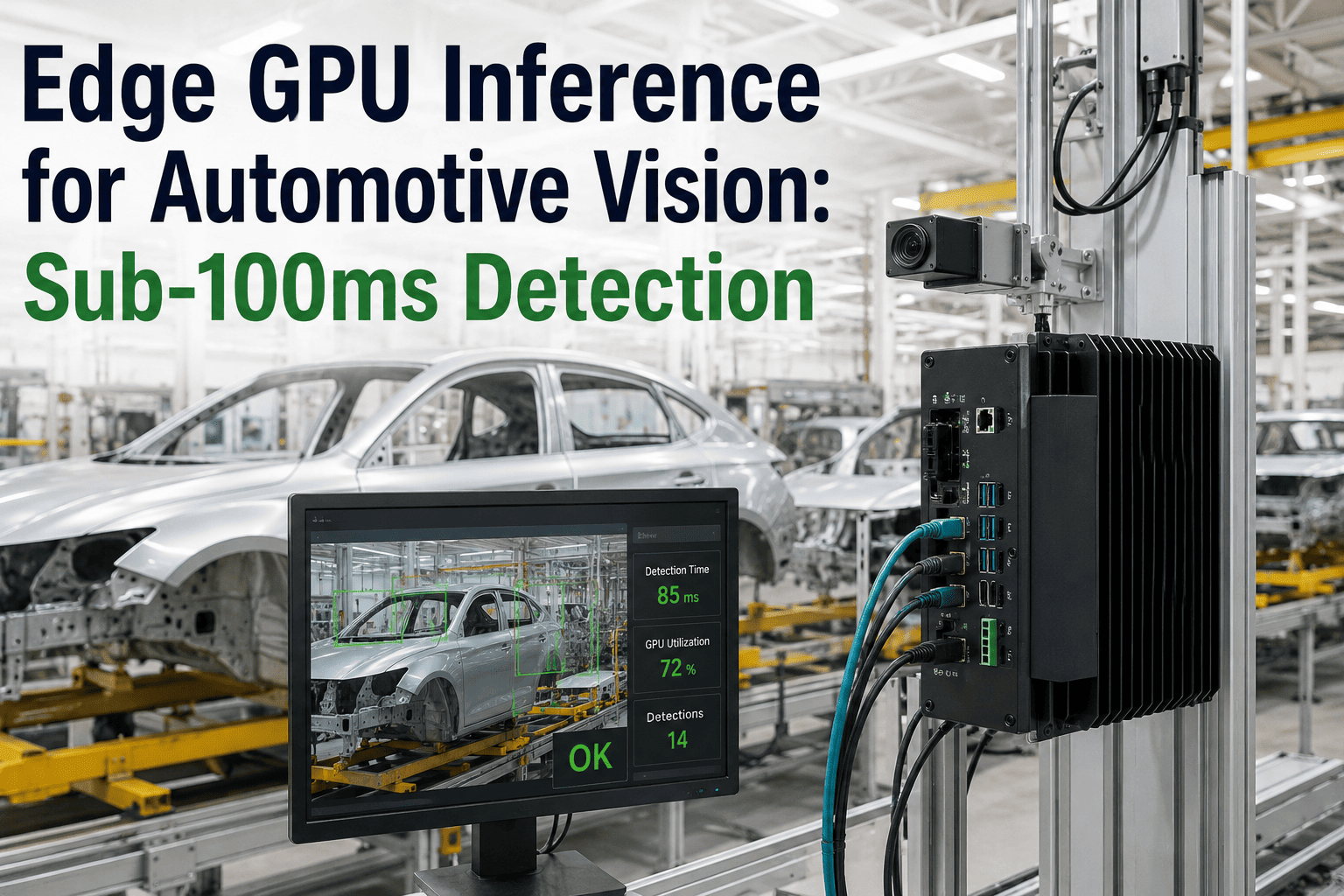
NVIDIA edge servers run inference inside the plant network — vision models, anomaly detection, control recommendations.
2–15 ms
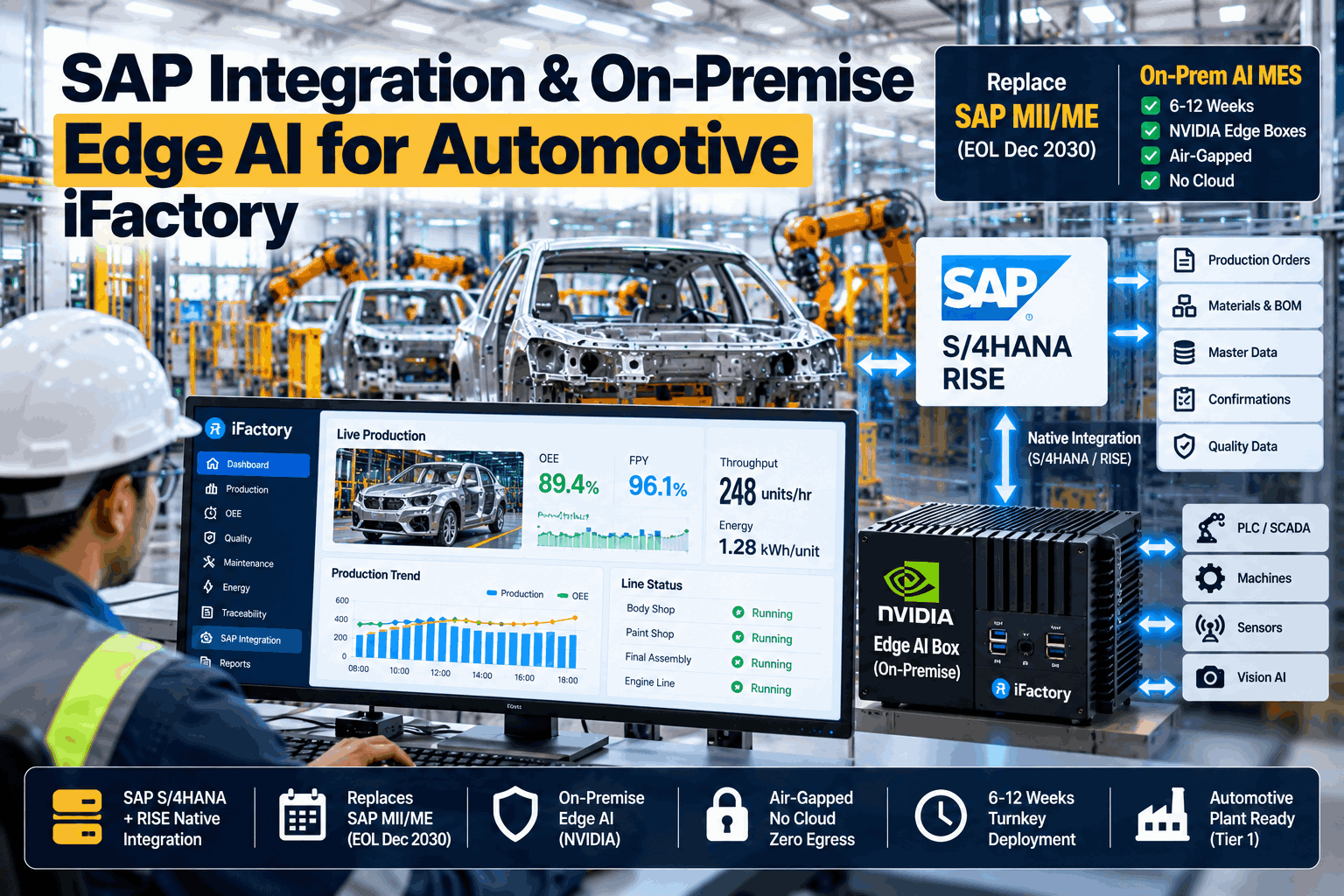
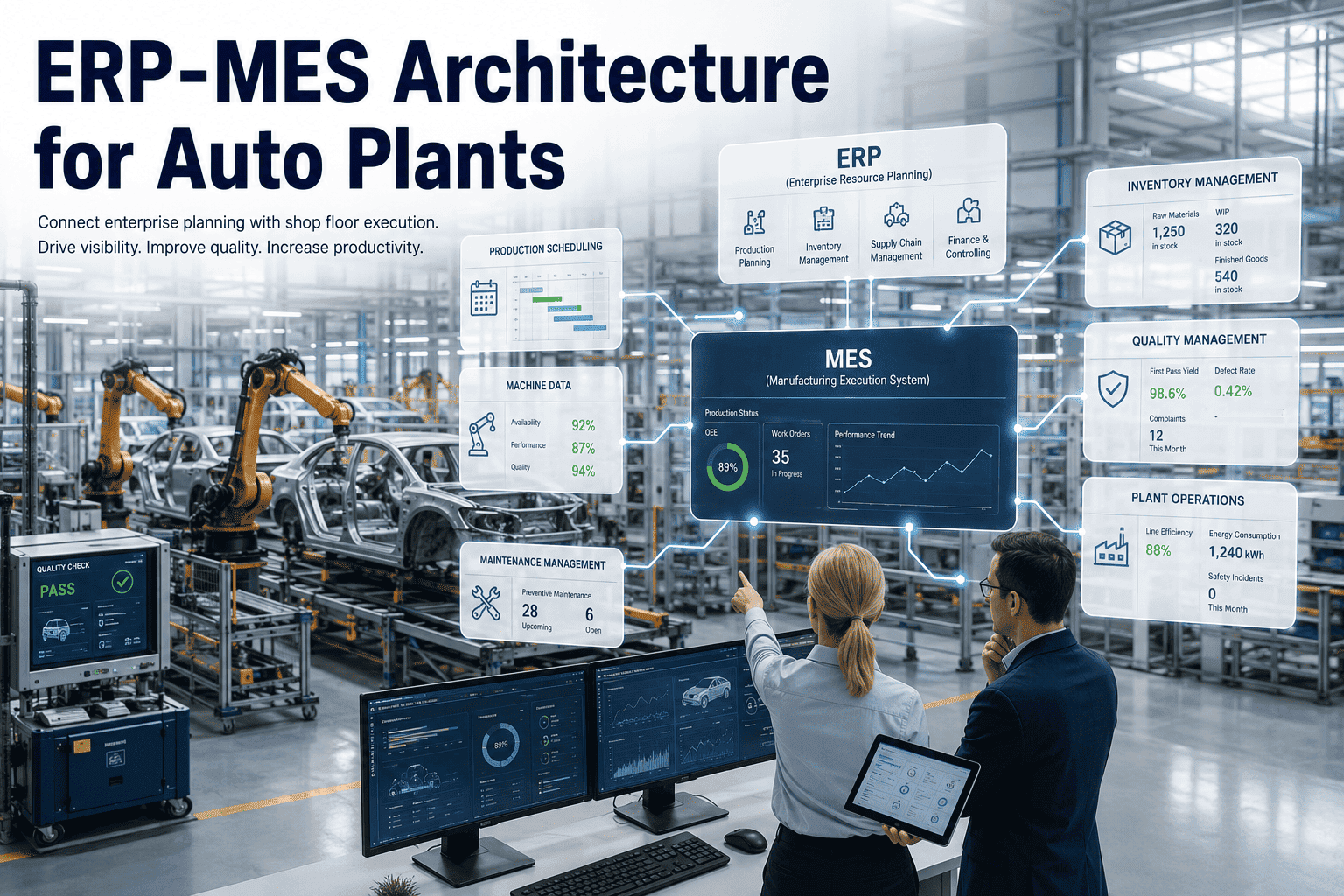
Plant Historian & MES
Aggregated results, trends, and quality records sync locally to MES and SCADA systems.
Seconds
Cloud (Optional)
Only aggregated, non-sensitive summaries leave the building — for cross-plant reporting, not real-time decisions.
Minutes+
See the Stack Running on a Real Line
An architecture diagram is easier to trust once you have watched it hold up against your own plant's network conditions and equipment mix.
Data Sovereignty and Compliance by Architecture
On-prem AI does not just solve latency. It solves the harder conversation with a compliance officer about where sensitive process and production data physically resides.
IEC 62443
Industrial cybersecurity requirements are satisfied when inference hardware never exposes an open path to the public internet.
NIST 800-82
OT security guidance is met by architecture rather than by a configuration workaround layered on top of a cloud connection.
GDPR & Regional Rules
Process data that never leaves the facility sidesteps cross-border data transfer questions entirely for multinational operations.
Air-Gap Option
Highest-security lines can run with zero internet connectivity required for inference, with updates delivered on a controlled schedule.
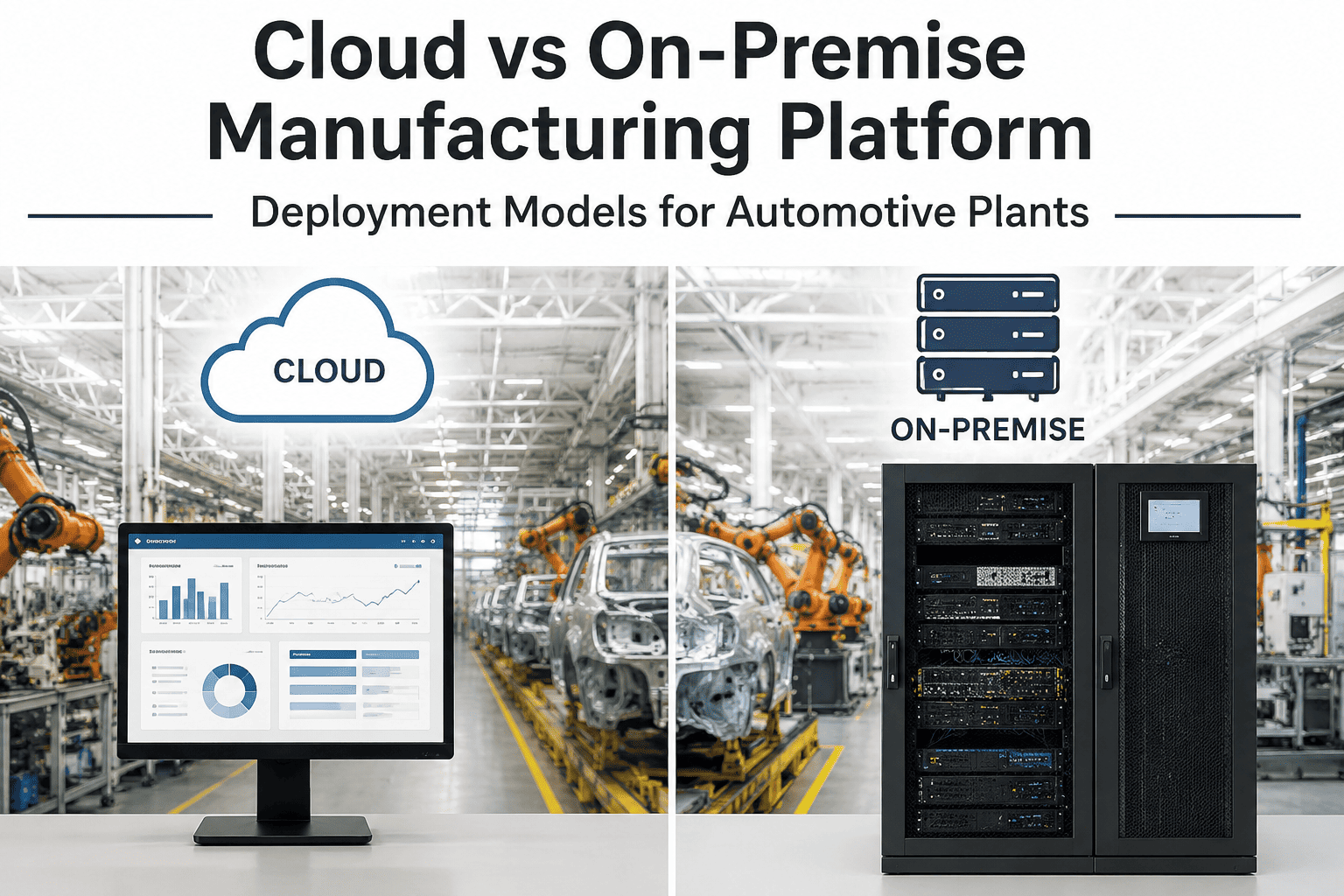
On-Prem vs Cloud-Only AI: A Direct Comparison
Neither approach is universally wrong, but automotive line decisions have a specific latency and sovereignty profile that tips the balance clearly toward on-prem for anything touching the production line itself.
| Dimension |
Cloud-Only AI |
On-Prem Edge AI |
| Typical inference latency |
200–800 ms round trip |
Under 15 ms |
| Works without internet |
No |
Yes, fully air-gap capable |
| Data leaves the facility |
Yes, by default |
No, only aggregated summaries if configured |
| Best suited for |
Cross-plant reporting, long-horizon analytics |
Real-time vision, control loops, safety-critical alerts |
| Hardware footprint |
None on-site |
Edge GPU server per line or zone |
| Resilience during network outage |
Decisions stop |
Decisions continue uninterrupted |
What Changes for the Team Running the Line
An architecture decision like this eventually shows up as a difference operators and engineers can actually feel on the floor, not just a diagram in a planning deck.
Operators stop waiting on a dashboard that lags behind what they can already see happening in front of them. A vision-guided station that flags a defect the moment a part passes, instead of a few hundred milliseconds later, feels instantaneous rather than assisted, which is a meaningfully different experience for the person standing at that station all shift. Maintenance engineers gain a similar shift in how alerts arrive — a precursor signal that used to be buried in a historian query now surfaces as a real-time notification because the model generating it is running a few feet away rather than across a network boundary.
For the digital lead accountable for the architecture itself, the practical benefit is fewer escalations tied to network conditions outside their control. A cloud outage, a VPN hiccup, or a saturated WAN link no longer determines whether a safety-critical inspection station keeps running. That resilience is difficult to quantify on a spreadsheet next to latency numbers, but it is frequently the argument that ultimately convinces a plant director to fund the transition.
Where On-Prem AI Delivers the Fastest Payback
Not every workload needs to move on-prem on day one. The highest-value starting points are the ones where a delayed decision has an immediate cost.
Vision-Guided Robotics
Pick-and-place and weld robots need a decision inside a single control cycle, not after a network round trip.
Real-Time Defect Detection
Surface and dimensional inspection at line speed depends on inference finishing before the part reaches the next station.
Predictive Shutdown Triggers
Vibration and thermal anomaly alerts that protect equipment need to fire in milliseconds, not after a cloud queue clears.
Safety Interlocks
Any AI feeding a safety-rated decision path should never depend on connectivity that can be interrupted.
Planning the Transition Without Disrupting the Floor
Digital leads inheriting a mixed cloud-and-on-prem environment rarely get to start from a blank slate. The realistic path is a phased migration that respects what is already running well.
The first phase is almost always an audit: mapping which existing workloads sit on a time-critical path and which are genuinely fine living in the cloud. Vision inspection, robotic guidance, and any control-loop feedback belong on the short list for on-prem migration first, since these are the workloads where a network hiccup translates directly into a line stop or a missed defect. Reporting dashboards, long-horizon trend analysis, and cross-plant benchmarking can generally stay wherever they already run without urgency, because a few seconds or minutes of latency does not change the value of that data.
The second phase is hardware sizing. Rather than provisioning for an entire plant at once, most digital leads start with a single line or a single zone, sized to the camera count and inference load that zone actually needs. This keeps capital exposure low while the architecture proves itself against real plant conditions — network jitter, ambient temperature, and the specific mix of PLC and SCADA systems already installed. Once that first zone is validated, scaling to additional lines is largely a repeat of a known pattern rather than a fresh integration project, which is typically where the timeline compresses the most.
Frequently Asked Questions
Does on-prem AI mean giving up cloud analytics entirely?
No. Most automotive plants run a hybrid model where real-time inference happens on-prem, close to the equipment, while aggregated summaries and longer-horizon trends sync to the cloud for cross-plant reporting and executive dashboards. The distinction is which workloads sit on the time-critical path. A quality alert that needs to stop a line in milliseconds stays on-prem, while a monthly yield comparison across five plants can comfortably live in the cloud. A
demo call can map which of your specific workloads belong in each tier.
What hardware is actually required inside the plant?
A typical deployment uses NVIDIA edge GPU servers rated for industrial environments, capable of running from harsh temperature ranges and tolerating shock and vibration near production equipment. The exact server count depends on how many lines and camera streams need simultaneous inference, and this is confirmed during a plant walkthrough rather than estimated on paper. Existing IP cameras and sensors are frequently reusable, which keeps the hardware footprint smaller than most teams expect going in.
How does on-prem AI connect to our existing PLCs and SCADA?
On-prem AI servers connect through standard industrial protocols such as OPC-UA, reading data from PLCs and SCADA systems without requiring reprogramming or hardware replacement. The AI layer sits on top of the existing automation stack rather than replacing it, which is one of the main reasons deployment timelines stay short compared to a full controls overhaul. Specific compatibility with your PLC vendor and SCADA platform is confirmed early in planning, and
support can walk through your current setup directly.
Is an air-gapped deployment actually practical for a working plant?
Yes, and it is increasingly common for lines handling sensitive process data or operating under strict regulatory requirements. An air-gapped configuration runs all inference, model updates, and record-keeping entirely inside the facility network, with zero internet connectivity required for day-to-day operation. Software updates and model retraining are handled through a controlled, scheduled process rather than a live connection, which satisfies the strictest OT security postures without sacrificing AI capability.
How long does an on-prem AI rollout typically take?
A single high-impact station, such as one inspection point or one predictive maintenance zone, typically moves from hardware installation to a validated, live system within four to six weeks. Full multi-line rollouts extend from there once the first station has documented results and the integration pattern with your PLC and SCADA environment is proven. Teams that try to convert an entire plant at once tend to stall; starting narrow and expanding is consistently the faster path to a documented result.
Map Your Plant's On-Prem AI Architecture
Every millisecond a line-side decision waits on a network round trip is a millisecond of exposure your competitors running edge AI no longer carry.