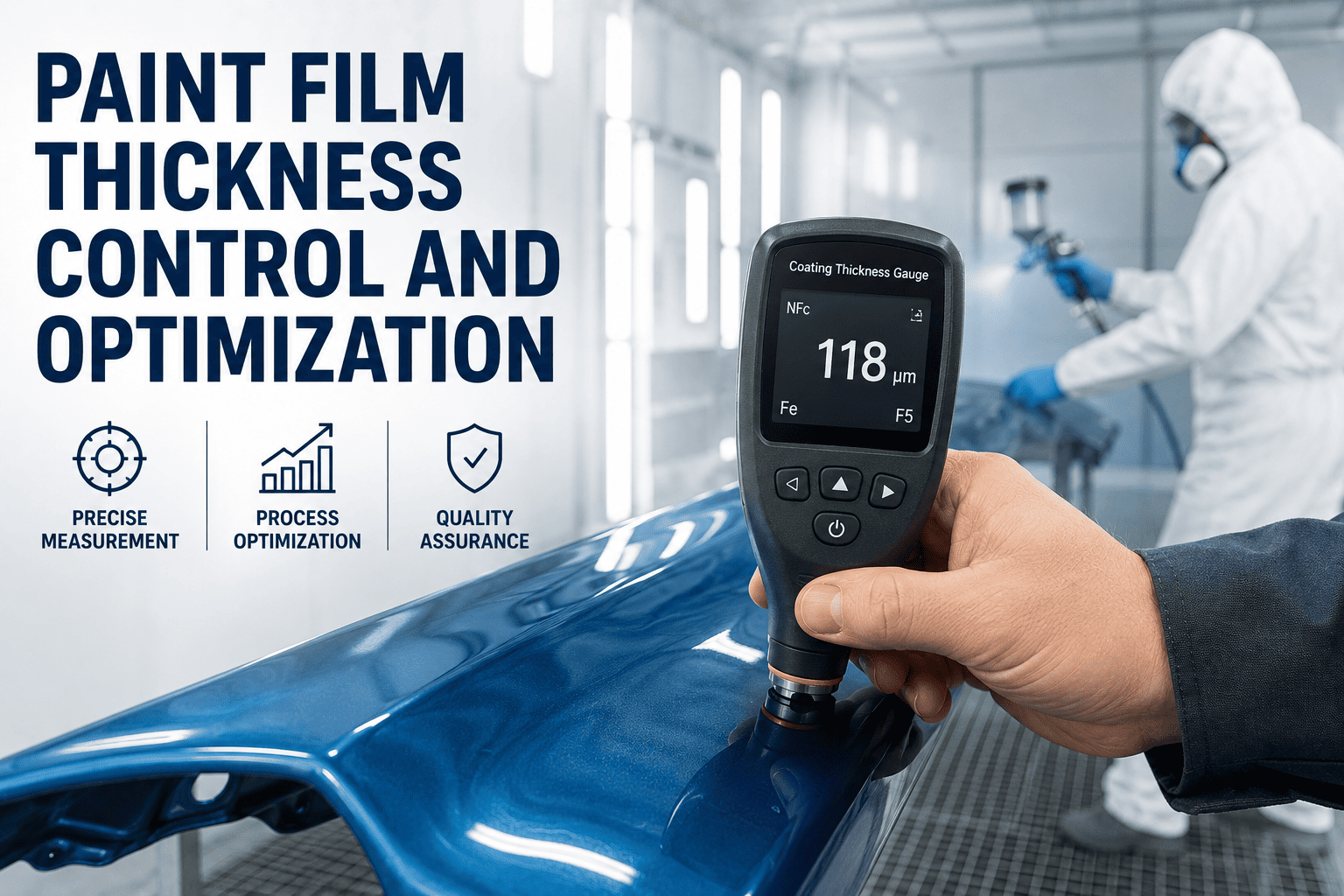
In high-volume paint operations, especially in automotive and industrial coating lines, controlling paint film thickness with precision is a constant battle. Even minor deviations from the target film build—measured in microns—can cascade into severe quality defects, massive material overconsumption, and costly rework. Traditional feedback loops rely on manual sampling and offline thickness gauges, introducing latency that allows drift to persist for hundreds of parts before correction. This delay not only wastes expensive paint materials but also jeopardizes critical performance attributes like corrosion resistance, chip protection, and gloss retention. Advanced manufacturers are now turning to AI-driven film thickness control systems that fuse real-time process data—flow rates, atomizer speeds, booth temperature, humidity, and part geometry—with predictive models to anticipate thickness variations before they occur. By proactively adjusting application parameters, these systems hold film build tightly on target across color changes, substrate variations, and line speed fluctuations, reducing paint giveaway by 15-25% while improving first-pass yield. For paint process engineers and plant managers seeking to cut costs without compromising quality, adopting AI-based film thickness optimization is no longer optional—it is a competitive necessity. Book a Demo to see how iFactory's AI module transforms your paint line.
Precision Film Build: The Economic and Quality Imperative
Every micron of paint carries cost. AI ensures you never apply more than needed—or less than required.
Real-Time Process Data Fusion
AI ingests data from flow meters, viscosity sensors, atomizer RPM, booth climate, and part geometry to build a high-resolution picture of current coating conditions.
Predictive Deviation Modeling
Machine learning models trained on historical thickness measurements predict where film build will drift off target, enabling preemptive parameter adjustments.
Closed-Loop Parameter Control
The system automatically adjusts paint flow, atomizer speed, and gun triggering in real time to maintain target thickness, eliminating manual intervention delays.
Color Change Optimization
Different pigments have different hiding power. AI adapts film build targets per color, reducing over-application on high-opacity colors and ensuring coverage on low-opacity ones.
Implementation Journey: From Data to Closed-Loop Control
Sensor Integration & Data Pipeline
Install high-frequency flow meters, temperature/humidity sensors, and connect to existing PLCs and vision systems. Data is streamed to a central edge gateway for preprocessing.
Model Training & Calibration
Historical thickness measurements (both wet and dry film) are paired with process parameters to train a regression model. The model is calibrated using offline gauge samples for accuracy.
Real-Time Prediction & Advisory
The trained model runs in real time, outputting predicted film thickness every 100ms. Operators see a dashboard with alerts when deviation exceeds a configurable threshold.
Closed-Loop Automation
After validation, the system is given control authority to adjust paint flow and atomizer speed directly. Safety limits prevent extreme changes, ensuring process stability.
Technical Architecture of AI Film Thickness Control
At the core of iFactory's solution lies a multi-modal neural network that fuses structured sensor data with unstructured part geometry features extracted from CAD models. The network architecture employs a temporal convolutional network (TCN) to capture time-dependent patterns in process variables, combined with a fully connected regression head that outputs a continuous thickness prediction. Training data is sourced from thousands of production parts, each labeled with dry film thickness measurements from offline gauges. Data augmentation techniques—such as adding synthetic noise and simulating sensor drift—improve model robustness. The inference engine runs on an edge device (NVIDIA Jetson or equivalent) with sub-10ms latency, ensuring real-time responsiveness. A separate anomaly detection module flags sensor failures or process disturbances, triggering a fallback to safe default parameters. The entire pipeline is containerized and orchestrated via Kubernetes, enabling seamless updates and scaling across multiple paint booths.
Comparative Analysis: Traditional vs. AI-Based Film Thickness Control
| Parameter | Traditional Control | AI-Based Control |
|---|---|---|
| Update Frequency | Every 30-60 minutes (manual sampling) | Every 100ms (real-time) |
| Deviation from Target | ±8-12 microns | ±2-4 microns |
| Paint Giveaway | 20-30% over target | 5-10% over target |
| Color Change Adaptation | Manual recipe adjustment | Automatic target optimization |
| First-Pass Yield | 75-80% | 90-95% |
| Reject Rate | 5-8% | 1-3% |
Ready to Cut Paint Waste by 20%?
See how AI-driven film thickness control transforms your bottom line. Schedule a personalized demo with our industry experts.
Real-World Impact: Automotive Tier 1 Supplier Achieves 18% Paint Savings
A major automotive tier 1 supplier operating a high-volume paint line for exterior trim parts implemented iFactory's AI film thickness control across six robotic paint booths. Within three months, the system reduced average film thickness from 85 microns to 72 microns while maintaining all quality specifications. Paint consumption dropped by 18%, translating to annual savings of €1.2 million. First-pass yield increased from 78% to 93%, reducing rework and scrap costs. The project payback period was under six months. Operators reported higher confidence in process stability, and the quality team noted a 40% reduction in customer complaints related to paint appearance.
Wet Film vs. Dry Film: Dual Measurement Strategy
AI models can be trained on both wet film thickness (measured inline via laser triangulation) and dry film thickness (measured offline). Correlating the two enables predictive control that compensates for solvent evaporation and curing dynamics.
Substrate Influence Compensation
Different substrates (steel, aluminum, plastic) have different thermal conductivity and surface energy, affecting paint flow and adhesion. AI models learn these relationships and adjust parameters per substrate type automatically.
Humidity & Temperature Feedforward
Booth climate conditions directly impact paint viscosity and evaporation rate. AI feedforward control uses weather forecast data and real-time sensors to preemptively adjust application parameters before conditions change.
Multi-Color Batch Sequencing
In high-mix paint lines, frequent color changes cause transient thickness spikes due to purge cycles. AI optimizes the sequencing and purge parameters to minimize material loss during changeovers.
Frequently Asked Questions
How does AI handle the variability between different paint chemistries (solvent-based vs. waterborne)?
The AI model is trained on a dataset that includes both solvent-based and waterborne paint runs, each with distinct rheological properties. During inference, the system automatically detects the paint type via barcode or recipe ID and selects the corresponding model branch. The neural network architecture includes a categorical embedding layer that encodes paint chemistry, allowing the model to adjust its predictions for differences in viscosity, solids content, and drying behavior. This ensures that film thickness targets are met regardless of the coating material. For more details on integration, contact our support team.
What is the minimum data required to train an accurate film thickness prediction model?
A robust model typically requires at least 500 labeled parts spanning the full range of operating conditions—different colors, substrates, line speeds, and booth climates. Each part must have corresponding process parameter logs (flow rate, atomizer speed, temperature, humidity) and a dry film thickness measurement. If historical data is limited, transfer learning from a pre-trained model on similar paint lines can reduce the required dataset to approximately 200 parts. iFactory provides a data readiness assessment to help you determine if your existing data is sufficient. To schedule a data audit, book a demo.
Can the AI system be retrofitted to existing paint booths without major hardware changes?
Yes, the iFactory solution is designed as a bolt-on edge computing platform that connects to existing PLCs and sensors via standard industrial protocols (OPC UA, Modbus, Profinet). No changes to the robotic applicators or paint delivery system are required. The edge device runs the inference engine and communicates setpoint adjustments to the PLC over a secure network. Installation typically takes two to three days per booth, including sensor calibration and model validation. For a detailed integration guide, visit our support page.
How does the system ensure safety and prevent runaway conditions during closed-loop control?
Safety is paramount. The AI controller operates within hard-coded limits for flow rate, atomizer speed, and gun trigger timing. If the model requests a parameter change that exceeds these limits, the request is rejected and logged for review. Additionally, an independent watchdog timer monitors system health; if the edge device fails to send a heartbeat signal within 500ms, the PLC reverts to safe default parameters. All control actions are recorded in an immutable audit trail for compliance with ISO 9001 and IATF 16949. For more on safety features, contact support.
What is the typical ROI timeline for implementing AI film thickness control?
Based on implementations across multiple automotive and industrial coating facilities, the average payback period is between 4 and 8 months. The primary driver is paint material savings, typically 15-25%, followed by reductions in rework and scrap. For a facility consuming 100,000 liters of paint annually at €20 per liter, a 20% savings translates to €400,000 per year. Including the cost of the edge hardware, software license, and integration services, the total investment is usually recovered within the first year. To get a customized ROI estimate for your line, book a demo.
Transform Your Paint Line with AI Precision
Stop wasting paint on over-application. Achieve micron-level control and unlock millions in savings. Talk to our experts today.