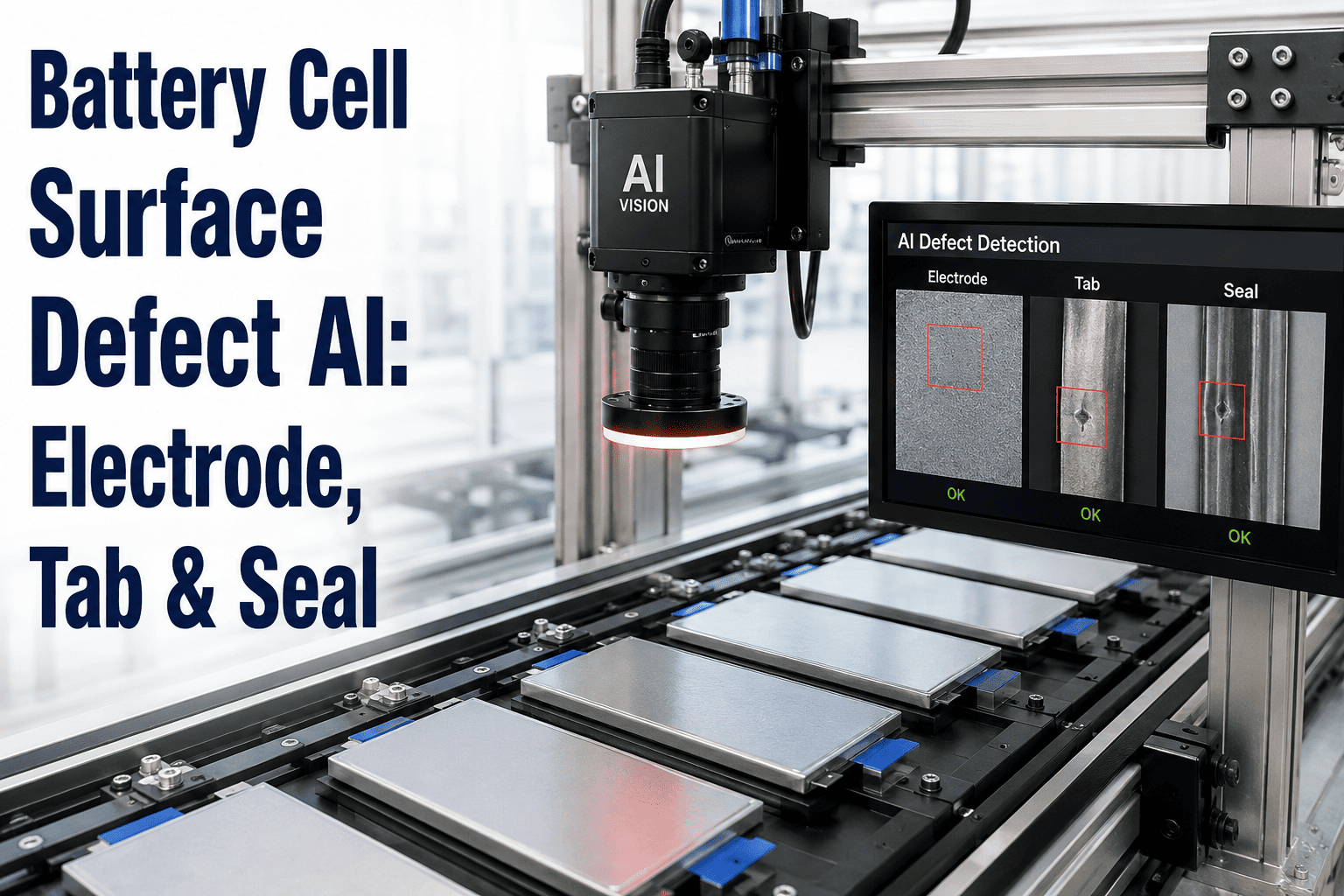
The transition to electric vehicles has accelerated demand for high-energy-density pouch cells, yet their inherently flexible packaging introduces unique quality challenges that can compromise safety and performance. A single micron-sized pinhole in the seal, a barely visible tab deformation, or a microscopic foil protrusion can lead to electrolyte leakage, internal short circuits, and ultimately thermal runaway—a catastrophic failure that not only destroys the cell but can cascade across an entire battery pack. Traditional manual inspection methods, relying on human visual acuity under magnification, are simply inadequate for the volumes and precision required in modern gigafactories. They are slow, subjective, and prone to fatigue-induced errors, resulting in costly escapes that erode brand reputation and pose serious safety risks. This is why leading pouch cell manufacturers are turning to artificial intelligence (AI) and machine vision to automate and enhance every aspect of pouch seal and surface inspection. By deploying deep learning models trained on millions of defect images, these systems can identify and classify anomalies with superhuman speed and consistency, operating 24/7 at line speeds exceeding 200 parts per minute. Book a Demo to see how iFactory's AI vision platform can transform your pouch cell quality assurance.
Eliminate Pouch Cell Defects with AI Vision
Deploy deep learning models that detect pinholes, tab deformations, and surface anomalies with 99.99% accuracy. Protect your brand and your customers.
Seal Pinholes
Microscopic holes in the heat-sealed perimeter that allow electrolyte to escape and moisture to ingress. AI vision systems use high-resolution line-scan cameras and deep learning to detect pinholes as small as 10 microns.
Tab Deformation
Bent or misaligned electrode tabs that can cause poor electrical contact or internal shorts. 3D laser profilometry combined with AI shape analysis ensures tab geometry meets specification.
Foil Protrusion
Sharp edges or burrs on the aluminum or copper foil that can pierce the separator. AI classification models trained on surface topography data identify protrusions before they cause failures.
Surface Contamination
Foreign particles, dust, or electrolyte residue on the pouch surface that can compromise seal integrity. Hyperspectral imaging and AI detect contaminants invisible to the human eye.
Traditional machine vision relies on rule-based algorithms that struggle with the natural variability of pouch cell surfaces. Reflections, subtle color changes, and the inherent flexibility of the pouch material create false positives that slow down production and frustrate operators. AI-based inspection overcomes these limitations by learning from thousands of annotated images what constitutes a true defect versus acceptable variation. Convolutional neural networks (CNNs) analyze each pixel and its context, enabling the system to distinguish between a harmless scratch and a critical seal breach. Furthermore, AI models can be continuously updated with new defect types as they emerge, ensuring the inspection system evolves with the manufacturing process. This adaptability is crucial for high-mix, high-volume production environments where pouch cell formats and materials change frequently.
Image Acquisition
High-speed line-scan cameras and 3D sensors capture multiple views of each pouch cell at line speed.
Preprocessing
Images are normalized for lighting, reflection, and positioning variations to ensure consistent analysis.
AI Inference
Trained deep learning models classify each region of interest as pass or fail, with sub-pixel accuracy.
Decision & Reject
Defective cells are automatically rejected and sorted for root cause analysis, while good cells proceed.
Stop Escapes Before They Happen
Integrate AI vision into your pouch line and achieve true zero-defect manufacturing. Our platform is proven in gigafactory environments.
| Defect Category | Sub-Type | AI Detection Method | Criticality |
|---|---|---|---|
| Seal Defects | Pinhole, Crack, Delamination | Deep learning on bright-field images | High |
| Tab Defects | Deformation, Misalignment, Burr | 3D laser profilometry + CNN | High |
| Surface Defects | Scratch, Dent, Contamination | Hyperspectral imaging + AI | Medium |
| Foil Defects | Protrusion, Tear, Wrinkle | Structured light + AI segmentation | High |
| Geometry Defects | Dimension out of spec, Warpage | Machine vision gauging + AI | Medium |
Seal pinholes are among the most dangerous and difficult-to-detect defects in pouch cell manufacturing. These microscopic openings, often less than 20 microns in diameter, can form during the heat sealing process due to contamination, temperature fluctuations, or pressure variations. Once a pinhole exists, it creates a pathway for electrolyte to leak out and moisture to ingress, leading to capacity fade, swelling, and eventually internal short circuits. AI vision systems address this challenge by using high-resolution line-scan cameras with specialized optics and lighting to capture images of the seal area at multiple angles. The AI model, trained on a dataset of hundreds of thousands of seal images, learns to identify the subtle texture and intensity changes that indicate a pinhole. Unlike traditional thresholding methods, the AI can reject false positives caused by seal wrinkles or reflections, maintaining high throughput while ensuring no defect escapes. In production, these systems have demonstrated a defect capture rate of 99.99% with a false positive rate below 0.1%.
Electrode tabs are the critical electrical interface between the pouch cell and the battery pack. Any deformation, misalignment, or burr on the tab can cause poor welding, increased resistance, or even arcing during operation. Traditional 2D vision systems struggle to measure the three-dimensional geometry of tabs accurately, especially when the pouch material is flexible and the tab position can vary. 3D laser profilometry solves this by projecting a laser line across the tab surface and measuring the reflected light to create a high-resolution height map. AI algorithms then analyze this 3D profile to detect anomalies such as bending, twisting, or burrs that exceed specification limits. The system can measure tab flatness, coplanarity, and edge quality with micron-level precision, all at line speed. By integrating this data with the overall pouch inspection system, manufacturers can correlate tab defects with other quality parameters, enabling a holistic view of cell health.
Beyond real-time defect detection, AI vision systems generate a wealth of data that can be used to optimize the entire pouch cell manufacturing process. By tracking defect rates by station, shift, and material batch, manufacturers can identify root causes and implement corrective actions quickly. For example, if a spike in seal pinholes is correlated with a specific seal bar temperature, the system can alert operators to adjust parameters before a large batch of defective cells is produced. Predictive analytics models can even forecast defect trends based on historical data, enabling proactive maintenance and process adjustments. This closed-loop quality control transforms inspection from a cost center into a strategic asset, reducing scrap, improving yield, and accelerating time to market for new cell designs. iFactory's platform provides dashboards and reports that make this data actionable for plant managers, quality engineers, and process engineers alike.
Frequently Asked Questions
What is the smallest defect an AI vision system can detect on a pouch cell seal?
Modern AI vision systems equipped with high-resolution line-scan cameras and deep learning models can reliably detect pinholes as small as 10 microns in diameter. For reference, this is about one-tenth the width of a human hair. Detection limits depend on factors such as camera resolution, lighting, and the specific AI model architecture. iFactory's platform uses multi-angle illumination and a specialized CNN that achieves sub-pixel accuracy, enabling detection of defects that are invisible to conventional machine vision. Book a Demo to see our system in action on your pouch cells.
How does AI vision handle the variability in pouch cell materials and formats?
AI models are trained on diverse datasets that include multiple pouch cell formats, materials (aluminum laminate, steel laminate), and surface finishes. The training process involves data augmentation techniques that simulate variations in lighting, angle, and surface texture, making the model robust to real-world conditions. Additionally, iFactory's platform supports transfer learning, allowing a base model to be fine-tuned on a specific cell type with just a few hundred images. This means deployment on a new pouch line can be accomplished in days, not weeks. Contact Support to discuss your specific requirements.
What is the false positive rate of AI-based pouch inspection, and how does it affect throughput?
In well-tuned production systems, the false positive rate is typically below 0.1%, meaning fewer than one in a thousand good cells is incorrectly rejected. This is achieved through rigorous model training and validation, as well as the use of ensemble methods that combine multiple AI models for cross-verification. Low false positive rates are critical for maintaining high throughput, as each false rejection requires manual review and retesting. iFactory's platform includes a feedback loop where operator verifications of rejected cells are used to continuously improve model accuracy, further reducing false positives over time. Book a Demo to learn more about our performance metrics.
Can AI vision detect defects on the inside of the pouch, such as electrode alignment issues?
While AI vision is primarily used for external seal and surface inspection, it can also detect certain internal defects indirectly. For example, electrode misalignment may cause visible bulges or uneven thickness in the pouch, which can be detected by 3D profilometry. Additionally, X-ray or CT imaging can be integrated into the inspection line for non-destructive internal analysis, with AI models trained to identify anomalies in those images. iFactory offers a modular platform that can combine multiple sensing modalities to provide a complete picture of pouch cell quality. Contact Support for a consultation on multi-modal inspection.
How long does it take to set up an AI inspection system for a new pouch cell line?
Setup time depends on the complexity of the inspection requirements and the availability of training data. For a standard pouch cell line with well-defined defect types, iFactory's platform can be deployed and running at full production speed within 4-6 weeks. This includes camera and lighting installation, model training on a representative dataset, and integration with the existing line control system. For novel cell formats or materials, additional time may be needed for data collection and model refinement. Our team provides full support throughout the process, from initial feasibility study to final acceptance testing. Book a Demo to discuss your timeline.
Ready to Achieve Zero-Defect Pouch Cell Production?
Join the world's leading battery manufacturers who trust iFactory's AI vision platform. Schedule your personalized demo today.